Getting the transcript
Reading the captions from YouTube. A video nobody has opened here before takes 10 to 30 seconds; this page fills in on its own.
Getting the transcript
Reading the captions from YouTube. A video nobody has opened here before takes 10 to 30 seconds; this page fills in on its own.
Jacob C. Edmunds · @JacobCEdmunds
Words
1,498
Runtime
8:52
Speaking pace
169wpm
Reading time
6min
169 words per minute, between the 160 25th percentile and the 181 median of 349 measured videos. That distribution comes from the 349-video hook study.
Opening (first 30 seconds)
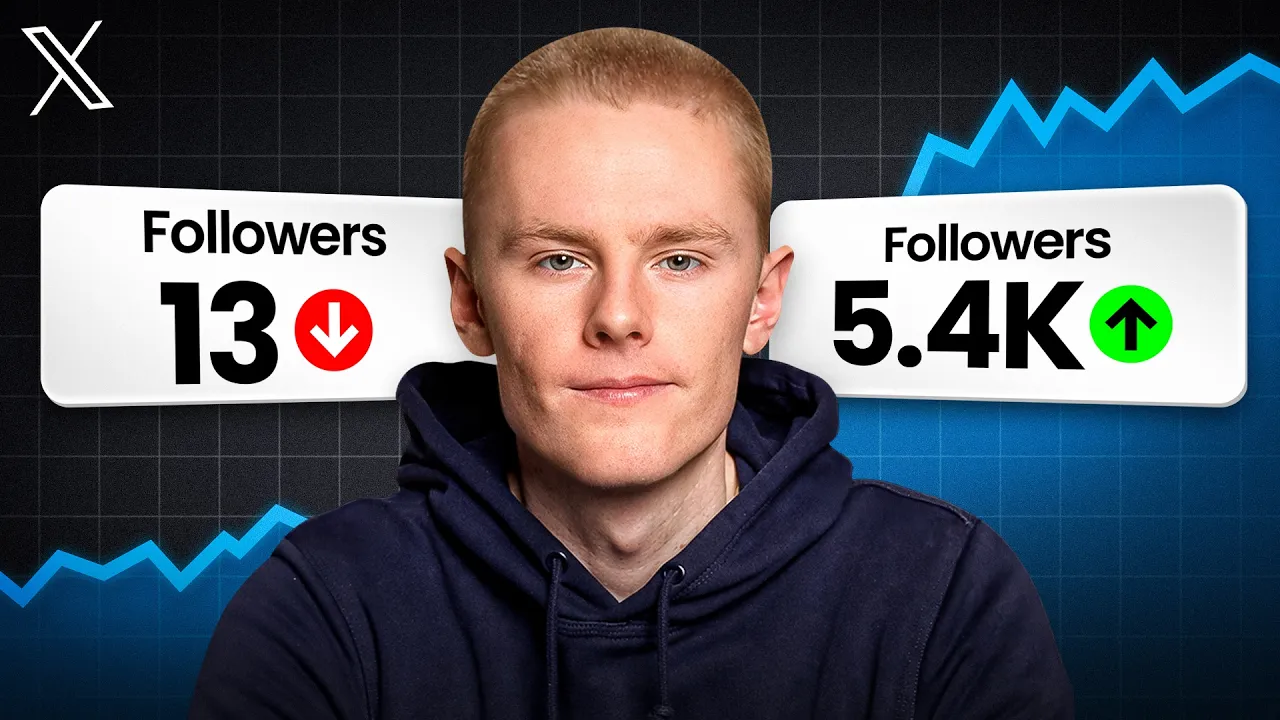
Growing on X is a lot simpler than you think, and to prove it, I'm going to share a simple three-step framework that helped me grow from zero to over 5,000 followers. So, let's jump into step number one. In order to build an audience, people first have to know you exist, and there's two main ways that you do this: making posts and making comments. So, if you're just starting out, the most effective way to get traffic is by making comments because not
85 words, the words spoken in the first 30 seconds at 169 words per minute.
Free, no signup. See how the first 30 seconds hold attention, with rewrites.
Sentence shape
| Measure | This transcript |
|---|---|
| Sentences | 67 |
| Average words per sentence | 22.4 |
| Longest sentence | 40 words |
| Questions asked | 0 |
| Sentences containing a number | 2 |
Most used terms
Filler phrases
3 in total: like 2 · actually 1.
A literal whole-word count of the same phrase list the Prepublish browser extension uses, so a phrase inside another word is not counted and a phrase used in its ordinary sense still is. It is a count and not a judgement.
What this transcript is
Every word below is the caption track YouTube publishes for this video, pulled from the video itself and reproduced unchanged. It is not Prepublish's writing, not a summary, and not a re-transcription: it is the video's own published captions. English captions, generated automatically by YouTube, in the video’s original language. Source: the video on YouTube. A channel that would rather this page did not exist can ask for its removal through the contact page, and it is removed.
No Script X-ray for this video: YouTube shows a Most replayed graph only once a video has enough views.
Growing on X is a lot simpler than you think, and to prove it, I'm going to share a simple three-step framework that helped me grow from zero to over 5,000 followers. So, let's jump into step number one. In order to build an audience, people first have to know you exist, and there's two main ways that you do this: making posts and making comments. So, if you're just starting out, the most effective way to get traffic is by making comments because not very many people are going to see your posts.
So, you're going to want to hang out in places that your ideal follower hangs out, which is typically in the comment section of bigger accounts in your niche. And the strategy here is to just engage with these accounts like a normal person. You don't need to be sending a thousand replies a day, just engage with the accounts you resonate with, and if you don't have anything to say, don't force it because people can tell when you're trying too hard.
And as you do this, you'll find that many of these accounts start engaging with your content, and if you follow some of them, many of them will follow you back. So, if you repeat this process every day, then it's pretty easy to get your first one to 2,000 followers and start getting some engagement on your content. However, as your account starts building up, it's important to shift your focus from replies to your content.
Replies are great at the start when you're not getting much traction on your content, but the problem with relying on this strategy for too long is that your results are tied directly to how many replies you send. So, that's going to make it take a lot longer to make progress. But with posts, there's potential for exponential growth because people are more likely to share these, find them in search, or come across them on the For You page.
So, it makes more sense to focus here once you start getting traction. That being said, it doesn't matter how much traffic you get if you're not ready to capture it. So, that's where the next step in the framework comes in, which is conversion. Conversion is all about getting people to click follow, and there's a couple ways you do this. The first is by picking a niche, which I break into two parts, the problem that you solve and the person that you solve it for.
For example, the problem I solve is how to build an audience on X, and the person I solve it for is educational creators. And clearly establishing this makes it a lot easier to grow because when a potential follower comes to my profile, they can immediately tell whether my content is for them or not. Now, I know this advice can be controversial to some, so let me share an analogy that I recently heard from Aidan Labrecque that will help really drive this home.
All right, so I want you to think about a magnet. You picture it, you've got two different poles, a positive and a negative, and if you take two of these magnets and you try and push them together on the positive sides, they will repel each other. However, if you then flip one of the magnets around and you push the positive and the negative sides together, then it will snap right together. You want your profile to be like a magnet where it clearly attracts some people and clearly repels others because when you try and attract everyone, you just end up attracting no one.
That's why I specifically target educational creators and not all creators. All right, then, the second part of conversion is optimizing your profile to match your niche. When someone discovers your account, they're going to do so by first seeing one of your posts or one of your replies. Then, they will come and visit your profile and they'll determine whether to follow you based on what they see there. So, the goal of your profile should be to confirm the viewer's expectations based on what idea they formed of you from seeing your content.
So, let's say someone discovered me through this article that I wrote. In their head, they probably formed the idea that I talk about how to grow on X. Then, when they visit my profile, that idea is validated in their head because of my bio and my banner, but then most importantly, because my other content also talks about how to grow on X. So, if the person who clicked on my profile is an educational creator who wants to grow on X, there's a high likelihood they're going to click follow.
Then, if someone needs more convincing, you can also have testimonials and case studies from people you've worked with, and this will help push those people over the edge. All right, this now leads us to the third part of the framework, which is retention. So, in a lot of ways, attracting new followers is the easiest part, but getting them to stay engaged and keep interacting with your content is a different story. So, here's a few ways to do that.
The first thing to understand is there's a reason people followed you. So, if you want to keep people engaged, you need to keep giving them what they followed for. A silly analogy to help illustrate this principle is to imagine you discover a sushi restaurant that makes the best sushi you've ever had. So, you go home after eating there with dreams of sushi in your head as you fall asleep, and then you wake up the next morning with a strong urge to go there again.
So, you make plans to go there the next night, you show up, and the waitress comes to your table and says, "Sorry, the chef actually decided to make burgers today. So, you can't have any sushi." Even if you absolutely love burgers, you're going to be disappointed at this news because you didn't go there to eat burgers. You wanted that amazing sushi you had the night before. Now, you may hear this analogy and think there's no way you would do the same thing with your content, but there's a chance that many of you watching this right now are doing this very thing.
Thinking about this tactically, the algorithm shows people content based on what they've previously interacted with. So, even if someone follows you, if they stop interacting with your future content, they're eventually going to stop seeing your content altogether. This means you need to keep giving them what they want so they keep engaging, and then they always see the next post. All right, then, an even more powerful way to retain followers is if they see a positive result from following your advice.
So, an extreme example of this is Alex Hormozi. Part of the reason why he's so big is because he's helped so many people get crazy results. And if you think about it, it makes sense because if you started following Alex, then you followed his advice, and then you made over a million dollars, you're going to follow that guy for the rest of your life. On the other hand, if you follow someone else's advice and you don't get results, or even worse, you go backwards, you're going to unfollow and stop paying attention to that person's content.
So, the more you can help your followers, the more loyal they will be. And then finally, your personality can go a long way towards retaining people as well. A great example of this is the YouTube growth niche. So, there's a million different creators who check those first two boxes of consistently providing what people want and getting people results, but they all have different personalities. And so, they attract different types of people, and some people are going to gravitate towards one over the other because of that personality.
So, don't be afraid to lean into your quirks, interests, and sense of humor in your content because that could end up being your secret sauce. All right, so those are the three steps in the framework. But, the great thing about this is it's not just one, two, three, and done. The process is cyclical. As you get traffic, convert it into followers, and then retain those followers, you're also going to get more traffic because more people engaging with your content means more people are going to see it.
This in turn will lead to more people converting, and if you can retain a percentage of those people, then the process continues, and that's how you build an audience. And for more help growing your X account, click the video on screen to watch me roast some of my followers' profiles.
The words are the caption track's own and nothing is reworded or re-transcribed. Paragraph breaks are placed between sentences so the text reads as prose.
Free tools for your own script. No signup, no login.
Paste your draft and see where viewers are likely to drop off, with a rewrite for each weak line.
Paste the first 30 seconds of your own draft for a hook score and rewrites.
Check your draft against YouTube's advertiser-friendly guidelines before you record it.
Read this channel's public videos and transcripts, and download a writing brief for it.