Getting the transcript
Reading the captions from YouTube. A video nobody has opened here before takes 10 to 30 seconds; this page fills in on its own.
Getting the transcript
Reading the captions from YouTube. A video nobody has opened here before takes 10 to 30 seconds; this page fills in on its own.
EverythingProfessor · @EverythingProfessor
Where viewers went back to watch this video again, from YouTube's public Most replayed graph, lined up with what was said at that moment.
Most replayed moment #1
1:113.5x the video's typical replay level
shutdown. It's harmless. It's common. It's still annoying every single time. Sleep inertia. Your alarm goes off, you turn it off, you attempt to function like a human being, and for the next 10 to 30 minutes, you basically can't.
Said at 1:04
Most replayed moment #2
6:212.5x the video's typical replay level
hallucination rather than a real event. They're also a core component of sleep paralysis episodes, which is where they stop being interesting and start being terrifying. Hypnopompic hallucinations, same experience, different direction. These happen as you're waking up rather than
Said at 6:13
Most replayed moment #3
4:582.5x the video's typical replay level
deprivation, and in people who also sleepwalk. It's not harmful. It's not a sign of anything wrong. It's just your brain leaving its microphone on. Hypnagogic hallucinations. You're not asleep yet, but you're seeing things. Hypnagogic hallucinations are sensory
Said at 4:51
The graph counts replays. It does not show where viewers stopped watching.
Words
3,090
Runtime
19:50
Speaking pace
156wpm
Reading time
13min
156 words per minute, below the 160 25th percentile of 349 measured videos. That distribution comes from the 349-video hook study.
Opening (first 30 seconds)
Hypnic jerk. You're drifting off, everything is quiet, and then your entire body slams awake like you just missed a step on a staircase. That's a hypnic jerk, and it happens to around 70% of people, which means it's not a problem. It's just your brain being weird during the transition from wakefulness to sleep. Here's what's actually happening. As you fall asleep, your muscles begin to relax. Your brain, which is also powering down, sometimes misreads that
78 words, the words spoken in the first 30 seconds at 156 words per minute.
Free, no signup. See how the first 30 seconds hold attention, with rewrites.
What this transcript is
Every word below is the caption track YouTube publishes for this video, pulled from the video itself and reproduced unchanged. It is not Prepublish's writing, not a summary, and not a re-transcription: it is the video's own published captions. English captions, generated automatically by YouTube, in the video’s original language. Source: the video on YouTube. A channel that would rather this page did not exist can ask for its removal through the contact page, and it is removed.
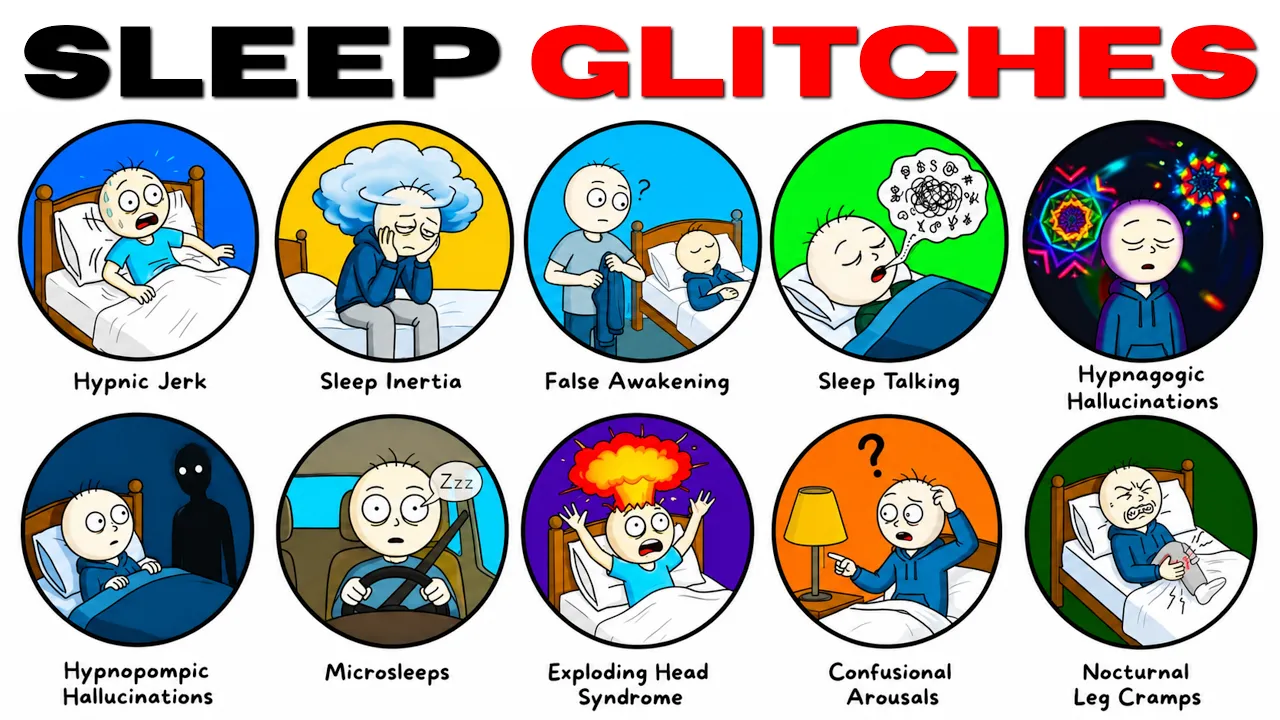
Hypnic jerk. You're drifting off, everything is quiet, and then your entire body slams awake like you just missed a step on a staircase. That's a hypnic jerk, and it happens to around 70% of people, which means it's not a problem. It's just your brain being weird during the transition from wakefulness to sleep. Here's what's actually happening. As you fall asleep, your muscles begin to relax. Your brain, which is also powering down, sometimes misreads that sudden loss of muscle tone as falling.
So, it fires a jolt of electricity through your body to catch you. Emergency response. Completely unnecessary. Some researchers think it's an evolutionary leftover from when our ancestors slept in trees. A sudden drop in muscle tension while up high would have been genuinely dangerous. The jerk kept them from falling out. Your bed is on the ground. Your brain didn't get the memo. Stress, caffeine, and sleep deprivation make them worse.
Not because something is wrong, but because an overstimulated brain makes more mistakes during shutdown. It's harmless. It's common. It's still annoying every single time. Sleep inertia. Your alarm goes off, you turn it off, you attempt to function like a human being, and for the next 10 to 30 minutes, you basically can't. That's sleep inertia, the technical term for the period of impaired cognition, slowed reaction times, and general brain deadness immediately after waking.
Here's the thing. Waking up is not instant. Your brain doesn't go from fully asleep to fully operational in a single step. Cerebral blood flow is still low. Adenosine, a chemical that builds up during wakefulness and drives sleepiness, hasn't cleared yet. Your prefrontal cortex, which handles decision-making and rational thought, is one of the last regions to come back online. The result is that for a window after waking, your cognitive performance is measurably worse than if you'd stayed awake all night.
Surgeons woken from sleep to perform emergency procedures have documented this. Pilots have crashed planes in this window. It usually clears in 15 to 30 minutes for most people. It can last up to 4 hours after forced awakening from deep sleep. So, when you make a terrible decision first thing in the morning, it might not be you. It might just be that your brain was still technically asleep. False awakening. You wake up, get out of bed, walk to the bathroom, start getting ready, and then you actually wake up.
False awakenings are exactly what they sound like. You dream that you've woken up and begun your day with enough realism that you have no idea you're still asleep. Sometimes it happens multiple times in a row, a loop of fake mornings before the real one. They occur most often during REM sleep, which is when dreaming is most vivid and the brain most closely mimics waking consciousness. The brain runs such a convincing simulation of your bedroom and morning routine that it fools itself.
The experience is heavily associated with sleep paralysis and lucid dreaming, and tends to cluster when sleep is disrupted, irregular, or when the person has been actively thinking about sleep and dreaming before bed. What makes false awakenings unsettling isn't the experience itself. It's the unreliability of waking up. If it's happened once, there's a moment in the real morning where you can't be entirely sure this one is real either.
Some lucid dreamers use them as an entry point. If you're experienced enough to recognize the signs inside the dream, a false awakening can be converted into a fully conscious controlled dream. Most people just find them disorienting. Sleep talking. You're completely unconscious. Your brain is partially cycling through sleep stages, and apparently you have some things to say. Sleep talking, formally called somniloquy, affects around 66% of people at some point in their lives.
It's most common in children and tends to decrease with age, though plenty of adults do it, too, often without knowing. The content is almost always meaningless. Fragments, half sentences, occasional words delivered with complete conviction, rarely coherent enough to hold a conversation with, though people do try and sometimes get responses that sound almost logical. It happens across multiple sleep stages, not just REM.
During lighter stages, it can sound relatively clear. During deep slow wave sleep, it tends to be more garbled and emotionally flat. Here's the question everyone wants answered. Can you extract real information from someone talking in their sleep? Almost never. The content doesn't reliably reflect actual thoughts, memories, or secrets. The brain isn't running a conscious monologue. It's producing verbal fragments from partially active networks.
It's more common during periods of stress, fever, sleep deprivation, and in people who also sleepwalk. It's not harmful. It's not a sign of anything wrong. It's just your brain leaving its microphone on. Hypnagogic hallucinations. You're not asleep yet, but you're seeing things. Hypnagogic hallucinations are sensory experiences that occur during the transition from wakefulness into sleep. Visual ones are most common.
Flashes of light, faces, landscapes, geometric patterns that appear behind closed eyes. But they can be auditory, too. Hearing your name called, a sudden sound, a voice saying something just coherent enough to be unsettling. They happen because the brain doesn't switch cleanly between states as it starts generating the neural activity associated with dreaming. While the conscious mind is still partially online, those signals bleed through.
You're awake enough to experience them, but not awake enough to immediately dismiss them. Around 70% of people report experiencing these at some point. They're strongly associated with sleep deprivation, which makes the transition into sleep faster and less controlled. Here's the trap. Because they can be extremely vivid and occur right at the edge of sleep, people sometimes misremember them as things that actually happened.
You heard something, you saw something. Your brain just doesn't correctly timestamp it as a hallucination rather than a real event. They're also a core component of sleep paralysis episodes, which is where they stop being interesting and start being terrifying. Hypnopompic hallucinations, same experience, different direction. These happen as you're waking up rather than falling asleep. Hypnopompic hallucinations occur as the brain transitions from REM sleep back to wakefulness, and the dreaming circuitry doesn't fully shut off before consciousness returns.
The result is that dream content, visual, auditory, sometimes tactile, bleeds into the waking world. You might see a figure in the room, a spider on the wall, hear a voice or a sound, and unlike the pre-sleep version, you're conscious enough to be genuinely alarmed. Because it looks and feels exactly like something real. They typically last seconds, occasionally a minute or two, and they vanish the moment the brain fully transitions to wakefulness.
Around 12% of people experience these regularly. They're more common in people with narcolepsy, irregular sleep schedules, and high stress. What makes them clinically interesting is how convincingly real they appear. Unlike most dreams, which are processed as dreams even while you're in them, hypnopompic hallucinations are indistinguishable from reality in the moment. The brain's reality checking systems are still coming back online.
There's a gap where the hallucination is all there is. Sleep paralysis, you wake up and you cannot move. Not stiff, not groggy, completely paralyzed. And there is something in the room. Sleep paralysis occurs when rem atonia, the mechanism that paralyzes your muscles during dreaming so you don't act them out, persists after you've regained consciousness. You're awake. Your brain knows it. Your body hasn't gotten the signal to unlock yet.
That lasts anywhere from seconds to a couple of minutes. It feels much longer. The presence is the part nobody is prepared for. A significant percentage of people who experience sleep paralysis also report the feeling of a figure in the room. Watching, sometimes pressing on the chest, occasionally perceived as malevolent. This has been documented across cultures, centuries, and continents, which is why virtually every culture has a different name for the same experience.
The old hag, the incubus, the shadow person, all sleep paralysis. The presence is generated by the brain's threat detection system. Paralyzed and unable to investigate, your brain concludes something must be causing the paralysis and generates a corresponding hallucination. Around 20% of people experience it at least once. It's not dangerous. It ends on its own. That doesn't make it any less awful while it's happening.
Exploding head syndrome. You're almost asleep and then an enormous bang goes off inside your head. Not a headache. Not a sound from outside. A loud crash, a gunshot, a cymbal smash that exists entirely inside your skull and jolts you fully awake with your heart pounding. Exploding head syndrome is real. It has a clinical name and it affects around 10% of people. Despite how alarming it sounds and feels, it is completely harmless.
The leading theory is that it's a glitch during the brain's shutdown process. As the brain powers down for sleep, it normally quiet sensory processing gradually. Sometimes that process misfires, and instead of a gradual fade, auditory neurons discharge all at once. Your brain interprets this as a massive sound. There's no actual bang, no physical event, just a mass of neurons firing simultaneously, and your auditory cortex doing its job, which is to interpret neural signals as sound.
It's more common during periods of sleep deprivation and high stress. Some people experience it rarely, once or twice in their lives. Others get it in clusters, several times a night for a period, and then nothing for months. It sounds catastrophic. It causes no damage. The only real problem is that once you know it can happen, falling asleep becomes slightly more nerve-wracking. Confusional arousal. Someone shakes you awake.
You open your eyes, and for the next several minutes you have absolutely no idea what's happening, where you are, or why the person in front of you is talking. Confusional arousal happens when someone is woken abruptly from deep slow-wave sleep, the deepest, hardest to arouse stage. The brain comes partially online, but doesn't fully transition to wakefulness. The result is a person who appears awake, but is operating with severely impaired cognition, and often no memory of the episode afterward.
Behavior during confusional arousal ranges from quiet disorientation to agitation, aggressive responses, or saying things that make no sense delivered with total confidence. Partners who have tried to wake someone in this state often describe it as alarming, like the person is there, but completely unreachable. The episode typically lasts a few minutes, occasionally longer. The person usually has no recollection of it the next morning.
It's most common in children, which is why young kids can wake screaming in apparent distress and have no idea why in the morning. It also occurs in adults, particularly with sleep deprivation, alcohol, and irregular schedules. Like sleepwalking, it's a disorder of arousal. The brain gets partway out of sleep and gets stuck there briefly. Nocturnal leg cramps and myoclonus. Two different things, both happen while you're trying to sleep.
Both are deeply unpleasant. Nocturnal leg cramps are involuntary muscle contractions, usually in the calf, that hit during sleep or the transition into it. They're sudden, they're painful, and they can last anywhere from a few seconds to several minutes. The muscle seizes, and the only way to resolve it is to stretch it out, which is difficult when you were just asleep. The cause isn't fully understood. Contributing factors include dehydration, electrolyte imbalances, prolonged sitting, overexertion, and certain medications.
They become more common with age. Myoclonus is different. That's the sudden, brief, shock-like muscle jerks that can occur during sleep. Hypnic jerks are a form of this. But myoclonus can also present as repeated, rhythmic twitching across a limb or the whole body. Sleep myoclonus in isolation is usually benign. Here's the thing, both conditions interrupt sleep architecture, meaning even if you don't fully wake, the movement pulls you into a lighter stage.
You can have dozens of these events per night without remembering any of them and still feel completely unrested in the morning. Your body kept waking itself up and you have no idea. Microsleeps. You're awake, and then for 2 to 30 seconds, you're not, and then you're back, and you have no idea it happened. Microsleeps are involuntary episodes of sleep that occur while a person appears to be awake. The eyes may be open, the person may be sitting upright.
To an outside observer, they might look briefly zoned out. Internally, consciousness has simply vanished for a moment. EEG studies confirm it. The brain shows sleep stage activity, full stop, then returns to wakefulness. They're caused by sleep deprivation, and they are one of the most dangerous consequences of it. Microsleeps are responsible for a significant portion of drowsy driving crashes, industrial accidents, and medical errors.
The person at the wheel doesn't feel tired. They don't realize they're impaired. They're just suddenly 2 seconds further down the road with no memory of the gap. The terrifying part is that you cannot detect your own microsleeps. By definition, you're unconscious when they happen. You only find out through external observation or the consequences. Studies on sleep-deprived individuals show microsleeps beginning after as little as 17 hours without sleep.
That's not an extreme case. That's a long day. REM rebound. You've had a bad run of sleep, a few nights of too little, or alcohol suppressing your dream cycles, or a medical reason your REM sleep has been cut short. Then you finally get a full, uninterrupted night, and the dreams are like nothing you've ever experienced. REM rebound is your brain catching up. When REM sleep is consistently suppressed or reduced, the brain accumulates a deficit.
The moment it gets the opportunity, it dramatically increases the proportion of sleep spent in REM, producing longer, more vivid, more emotionally intense dreams than usual. This is why people who quit alcohol after heavy use report bizarre, overwhelming dreams in the first weeks of sobriety. Alcohol almost entirely suppresses REM. When it's removed, the brain goes into overdrive trying to recover what it lost. The same thing happens after any sustained period of poor sleep.
The first good night hits differently because the brain is running the REM stage at elevated intensity. Dreams during REM rebound tend to be more emotionally charged, stranger, and more memorable than usual. Some people find them disturbing. Others find them fascinating. Either way, they're a signal that your brain was running a sleep debt, and it is now collecting. Night terrors. This is not a nightmare. A nightmare is a frightening dream that you wake from with memory of what scared you.
Night terrors are something else entirely. They occur during deep slow wave sleep, not REM. The person appears to wake, sitting up, eyes open, screaming or crying with a heart rate that can reach 180 beats per minute. Complete physiological panic, and they are essentially not conscious. You cannot comfort someone during a night terror in the way you would during a nightmare. They're not fully awake. They can't process your presence normally.
Attempts to hold or restrain them can actually make the episode more intense. The standard guidance is to stay nearby, keep them from hurting themselves, and wait. The episode typically lasts between 30 seconds and 5 minutes. And here's the part that makes them so strange. When it's over, the person usually goes straight back to sleep. The next morning, they remember nothing. They're most common in children between 3 and 8, and most kids outgrow them.
Adults who experience them are more likely to do so during periods of sleep deprivation, stress, fever, or when sleeping in unfamiliar environments. The person inside the terror is in extreme distress. They have no memory of it whatsoever. Both of those things are true at the same time. Sleepwalking. The brain is capable of navigating your home, unlocking doors, preparing food, and in some documented cases driving a car while the person doing all of it is completely asleep.
Sleepwalking is a disorder of arousal, the same family as confusional arousals and night terrors. It happens during deep slow-wave sleep when the brain partially activates the motor system while consciousness remains off. The result is purposeful-looking movement with no awareness behind it. Sleepwalkers are not acting out dreams. That's a common misconception. Dream enactment happens in REM. Sleepwalking happens in slow-wave sleep when dreaming is minimal.
Whatever the sleepwalker is doing, it's not connected to a dream narrative. The brain just started doing something. Episodes range from sitting up in bed to full complex behaviors lasting several minutes. The person typically has no memory of it. They can appear awake to an observer. Their eyes may be open. They may respond to simple instructions, but they are not there. The old advice about not waking sleepwalkers being dangerous is mostly myth.
Waking them can cause brief confusion, but it's not harmful. The real risk is that they'll injure themselves navigating an environment without full awareness. Lucid dreaming. At some point during a dream, something clicks. You realize you're dreaming, and then you're awake inside it. Lucid dreaming is the state of being conscious and aware within a dream. It occurs during REM sleep and has been scientifically confirmed through a neat trick.
Researchers asked participants to signal when they became lucid by moving their eyes in a pre-agreed pattern. The eye signals, one of the few things not paralyzed during REM, appeared in the EEG record at the exact moment participants reported becoming conscious in the dream. It's real. The brain is simultaneously in REM sleep and aware of that fact. Around 55% of people report experiencing at least one lucid dream in their lifetime.
Regular lucid dreamers, people who experience it frequently and with control, are far rarer. The experience varies widely. Some people simply become aware they're dreaming and observe. Others achieve significant control over the dream environment, essentially generating any experience they want. The degree of control varies by individual and by practice. There are established techniques for inducing it. Reality testing during waking hours, checking your hands or reading text repeatedly throughout the day.
Wake back to bed, where you sleep for a few hours, wake briefly, then return to sleep to enter REM more directly. MILD technique, setting a mental intention to recognize the dream state before falling asleep. It's the one glitch on this list you might actually want to have.
The words are the caption track's own and nothing is reworded or re-transcribed. Paragraph breaks are placed between sentences so the text reads as prose.
Free tools for your own script. No signup, no login.
Paste your draft and see where viewers are likely to drop off, with a rewrite for each weak line.
Paste the first 30 seconds of your own draft for a hook score and rewrites.
Check your draft against YouTube's advertiser-friendly guidelines before you record it.
Read this channel's public videos and transcripts, and download a writing brief for it.
Sentence shape
| Measure | This transcript |
|---|---|
| Sentences | 264 |
| Average words per sentence | 11.7 |
| Longest sentence | 34 words |
| Questions asked | 1 |
| Sentences containing a number | 16 |
Most used terms
Filler phrases
15 in total: like 8 · actually 5 · basically 1 · you know 1.
A literal whole-word count of the same phrase list the Prepublish browser extension uses, so a phrase inside another word is not counted and a phrase used in its ordinary sense still is. It is a count and not a judgement.