Getting the transcript
Reading the captions from YouTube. A video nobody has opened here before takes 10 to 30 seconds; this page fills in on its own.
Reading the captions from YouTube. A video nobody has opened here before takes 10 to 30 seconds; this page fills in on its own.
Riat Ismagilov. About teeth and implantation · @riat_eng
Where viewers went back to watch this video again, from YouTube's public Most replayed graph, lined up with what was said at that moment.
Words
2,881
Runtime
17:16
Speaking pace
167wpm
Reading time
12min
167 words per minute, between the 160 25th percentile and the 181 median of 349 measured videos. That distribution comes from the 349-video hook study.
Opening (first 30 seconds)
Is it already possible to grow a new tooth instead of getting an implant? Not long ago, this sounded like science fiction, but now scientists are closer to making it a reality than ever before. There's already a drug being tested on humans, and its goal isn't to insert an artificial tooth, but to trigger the growth of your own. Basically, not an implant, not a bridge, not a denture, but a brand new tooth that should grow inside your body. In this video,
84 words, the words spoken in the first 30 seconds at 167 words per minute.
Free, no signup. See how the first 30 seconds hold attention, with rewrites.
What this transcript is
Every word below is the caption track YouTube publishes for this video, pulled from the video itself and reproduced unchanged. It is not Prepublish's writing, not a summary, and not a re-transcription: it is the video's own published captions. English captions, generated automatically by YouTube, in the video’s original language. Source: the video on YouTube. A channel that would rather this page did not exist can ask for its removal through the contact page, and it is removed.
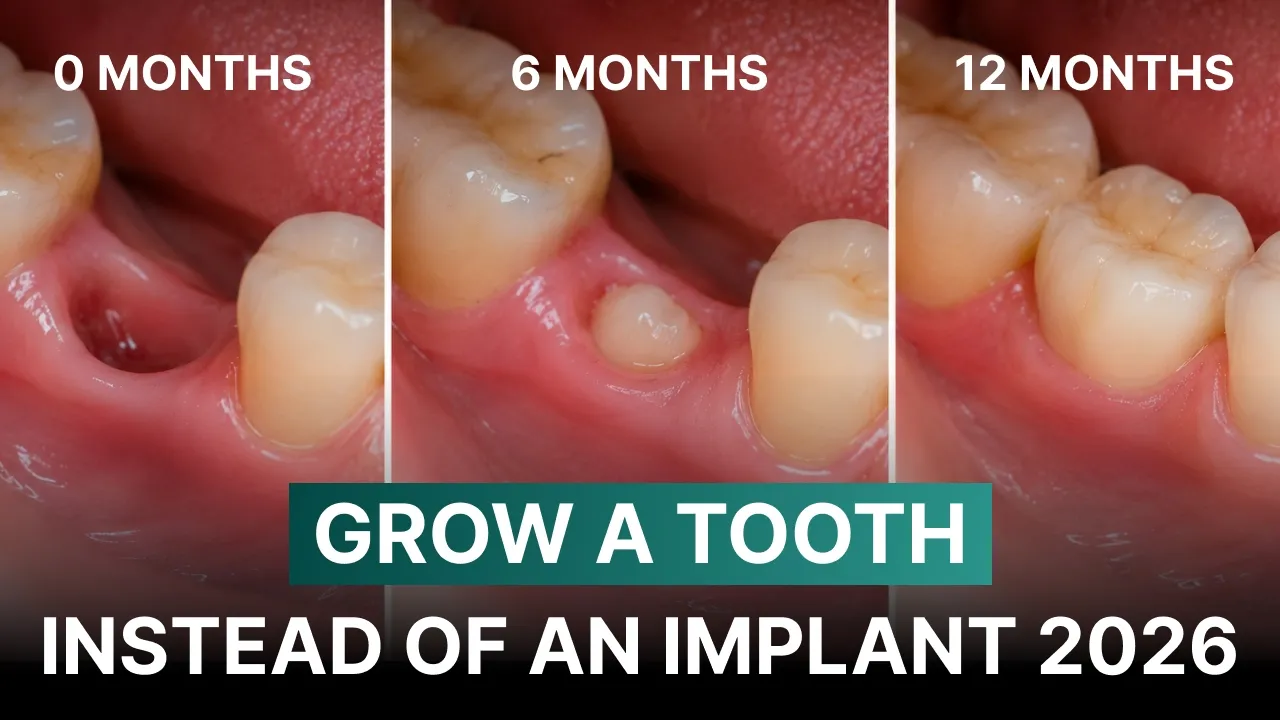
Is it already possible to grow a new tooth instead of getting an implant? Not long ago, this sounded like science fiction, but now scientists are closer to making it a reality than ever before. There's already a drug being tested on humans, and its goal isn't to insert an artificial tooth, but to trigger the growth of your own. Basically, not an implant, not a bridge, not a denture, but a brand new tooth that should grow inside your body.
In this video, I'll break down the scientific data in simple terms. What this technology is, how it's supposed to work, what has already been tested on humans, why there's so much buzz and gossip around it, and just how close we really are to the moment when we can regrow teeth. And based on scientific evidence, we'll figure out whether this is almost a reality or still just a bunch of pretty promises. There's a real reason behind all this hype.
Right now in Japan, they're developing a drug that's often called a medicine for growing teeth. A lot of people are already eagerly waiting for it to hit the market, but do you really understand what's behind this research? The idea sounds almost unbelievable. The goal is not to replace a lost tooth with a synthetic dental replacement, but to encourage the body to begin naturally regenerating its own new tooth right where the old one was previously lost or removed.
There's a specific biological concept behind this, along with animal studies, scientific publications, and clinical trials on humans. So, it's not just at the level of maybe someday in the distant future scientists will come up with something. It seems like it's already at that level. There's a candidate drug, and it's being studied. And now, the main question, how likely is it that it can actually help adults grow new teeth?
And here's a logical question, >> [music] >> if the idea is so great, why haven't people learned how to grow teeth before? The problem is that a tooth isn't just a hard white thing in our mouths. It's a complex organ. It has a crown, a root, a nerve, blood vessels, >> [music] >> and a ligament that holds the tooth in the bone. It has to erupt in the right place, with the right shape, at the right angle, and most importantly, fit into the bite correctly. >> [music] >> So, it's not enough for scientists to just make the body grow something, it has to be an actual tooth, not a bone growth, not extra tissue, not some random structure, but a fully functional tooth you can chew with and smile beautifully.
And most importantly, this whole process needs to be controlled. If the tooth grows in the wrong place, in the wrong shape, or God forbid, doesn't fit into the bite, that's not solving the problem. That's just creating a whole new one. That's why growing new teeth has remained just a dream for decades. Medicine understood that it was theoretically possible, but there was no clear way to safely trigger this process, and most importantly, control the outcome.
This is exactly where an incredible Japanese innovation comes in. It aims to target one of the biological inhibitors that prevents the tooth from developing. The key word in this story is USAG-1. Let me explain with a simple analogy. When you're building a brand new house, you don't just need skilled workers, heavy bricks, and a detailed construction plan, you also [music] need a dedicated foreman who says, "Build right here, stop over there, and don't go any further in this direction." Otherwise, instead of a proper house, you'll end up with chaos.
It's a similar story with teeth. When a person's permanent teeth are forming, the body doesn't just grow them randomly, it constantly gives cells specific instructions on where to grow, when to stop, how many teeth should appear, and exactly where they belong. USAG1 is actually one of those natural stop signals. Basically, it's not the builder of the tooth, but part of the system that tells the body from here on, tooth growth is limited.
The Japanese idea is to temporarily remove this stop signal with a special drug. Imagine there's a door in the body, and behind it is the program for tooth growth. USAG1 is like the lock on that door. [music] The drug doesn't build the tooth itself. It tries to unlock the lock, but here's the important thing. If there's nothing behind the door, nothing will happen. If there's a tooth bud or tissue that can respond to the signal, then in theory, the body could start forming a new tooth.
So, the drug doesn't bring ready-made enamel, a root, or a tooth nerve. It tries to create the conditions for the body to start the process on its own. And that's why the idea sounds so revolutionary. Instead of replacing the tooth with an artificial structure, it tries to grow one from the inside out. If you'd like me to break down more medical technologies like this in simple terms, not just based on headlines, but on what's actually happening in science, give this a like.
For me, that'll be a sign that you're interested not in scare stories or hype, but in honest explanations in plain understandable language. In the ideal scenario, here's how it all looks. An individual patient is administered a drug that blocks that very specific growth inhibitor. After that, a tooth bud or tissue capable of developing into a tooth is activated in the right area. >> [music] >> And then, the body itself slowly and naturally develops a brand new tooth.
Not a metal implant, and not a crown on an artificial root, but your own biological tooth that's specifically designed to become a permanent part of your body. If they ever learn how to do this, it's predictable that the entire field of dentistry could change quite dramatically. Because today, if a tooth is lost, the dentist's job is to replace it with something. But in the future, the question might be different. Is it possible not just to replace a tooth, but to make the body grow its own new one?
Why does this idea resonate so much with people? Because an implant is a great modern solution, but it's still an artificial structure. A titanium or other artificial root is placed into the bone and the crown is fixed on top. For many patients, this is the best restoration option, but it's still not a living tooth that grew on its own. A bridge requires grinding down the neighboring teeth. A removable denture can be uncomfortable, especially if a person has lost many teeth.
But growing your own tooth sounds like the perfect scenario. It's the dream of getting your own tooth back, not just replacing it with something artificial. Now, here's an important point. This isn't just a theory from a fancy presentation. First, [music] this idea was tested in preclinical studies, meaning on animal models. There, blocking USAG1 showed promise. In animals, they managed to trigger tooth formation in situations where teeth didn't develop normally.
And after that, the technology moved on to human trials. But here, it's important to understand how medicine works. When a drug is tested on humans for the first time, scientists don't immediately start by asking, "Did everyone grow new teeth?" The first question is much more down-to-earth. Is it even possible to administer this drug to a person? Is it safe? What dose can the body tolerate? This process is what's known as a safety check.
Because here, researchers are not simply interfering with tooth color or sensitivity, but directly with the system that is responsible for regulating tissue growth. And tissue growth is an area where mistakes can be dangerous. Tissue might start growing in the wrong place, in the wrong way, too aggressively, or trigger an unwanted reaction from the body. That's why first, you need to prove not, "Wow, a tooth grew." but something more basic.
The drug doesn't trigger anything extra and the body tolerates it normally. And here's the main nuance that usually doesn't make it into the flashy headlines. The drug doesn't create a tooth out of nothing, out of thin air. Let's go back to the analogy of the door and the lock. Imagine there's a door in your jaw and behind it is the program for tooth growth. USAG1 functions much like the lock on that door. The drug attempts to successfully unlock that lock and if there's a room behind the door, meaning there's a tooth bud, a growth zone, or tissue capable of responding to the signal, then in theory, [music] it's entirely possible to initiate the biological process of forming your own tooth.
But if there's nothing behind the door, then even an unlocked lock won't do anything. >> [music] >> That's why the most critical question we face is not simply a matter of whether we can successfully obstruct USAG1. The main question is, does the body have something that can be activated? And if such a foundation exists, then theoretically, there's a chance. If not, things get much more complicated. That's why the closest and most straightforward scenario right now is people whose teeth never developed from birth.
For example, a child or an adult may be missing some permanent teeth not because they were removed, but because they never erupted or formed in the first place. This is called congenital absence of teeth. For these patients, the idea makes more sense. It's possible that the body has a tooth development program that for some reason didn't start properly, and the medication tries to activate this program. [music] That's why the first rigorous scientific investigations are concentrating almost exclusively on these specific types of instances.
In other words, the technology doesn't start with let's regrow a molar for someone who had it removed 10 years ago. It begins with a more highly specific and controlled challenge. Can we provide assistance to those individuals whose teeth have never actually developed from birth? Now, here's the main question most people are interested in. If I'm an adult and I've already had a tooth removed, will it be possible to grow a new third tooth?
By a third tooth, I mean a [music] tooth that comes after the permanent one. So, baby tooth, permanent tooth, and then an additional newly grown third tooth. Here, the answer is very cautious. The developers do have the idea of moving toward replacing lost teeth in adults. So, not just teeth that are missing from birth, but also teeth lost due to cavities, injury, periodontitis, or extraction. But, that's much more complicated.
Why is that? Teeth in your mouth aren't like books on a shelf. You take one out and the space stays empty forever. Teeth exist as part of a system. They constantly keep each other in place. If one tooth is removed, the neighboring teeth gradually start to tilt into the empty space. The tooth above or below, which used to have something to press against, might start to move toward the gap. And the bone where the tooth was removed, if it isn't loaded for a long time, gradually shrinks.
So, after a few years, instead of an open spot for a new tooth, you might have an altered area there. Less space, less bone. The neighboring teeth are positioned differently. And here's the main takeaway. Even if scientists discover the exact methods to trigger the growth of a new tooth, an adult will first need to establish the necessary biological conditions for it. There needs to be space. There needs to be bone. The tooth has to grow in the right direction and then fit into the bite properly.
That's why for an adult who's lost a tooth, the challenge isn't just to trigger tooth growth. The challenge is to grow a tooth in a jaw that's already changed after the extraction. That's exactly why it's much harder than helping someone whose [music] teeth simply never formed or erupted from birth. And most importantly, it's unclear whether there's even a tooth bud or tissue there that can just be awakened. Let us know in the comments, >> [music] >> would you trust a tooth regrowth technology if it became available in clinics?
Or would you stick with the tried and true implants? Here's another important point. Even if scientists learn [music] how to trigger tooth growth, that's still isn't enough. In dentistry, you can't just say, "Well, something grew. That's good enough." The tooth has to grow exactly where it's needed. It [music] absolutely has to be the exact right shape, possess a proper and stable root structure, fit perfectly into the patient's bite, ensure it does not interfere with any of the neighboring teeth, and be fully able to handle the intense pressure of daily chewing.
And most importantly, it needs to last not just for a month or a year, but for many years. That's why growing teeth isn't just a question of whether we can trigger growth. It's about whether we can control that growth precisely enough to get a fully functional working tooth. Now, here's some important specifics. [music] Who was actually selected for the first trials? Not children, not patients who need a tooth grown right now, and not just any adults.
In the first stage, they chose adult men roughly between 30 and 65 years old who were missing one or more molars, but that doesn't mean they were already promised new teeth would be grown for them. They were needed for something else, to check how an adult body tolerates the drug. In other words, it was a safe entry point for human trials. Why didn't they start right away with children who never grew teeth from birth?
Because first, you need to figure out a basic thing. Is it even possible to admin minister the drug drug to a person? Are there any serious side effects? What dosage can be used? And then the subsequent and most logical step is to test the drug on the specific individuals it is actually intended to help according to the technology. That is, on patients born without teeth whose teeth either failed to develop entirely or never erupted.
And there, the main question will be not just whether it's safe, but whether a new tooth actually appears. So, right now, the technology is moving from safety testing to testing for real results, and that's a good sign. It's no longer just an idea, but before it can be used widely in clinics, it still needs to prove that the tooth really grows, grows correctly, and that this can be repeated in different patients. So, does this mean that implants will soon become unnecessary?
Unfortunately, not yet. >> [music] >> Implantation is already a proven, well-understood, and established technology. It has protocols, timelines, forecasts, and limitations, >> [music] >> but it's available here and now. Tooth cultivation still needs to prove three main things. First, safety. Second, effectiveness, meaning the tooth actually grows. Third, predictability, meaning it grows correctly in the right place, and functions like a real tooth.
And until these three points are proven in humans, it's still too early and premature to say that implants are a thing of the past. But, saying that it's just science fiction isn't right anymore either because the technology really has moved from the realm of dreams to real-world trials. And now, the final answer. Tooth cultivation is not science fiction. >> [music] >> There's a scientific concept, a candidate drug, and human trials underway.
But, the immediate goal isn't for any adult to just come in and grow a tooth instead of getting an implant. Right now, the technology is closest to helping patients whose teeth never developed from birth or never erupted at all. Growing a third tooth for an adult after extraction is much more complicated. The developers do have such plans, but there's no exact timeline for regular patients yet. If everything goes well, the technology might reach its first limited applications only after the next successful stages of trials.
But, right now, it's impossible to give an exact date for clinical use. On the other hand, a widespread replacement of implants with grown teeth definitely isn't something that'll happen in just a couple of years. I think for the next 20 or 30 years, it's not really something to worry about yet. So, the conclusion is simple. If you've already lost a tooth, don't wait around for a magic pill. Right now, you need to solve the problem with the methods that are available.
And if your tooth can still be saved, save it because your own tooth is still more valuable today than any future technology. The only thing you can say for sure is that this technology or this topic is [music] definitely something to keep an eye on. Maybe we really are witnessing the beginning of a new era in dentistry where teeth won't just be treated or replaced, but actually regrown from scratch.
The words are the caption track's own and nothing is reworded or re-transcribed. Paragraph breaks are placed between sentences so the text reads as prose.
Free tools for your own script. No signup, no login.
Paste your draft and see where viewers are likely to drop off, with a rewrite for each weak line.
Paste the first 30 seconds of your own draft for a hook score and rewrites.
Check your draft against YouTube's advertiser-friendly guidelines before you record it.
Read this channel's public videos and transcripts, and download a writing brief for it.
Most replayed moment #1
5:216.6x the video's typical replay level
sign that you're interested not in scare stories or hype, but in honest explanations in plain understandable language. In the ideal scenario, here's how it all looks. An individual patient is administered a drug that blocks that very specific growth inhibitor. After
Said at 5:14
Most replayed moment #2
1:024.2x the video's typical replay level
hype. Right now in Japan, they're developing a drug that's often called a medicine for growing teeth. A lot of people are already eagerly waiting for it to hit the market, but do you really understand what's behind this research? The idea sounds almost unbelievable. The
Said at 0:55
Most replayed moment #3
15:324.2x the video's typical replay level
just science fiction isn't right anymore either because the technology really has moved from the realm of dreams to real-world trials. And now, the final answer. Tooth cultivation is not science fiction. >> [music] >> There's a scientific concept, a
Said at 15:27
The graph counts replays. It does not show where viewers stopped watching.
Sentence shape
| Measure | This transcript |
|---|---|
| Sentences | 189 |
| Average words per sentence | 15.2 |
| Longest sentence | 49 words |
| Questions asked | 22 |
| Sentences containing a number | 9 |
Most used terms
Filler phrases
22 in total: like 10 · actually 9 · basically 2 · I mean 1.
A literal whole-word count of the same phrase list the Prepublish browser extension uses, so a phrase inside another word is not counted and a phrase used in its ordinary sense still is. It is a count and not a judgement.