Getting the transcript
Reading the captions from YouTube. A video nobody has opened here before takes 10 to 30 seconds; this page fills in on its own.
Getting the transcript
Reading the captions from YouTube. A video nobody has opened here before takes 10 to 30 seconds; this page fills in on its own.
Apex Psychology · @ApexPsychologyYT
Where viewers went back to watch this video again, from YouTube's public Most replayed graph, lined up with what was said at that moment.
Most replayed moment #1
11:339.7x the video's typical replay level
and watching the TV screen inside your head go completely dark. This command acts as a wall across the path, forcing the thoughts that are racing downhill to slam on the brakes. Step three, take over the bandwidth so
Said at 11:27
Most replayed moment #2
5:516.6x the video's typical replay level
of yourself. You might imagine tomorrow's conversation with your boss, an upcoming job interview, or a difficult thing you need to say to someone you care about. In your head, you try out different ways to open the conversation, predict how the other person will respond, and adjust your reply. The same situation might
Said at 5:44
Most replayed moment #3
4:284.7x the video's typical replay level
so you can create your own ending. The fact that you keep replaying it doesn't mean you're holding a grudge. It means you're trying to clean up the emotional wreckage someone else left behind. The new scene gives you a small sense of relief because this time the story doesn't stop at the part that left you stuck. Need
Said at 4:22
The graph counts replays. It does not show where viewers stopped watching.
Words
2,820
Runtime
15:23
Speaking pace
183wpm
Reading time
12min
183 words per minute, just over the 181 median of 349 measured videos. That distribution comes from the 349-video hook study.
Opening (first 30 seconds)
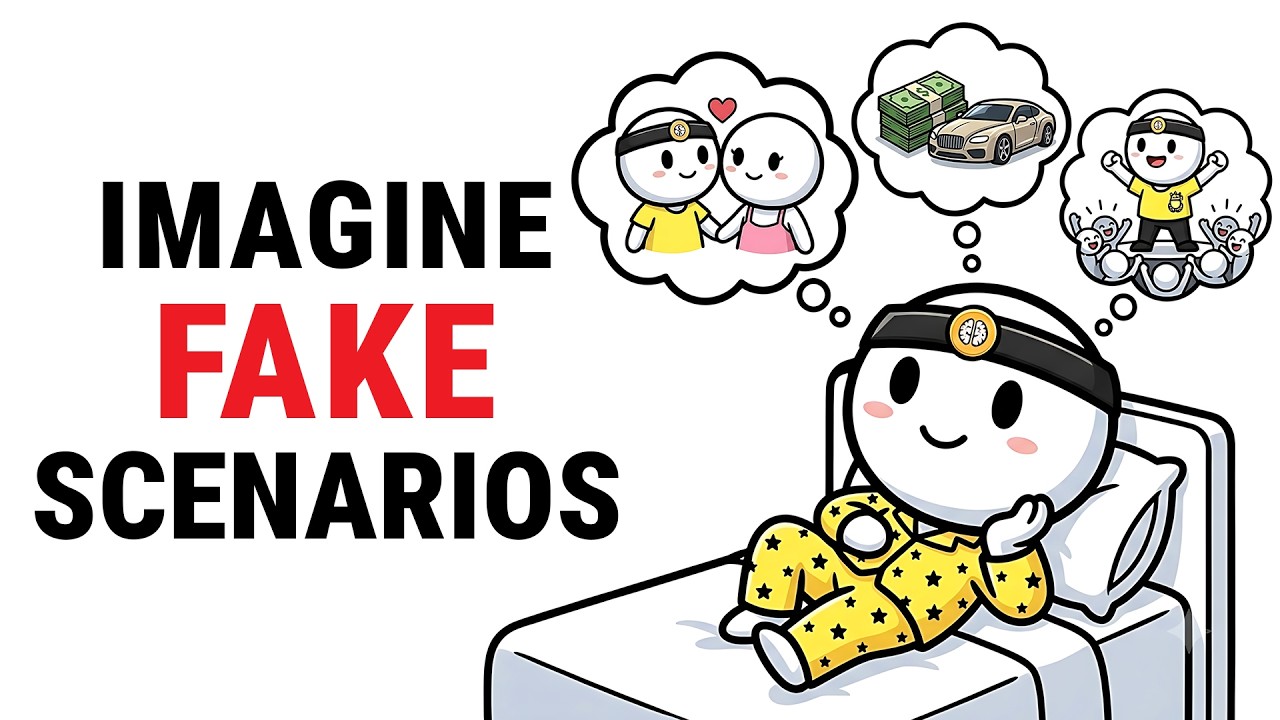
Lights off, eyes closed, and instead of drifting to sleep, your brain immediately yells, "Action!" You're no longer lying in bed. You're back in that morning clash with your toxic co-worker, but this time you fire back with the perfect comeback, the one you completely blanked on in real life. Or maybe you're scripting out a disaster that hasn't even happened yet, replaying it over and over, tweaking every line and every expression until you come out looking like a total badass. You've officially become the director and the lead actor of
92 words, the words spoken in the first 30 seconds at 183 words per minute.
Free, no signup. See how the first 30 seconds hold attention, with rewrites.
What this transcript is
Every word below is the caption track YouTube publishes for this video, pulled from the video itself and reproduced unchanged. It is not Prepublish's writing, not a summary, and not a re-transcription: it is the video's own published captions. English captions, generated automatically by YouTube, in the video’s original language. Source: the video on YouTube. A channel that would rather this page did not exist can ask for its removal through the contact page, and it is removed.
Lights off, eyes closed, and instead of drifting to sleep, your brain immediately yells, "Action!" You're no longer lying in bed. You're back in that morning clash with your toxic co-worker, but this time you fire back with the perfect comeback, the one you completely blanked on in real life. Or maybe you're scripting out a disaster that hasn't even happened yet, replaying it over and over, tweaking every line and every expression until you come out looking like a total badass.
You've officially become the director and the lead actor of a blockbuster film that only ever plays inside your head. A lot of people would say you're just having trouble sleeping or you're overthinking, but that's not it. Running these fake scenarios in your head at midnight is actually a deeply sophisticated psychological mechanism. Your brain isn't broken. It's quietly carrying out a secret mission, one with a purpose far deeper and more surprising than you'd ever expect.
So, what exactly is pulling the strings inside the movie theater of your mind every single night? And what is the real purpose behind these mental scripts? I'm Apex, and today we're going to decode the psychology of people who imagine fake scenarios before sleep. So, why is it that the moment you're about to fall asleep, your brain suddenly decides to kick into overdrive? To answer that, we need to look at a quiet power shift happening inside your nervous system right at the moment the bedroom light goes out.
Think about a typical day. Life keeps throwing things at you that you have to respond to rationally. An unreasonable email from a client, you push it aside to keep working. A comment that gets under your skin, you swallow the frustration to keep the peace. Biologically speaking, the part of your brain that makes this possible is the prefrontal cortex, the region responsible for logical thinking and controlling your behavior.
It has to work at full capacity all day long, actively holding down emotions you can't afford to show. But the moment you lie down in bed, everything starts to shift. Scientists call this window of time when you've closed your eyes but haven't fully fallen asleep the hypnagogic state. At this point, your logical brain is completely exhausted from a long day of holding things together, and it starts drifting toward rest first.
Meanwhile, the limbic system, the part of the brain that handles emotions and memories, is still wide awake. It's running at full speed. Your body is lying in the dark, no phone screen, no noise, no deadline pulling your attention away. Cut off completely from the outside world, your brain is forced to turn inward. It starts pulling up all the emotions, the frustration, and the unmet desires you pushed down earlier in the day to finally deal with them.
But, here's where things get interesting. Because the logical brain has already checked out, your brain can no longer process these emotions in a clear, analytical way. Instead, it processes them through images and storylines. That's why you don't just lie there thinking, "I feel sad because I was undervalued today." Instead, your brain builds an entire scene where you stand up, prove your worth, and make everyone who ever doubted you regret it.
This shift in biological processes is why the scenarios in your head are never random or meaningless. They're always personal, and you're always the main character. So, the real question is, when your brain keeps replaying these mental movies, what is it actually looking for in real life? The hypnagogic state explains why these scenarios tend to show up right when you lie down, but it doesn't explain why your mind picks a specific person, a specific conversation, or a specific outcome.
The answer usually comes down to three core psychological needs. Need one, finishing what's left unfinished. You might not remember what you ate a few days ago, but you can clearly recall something someone said to hurt you years back. Not necessarily because that memory matters more than everything else, but because it never got a real sense of an ending. Maybe the conversation stopped before you got to say what you needed to say.
Maybe the other person walked away without any explanation. Or maybe hours later, you finally thought of the exact response you wish you'd had in that moment. In psychology, the mind craves something called closure, a clear ending so it can finally set the issue down. This obsession has a lot in common with the Zeigarnik effect. Your brain tends to remember unfinished things far more vividly than things that are already resolved.
When real life refuses to give you an apology or a final word, your mind refuses to let it go. It turns the projector on, rewinds the situation, and pushes you into the role of screenwriter so you can create your own ending. The fact that you keep replaying it doesn't mean you're holding a grudge. It means you're trying to clean up the emotional wreckage someone else left behind. The new scene gives you a small sense of relief because this time the story doesn't stop at the part that left you stuck.
Need two, chasing reward, recognition, and a sense of control. You imagine walking into a room and having everyone's eyes on you. You shine in front of people who once looked down on you. Your crush finally returns your feelings. Or the people who doubted you are forced to admit they were wrong. Why are these unrealistic scenarios so addictive? The secret is dopamine. Most people think dopamine only kicks in when you actually receive the reward, but neuroscience tells us that simply anticipating and expecting a win is enough to release a significant amount of dopamine.
When you picture yourself shining in front of everyone, your nervous system feels just as satisfied as if it were actually happening. And the best part? In that imaginary world, you have 100% control. You decide what you say, how others react, and how everything ends. If a scene doesn't go the way you want, you rewrite it and start over. That means you get to reach the outcome you're hoping for without ever having to face the risk of rejection, failure, or the unpredictability of real life.
In the world of your imagination, your victory is guaranteed. Need three, rehearsing for the future and testing a new version of yourself. You might imagine tomorrow's conversation with your boss, an upcoming job interview, or a difficult thing you need to say to someone you care about. In your head, you try out different ways to open the conversation, predict how the other person will respond, and adjust your reply.
The same situation might run several times, each one with a different outcome. Cognitive science calls this process mental simulation. Your brain is building a practice room. It walks you through your words in advance, helps you anticipate risks, and reduces the feeling of uncertainty, so you're not completely caught off guard when things actually happen. But on a deeper level, this is where your mind experiments with a different version of yourself.
A version that stays calm under pressure, that sets limits with confidence, or that speaks up about things you usually keep inside. And that clearer, stronger version is not fictional. That's not you making things up. That's you getting familiar with a way of responding that you haven't had the courage to try in real life yet. These bedtime scenarios have quietly become a private rehearsal for your identity. By now, you understand why your mind craves these scenarios, but that still doesn't explain why you can't just hit the stop button yourself.
Have you ever wondered why the moment you close your eyes, everything floods back in, even when your body is completely drained? The answer lies in how your brain has quietly built three habits. One, nighttime gradually becomes a trigger. Think about the moment at the end of your day. You sink into bed, lights are off, phone is set aside. The room is quiet, no work, no one calling your name, and nothing from the outside world demanding a response.
At first, maybe you just purposely create a few scenarios to wind down and help yourself fall asleep. But when the same situation repeats night after night, your brain starts learning an association. The science of habits calls this cue linkage. Your brain quietly figures out the darkness, the bed, and silence are the signal for the mind to start working. Eventually, the moment your back hits the mattress, the familiar film starts playing on its own, even when your conscious mind doesn't want it to.
You're no longer actively imagining anything. The quiet space itself has become a command telling your mind to start thinking. Two, the scenario delivers an immediate reward. Any behavior that wants to become a habit needs a reward. But, the reward here isn't in the content of the story, like winning an argument or being praised in your imagination. The real reward is far more practical. It's the distraction that instantly shifts your emotional state.
When you're lying alone, worries, emptiness, and boredom can easily take over your mind. The second you slip into a scenario, your mind immediately has something to hold on to. Take a heated back-and-forth, for example. When you're focused on figuring out the most satisfying comeback, you feel a rush of energy and a sense of purpose. That feeling of satisfaction and being occupied instantly wipes out the boredom you started with.
That quick relief is the reward. Because it resolves the discomfort so fast, your brain records a new lesson. Whenever you're lying alone and feeling empty, turn the imagination on. Three, the loop starts feeding itself. And this is where the loop closes in on itself. The scenarios fill the empty space, but in return, they steal your rest. Whether you're imagining something wonderful or a heated fight, your mind is still generating strong emotions.
These emotions quietly wake up your nervous system. Your heart rate picks up a little, and your body loses the relaxation it needs. This state is called pre-sleep cognitive arousal. When your body is stimulated, you stay awake longer. And because you can't sleep, your mind has another empty window of time. What does it do with that window? It keeps extending the story. The more you imagine, the longer you stay awake.
The The you stay awake, the more tired your body gets, but the louder your mind becomes. After hundreds of nights like this, your bed is no longer a place to rest. It has become a switch that turns on wakefulness. That's why if someone tells you to just relax or stop overthinking, you feel completely helpless because you're not just dealing with a few passing thoughts. You're up against a habit your brain has been carefully building and wiring in for a long time.
Imagination starts out as a tool for releasing stress, but it becomes a problem when it turns into a loop that controls you. That's the moment you close your eyes desperately wanting sleep, but your brain flat-out refuses to shut down. Your body tenses up, your heart beats faster, and your energy gets drained by frustrating situations you created yourself. When you're stuck in it, every piece of advice to just relax feels pointless and only makes you more irritated.
It's time to take back control. Tonight, when the old scenarios start closing in again, use this process to flip the switch on your own mind. Step one, acknowledge the worry by naming it. When you can't sleep, you often panic and try to push your thoughts away or get frustrated with yourself. But that resistance is quietly pumping more energy into your brain to keep it going. Instead of fighting it, just quietly say to yourself, "I'm worrying about this again." The magic is in the biology.
The moment you put a name to the problem, the logical part of your brain immediately wakes up. It's like throwing cold water on an emotional fire. The tension has to cool down. You're not judging whether it's right or wrong, you're simply calmly confirming that it's there. Step two, cut off the thought stream with a firm command. Without hesitation, send a firm command through your mind. Stop. To help your brain follow it faster, attach a visual image to it.
You can picture a bright red stop sign appearing in your mind or imagine yourself slamming a power button and watching the TV screen inside your head go completely dark. This command acts as a wall across the path, forcing the thoughts that are racing downhill to slam on the brakes. Step three, take over the bandwidth so your brain can't replay the old film. This is the core step that determines whether the whole thing works or not.
The moment you shut off the mental TV screen and empty space immediately opens up. If you leave it alone, the old thought noise will rush right back in to fill it. Your brain's processing bandwidth is limited, so the only way to block those thoughts is to force your brain to handle something completely neutral. Right after you say stop, immediately replace it with something else. Count your breaths from 1 to 10. Quietly recite an old poem.
Picture a quiet beach. Or focus on listening to the hum of the air conditioner. Remember this rule, never leave a gap. Always replace it immediately. Step four, patiently retrain your brain's habit. In the first few days, the old thoughts will definitely push their way back in because your brain has been running the script for years. What you need to do is simple, repeat the process. No frustration, no self-blame. When your mind wanders, patiently pull it back into line.
Acknowledge it, tell it to stop, then immediately redirect. Keep repeating like a machine running on autopilot until your brain runs out of energy to resist and is finally forced to give in to sleep. To truly master this method, understand that this technique wasn't designed to erase memories. It was designed to break the negative loop that's draining your energy. On top of that, so you don't have to fight this battle every single night.
Try setting aside 15 to 20 minutes during the day for what you can call a controlled worry session. Sit down and write out every worry on a piece of paper. When your brain has already vented during the day, it tends to be much calmer at night. Rewiring a habit always takes time. So, practice this every night for about 2 to 3 weeks until it becomes a natural reflex. Before you close out the day, send your mind one clear message.
Nighttime is a sanctuary for rest, not a conference room for solving problems. No matter how unfinished the film in your head might feel, have the courage to press pause. Because the best decisions you'll ever make need a clear, well-rested brain to meet the morning light. Not a mind that's been running on empty in the dark. Having a noisy mind that constantly builds scenarios doesn't make you a failure or someone with something wrong with you.
It actually just proves that you have a rich, sensitive inner world and a survival mechanism that's working overtime to protect you. It's just that the brain has gone a little too far. By recognizing the loop, firmly telling it to stop, and immediately redirecting your mind, you're resetting the boundary. You're reminding your brain that the bed is a place to recover, not a courtroom for the day's mistakes, and not a bunker to hide in and worry about the future.
In the end, what matters isn't how well you resolve the scenarios in your imagination. What matters is whether you have the courage to let them go when the day is done. What about you? What kind of scenario do you find yourself directing most nights without even realizing it? An argument that never got resolved, a big moment of triumph, or worries about something that hasn't even happened yet? Leave a comment below. Facing it and saying it out loud is the first step to breaking the loop.
If today's video gave you a new perspective and helped you understand yourself a little better, hit like and share it with someone who's also struggling with the noise in their head. You never know, your share might be what helps someone finally find a peaceful night. Thank you for staying with me until the very end. I'm Apex. Don't forget to subscribe so we can keep uncovering the most fascinating corners of psychology together in our next video.
The words are the caption track's own and nothing is reworded or re-transcribed. Paragraph breaks are placed between sentences so the text reads as prose.
Free tools for your own script. No signup, no login.
Paste your draft and see where viewers are likely to drop off, with a rewrite for each weak line.
Paste the first 30 seconds of your own draft for a hook score and rewrites.
Check your draft against YouTube's advertiser-friendly guidelines before you record it.
Read this channel's public videos and transcripts, and download a writing brief for it.
Sentence shape
| Measure | This transcript |
|---|---|
| Sentences | 194 |
| Average words per sentence | 14.5 |
| Longest sentence | 34 words |
| Questions asked | 11 |
| Sentences containing a number | 4 |
Most used terms
Filler phrases
13 in total: actually 6 · like 6 · kind of 1.
A literal whole-word count of the same phrase list the Prepublish browser extension uses, so a phrase inside another word is not counted and a phrase used in its ordinary sense still is. It is a count and not a judgement.