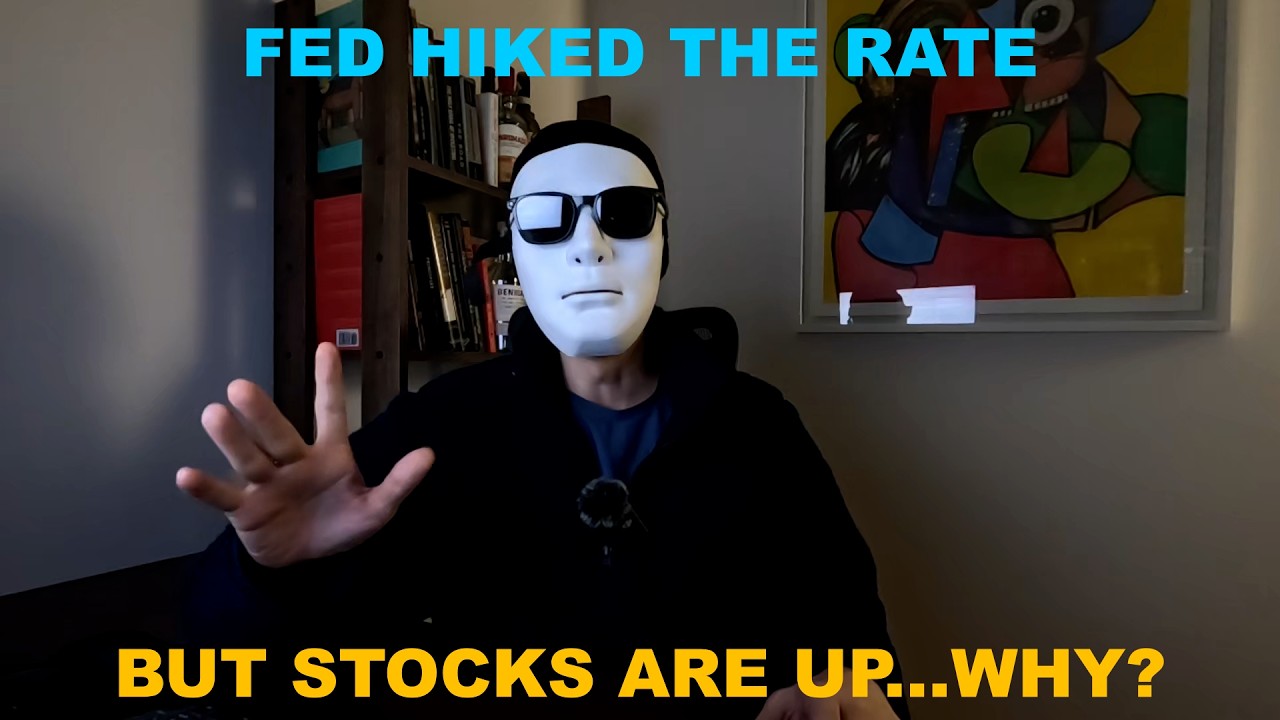
Fed hiked...but stocks are up..? transcript
Defiant Gatekeeper · @DefiantGatekeeper
Words
1,927
Runtime
11:12
Speaking pace
172wpm
Reading time
8min
172 words per minute, between the 160 25th percentile and the 181 median of 349 measured videos. That distribution comes from the 349-video hook study.
Opening (first 30 seconds)
Okay guys, let's go over the market for the past week. Now, the most important event happened which was the FOMC meeting. As you guys all know, the interest rate was increased by 25 basis point. So, the Federal Reserve's policy rate is now at 3.75% to 4.0%. Now, what's important here is not the fact that the rate was increased. The market was expecting around 90% chance of a rate hike. So, the outcome was the same as what the market expected. Now I understand
86 words, the words spoken in the first 30 seconds at 172 words per minute.
Sentence shape
| Measure | This transcript |
|---|---|
| Sentences | 107 |
| Average words per sentence | 18.0 |
| Longest sentence | 50 words |
| Questions asked | 0 |
| Sentences containing a number | 19 |
Most used terms
- bond36
- market36
- rate27
- yield23
- bond yield18
- fed14
- number14
- okay14
- inflation12
- federal11
- interest11
- interest rate11
Filler phrases
14 in total: basically 9 · actually 5.
A literal whole-word count of the same phrase list the Prepublish browser extension uses, so a phrase inside another word is not counted and a phrase used in its ordinary sense still is. It is a count and not a judgement.
What this transcript is
Every word below is the caption track YouTube publishes for this video, pulled from the video itself and reproduced unchanged. It is not Prepublish's writing, not a summary, and not a re-transcription: it is the video's own published captions. English captions, generated automatically by YouTube, in the video’s original language. Source: the video on YouTube. A channel that would rather this page did not exist can ask for its removal through the contact page, and it is removed.
Transcript
Okay guys, let's go over the market for the past week. Now, the most important event happened which was the FOMC meeting. As you guys all know, the interest rate was increased by 25 basis point. So, the Federal Reserve's policy rate is now at 3.75% to 4.0%. Now, what's important here is not the fact that the rate was increased. The market was expecting around 90% chance of a rate hike. So, the outcome was the same as what the market expected.
Now I understand that there are a lot of debates among the investors around whether the Fed will indeed increase the rates given the relationship between Trump and Kevin Worish but the rate was hiked and we all just need to analyze the market based on what happened. Now what really matters here is the movement of the equity market. Now this week the NASDAQ was up by around 0.7% and the S&P 500 was roughly flat. However, if you look at the movement after the rate hike was announced, which is Thursday, which is the day after the announcement, NASDAQ was up 1.7% and S&P 500 was up 1.1%.
Then on Friday, NASDAQ was up 0.4% and S&P 500 was up 0.2%. So, after the announcement of the rate hike, for two consecutive days, the market was up across the board. Now from a textbook perspective this doesn't really make sense. If the Fed hikes the rates it must increase the discount rate of the future cash flows of companies leading to a lower valuation of equity market. However, that was not the case. Now I'm sure a lot of you already read the news around the FOMC.
So I just want to focus on why this happened. The market can often behave in irrational manner. But what's important for us is to understand why such behaviors happened in the market. Okay. So there are a lot of noise in the media but from my perspective I can think of around three reasons for this happening. Number one the movement of the bond yield and number two the Federal Reserve narratives around growth and number three global collective efforts to manage long-term bond yields.
Okay so let's go over the three points one by one. Now just to warn you my explanations today may not sound entirely logical and fact-driven but just please bear with me. Okay. So first on the movement of the bond yield. Now one thing to make clear is that what determines the stock market's overall valuation is the yield of the actual bond i.e. 5year bond yield, 10-year bond yield and etc. Now as we saw last week the 10-year bond yield which is pretty much the most important factor when it comes to a stock's valuation was at almost 5%.
Which is the highest level in the past 19 years. The high 10-year bond yield was generally acting as a pressure to the stock market and as I've said for a few months this was the primary metric which we needed to monitor. Now the Federal Reserve's interest rate which is the federal funds rate provides a guidance on the bond yield. Now if the Federal Reserve increases or lowers the Federal Funds rate it acts as a rule of thumb on the short-term bond yield i.e. the one month or three-month bond yields which will subsequently also impact the long-term yields.
So I just wanted to get that concept clear. Direct impact comes from the bond yield and the Fed's interest rate decision is an indirect impact. Now on the day the Federal Reserve increased the interest rate by 25 basis point. While the textbook theory would generally say that the bond yield will also increase the bond yields actually decreased. Now, as I said earlier, if the bond yield decreases, this would mean a more favorable environment for the stock market.
So, what we need to find out is why the bond deal decreased despite the federal funds rate increasing. Now, broadly, there are two reasons to why this happened. Number one, the oil price. Now, about a week prior to the FOMC meeting, there was a drone strike from Iraq to Saudi Arabia's pipeline, which sent the oil price to over $100 per barrel prior to the FOMC. Now, as a result of the attack, Saudi Arabia shut down the entire oil pipeline as a precautionary measure.
However, right after the FOMC meeting, coincidentally, Saudi Arabia announced a relief effort involving a shipto- ship transfers near Oman port bypassing the damaged pipeline. Now, this pushed the oil price back down to under $100 per barrel and also gave a little bit of positive impact on the overall outlook of the inflation trajectory. Now, number two, the relief of the bond market. Now, this may sound very fluffy, but long story short, the bond market is relieved that the Fed took actions as expected.
Now, this may sound weird, I know, but let me explain. So basically the bond market was showing extreme concerns on the inflation. Now the fact that the yield was skyrocketing was basically a tantrum from the bond market saying that they're extremely worried about the inflation and want somebody to do something about it. Now the most effective way to cool down the inflation is to increase the interest rate. And because the Fed actually increased the interest rate, the bond market is now saying that they're now less worried about the inflation than they were before.
Okay. Now, just to explain this one more time from the other side, basically, if the Federal Reserve didn't increase the interest rate at this week's FOMC, that would basically mean that the Federal Reserve does not care about the ongoing inflation. And if the Fed doesn't care, it could lead to a even more severe inflation and that would have gotten the bond market even more worried leading to a even higher long-term bond yield.
Okay. So, ironically, what this means is that because the Fed increased the rate, this means that the Fed cares about the high inflation and the higher interest rate will contribute towards lowering the inflation and therefore the bond market is now less worried and therefore the long-term yield went down. Okay. Okay. So, I have to try very hard to explain this because it is a weird situation, but that's actually what happened.
The 10-year bond yield actually went down a lot. It went down from around 5.02% to around 4.94%, which is almost a 10 basis point drop from the prior day. Now, the 10-year bond went back up to around 4.99% the next day, but it is still lower than where it was prior to the FOMC meeting. Okay, so that's the first reason why the equity market rallied. Then number two, the Fed's narratives around growth. Okay, so as I've said multiple times, equity market's valuation is a balance between growth and bond yield.
Now even if the bond yield is very high, if the company's growth is even higher, equity market can go up and vice versa. Now at the FOMC meeting while they did increase the interest rate the FOMC statement actually did emphasize the growth trajectory as well as further growth potential. Now just to give you a few quotes from the statement and the meeting. Economic activity is expanding at a solid pace despite elevated uncertainty that owes in part to the conflict in the Middle East.
Productivity growth and capital investments are strong. Job gains have kept pace with the workforce and the unemployment rate has changed little. Our decision comes at a time when the American economy appears to be strengthening. New hiring, private sector earnings, business capital investment, each of these markets have improved in recent months and is pointing in a good direction. Now, in addition to the quotes, the economic projections provided by the Fed indicated that GDP growth will be 2.3% for 2026 and 2.4% 4% for 2027 which were both revised upward from June.
Also, unemployment rate was held constant as well indicating a healthy job market. Now, basically what the Fed is trying to do is framing this rate hike as something which is not destructive to the economy or the equity market but as something which is a result of a healthy economy and a resilient economy. Okay, moving on to the next factor. Global collective efforts to manage long-term yields. Okay, so in addition to the Fed increasing the interest rate as expected, the Bank of England held its rates constant at 3.75% which was expected as well.
Now basically the two central banks delivered no surprises to the market which plausibly lowered global cross asset volatility. If the Bank of England unexpectedly increased or decreased the interest rate on the same day, that may have caused some tantrum in the overall bond market, triggering more fear on the global inflation. But that didn't happen. Also, the Bank of England didn't just stop there, but it also announced a cut in its quantitative tapering from 70 billion pounds to 46 billion.
Now what this basically means is that the bank of England will be slowing in reducing its central bank balance sheet and what this means is that the bank of England will not sell as much bonds to the market as it used to sell. Now generally there are two ways to do a QT. Number one, sell the bonds on the balance sheet to the market or two just keep the bonds and let it mature. The side effect of selling the bonds is that if more bonds are sold in the market, it'll lower the price of the bonds which will increase the yield of the bonds.
However, Bank of England has announced that they will slow the pace of doing this QT. So less bond will be sold in the market which means the long-term bond yield i.e. the guilt yield will not be as high as before. Now basically what this means is that it's not only the Fed but also the central banks around the world which are extremely wary of the long-term bond yields. Now this also provided some comfort to the market regardless of the inflation.
Basically the central banks are trying to manage the bond deals altogether. Okay. So, a lot of explanations today were very fluffy and may or may not make sense. And trust me, this doesn't happen that often, but we're going through some exceptional non-extbook periods in the financial markets. But just to summarize, number one, the equity market is directly impacted by the bond yield and indirectly impacted by the Federal Reserve policy rate.
Number two, the bond yield decreased despite the increased policy rate because of number one, the oil price. And number two, the relief in the bond market with less concerns on inflation. And number three, the equity market was supported further with number one, the Fed's outlook on growth. And number two, central bank's collective efforts to manage long-term yields. Okay, so I'm not sure whether you guys fully agree with my analysis today, but I tried my best to explain the situation.
Now, I do understand the market can be irrational and weird sometimes, but let's at least try to use this opportunity to learn more about how the market can behave at certain times. Now, I hope you enjoy the video and I'll be back with more videos very
The words are the caption track's own and nothing is reworded or re-transcribed. Paragraph breaks are placed between sentences so the text reads as prose.
Use this transcript
Three free tools that work on the material around a video like this one. No signup, no login.
Hook Analyzer
Paste the first 30 seconds of your own draft for a hook score and rewrites.
Policy Pre-Flight
Check your draft against YouTube's advertiser-friendly guidelines before you record it.
Channel Skill Generator
Read this channel's public videos and transcripts, and download a writing brief for it.