Getting the transcript
Reading the captions from YouTube. A video nobody has opened here before takes 10 to 30 seconds; this page fills in on its own.
Getting the transcript
Reading the captions from YouTube. A video nobody has opened here before takes 10 to 30 seconds; this page fills in on its own.
Rare Cars · @rarecars3336
Where viewers went back to watch this video again, from YouTube's public Most replayed graph, lined up with what was said at that moment.
Most replayed moment #1
6:5911.0x the video's typical replay level
reference. The main instrument panel was made from brushed aluminum with an electronic tachometer to round out the many gauges. The steering wheel was covered in leather color keyed to the rest of the interior. Now, Teague and AMC really pulled out all the stops to
Said at 6:53
Most replayed moment #2
5:2910.8x the video's typical replay level
total, the number of them with the high-altitude rear end might be in the single digits. No sources that I could find really had much detail. With new suspension underneath and a reworked V8 under the hood, Teague and his team wanted the AMX to look meaner, wider,
Said at 5:22
Most replayed moment #3
4:528.8x the video's typical replay level
too. All other companies were playing in the same sandbox. For instance, the Mustang's best option that same year with its 302 was 140 horsepower. The AMX's 125 horsepower was routed through either a four-speed manual or a
Said at 4:44
The graph counts replays. It does not show where viewers stopped watching.
Words
2,120
Runtime
12:28
Speaking pace
170wpm
Reading time
9min
170 words per minute, between the 160 25th percentile and the 181 median of 349 measured videos. That distribution comes from the 349-video hook study.
Opening (first 30 seconds)
In the late 1970s, American Motors, as usual, was struggling to compete with the Big Three. They had managed to jump into the subcompact market early with the Gremlin in 1970, which was a major first-mover advantage. But, that design was getting long in the tooth, and competition was rising rapidly after they saw the success of the Gremlin. The Chevy Vega, Ford Pinto, and others were eating into that subcompact AMC needed to make a major move to stay profitable. In 1979, AMC thought
85 words, the words spoken in the first 30 seconds at 170 words per minute.
Free, no signup. See how the first 30 seconds hold attention, with rewrites.
Sentence shape
| Measure | This transcript |
|---|---|
| Sentences | 108 |
| Average words per sentence | 19.6 |
| Longest sentence | 42 words |
| Questions asked | 1 |
| Sentences containing a number | 44 |
Most used terms
Filler phrases
3 in total: like 2 · actually 1.
A literal whole-word count of the same phrase list the Prepublish browser extension uses, so a phrase inside another word is not counted and a phrase used in its ordinary sense still is. It is a count and not a judgement.
What this transcript is
Every word below is the caption track YouTube publishes for this video, pulled from the video itself and reproduced unchanged. It is not Prepublish's writing, not a summary, and not a re-transcription: it is the video's own published captions. English captions, generated automatically by YouTube, in the video’s original language. Source: the video on YouTube. A channel that would rather this page did not exist can ask for its removal through the contact page, and it is removed.
In the late 1970s, American Motors, as usual, was struggling to compete with the Big Three. They had managed to jump into the subcompact market early with the Gremlin in 1970, which was a major first-mover advantage. But, that design was getting long in the tooth, and competition was rising rapidly after they saw the success of the Gremlin. The Chevy Vega, Ford Pinto, and others were eating into that subcompact AMC needed to make a major move to stay profitable.
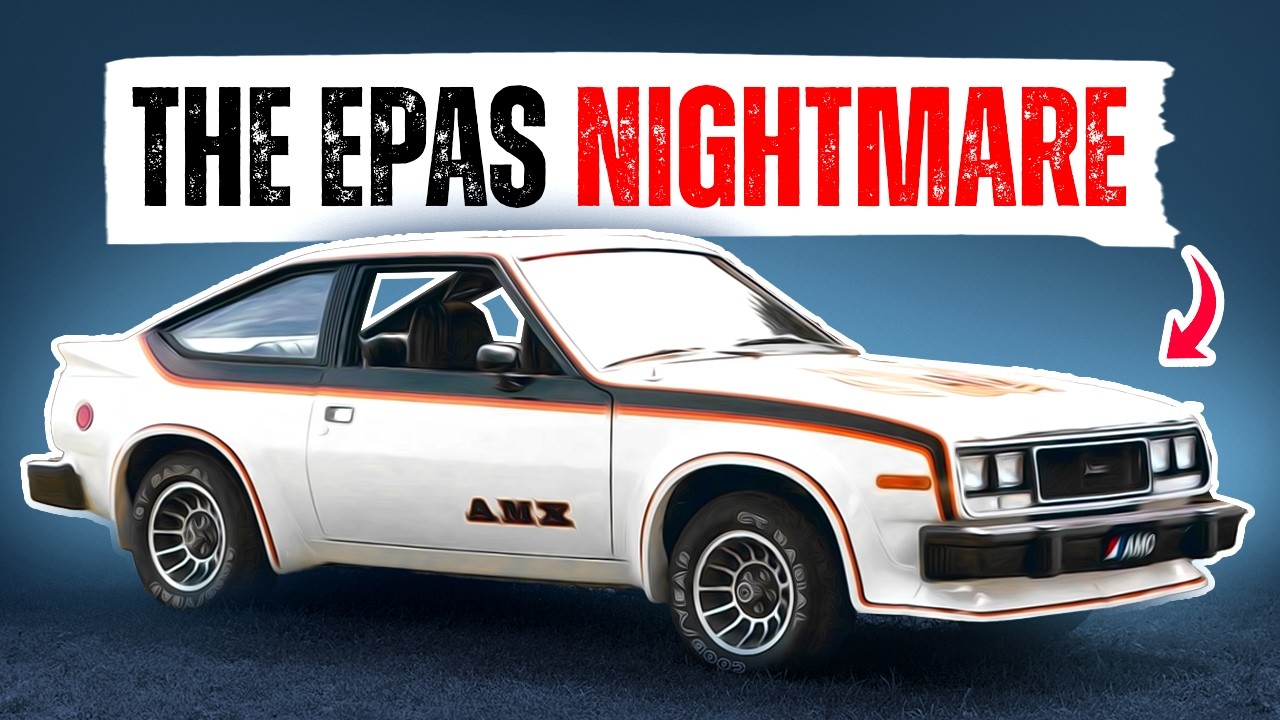
In 1979, AMC thought that they could outmaneuver its competitors with a bizarre little car that combined a nostalgic name with a subcompact frame and a touch of pop culture to top it all off, and a V8 shoehorned inside of it. That car was the Spirit AMX. Now, the Gremlin had a good run. It jump-started AMC's earnings by catering to a market segment that the Big Three were just too busy to bother with during the horsepower wars of the late '60s and early '70s.
But, over its nine years of production, the Gremlin went from innovative and affordable to somewhere near the back of the pack as newer and better competitors arose that ended up being in a similar price point. Dick Teague, the chief stylist for AMC, got to work on a new design to freshen up AMC's offerings to boost sales. That car he came up with was the Spirit. The Spirit had a much more modern look than the Gremlin, especially in the front end, where he replaced that dated round headlight setup and wide grill with two pairs of rectangular lights and a taller, more squared-off front grill.
Like the Gremlin, the Spirit was offered in both sedan and liftback forms. It was still a subcompact on a tiny 98-in wheelbase. But, the new Spirit liftback had a longer sloping rear end that was reminiscent of a classic fastback profile, not so much of the Gremlin where they just lopped off the back of the car. The Spirit was not a bad-looking vehicle at its core, and it was affordable and practical, albeit a bit boring if AMC had left things there.
However, Teague and his team were not done, not by a long shot. They envisioned an upscale sporty version of the Spirit liftback, which would hearken back to the heyday of AMC's muscle cars in the late '60s. The original AMC AMX, which they made from '68 to '70, was one of the most iconic cars the brand made. And so, they used that nameplate again with the AMC Spirit AMX. Now, this wasn't just a visual trim package. Teague and his team took the fairly sedate Spirit and transformed it into something much more sporty.
This was the late '70s still, though, so every automaker had to deal with the performance hole that they were in. So, the first place AMC went was with the handling. The Spirit AMX got what they called a GT rally-tuned suspension, including better front and rear sway bars, adjustable Strider shocks, new steering parts, and beefier parts all around in the suspension. The front disc brakes and rear drum brakes were both improved as well compared to the base model.
And these cars also got a throatier exhaust. Now, what that exhaust would connect to would be the engine, obviously. The difference here with the AMX was that they decided that the 258 cubic inch inline-six that was in a lot of Spirits just wouldn't do that nameplate any justice. They knew they needed a V8 if they were going to slap the AMX badge on the car. So, they decided to shove one into this tiny hatchback. Now, it was a crazy idea for the period, sure, but what they didn't realize was that this decision would give the Spirit AMX even more potential than they ever imagined.
But, more on that in a minute. In terms of the power plant, the best candidate that AMC had at the time was its 304 cubic inch V8, which they had been using since 1970. It had been a decent engine at the start of its run with 210 gross horsepower, but EPA regulations have been strangling it for years. And in '79, it was in a pretty sorry state. The '79 version of the 304 choked out by its extremely restricted exhaust and a totally insufficient two-barrel Motorcraft carburetor with an 8.4:1 compression ratio.
These downgrades have brought the 304's power down to a measly 125 net horsepower and 219 ft lbs of torque. Still, AMC wasn't alone in having to cope with these emission regulations, too. All other companies were playing in the same sandbox. For instance, the Mustang's best option that same year with its 302 was 140 horsepower. The AMX's 125 horsepower was routed through either a four-speed manual or a three-speed automatic to a rear axle with a 287:1 gear ratio for the manual or a 256 gear ratio for the automatics.
Now, according to the sales brochures, there was a high-altitude version of the automatic that could still be used with the 287 rear gear. But, considering how few V8s of these cars that were made in total, the number of them with the high-altitude rear end might be in the single digits. No sources that I could find really had much detail. With new suspension underneath and a reworked V8 under the hood, Teague and his team wanted the AMX to look meaner, wider, and faster than the rest of the fairly pedestrian Spirits.
So, they improved nearly every visual aspect of the car. They got halogen headlights, custom trimmed interior door panels, and special black bumpers back and front. A unique front air dam and rear spoiler were added with a stylish blacked-out grill. The wheels that were standard on the Spirit were switched out with Turbo Cast IIs that were 14 by 7 in dimensions. And the factory tire on the Spirit AMXs was an ER60 by 14 Flexsteel radial belted tire.
Those new deeply back-spaced wheels, combined with the flared wheel wells and the sharp contrasting stripes, made the AMX look much wider and more aggressive than it really was. It looked sharper and faster than any other Spirit with the short squat aggressiveness of a rally car. And it looked a lot better than most of its competition in class. Moving inside the car, these AMX versions got better sound deadening, custom bucket seats, and a special center console.
That console was integrated with a floor-mounted shifter, the armrest, and additional gauges, of which there was a clock, a manifold vacuum gauge, and an oil pressure gauge, all tilted toward the driver for easy reference. The main instrument panel was made from brushed aluminum with an electronic tachometer to round out the many gauges. The steering wheel was covered in leather color keyed to the rest of the interior.
Now, Teague and AMC really pulled out all the stops to make the Spirit AMX everything it could be, both visually and mechanically, at least as much mechanically as they could without running a foul of the EPA. Compared to the standard Spirit or even the upgraded Spirit GT, the AMX was on a whole different level. It looked quick, and the V8 was almost 10% more powerful than their other biggest engine, which was the six, and it was fairly quick for the period.
But, Teague's team had one more ace up their sleeve. Apparently, Teague or someone from his team was a big fan of Smokey and the Bandit because they took inspiration from the fiery Phoenix hood decal on Smokey's Trans Am and adapted it to a fiery version of the AMC logo. And the cherry on top was a giant pop culture inspired hood decal that no other AMC car would ever get. At a curb weight of just under 3,000 lb, it was also fairly light.
So even with the restricted engines, weight was on its side. Reviewers who drove the Spirit AMX in 1979 said it wasn't bad compared to what else was on the market that year. In fact, AMC and BFGoodrich sent a pair of AMXs to the Nürburgring that year to show off the car's endurance. They were the first-ever American entries to the FIA Group 1 24-hour race. They managed with a team including Amos Johnson, Dennis Shaw, James Brolin, and auto journalist Gary Witzenburg to take first and second place in their class at this race, 25th and 43rd overall in the run.
Sadly, all these changes and upgrades just didn't give the market what it was looking for. Of the nearly 53,000 AMC Spirits that were made in 1979, only 3,657 buyers chose to upgrade to the AMX. And only a fraction of those upgraded to the V8. In 1980, AMC kept the AMX trim package but dropped the V8 engine option entirely. And so, the V8-powered Spirit AMX was a one-year wonder. The Spirit would continue through 1983 when it would be replaced by the all-new Renault Alliance or Encore.
But by then, AMC was just not doing well. And in '87, they were bought by Chrysler, thus ending AMC's era. But even with the official history ending then, there are two huge silver linings to this sporty little subcompact that I think are worth talking about. Remember how I said this car had potential? I said that the carburetor was too small and the exhaust was too restrictive even though they tried to make it good.
Well, as it turns out, if you bought one of these cars, you could get a lot more power out of it with some very minor mods. I've seen claims that simply replacing the carburetor with a four-barrel and with a more free-flowing dual exhaust, you could get up to 100 horsepower more out of that 304. Even if they're exaggerating a little bit, that would bring the unimpressive 125 net horsepower all the way up to over 200.
For a 1979 car weighing only 3,000 lb, that's nothing to sneeze at. If you wanted to go crazy throwing on a set of performance heads and a manifold and definitely upping that compression ratio could get you way further as well. But, it gets even better. The fact that AMC had to either fit an inline six or the V8 in that same engine compartment for a subcompact meant it was an incredibly roomy engine space for a vehicle of its size.
You could in theory replace that 304 with something much larger. All you needed was time, money, and a little know-how. Some people have even gone as far as to throw AMC's beloved 401 into this little subcompact to make it a serious contender, which I think is a pretty rad combination. Those 401 engines back in 1971 were putting out 330 gross horsepower and 430 ft-lb of torque stock. And with mods, you could do way better.
You could also opt in for a 390 from the original AMX cars, which would be a really cool crossover in this new nameplate. All of which just requires time and money, and I say that sarcastically. To bring it all full circle though, in short, not only was the AMC Spirit AMX a decent car for its time, but it was really unique. It was a time where people were not throwing V8s into everything to make it work, yet AMC decided, "Let's go ahead and appeal to our heritage and throw a V8 into our little hatchback." And with a little bit of how-to and some improved suspension parts, it actually was a decent base for a little hot rod.
With their very small production value, these cars don't come up for sale too often. But, when they do, they're not that badly priced. Many of them in really nice condition sell in the $20 to $30,000 range. They look good and they have lots of unexplored possibilities for a unique build that doesn't have to be hundreds of thousands of dollars, which in today's day and age, I have to say, is nice to see. And that ends the story of the V8 Spirit AMX.
Let me know in the comments down below if you ever knew someone who had one or if you had driven one of these. I would love to know. Otherwise though, I hope you all enjoyed another episode. If you did, make sure to go ahead and smash that like button and subscribe to the channel because it helps us out a ton. And with that, I will see you all in the next one, enthusiasts.
The words are the caption track's own and nothing is reworded or re-transcribed. Paragraph breaks are placed between sentences so the text reads as prose.
Free tools for your own script. No signup, no login.
Paste your draft and see where viewers are likely to drop off, with a rewrite for each weak line.
Paste the first 30 seconds of your own draft for a hook score and rewrites.
Check your draft against YouTube's advertiser-friendly guidelines before you record it.
Read this channel's public videos and transcripts, and download a writing brief for it.