Getting the transcript
Reading the captions from YouTube. A video nobody has opened here before takes 10 to 30 seconds; this page fills in on its own.
Getting the transcript
Reading the captions from YouTube. A video nobody has opened here before takes 10 to 30 seconds; this page fills in on its own.
AI Engineer · @aiDotEngineer
This video has no Most replayed graph yet: YouTube shows one only once a video has enough views. These are the moments viewers replayed most in AI Engineer's most watched videos.
Most replayed moment at 18:45
4.8x that video's typical replay level
that they're they're changing they're changing things in the database not yet. You want to run them through the ontology first and make sure that works. Okay. I only got an I've got I've got another I've just a short time. I'm going to try to show you some of the things that um that you can
Said at 18:37
Most replayed moment at 16:13
3.6x that video's typical replay level
method signatures, the program layout and the call stacks. So here's some examples. I don't think you'll be able to read this one, but this is like the level of abstraction we're at. It's how we're actually going to lay this stuff out and how these systems are going to interact. Dylan Mulroy from Cloudflare talks a
Said at 16:06
Most replayed moment at 2:02
2.5x that video's typical replay level
are re-bumbling around the work itself. And the important question here becomes a lot less about what is your title and more what part of the system can you own? Now, I like this taxonomy quite a lot.
Said at 1:56
The graph counts replays. It does not show where viewers stopped watching.
Words
3,308
Runtime
17:42
Speaking pace
187wpm
Reading time
14min
187 words per minute, between the 181 median and the 201 75th percentile of 349 measured videos. That distribution comes from the 349-video hook study.
Opening (first 30 seconds)
Thank you to the organizers for having me. I'm one of the co-founders and CTO at Latch. We are basically a vertical AI lab for benchmark and agent engineering. I'm hoping to motivate and explain exactly what that means today. Starting directly with motivation for agents in in bio generally. Um Many people in my domain are familiar with this curve, but this is basically the log linear curve of data generated over the years in in biology. And the reason I'm bringing it up it will become directly important to the kinds of
94 words, the words spoken in the first 30 seconds at 187 words per minute.
Free, no signup. See how the first 30 seconds hold attention, with rewrites.
Sentence shape
| Measure | This transcript |
|---|---|
| Sentences | 208 |
| Average words per sentence | 15.9 |
| Longest sentence | 77 words |
| Questions asked | 11 |
| Sentences containing a number | 4 |
Most used terms
Filler phrases
205 in total: um 68 · like 59 · uh 52 · kind of 13 · actually 4 · you know 4 · basically 3 · I mean 1 · sort of 1.
A literal whole-word count of the same phrase list the Prepublish browser extension uses, so a phrase inside another word is not counted and a phrase used in its ordinary sense still is. It is a count and not a judgement.
What this transcript is
Every word below is the caption track YouTube publishes for this video, pulled from the video itself and reproduced unchanged. It is not Prepublish's writing, not a summary, and not a re-transcription: it is the video's own published captions. English captions, generated automatically by YouTube, in the video’s original language. Source: the video on YouTube. A channel that would rather this page did not exist can ask for its removal through the contact page, and it is removed.
Thank you to the organizers for having me. I'm one of the co-founders and CTO at Latch. We are basically a vertical AI lab for benchmark and agent engineering. I'm hoping to motivate and explain exactly what that means today. Starting directly with motivation for agents in in bio generally. Um Many people in my domain are familiar with this curve, but this is basically the log linear curve of data generated over the years in in biology.
And the reason I'm bringing it up it will become directly important to the kinds of things we want to do in engineering. Um This curve is driven by a very small handful of experimental classes. One is called single cell biology. This is where we split up cells, break them apart, and measure their RNA. The second is spatial biology, which will become the focus of the next segment of the talk. Same thing as single cell, but you get spatial resolution.
You can look at how RNA is spread out geometrically over a tissue. And the third thing is proteomics. It's a broad category of different techniques. They measure proteins. Um Less less abundant in ordering. Like less less data volume generated relative to the other two, but still important. Um you guys are technical and I always think it's good to ground things somewhat quantitatively, but um these are really big numbers and the experimental data from these techniques is growing quite rapidly.
Um Almost greater than any other domain of science other than particle collider um machines. Single cell experiments can yield two to six terabytes per run. Spatial runs can yield seven terabytes of run. Proteomics a few hundred gigs. Um and the only reason I bring this up is to say hey like the output of a single experiment can exceed what a scientist can safely store on a consumer laptop in many cases. And the laws driving how the the molecular capture works point to rapid gains in this throughput over the coming years.
Um one thing I like to do uh is when I read a new paper is decompose it and align it to this framework because it will be important in a second. Uh modern biology research is centered around those experiments. You basically choose a model biological model, not the kind of models you guys are used to. You generate data from that model, you process the data, you creatively think about the results in the context of prior literature, and you make a claim.
Almost all modern experiments papers that you see published follow this loose structure with a lot of nuance. Um all all all that to say is they be they become something of a a panning experiment. You're looking for a signal using measurement in a sea of noise. Um and so this is building up to the claim that like code and sweet data analysis scaffold to genetic biology. It becomes this executable substrate that we can use to train things.
It introduces a natural way to benchmark and climb capability. Um I've written about this a lot at this blog. Uh link here. There's a lot more depth to this claim, so I wouldn't take it at face value, but it's something to look into. All you can take away from this is like just like code provided a verifiable substrate for complex software tasks that are not inherently verifiable, uh data analysis might do the same thing in bio.
So how do we get started? We were originally a data tool vendor for biotech and pharma. Um where we started 5 years ago out of Berkeley on 25. We started when I was 20. We stored, transformed, filed data from large experiments as a service. Uh we'll try to build products, explored lots of things. Over the last 2 years, um we started moving away from biotech and pharma and more towards the people who build those kits I was talking about.
Package the software into kind of white-labeled things that they s- provided to the scientists themselves. Um Help them analyze their data. And then over time, there became this strong interaction uh with the agents uh using the infrastructure components as tools and the loop context you guys are familiar with. Except in our domain, the tools can take days or weeks. I'm serious. Um What started to happen around last summer is agent prototypes uh started to work.
So, we took uh coding models uh to our knowledge at the time they were not seriously post-trained on any tasks in biology to this point. And we started to build products that look a lot like all the other agent products. They have a chat interface for you to ask questions to and they build dashboards and dispatch operations to external compute. Um the kinds of things these that this this agent would do is take large file data from the types of experiments I was talking about earlier.
Say like uh tissue bisect biopsy from cancer with a spatial measurement. And then the the scientist is just iterating with it to get at some question they have. You know, maybe between a malignant and non-malignant part of the tissue, what kind of genes are being overexpressed? Um but what was fascinating is even though it was pretty bad, it showed the early signs of working. And uh It became clear to us at this time that agentic biology might look a lot like code.
Actually lifted this slide from Anthropic's um Claude science announcement yesterday, but we uh just like, you know, you had this like kind of faulty silly engineer that became better and then as it improved in capability, you could dispatch work to teams of them that work together. The same pattern will probably emerge in science. And products and harnesses will emerge to orchestrate uh work and abstract it so that teams of teams of agentic scientists can take on capability.
But we needed focused post-training. Uh cuz at the time and still now, um frontier models cannot be trusted to do real work. They're missing some capability between knowing biology and writing code. And this is exactly extracting scientific insight from real-world data. Unlike code, it which is one constituent component of this work, uh it also involves data analysis and domain reasoning, scientific reasoning. We thought spatial biology is a good place to start, so we started building agents.
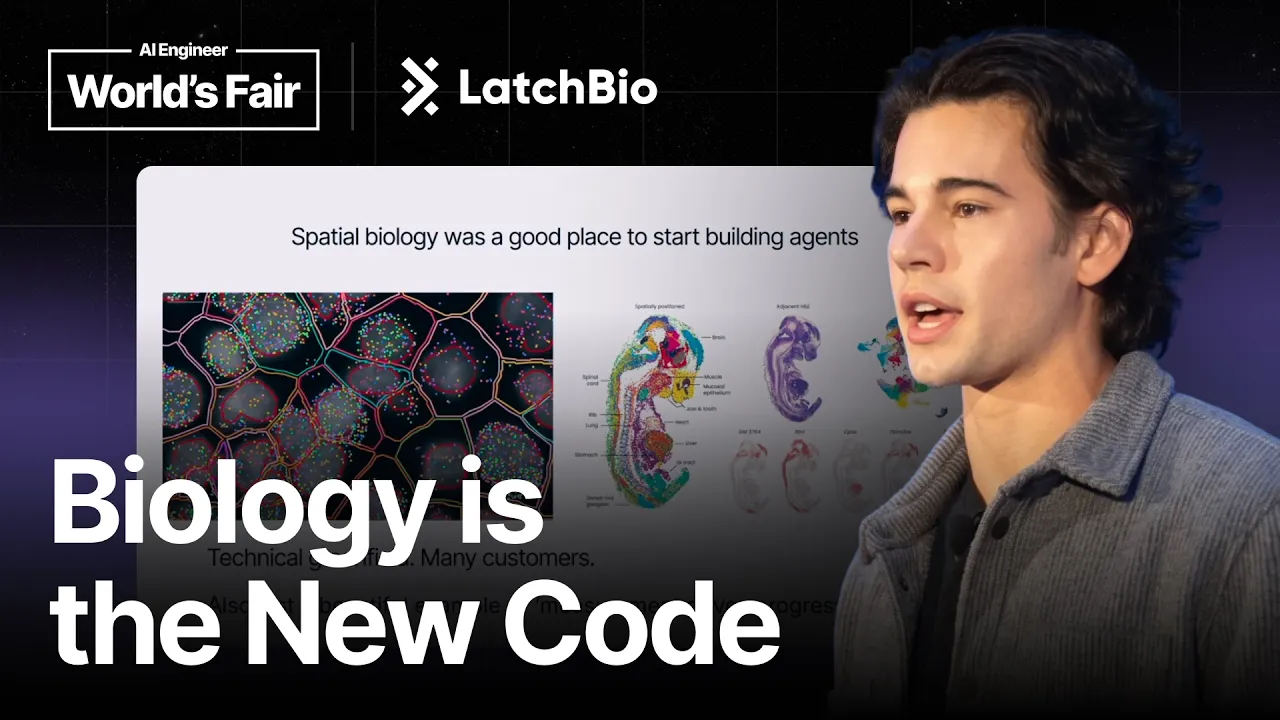
This is a technical green field. We had many existing customers. Uh it's also just a beautiful example of measurement drives progress. You can actually see biological phenomena play out. Um you can look at a developing mouse embryo. Um And we had to get in the guts of how the data was captured and analyzed to build good agents. Um I'm not going to get into this in detail, but I put up this tree of uh different capture technologies in spatial biology to highlight the diversity of things that exist.
They really span advances in chemistry, optics, semiconductors, physics. Each branch uh is induced from decades of cumulative work to figure out how to measure a a type of molecule. As a specific example, one technique we work with is called sequencing base spatial, and it's where you take a slide of little beads with clumps of DNA attached to them that fuse to the RNA inside of a tissue section, so biologists can like lay like a chunk of a tumor over it, and then it'll capture all the RNA in it, and then let you know with precise uh geometric resolution where the RNA was.
It's cool stuff. The data, when it comes out, ends up looking like a big matrix of numbers in a large high-content image. Um you have to take it through a sequence of steps uh to get to the end thing that you want. These steps are highly variable, especially across technology types, tissue, disease contexts. Um there isn't a lot of consensus in the field uh for each step, so we really needed a measuring stick to understand if the agents we're building were doing scientific work.
Uh the existing benchmarks we saw at the time did not measure the tasks relevant to this category of work. Um they mostly measured things in a Q&A settings, like what what do in a kind of academic way, or they weren't sufficiently focused on the experiment type. This is an actual screenshot of Anthropic's model card at the time that we built this benchmark. So, we built one. It's called spatial bench. Um last December, there's 146 problems.
They spanned the different kits I talked about or attempted to. And then they spanned all those different tasks that I talked about as well. So, the thing that we found at this time, and still to an extent is true today, is the the grading of these end outcomes in biology uh is too sparse because the models are pretty bad. So, you have to break things up into manageable chunks to get some semblance of verifiability. And that's kind of induced by um sticking to these little components of like that DAG, that analysis DAG.
Um getting data to a state where it would exist right before a scientist or theoretician could do work on it, and then um figuring out what the ground truth would be in that context. So, a single evaluation kind of looks like one or more data nodes, again like a matrix of numbers, high content image, something like this. A task prompt carefully describing some scientific goal, configuration for a grader, and then a deterministic grader, so a Python function.
If you guys notice, this looks a lot like SweetBench. We borrowed a lot of the early ideas and tried to extend them as much as possible. Evaluation ends up looking like this. It's a lot of JSON. And we ended up identifying properties of like what we thought good biological tests were. Um little little different from code, and we built on these over time, but they still hold up. They got to be verifiable. You have to be able to check the success condition with a function.
Um nothing's changed there. We'll get into some rubric stuff later, but still holds. Durability is particularly important. Science does not admit clear ground truth. Um if you are lazy with your ground truth construction of the task, a possible valid analysis path can come with the correct answer, um and you'll fail it uh incorrectly. So, you got to make sure you're reasoning about something that's somehow invariant across analysis paths.
And then obviously, we're we're working with the genetics stuff here. You don't want the model to answer the question in one turn. You You want the conclusion to require interaction with the data, not some memorized knowledge. In practice, that's pretty difficult. We learned a lot about what models could do and which ones to use in specific context for this category of work for our customers, and we thought, "Hey, this is pretty cool.
Let's Let's start to improve and learn more about this benchmarking problem." So, we jumped to human verification long horizon extension. I'm going to quickly breeze through these. So, human verification is incredibly important in science. Science is not in the clear ground truth. Uh after watching trajectory data from multiple rounds of model releases, circa like January to March of this year, um we really realized a lot of our assumptions were pretty bad.
Um and in the absence of like a canonical answer, uh having a bunch of scientists grade each other's work ended up being like the best proxy. So, I'm going to look at one one issue to highlight exactly what I'm talking about. Um this problem ambiguity. A task might ask an agent to split a gene list into two groups of activity, microglial activation, oligodendrocyte inflammation, just like biological categories of things.
Score the cells, find neighboring oligodendrocytes around some region using an appropriate radius, compute a Spearman correlation at two time points. Uh as you can probably clearly deduce, the original problem statement creates a host of open choices. How do you split the gene list? How do you count what inflammatory genes are? It's like somewhat ambiguous word. How do you normalize the data? Um what what what the hell is an appropriate radius?
How do you pull the counts within the selected radius? Um These are all problems that pointed to tasks that were bad, that only became revealed with human verification. Another issue is just like a lot of people in bioinformatics canonically have used like numerical thresholds to QC stuff. Just like completely arbitrary stuff. Um cool thing about evaluation like coding is it forces you to reason about things more rigorously than you would when you're doing the thing yourself.
If you have to teach a machine to do it, uh you you might be picking out some structure that's more important or more durable than what you were doing if if you're just doing it on your own. So, we just found a lot of these numerical thresholds to be like that. Uh I'm not going to get into this. Um after two rounds of human attempts, we produce a verified subset of the benchmark. Uh we we publish it. That was fun. Uh and then we also tried to increase the time horizon.
So, I want to be clear the frontier of knowledge is still not quite there with biology. Like the labs are starting to catch up with the post training, but we kind of want to stay ahead. Um so, we built a benchmark that we thought would recapitulate like really difficult true work. Um so, we built a space much longer. Um real biological tasks are messy. They use lots of different experiment types. They are use the whole workflow, don't use little chunks.
They are uh tasks every step is interpreted against the experimental design or contextualized with some prior literature and the original goal of what you're doing in the first place. Um so, we built a bank of these tasks that are really trying to simulate the result sections of entire papers or the kinds of decisions you make in practice in industry to make a go no go decision on a drug program. Um these got these tasks took like a week for a group of three people to make each.
Taught us a bunch of stuff. Um example is can an agent reconstruct a like metastatic niche in a tumor? Um if you have like a tumor biopsy and a bunch of metastatic biopsies from like where it metastasized and spread across the body, can it use like both the genetics and mRNA of the metastatic lesions and the tumor to like find the part of the tumor that initially seeded the metastatic growth and let it spread? From that you can figure out like, "Hey, what parts of the tumor are more like genetically fit?
Which ones actually cause problems?" And construct targeted medicines to nip them in the bud. Like for example, this is one of the benchmark uh evals in the long horizon set. None of the models get this right. Um but they're getting there. As As imagine with these long horizon extensions, uh verifiable reward at the end are like somewhat uninformative. So, we we're starting to play with rubrics, uh constructing these choke points.
If you can imagine like the set of analysis paths is inducing some sort of tree. Um there are nodes that are invariant with respect to yeah, different paths, and you can use these to build rubrics um using knowledge of how the task work. Uh we we we're playing with these. We noticed that um they're associated with the verifiable outcomes, uh which is exciting, but they're loosely correlated numerically, um making us not fully have confidence in them for things like RL or benchmarking.
Um a lot of lot more work to do here still. Uh we we still strongly believe the verifiability structure is what's going to carry in- intelligence uh a bit a bit longer. And so, these days uh excitingly, we've been expanding um from this initial spatial focus. Uh really cool to see the frontier labs and community adopt these benchmarks organically. Um we had this interesting position by like, you know, building and shipping products uh early and kind of playing with the coding agents.
So, I think we just had uh early advantage, but the benchmarks are now in like the recent Anthropic model cards, and uh this is a picture from yesterday. Eric just showing the benchmarks um at their cloud science launch. They don't tell us this happens. They just like do it, um and you like read about it, and it's cool. Uh we published a bunch more papers um beyond spatial to other omics classes, so other experiment types, single-cell, epigenomics, so RNA, and then the bit above the the DNA, and then long horizon extensions of these things.
Um and then we're starting to index and measure the very gnarly complex landscape that is drug discovery. We just put out our first benchmark on um preclinical pharmacology for small molecules, and then systematically biting off pieces of the program landscape from discovery to development to translation, strati- stratifying it by um therapeutic types and experiment types. We just acquired a uh company building in biosecurity to form a biosecurity team.
And then we just put out a collaboration with American Wetware and a surveillance company called Aquid. Um some new work that was first released this morning. I don't know if you guys have been hearing uh fuzzles kind of suck in biology right now. If you ask Fable basic questions about like mitochondria, it'll won't answer. It's kind of stupid. So, I mean this is just like an evaluation problem. There's a lot There's a lot more nuance to this, but I just use that cuz people tend to recognize it.
Uh where we build routine tasks that simulate the kinds of things a scientist would ask for, and then more sinister red team tasks, which are supposed to look innocuous but have some structure that is bad, like, "Hey, I want to clone a gene into a bacteria, and I'm telling you it's GFP." It's like a glowing protein, but in reality it's like a toxin um or it could be used to bootstrap a virus. We found that the routine tasks like drastic get drastic used drastically more frequently than the red team tasks, which is uh not great.
Um we're aggregating a lot of these results, uh essential resource along with all the preprints and a lot of evals and trajectories for you guys to check out. Um and I actually did okay on time. Let's go. Uh and that's it. So, we we are kind of like I don't even I hate the word lab, but we're kind of like a research lab for bio, and we do research and deployment of these agents. So, we we still have like a lot of customers.
Um we work with the kit manufacturers, and we use that to inform what kinds of things we make benchmarks for. We try to get the labs to compete um on the benchmarks cuz then it makes the models better at our products. And it's a It's been a pretty rewarding flywheel. A lot of growth, and we're hiring aggressively across engineering and science. So, if you're interested in this work, please find me afterwards. Thank you. >> [music]
The words are the caption track's own and nothing is reworded or re-transcribed. Paragraph breaks are placed between sentences so the text reads as prose.
Free tools for your own script. No signup, no login.
Paste your draft and see where viewers are likely to drop off, with a rewrite for each weak line.
Paste the first 30 seconds of your own draft for a hook score and rewrites.
Check your draft against YouTube's advertiser-friendly guidelines before you record it.
Read this channel's public videos and transcripts, and download a writing brief for it.