Getting the transcript
Reading the captions from YouTube. A video nobody has opened here before takes 10 to 30 seconds; this page fills in on its own.
Getting the transcript
Reading the captions from YouTube. A video nobody has opened here before takes 10 to 30 seconds; this page fills in on its own.
AI Engineer · @aiDotEngineer
This video has no Most replayed graph yet: YouTube shows one only once a video has enough views. These are the moments viewers replayed most in AI Engineer's most watched videos.
Most replayed moment at 18:45
4.8x that video's typical replay level
that they're they're changing they're changing things in the database not yet. You want to run them through the ontology first and make sure that works. Okay. I only got an I've got I've got another I've just a short time. I'm going to try to show you some of the things that um that you can
Said at 18:37
Most replayed moment at 16:13
3.6x that video's typical replay level
method signatures, the program layout and the call stacks. So here's some examples. I don't think you'll be able to read this one, but this is like the level of abstraction we're at. It's how we're actually going to lay this stuff out and how these systems are going to interact. Dylan Mulroy from Cloudflare talks a
Said at 16:06
Most replayed moment at 6:57
5.9x that video's typical replay level
do light mode. It's I It's not my nature, but sometimes. That's better, yeah? Okay. So we have we have a model and we're trying an old LG Sorry. We We shouldn't have seen that. No, we'll
Said at 6:50
The graph counts replays. It does not show where viewers stopped watching.
Words
1,790
Runtime
10:39
Speaking pace
168wpm
Reading time
7min
168 words per minute, between the 160 25th percentile and the 181 median of 349 measured videos. That distribution comes from the 349-video hook study.
Opening (first 30 seconds)
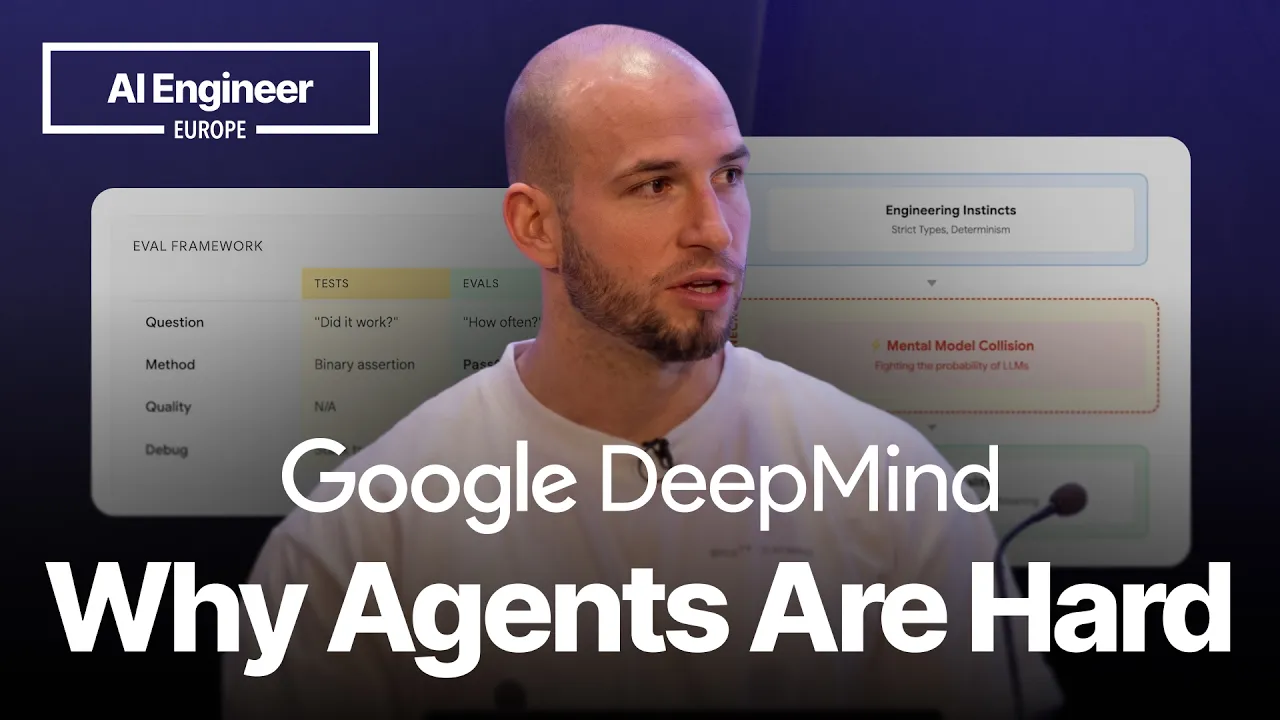
[music] >> Okay, cool. Awesome. Hi everyone. My name is Philip. I work at DeepMind everything related to agents on Gemini or Gemini API. So if you have some questions afterwards, some concerns, some bugs, some issue, please let me know. We're going to talk today 10 minutes about why engineers struggle to build agents and I see this every day internally at Google but also externally at Google and I brought five example on like what's really different to how we built traditional
84 words, the words spoken in the first 30 seconds at 168 words per minute.
Free, no signup. See how the first 30 seconds hold attention, with rewrites.
Sentence shape
| Measure | This transcript |
|---|---|
| Sentences | 103 |
| Average words per sentence | 17.4 |
| Longest sentence | 55 words |
| Questions asked | 11 |
| Sentences containing a number | 4 |
Most used terms
Filler phrases
70 in total: like 44 · right? 9 · kind of 8 · I mean 3 · um 3 · basically 2 · uh 1.
A literal whole-word count of the same phrase list the Prepublish browser extension uses, so a phrase inside another word is not counted and a phrase used in its ordinary sense still is. It is a count and not a judgement.
What this transcript is
Every word below is the caption track YouTube publishes for this video, pulled from the video itself and reproduced unchanged. It is not Prepublish's writing, not a summary, and not a re-transcription: it is the video's own published captions. English captions, generated automatically by YouTube, in the video’s original language. Source: the video on YouTube. A channel that would rather this page did not exist can ask for its removal through the contact page, and it is removed.
[music] >> Okay, cool. Awesome. Hi everyone. My name is Philip. I work at DeepMind everything related to agents on Gemini or Gemini API. So if you have some questions afterwards, some concerns, some bugs, some issue, please let me know. We're going to talk today 10 minutes about why engineers struggle to build agents and I see this every day internally at Google but also externally at Google and I brought five example on like what's really different to how we built traditional software a few years ago and to now how we build agents.
And if we like on a high level compare them, right? When we wrote software, we created a spec, a PRD, wrote code, sometimes created tests to make sure our code works. We deployed it and then our user used it. And when building agents, things are a little bit different. We define instructions on what we want our agent to do. We run it, we observe what it does, we maybe adjust our prompts, maybe we adjust our tools. We run it again and we have like this iterative loop of how can we improve and make our agent way more reliable, which is very different to how we build software.
And like something I like to compare it to is like traditional software is more like we acted as a traffic controller, right? We had control over the street lights or how fast you can go, which roads you can use, basically how the car drives. And now with agents, we are more of a dispatcher. We tell the agent, "Hey, I want to go to London and I'm from like Germany. I could use the train, I could fly, I could use my car and go like under the water." And it's more about, "Okay, we define the goal on what we want the agent to do, but we don't define the exact step the agent needs to take to achieve that goal.
And I mean every one of you has probably seen in their coding agent that sometimes it does something very weird, but at the end it achieves the outcome. And that's what we want to do. So starting with the first example, text is our new state. I mean traditionally we had data structures and everything was kind of mapped to Boolean or to like flags we could check. So initially when we created for example a deep research agent, deep research agent returns a plan to you, "Okay, I'm going to research this and that." In traditional software, we might have had an exact plan or deny plan, but we couldn't catch semantic meaning.
And now what we have with LLMs is they can understand the semantic meaning. So for example, if I have a deep research request on like doing some market research, I can approve the initial plan, but I can also on the same time provide additional information. So maybe I want to focus on like the US market and ignore California. Maybe I want to provide something additional and not have like this multiple steps, right? Traditionally it would probably said decline and then it has a follow up.
I might needed to provide more input, create a new plan and continue. And another good example is everything related to memory and personal personalization we do cannot really be mapped to data structures, right? The example I here I have is like I'm from Europe, so I mostly use Celsius, but what if I would like to use Fahrenheit for cooking, right? Previously we might had some flags on like the user profile is Celsius or is Europe or use Fahrenheit, but I couldn't like dynamically adjust based on the user preference, based on what I provide.
So really it's all about text and context. I mean could be images, video, audio as well, but we no longer are really operating in those clear structured data concepts. The other thing is we should start handing over control and the the trap or the example which we might have from like previous customer support is like when a user reached out, "Hey, I want to cancel my subscription." I might have had classification model which kind of classified the intent, "Okay, the user wants to churn." And then I had a predefined workflow of, "Okay, do you try to sell it?
Do you cancel the subscription?" But there was no like dynamic kind of option to to react to it dynamically. And maybe instead of like um or going through the subscription cancel flow, what if your agent like kind of tries to understand the meaning and like offers something uh in ex- step to like the subscription and the user changes their mind and now you have like a whole different intent. And it's very hard to model all of those differences and uniqueness and to to like all of those stateful workflows we had before.
So we need to like trust into the LLM or like hand over control that we are no longer working in those purely deterministic um environments. The third one is errors are just inputs. So if something in your agent flow fails, we need to treat it as a normal input as very similar to a user input. In Go, we already do this, right? A function call can be an error or can be a value and we treat them kind of equally. And we have to do this for agents very similarly.
In the past, HTTP requests were very cheap. When some search, some product search failed, you just rerun your request, you redid all of the work, which was okay. But now if you have like an agent which takes 5 minutes, 15 minutes and something in the flow breaks and you would start all all over, you would need to spend you need to spend a lot of compute again to like do all of the previous steps. And you also might lose the existing context.
So we cannot like just start over the whole process. We need to kind of understand and treat errors differently, provide them back to the model, maybe have some other workarounds, some additional checks that we basically keep going forward in the flow and not like starting over from the beginning. The fourth example or step is like we need to move from unit test to evals. So when building software before, right? We wrote integration tests, unit tests, smoke tests and all kind of different tests and we assume that when we provide input A for our code B, we will always get C as an output.
And that's no longer the case with agent. Agents are non-deterministic. We cannot always guarantee that the same input will lead to the same steps and the same result. So we need to move from unit tests to eval. We need to test how often something works because agents are only successful if they are really reliable, right? If you have a customer agent and the same prompt only works one out of 10 times, it's nothing really you want to put in production and it becomes very flaky.
So we need to test on evals on how many times it passes and compared to traditional software, results are very subjective, right? An outcome can be very different if you ask it to create research report, if you ask it to create a customer feedback kind of scenario. And we need more like qualifying feedback. LLM as a judge or human expert for example is a good way. And we always need to trace what the agent is doing, but we need to create on the output.
We Maybe the agent decides for like one user it needs to do like four more steps to do more research than for the other user. It consumes maybe a few more tokens, but at the end the outcome is really what we need to measure and want to measure in terms of success. And then the last part is agents evolve and APIs don't. And if you have worked on the backend and if you have built an API, you might have seen a lot of methods, API endpoints which feel very self-explaining to you like delete item feels very self-explaining if you are working on like the product API.
But an agent doesn't see the code, an agent doesn't have the context and the background from all those years from you working on the API. So we need to build APIs or tools which are really agent ready, which are self-documenting with semantic interfaces. I would assume if you have like a product microservice and you have a delete item endpoint with an ID, you don't need to like define a doc string what the ID is or what happens if something fails.
But our agents only see like the function schemas and the doc strings and the tool definition. So on the first look, they don't really see what the delete item method does. That's why we need to really adjust to, "Hey, we need methods, tools which are written for agents to be used and not assume long year developer expertise and people who have built the API. So to to summarize everything, we need to give trust, but we also verify.
We should stop fighting the model. You should not like try to force the model into this one specific workflow with step one do this, step two do the other thing. We need to preserve meaning. Everything is a context now. We no longer have those very well-defined data structures for all of our applications. We need to design for recovery. Models are not perfect. Agents are not perfect, especially if we have longer running agents.
There will be some very weird things happening. So you need to design for recovery. We need to evaluate and then don't only assert. Agents are not 100% reliable. We need to find the right balance between how many times our run need to be successful to provide it to the user. And last but not least, build to delete. Um the bitter lesson is what everyone of us is learning is like software is disposable. We are going to rebuild many, many times the same things with better models, better agents.
Things will change. And yes, it's also available on my blog. So if you want to like look a bit deeper with some code examples. And if not, if you have any questions, feel free to to reach out to me and perfect on time. Thanks. >> [music]
The words are the caption track's own and nothing is reworded or re-transcribed. Paragraph breaks are placed between sentences so the text reads as prose.
Free tools for your own script. No signup, no login.
Paste your draft and see where viewers are likely to drop off, with a rewrite for each weak line.
Paste the first 30 seconds of your own draft for a hook score and rewrites.
Check your draft against YouTube's advertiser-friendly guidelines before you record it.
Read this channel's public videos and transcripts, and download a writing brief for it.