Getting the transcript
Reading the captions from YouTube. A video nobody has opened here before takes 10 to 30 seconds; this page fills in on its own.
Getting the transcript
Reading the captions from YouTube. A video nobody has opened here before takes 10 to 30 seconds; this page fills in on its own.
Epic History · @EpichistoryTv
Where viewers went back to watch this video again, from YouTube's public Most replayed graph, lined up with what was said at that moment.
Most replayed moment #1
4:002.1x the video's typical replay level
in European waters, while simultaneously taking on the Japanese in the Pacific. It’s a nightmarish scenario. So they seize the chance of a new deal with Germany, that limits the Kriegsmarine to 35% of the size of the Royal Navy.
Said at 3:54
Most replayed moment #2
15:092.0x the video's typical replay level
In May, he travels to Geneva, to address the League of Nations.... where he passionately denounces the Italian invasion, and use of chemical weapons.
Said at 15:06
Most replayed moment #3
0:511.9x the video's typical replay level
This coal-rich German region had been under League of Nations control since the end of the war, but now votes overwhelmingly to re-join Germany.
Said at 0:50
The graph counts replays. It does not show where viewers stopped watching.
Words
2,954
Runtime
28:35
Speaking pace
103wpm
Reading time
12min
103 words per minute, below the 160 25th percentile of 349 measured videos. That distribution comes from the 349-video hook study.
Opening (first 30 seconds)
1935. Adolf Hitler now wields unchecked power in Germany. His hostility to the World War One peace settlement is well known. How far he will go to tear up the existing order.. is yet to be seen. The year begins with a public relations triumph for Nazi Germany.. in the Saarland. This
52 words, the words spoken in the first 30 seconds at 103 words per minute.
Free, no signup. See how the first 30 seconds hold attention, with rewrites.
Sentence shape
| Measure | This transcript |
|---|---|
| Sentences | 204 |
| Average words per sentence | 14.5 |
| Longest sentence | 42 words |
| Questions asked | 0 |
| Sentences containing a number | 20 |
Most used terms
Filler phrases
7 in total: like 6 · actually 1.
A literal whole-word count of the same phrase list the Prepublish browser extension uses, so a phrase inside another word is not counted and a phrase used in its ordinary sense still is. It is a count and not a judgement.
What this transcript is
Every word below is the caption track YouTube publishes for this video, pulled from the video itself and reproduced unchanged. It is not Prepublish's writing, not a summary, and not a re-transcription: it is the video's own published captions. English captions, published by the channel, in the video’s original language. Source: the video on YouTube. A channel that would rather this page did not exist can ask for its removal through the contact page, and it is removed.
1935. Adolf Hitler now wields unchecked power in Germany. His hostility to the World War One peace settlement is well known. How far he will go to tear up the existing order.. is yet to be seen. The year begins with a public relations triumph for Nazi Germany.. in the Saarland. This coal-rich German region had been under League of Nations control since the end of the war, but now votes overwhelmingly to re-join Germany.
In March, Nazi aviation chief Hermann Göring officially confirms an open secret – Germany is rebuilding its air force, in defiance of the Versailles Treaty. Two weeks later, Hitler flouts the treaty again, announcing the reintroduction of military conscription. Germany is to raise an army of 36 divisions, half a million strong. Three months later, the Kriegsmarine launches a new U-boat – yet another breach of the Versailles Treaty.
So far, Britain has sought fresh, diplomatic agreements with Germany’s new government. Its politicians hope that in exchange for some concessions, Hitler may agree to limit German re-armament, and even re-join the League of Nations. But in both Britain and France, there is now increasing alarm about the scale of Hitler’s ambition. For Europe, the dilemma is whether Hitler’s goals can be accommodated peacefully, through diplomacy...
Or if a more forceful policy, based on military deterrence and containment, is required. This issue will divide politicians in both France and Britain, between ‘appeasers’.. and hawks. Most, however, are in the middle, seeking to combine elements of deterrence, and diplomacy. But any approach depends on co-ordinated action by Germany’s neighbours. So, that April, British, French and Italian leaders meet at the Piedmont resort of Stresa.
They resolve to act together, to oppose any further German violation of the Versailles Treaty. In particular, they will act jointly to preserve Europe’s borders, and the independence of Austria – which Hitler is known to have his eye on. The ‘Stresa Front’ seems to offer the hope of concerted European action to keep Hitler in check. But just two months later, without consulting its new Stresa Front partners, Britain agrees its own naval treaty with Germany – the terms of which themselves break the Versailles Treaty.
It seems an extraordinary move by Britain – and infuriates France and Italy. But British naval planners are deeply alarmed at the possibility of having to fight the German navy in European waters, while simultaneously taking on the Japanese in the Pacific. It’s a nightmarish scenario. So they seize the chance of a new deal with Germany, that limits the Kriegsmarine to 35% of the size of the Royal Navy. France’s new Prime Minister, Pierre Laval, regards it as a British betrayal.
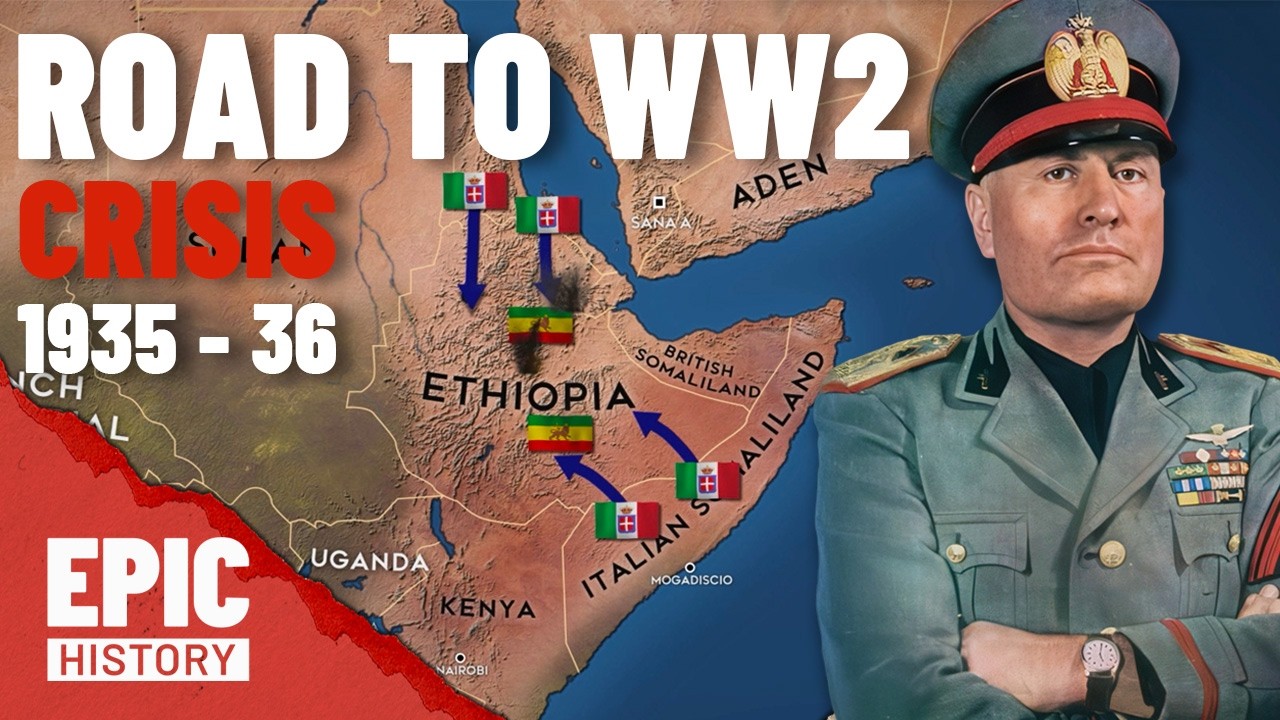
Italy’s leader, Benito Mussolini, concludes his Stresa partners are full of wind, and respect only strength. That autumn, he orders Italian forces to launch a long-planned invasion of Ethiopia. It is one of the last African states not already claimed as a European colony – and Mussolini means to have it for his new ‘Roman Empire’. For all his bluster, Mussolini is anxious that other powers will intervene. He is gambling that the League will protest loudly, but essentially, do nothing.
The League finds Italy to be in breach of Article 12 of the League Covenant – waging an illegal war. And for the first time in history, the international community imposes economic sanctions, in an attempt to end the conflict. But neither the USA, Germany nor Japan are bound by the sanctions, as they are not League members. And crucially, the sanctions do not include oil. Even some League members ignore them, in part, or entirely.
The economic impact on Italy is negligible. And the League – and the entire concept of ‘collective security’ – suffers another damaging blow. In Germany, Hitler is delighted by the collapse of the Stresa Front, and the humiliation of the League. In September that year, the Nazi-controlled Reichstag passes a ‘Reich Citizenship Law’, and a ‘Law for the Protection of German Blood and Honour’. These measures give legal force to Nazi pseudo-science about race.
The main target is Germany’s Jews, vilified as a racial menace, now stripped of their citizenship and political rights. Marriage and sexual relations between pure ‘Aryan’ Germans and Jews is also forbidden. 1935 is a year that sees Hitler’s Nazi government grow in confidence, with a series of steps that trigger alarm bells across Europe… but no concerted response. Hitler, a masterful opportunist, decides it’s time to push even further.
As Italy, Japan, and Germany take steps towards building their new empires... the biggest of all – the British Empire – faces a mounting struggle to maintain order. Britain rules Palestine as a ‘League Mandate’ – held in trust, with the supposed aim of preparing the territory for independence. In reality, it is treated much like a British colony. Here, in April, a general strike by Arabs marks the beginning of a three-year revolt against British rule.
Arabs clash with British soldiers and police, and the growing number of Jewish settlers. The violence leaves thousands dead, injured or in gaol. In Egypt, the British agree to end five decades of colonial occupation. An exception is made for the Suez Canal, considered a vital artery of the empire, which the British will continue to garrison. In India... the British face pressure from the Congress Party, led by Mahatma Gandhi and Jawaharlal Nehru, to grant full independence.
The British have no intention of doing so, and face ongoing protests and opposition – with up to 80,000 political prisoners in gaol. With so many imperial issues to deal with.. Britain wishes to avoid a conflict in Europe.. at almost any cost. But there is a growing sense in Britain that France is an unreliable partner... The feeling is entirely mutual… and France is taking steps to bolster its own security: After six years of construction, the ‘Maginot Line’ becomes operational.
This state-of-the-art chain of fortifications is between 12 and 16 miles in depth, with 142 forts, around 5,000 blockhouses, and in some sections, is served by an underground railway. In theory, France’s eastern border is now impregnable to any direct German attack. But the Line does not extend to the Ardennes frontier - a forested region thought to be unsuited to modern warfare. And the emphasis on fortifications, and a defensive mindset, has its critics.
Among them, a young staff officer, Lieutenant Colonel Charles de Gaulle, who argues the vast sums involved would be better spent on mechanisation of the French Army. Concerns about Germany’s resurgent military power are shared in Moscow... where Joseph Stalin has embarked on a second ‘Five Year Plan’, aimed at continuing the rapid expansion of the Soviet economy. Great sacrifices are demanded of the Soviet people, in the state’s bid to match the industrial and military might of its European rivals.
Rewards are offered to those who can imitate heroes like Alexei Stakhanov, credited the previous year with mining 102 tonnes of coal in six hours. Soviet production of modern weaponry, including tanks and aircraft, continues to rise – given fresh urgency by the deteriorating international order. But Stalin does not know from where to expect a blow – from the capitalist West... Nazi Germany... or imperialist Japan... and is therefore, suspicious of all.
But France is now prepared to reach out across the ideological divide, to renew the old Franco-Russian alliance. In February, in Paris, France ratifies a treaty of mutual assistance – aimed at deterring a German attack on either, by threatening Hitler with a two-front war. In truth, the treaty is toothless – no clause actually establishes military collaboration between France and the Soviets. Yet Hitler quickly claims it is a plan to encircle Germany.
He is emboldened by the weak international response to Italy’s invasion of Ethiopia. And now, citing the Franco-Soviet treaty as provocation, he orders German troops to cross the River Rhine, and remilitarise the Rhineland. Though part of Germany, the Versailles Treaty and the Locarno Pact stipulated that this region was to remain demilitarised – free of German troops and fortifications - as a security guarantee for France.
Hitler’s fresh breach of both treaties creates another international crisis. But it soon emerges that neither Britain nor France are willing to risk another war with Germany over the Rhineland. Their armed forces are unprepared. The public mood in both countries is firmly anti-war. Many regard Hitler’s move as 'no more than the Germans walking into their own backyard', as a British politician puts it. It later emerges that German generals, and Hitler himself, were deeply worried that the French army would intervene.
The German army remains weak. Their troops would have had to retreat. But Hitler has gambled, and won. And while his popularity in Germany soars… France and Britain are made to look weak and unreliable once more. Meanwhile, in Africa.. the Italian conquest of Ethiopia has been unexpectedly hard going – given the Italians’ massive advantage in military hardware, and liberal use of mustard gas. Finally in March, they win a decisive victory at Maychew.
Ethiopian military resistance collapses. And five weeks later, Italian troops occupy the capital, Addis Ababa. The King of Italy, Victor Emmanuel the Third, is proclaimed Emperor of Ethiopia. Italy’s new conquest is united with existing colonies to form ‘Italian East Africa’. Ethiopia’s former ruler, Emperor Haile Selassie, escapes into exile. In May, he travels to Geneva, to address the League of Nations.... where he passionately denounces the Italian invasion, and use of chemical weapons.
"God and history will remember your judgment," he warns. The League not only fails to condemn Italy’s actions. Within two months, it has removed all sanctions. In Japan, the government remains under threat from extreme nationalists, who wish to eliminate moderates, and force Japan onto a more aggressive, militaristic path. In the ‘February 26th Incident’, army officers from this faction launch another coup. Several leading politicians are killed, but the attempt to seize control of government fails.
The ringleaders are executed. Meanwhile, Japan’s Kwantung army seeks to extend its control of northern China. For the time being, a truce with Chiang Kai-shek’s government prohibits further southern advances, beyond the Great Wall. So instead, the Japanese push west, into Inner Mongolia. They establish another puppet government in Mengjiang... though an attempt to use proxy forces to conquer Suiyuan province is defeated by the Chinese army.
Within China, there is growing anger at Chiang Kai-shek’s failure to take on the Japanese. Now, encouraged by victory in Suiyuan, others decide to act. When Chiang travels to Xi’an to visit his local commander, General Zhang, the President finds himself placed under house arrest. Zhang then forces him to make a truce with the Communists – to end the civil war, so both factions can unite against Japan. This ‘Second United Front’, as it is known, will prove an uneasy alliance.
But it convinces Chiang Kai-shek to stand up to future Japanese demands. In Europe, the economic stress of the 1930s continues to drive political polarisation, and division. In France, a left-wing ‘Popular Front’ coalition wins the elections.. and the socialist Léon Blum becomes Prime Minister. Some right-wing opponents loathe him so much, they adopt the slogan, “Rather Hitler than Blum!” But it is in Spain, that political polarisation will explode into open violence.
Here, a left-wing ‘Popular Front’ coalition is also elected into power. Spanish nationalists despise this new government. And in July, army officers launch a coup to overthrow it. They quickly seize control of Morocco, the Canary Islands, and Seville. But, after some bloody fighting, the Republican government retains control of most major cities. With weapons distributed to civilians on both sides, the stage is set for a brutal civil war, that will rage for three years.
General Francisco Franco emerges as leader of the rebel, Nationalist forces, and declares himself Spain’s new head of state in October. Other nations publicly agree not to intervene in Spain’s civil war. But the Soviet Union is soon supplying the Republican side with weapons and advisers. Fascist Italy sends troops, blackshirt militia and aircraft to support Franco’s rebels. Hitler sends air units to assist Franco, known as the Condor Legion.
This support will be a contributory factor, as the war gradually swings in Franco’s favour. In August, the world turns its attention to the 1936 Summer Olympics, hosted that year... in Berlin. Nazi Propaganda Minister Joseph Goebbels turns the Games into a propaganda showcase for Hitler’s new ‘Reich’. Antisemitism is toned down, as foreign guests are dazzled by displays of German modernity, unity and strength. Dignitaries are lavishly entertained by Nazi leaders, such as Reichstag President, Hermann Göring.
Many visitors are impressed. Hitler appears to have transformed Germany... to have restored its self-respect, revived the economy, ended the political chaos, and dealt with the Communists. Hitler continues to profess his desire for peace. In Britain, particularly, some leading figures continue to wonder if the Nazis are not such a bad thing. They include King Edward the Eighth. And yet... that very month, Hitler gives secret orders to initiate a ‘Four Year Plan’.
In reality, Hitler foresees not peace – but an inescapable, existential war: between Nazi Germany, and what he calls ‘Judeo-Bolshevism’ – manifested in the Soviet Union. Germany must march east, crush the Soviets and seize ‘living space’. Otherwise, Hitler believes, the German people will themselves be annihilated by their racial enemies. Under Hermann Göring’s supervision, the Four Year Plan will prepare Germany for this conflict.
The initial focus will be on domestic production of resources essential for war – such as coal, iron ore, chemicals, textiles, and aluminium. This will free Germany from the threat of blockade, and provide the industrial base for large-scale rearmament. All other considerations are now subordinate to this goal. That autumn, there is a diplomatic coup for Hitler. Just a year before, Italy had been aligned with Britain and France in ‘the Stresa Front’, intended to contain Germany.
But Mussolini’s invasion of Ethiopia split the Front for good. On 1st November, Mussolini announces a new alliance.. with Germany. He calls it the ‘Rome-Berlin axis’. The two nations will co-operate to combat Communism, to aid Franco’s Nationalists in Spain, and support each other’s colonial ambitions. In December 1936, King Edward the Eighth announces his abdication. It follows months of rumour and scandal over his intention to marry an American divorcée.
Many of his former subjects breathe a sigh of relief - particularly those who knew of his enthusiasm for Adolf Hitler. In the 1930s, opinion polls are still in their infancy. But a survey of US public opinion that year finds 95% of Americans oppose involvement in any future overseas war. New neutrality laws ban the sale of US weapons to any warring nation. The spirit of isolation is largely a reaction to World War One – a conflict of immense horror, of which the chief beneficiaries seem to have been the empires of Britain and France.
In hindsight, many Americans believe they should never have got involved. It means that – much like Britain and France - this great power will also be a mere spectator... as abroad, new threats gather confidence, and power. The 1930s saw the rise of powerful modern dictators in Italy, Germany, the Soviet Union, and nationalist China. They harnessed mass media for propaganda and indoctrination, empowered secret police forces, and disappeared their political enemies.
And ever since, there have been those who seek to emulate their misdeeds with varying levels of competence and success. If you want to find out about some really bizarre and brutal despots, RealLifeLore's new series Mad Kings is not to be missed. Mad Kings explores the most insane and dangerous dictators, kings, and presidents for life of the modern era. Using stylish animations and astonishing archive, it chronicles the horrifying antics of Saddam's eldest son, Uday Hussein, the violent eccentricity of Idi Amin, self-titled last king of Scotland, and the iron rule of Romanian dictator Nicolae Ceaușescu.
Between them, they tortured international soccer players, fed opponents to crocodiles, and oppressed millions. Mad Kings charts their lives and recounts every bizarre incident. And to watch Mad Kings right now, prestige streaming service Nebula is the only place to be. Nebula is the video platform built and curated by creators like us. Featuring original, funny, fascinating, and insightful content, all made by talented humans.
It's packed with videos on history, engineering, tech, and current affairs, including a growing number of Nebula Originals, which you can't see anywhere else. Check out Nebula with a free trial that gives you complete access for 3 days. And if you think that's enough time to watch everything that's good here, we dare you to try. And if you do decide to sign up, don't miss out on Nebula's half price holiday offer. A yearly subscription to Nebula normally costs $60.
Our link gets you 50% off. That's just $30 for year-round entertainment, plus first access to all our new videos. Thanks to all our existing Nebula subscribers... and for everyone else watching, we hope to see you there soon. Thank you to our series consultant, World War Two historian Professor Richard Overy, of the Universty of Exeter. And thanks as always to the Patreon supporters who help to make this channel possible – from builders, such as Walker H., ASAP Meech and Jesse Chan… To citizens like Chris Rose, Nik Raymer and Tyler Hammond… And heroes, like Kirk Spinelli.
And now you can also support the channel by joining the ranks of ‘the Grognards’ – our valued Youtube members who gain access to loyalty badges, custom emojis, and merch discounts. Click the membership link on our channel page to sign up now!
The words are the caption track's own and nothing is reworded or re-transcribed. Paragraph breaks are placed between sentences so the text reads as prose.
Free tools for your own script. No signup, no login.
Paste your draft and see where viewers are likely to drop off, with a rewrite for each weak line.
Paste the first 30 seconds of your own draft for a hook score and rewrites.
Check your draft against YouTube's advertiser-friendly guidelines before you record it.
Read this channel's public videos and transcripts, and download a writing brief for it.