Getting the transcript
Reading the captions from YouTube. A video nobody has opened here before takes 10 to 30 seconds; this page fills in on its own.
Getting the transcript
Reading the captions from YouTube. A video nobody has opened here before takes 10 to 30 seconds; this page fills in on its own.
Cue Banks · @CueBanks
Words
1,438
Runtime
5:57
Speaking pace
242wpm
Reading time
6min
242 words per minute, above the 201 75th percentile of 349 measured videos. That distribution comes from the 349-video hook study.
Opening (first 30 seconds)
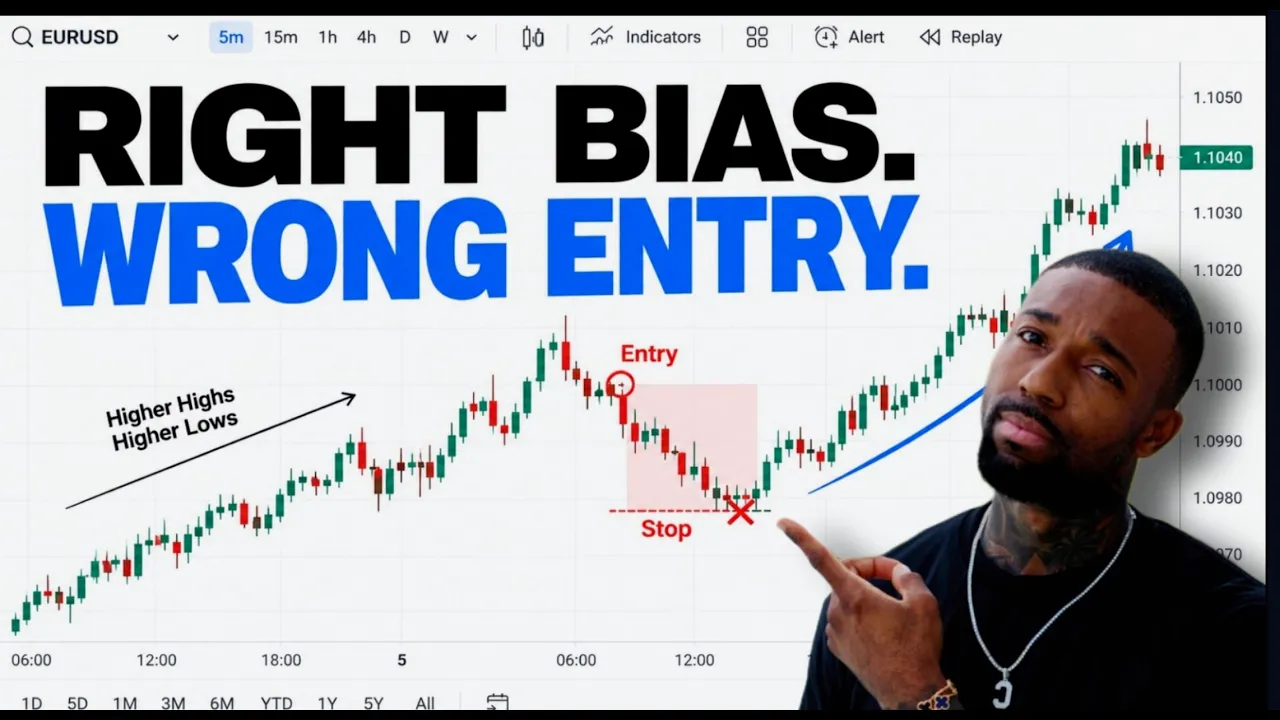
Where I struggled the most was with my entries and the timing is when I realized that nine out of 10 times I was correct but my entry was either late or way too early during the fluctuation period and then I got stopped out. So, this is the question I get more of more than anything else and I'll be honest with you, it's not really about an entry problem. Look at his own message. Nine out of 10, this isn't somebody who doesn't get the market. This is somebody that's getting stopped out while he's holding the right idea, which is totally different when it comes to that kind of situation. So, the direction is right and he's still
121 words, the words spoken in the first 30 seconds at 242 words per minute.
Free, no signup. See how the first 30 seconds hold attention, with rewrites.
Sentence shape
| Measure | This transcript |
|---|---|
| Sentences | 86 |
| Average words per sentence | 16.7 |
| Longest sentence | 53 words |
| Questions asked | 12 |
| Sentences containing a number | 17 |
Most used terms
Filler phrases
38 in total: actually 11 · right? 11 · like 10 · kind of 4 · I mean 1 · you know 1.
A literal whole-word count of the same phrase list the Prepublish browser extension uses, so a phrase inside another word is not counted and a phrase used in its ordinary sense still is. It is a count and not a judgement.
What this transcript is
Every word below is the caption track YouTube publishes for this video, pulled from the video itself and reproduced unchanged. It is not Prepublish's writing, not a summary, and not a re-transcription: it is the video's own published captions. English captions, generated automatically by YouTube, in the video’s original language. Source: the video on YouTube. A channel that would rather this page did not exist can ask for its removal through the contact page, and it is removed.
No Script X-ray for this video: YouTube shows a Most replayed graph only once a video has enough views.
Where I struggled the most was with my entries and the timing is when I realized that nine out of 10 times I was correct but my entry was either late or way too early during the fluctuation period and then I got stopped out. So, this is the question I get more of more than anything else and I'll be honest with you, it's not really about an entry problem. Look at his own message. Nine out of 10, this isn't somebody who doesn't get the market.
This is somebody that's getting stopped out while he's holding the right idea, which is totally different when it comes to that kind of situation. So, the direction is right and he's still losing. This tells you that the direction we never really had to fix. The bias comes [snorts] off with the time frames. Your entry happens on a completely different one and most people just never really add up the two. They pick a direction, then they sit kind of hoping that it shows up and eventually [music] matches.
So, let me show you what I mean. Now, look at this. One candle, H4, red. That's it. Same hour and a half, same price, same move. Down here on the M5 time frame is a whole another trend. You've got structure, lower highs, lower lows, the whole thing. Up to the H4, it's one red candle and you probably scrolled right past it. The lower time frames, that's where the detail happens. The higher time frames is less detail. You've got to hold both at the same time while you pretty much stitch all of them together to get the whole picture.
The candle that you glance up at the top is a full session down below. So, if you're only looking at one of them at one time, it's like you're missing a whole part of the story. So, missing a whole layer is what's actually going on. That's the problem. All right, now here's the order how to go all in. Top-down analysis every time. Daily and H4 is first just for direction. Are we above the market or are we below the market?
That's a filter, not a signal. It tells you which side that you're trying to actually get on when it comes to what to aim for. Then previous high and previous low, that's structure and structure always comes first before anything else, before any kind of technical. So, whatever's forming higher highs and higher lows, lower lows and lower highs, you've got to pretty much identify that first and then go to the next step.
Then you have fibs. One end to point B. This is when you actually are measuring the counter trend based off of the main trend. So, this level, the 23.6% a ton of people don't really understand this particular level right here. This level I consider as a continuation level based off of a strong momentum candle. So, this is not a price reversal zone, but it is a price [music] area that you see a lot of consolidation and a lot of continuation based off of the current trend.
So, during this 23.6% a lot of time you get a lot of chop, a lot of the sideways movements for hours and hours and hours. Things like this can cause a lot of people to jump in a little bit early. So, that's why I prefer to 38.2%, which like my most golden like PRZ level per se, right? Because this is when you're you're first identifying your lower high point or your higher low point based off the current trend that you're in.
So, I don't really consider any other PRZ level a point of structure if it's less than 38.2%. So, entries I always try to actually aim for at least 38.2% or even lower than than this because this is when you're able to actually get a great R to R that can help benefit the kind of trade that you're currently in. So, you're not rushing the entire process by trying to get in on a 23.6%. So, times like this I could also draw a counter trend line, right?
A counter trend line pretty much makes you see how long a minor trend is forming within a certain range. A lot of times you can spot this around a 38.2%, which can also give you your point B when it comes to plotting this counter trend line, right? Very, very different from a normal trend line, but a counter trend line it really, really matters based off of you trying to get in on a continuation of a current trend, which definitely [music] is a major key when it comes to trying to maintain a trade.
So, now waiting for this line to break is a major thing. So, this is when you can actually look for opportunities beyond this area cuz that's when you know guaranteed that the market is building up enough momentum to get back into the right trend and that's when you're able to actually find another opportunity for an entry to then flow along with this. >> [music] >> So, that's when you're continuing to get to the the next area in structure within this entire phase.
So, normally I would look for a specific candle for the main fact that you don't get in on just any candle. It doesn't make sense. You got to pretty much get in on a candle that provides enough bullish or bearish momentum to keep on going. Things like this normally forms right when you are spotting a level of support or level of resistance and then from that point you could take on this area knowing that you have a strong base to actually go to the next point of structure with.
Entries go with the close of candles, not while they're forming, right? So if you have a 5-minute candle, don't enter when the that 5-minute candle has 2 minutes left. Wait until the actual 5-minute candle is fully closed and don't try to rush that entire process. So quick word on the stop because this is when it happens a lot of times and people tend to trip up, right? Don't try to rush this process because you want to pretty much put your stops at a place that makes the most amount of sense.
So stops I like to place when you are either plotting either above the previous swing high or the previous swing low. Things like this can eliminate the fact that you might get a a retest of a previous low or previous high and then get stopped out. So things like this, you are being a bit more patient but also a bit more particular with getting in, how things are being placed versus just putting it anywhere based off of the amount of money that you [music] want to to lose, right?
Has to be based off of just pure structure that actually makes the most amount of sense and don't do this based off of your budget, right? It has to make sense based off of where the charts actually are showing you at at that point in time. So I go deep with this on another video because it changes how much you size and how much you carry. So for now, just take this with you. The swing high is in your stop, right? It really depends on how that's being placed and where it currently is because it it really all varies, right?
But this isn't just a level where you just can place a stop because it could easily be wrong if you're not doing it correctly. So let's go back to this message. His bias was never the problem, right? Nine out of 10 times he had [music] it right. Just certain things were a bit too early or a bit too late. He was entering off of a time frame that he never actually looked at. More detail, less detail, you put them together.
Leave the 23.6% alone. Two points of the counter trend line, like it's not always three, right? Wait for the candle to form break to get these extra confirmations. So markup framework is linked below this exact order [music] written out completely. Takes about an hour to run it properly on one pair. So, if you're going to do it, do it right. Structure first, everything else is way after. So, I'll catch you guys on the next one.
The words are the caption track's own and nothing is reworded or re-transcribed. Paragraph breaks are placed between sentences so the text reads as prose.
Free tools for your own script. No signup, no login.
Paste your draft and see where viewers are likely to drop off, with a rewrite for each weak line.
Paste the first 30 seconds of your own draft for a hook score and rewrites.
Check your draft against YouTube's advertiser-friendly guidelines before you record it.
Read this channel's public videos and transcripts, and download a writing brief for it.