Getting the transcript
Reading the captions from YouTube. A video nobody has opened here before takes 10 to 30 seconds; this page fills in on its own.
Getting the transcript
Reading the captions from YouTube. A video nobody has opened here before takes 10 to 30 seconds; this page fills in on its own.
BBC Global · @BBC_Global
Words
3,353
Runtime
23:16
Speaking pace
144wpm
Reading time
14min
144 words per minute, below the 160 25th percentile of 349 measured videos. That distribution comes from the 349-video hook study.
Opening (first 30 seconds)
I'm Paul Carter, BBC journalist and travel obsessive. I've always been fascinated by trains and the places they can take me. In fact, some of my earliest and fondest memories are of family holidays traveling Britain by train with my mom and dad. I've been fortunate enough to travel on Japanese trains many times. And it's always a special delight to travel on the Shinkansen. Better known around the world as the
72 words, the words spoken in the first 30 seconds at 144 words per minute.
Free, no signup. See how the first 30 seconds hold attention, with rewrites.
Sentence shape
| Measure | This transcript |
|---|---|
| Sentences | 357 |
| Average words per sentence | 9.4 |
| Longest sentence | 56 words |
| Questions asked | 37 |
| Sentences containing a number | 21 |
Most used terms
Filler phrases
40 in total: actually 11 · uh 9 · like 8 · kind of 4 · I mean 3 · um 3 · right? 1 · you know 1.
A literal whole-word count of the same phrase list the Prepublish browser extension uses, so a phrase inside another word is not counted and a phrase used in its ordinary sense still is. It is a count and not a judgement.
Run the check on the words above: where attention is likely to drop, with a rewrite for each weak line. The free check shows the scores and the one issue costing the most.
What this transcript is
Every word below is the caption track YouTube publishes for this video, pulled from the video itself and reproduced unchanged. It is not Prepublish's writing, not a summary, and not a re-transcription: it is the video's own published captions. English captions, generated automatically by YouTube, in the video’s original language. Source: the video on YouTube. A channel that would rather this page did not exist can ask for its removal through the contact page, and it is removed.
No Script X-ray for this video: YouTube shows a Most replayed graph only once a video has enough views.
I'm Paul Carter, BBC journalist and travel obsessive. I've always been fascinated by trains and the places they can take me. In fact, some of my earliest and fondest memories are of family holidays traveling Britain by train with my mom and dad. I've been fortunate enough to travel on Japanese trains many times. And it's always a special delight to travel on the Shinkansen. Better known around the world as the bullet train. 60 years ago, the Shinkansen opened up the country allowing high-speed travel between Japan's capital, Tokyo, and the port city, Osaka, on what became known as the golden route.
Now, a new extension has completed a grand looping circuit from Tokyo to Osaka that heads north inland and along the west coast. Dubbed the new golden route, making it even easier for me to go off the rails and explore some hidden gems. A hot springs mountain town. Absolutely stunning. A city steeped in gold. Look at this. And a resilient community of artisans. >> This is my job. >> I'll be taking the slow route over days rather than minutes, traveling from Tokyo to Osaka along Japan's stunning west coast.
All the while learning more about this spectacular country and making some new friends along the way. Come with me on the world's greatest train journeys. I'm starting my Japanese journey with a stay at the Tokyo Station Hotel. Built in 1913 at around the same time as the station itself. It evokes the spirit of the time, the golden age of rail travel. If I'm being honest, it doesn't feel very Japanese, but it's labyrinthine corridors hold unexpected delights.
So, this is my hotel room. It's beautiful, but it's also got a special surprise. Come and have a look at this. It looks out directly onto Tokyo Station concourse. I can see the ticket gates and people coming and going, and it's really making me itching to want to get start my journey. For maximum efficiency, the hotel connects directly with the station. Wow, what a contrast from the quiet of the hotel to the concourse of Tokyo Station.
What a sight. Tokyo Station is the busiest station in Japan with a staggering 4,000 trains arriving and departing daily. It's a national institution and the main hub of the iconic Shinkansen, the original bullet train. It's amazing to me that these revolutionary machines have been around for so many years. And to get the inside track on them, I'm meeting ex-driver, now Japan Rail Central Manager, Naoyuki Wano. You obviously this is a very busy station.
How frequently do these trains go? >> Yeah, every 3 minutes. >> Wow. >> Shinkansen operated. And also, uh since the birth of the Shinkansen, we have had a 6.8 billion passengers. >> 6.8 billion. >> Yeah, that's right. >> Wow. I mean, they are incredible, aren't they? They're wonderful to look at, but also they're fabulous bits of engineering as well. >> Because of aerodynamics, streamline you know, shape is very important to make sure that it is quiet and less vibration.
It is very reliable. average delay is about 1 minute. >> 1 minute average? >> Yeah, that's right. Including natural disaster. >> That's phenomenal. >> I'm proud of the Shinkansen. As a Japanese citizen, I'm proud of that. >> Yeah. And there There it goes. >> Yeah, that's right. >> Bye. I just love the unashamed pride in and enthusiasm for the Shinkansen here. It's a bit of a national obsession. The bin shaped like a Shinkansen.
It's a bin-kansen. And it's infectious. >> Yellow train. >> Now, we haven't staged this. This is actually just pulled into the station, and these are actually very rare, these yellow Shinkansens. It's quite a privilege to see them. People actually usually try and work out where they're going to be so they can take pictures of them. So, to have one come in and just while we've been standing here is pretty amazing. It's such an indication of how popular these trains are that people have come to take photos of it.
To find out more about why these trains are so beloved, I'm meeting Shizuka Anderson, a Tokyo-based travel blogger who's joining me for the first part of my journey. >> Oh my goodness. That is actually very rare to catch. >> But before we can get on board, the train is prepared by a highly drilled crack team known as dressers. Wow, they're so fast. >> Aren't they? They're so fast. They're so efficient. >> Bang on time.
Not that I should be surprised by now. >> Thank you. Okay. It feels like an airplane, doesn't it? All right, so we're 6A and B. All right. >> window. >> Thank you very much. Did you want to recline a little bit? >> Oh, yeah. >> Isn't this nice? Just in the lap of luxury today. >> I could definitely get used to this. >> Oh my goodness. >> Oh, we're off. Right on time. >> Oh, amazing. >> My journey starts by heading north from Tokyo towards the coastal region of Toyama.
I've traveled on high-speed Shinkansens many times from Tokyo to Osaka direct, which only takes 2 and 1/2 hours. But this time, I'm using my week-long rail pass to take a less-traveled, slower route across to the scenic north of the country. We've left the big city, and I'm already feeling more relaxed. >> So obviously we're keeping our voices down a little bit. >> There is a certain etiquette on Japanese trains, isn't there? >> I think the main thing is just being mindful of how your behavior might be affecting people around you.
So talking quietly on the trains. Um it actually says, "Please be considerate of other passengers while using your computer." In parentheses, "Keyboard noise." >> Keyboard noise. So you can't type too loudly. >> Yeah, that's kind of what Japanese culture is all about. Just really being mindful. >> Do you use these trains often? Has it enabled you to explore Japan any more? >> Definitely. I checked this recently, but I visited maybe about 34 prefectures in Japan out of 47. >> Oh, wow.
Okay. >> Which is decent. I'm getting there. Um it's a bit of a kind of goal for a lot of people to hit all 47. It's difficult, but thanks to the Shinkansen, it's a remarkably smooth experience. And so I think it was a a real kind of life-changing invention in the sense that it's shortened the amount of time to get across the entire country. >> Wonderful. It's been an absolute pleasure. Enjoy the rest of your journey. >> Likewise.
Happy travels. >> Thank you. Shizuka's staying on to check a few more prefectures off her list. But I'm leaving the high-speed route to catch a local train to here, Unazuki Onsen. It's a place I've wanted to visit for ages. A small town famous for both its trains, its iconic red carriages celebrated on top of town signposts, and its naturally occurring hot springs known as onsen. My guide for the day, Hashimoto Yuki, has said he'll meet me on the platform. >> Ah, there's Yuki.
Yuki, hi. Konnichiwa. >> Konnichiwa. Welcome to Unazuki Onsen. >> Thank you. What is this? >> Ah, this is a foot bath, so hot spring here. >> I wasn't expecting to see this before I'd even left the station. >> Ah, Japan is where lots of the active volcanoes. So, there's um many of the hot springs all over Japan. It's very relaxing and they're kind of healing. >> Keen to show me how relaxing the full immersive experience can be, Yuki is taking me to one of his favorite spots.
The Yamanoha Hotel has one of the best places to soak and watch the world go by. >> I mean, it's an incredible view, isn't it? You don't get much of a better backdrop than this. So, Yuki, we're here in this beautiful space. What do people do in a Japanese onsen? >> In Japan, we have the public bath culture. So, we are getting into the public baths and naked. Normally, you're naked in an onsen. We're we're not naked today.
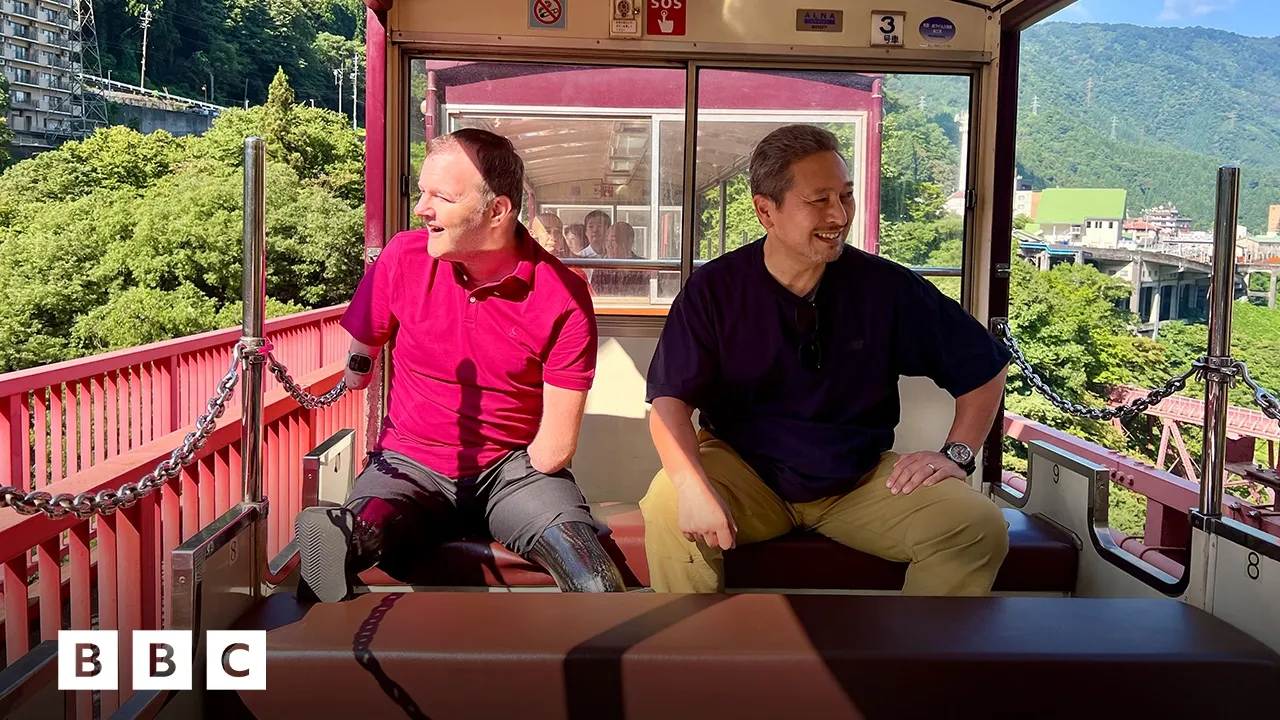
We've got our swimwear on. But, why would you normally be naked in an onsen? We combine with the nature. So, we we feel the nature with naked. So, we should be as it is. >> Yeah. So, it's a bit like meeting nature on its own terms. You're you're naked as nature intended. Yeah. What a beautiful place to do it. Ah, and there goes the train. The only thing that could make this view better is a view of a train. And there's one coming over the bridge. >> Yeah. >> These narrow gauge electric trains take sightseers high up into the spectacular Kurobe Gorge.
And as relaxing as it is splashing about in the onsen with Yuki, there's really only one place I want to be now. The line was originally built to aid construction of the mighty Kurobe Dam. >> So the the dam in the upstream was built in 1950s and this gorge train is used to bring the equipment and the machinery and the workers to the dam. >> This wasn't originally just built for tourists. >> No. >> It's hard to imagine that there was construction materials >> Yeah. >> going up and down this route.
Absolutely stunning. >> Yeah, right in the nature now. >> Very much so. Why do you think that connection to nature is so important to Japanese people? >> Yeah, nature is very important for Japanese people. So we are the mountainous island, so a lot of volcanoes. So we have the many of the disasters. So we have fear to the nature and also respect to the nature. >> So it's really important for you to have that connection. >> Yes. >> Yuki, this has genuinely been one of the most incredible experiences of my life.
Thank you so much for sharing. It's been an absolute blast. It's been a dream start to my great train journey across Japan with the Shinkansen whisking me away from the hustle and bustle of Tokyo to this spectacular onsen town. I want to continue my journey along the coast to discover more about what the regional heartlands have to offer. My next stop is in the samurai heartland of Kanazawa where tradition runs like a seam through the city.
I've been persuaded to swap the high-speed for the old school by my local guide, Nozomi Kondo. >> How is the ride? >> The traditional way to get around Japan. >> Absolutely. This is how they traveled in the olden days. >> I love the buildings here. They're so beautiful. >> Aren't they lovely? Along with Kyoto, Kanazawa was not bombed during the war, and therefore we have these old buildings still. >> It's amazing. Nozomi wants to show me one of the things that makes this place so alluring.
Wow, Nozomi, there's so many different >> Isn't that the only >> products in here? Some of this is really beautiful. >> Isn't that? The restroom is covered with gold. >> Wow. Well, that is the the blingest bathroom I've ever seen. There is gold everywhere. Gold leaf is made here by pounding tiny amounts of the metal into incredibly thin sheets before being carefully cut and applied to a huge range of objects. Nozomi, I've never seen so much gold in my life.
What is Kanazawa's relationship with gold? >> Kanazawa produces 100% of all the gold leaf produced in Japan. >> Wow, 100%? How long has Kanazawa been associated with gold leaf? >> Originally, it is a technique from Kyoto, originally. But then they brought it here, but I think they did it rather secretly. Gold is very expensive, so the shogun in Tokyo wanted to make sure that he had control over all this, and therefore restricted.
But in 1808, we had a big fire at the Kanazawa castle. So, they needed gold leaf to restore, and they asked permission to the Edo shogun if it was all right to use some gold leaf. And after that, actually they kept making it without probably without the permission of the shogun. But the one in Edo just declined, but the one in Kanazawa rose to power. So, the leaf from Kanazawa went around the world. >> Gold leaf is so big here, it's found its way onto most of the major food groups.
Nozomi is taking me to try one of Kanazawa's most popular treats. >> Ah, Nozomi, look at this. >> That is the gold leaf ice cream. >> that looks ridiculously decadent. I almost feel too guilty to eat it. But, shall we? >> Shall we? >> Let's go. >> Mhm. >> How is that? The ice cream itself is pretty good, right? >> It's very good, yeah. >> Mhm. >> It's the first time in my life I've ever eaten gold. >> Oh, really? >> So, does it add anything to the flavor, or is it just because it's nice to look at? >> Oh, it does not add any flavor.
It It does not not have any taste, but doesn't it look good? >> It does look very pretty, yeah. >> Shinkansen started coming here to all the way from Tokyo to to Kanazawa, and they were going to make just 1,000 to commemorate the occasion, but since this has become so popular, they're continuing it. >> So, it's thanks to the Shinkansen that we have the gold leaf ice cream. >> Yes, indeed. Otherwise, we wouldn't >> That's amazing. >> Right. >> I love that even here, a place so steeped in the past, the ultra-modern Shinkansen is celebrated with every mouthful.
It's nearly time for me to leave Kanazawa. But before I go, I've been told to try the breakfast at Yamano, a traditional Japanese inn, or ryokan. One of Kanazawa's oldest ryokans, it's a small family business, and it's pretty special. >> Oh, wow, look at this. Traditional Japanese breakfasts are a delicately balanced affair with multiple dishes. Oh, arigato gozaimasu. Smells amazing. And they keep coming. I mean for breakfast, this is certainly going to set me up for the day.
Got all the food groups covered. Time to tuck in. But my fork though, chopsticks aren't my thing. Mhm. Oh, yeah, that's delicious. That's really good. Going to go back in for some more. Well, that was quite a lot of food, but you actually get a second treat after you finish because you then get to enjoy the beautiful designs on the bottom of these bowls. They're very intricate and elegant. On the lacquerware itself on the bottom.
This one's got some birds on it. >> Next, I'll be visiting the city where lacquerware like this is made. Traveling north to Wajima at the top of the Noto Peninsula. But a final surprise awaits as I make my way. >> It's a Pokémon train. Look at the Pikachu on the front of the train. Oh my god. Well, that is a very unexpected sight. I didn't realize it was going to be a Pokémon train. Why not? It's Japan. >> Actually, this train was put on specifically to bring moments of joy to an area recently plunged into despair by one of the tough realities of life on these volcanic islands.
Wajima was the epicenter of a huge earthquake and resulting tsunami that devastated the city and its local industries. Particularly its famous export, traditional Wajima-nuri lacquerware. It's a highly skilled craft that involves the building up of multiple layers of lacquer to create a high-gloss effect, which is then painstakingly decorated. >> Hi. >> Hi, Maiko. >> I'm meeting Maiko, a member of the lacquerware community who's offered to show me around. >> So, here, as you see, we had a terrible earthquake on January 1st, and there are several markets in this area, and then after the quake, very big fire occurred, so almost every buildings are burned out. >> We can see that there is already some rebuilding happening.
Is there a spirit and a sense that Wajima will rebuild and come back to what it was before? >> This area, Wajima, our average population is very higher, so the leading by the younger generation is very important from the every industries, and especially Wajima Nuri lacquerware is very famous brand all over the Japan, so rebuilding our business in lacquerware industry is one of the key to rebuild this area from the earthquake. >> To explain how this fine traditional craft can help the city recover, Maiko is taking me to meet Taya, a 10th generation lacquerware producer. >> How should we address Taya? >> With their studios destroyed, we're meeting in one of the artisans' quake-damaged home.
And going back to the time of the earthquake itself, how did it feel to be here in the city at that time? >> When I see the city of Wajima, uh I actually, I gave up to rebuild our company, >> Mhm. >> but very big number of Wajima people working to make Wajima Nuri. So, if uh earthquake uh broke our industry, many people lose their job. Yeah, so I should rebuild uh this industry for the craftsmen, of course for the customers.
And I have a son. He is 2 years and 8 months. I would like to give this job to my uh son. >> So, you want to be able to have something that you can pass on to him. >> Yeah, this is my motivating. >> One of Taya's artisans, Yatsuka, is hard at work in his temporary studio. >> It's very beautiful. It's very intricate. >> He's holding his breath because this is very sensitive process. So, actually he's want to chatting with you, but uh he cannot. >> Okay.
How is it made? >> Wajima Nuri need takes long time to finish one vessel. We need to repeat painting and the polishing. So, it takes about 3 months to finish the painting process. After finishing painting process, we pass to the artisan like him, and then he's going to be decorate like this beautiful patterns. >> Oh, look at that. That's very beautiful. Oh, wow. That is so pretty. Yatsuka has offered to let me loose in his studio. >> this kind >> Okay, so you want me to draw that? >> Yeah. >> Hold. >> Okay, man.
Okay, Fujiyama. >> Uh uh >> I stop. >> Oh, okay. It's quite a dramatic mountain, I think, I've made. >> So, this is gold. >> This is gold? >> Gold. >> Oh, right. Now we're bringing out the good stuff. >> Oh, okay. Okay. Okay. Okay. >> Is that okay? >> Okay. >> I think it's beautiful in its own way. >> Mhm. Totally Oh, wow. Actually, it looks amazing now he's cleaned it up. Oh, that is beautiful. So, technically, this is a piece of Wajima lacquerware.
I don't think it's quite up to the standards that the artisans can make, but I'm pretty proud of it nonetheless. Love it. Looking back on my journey so far, I've learned that trains can be so much more than just a means of getting from A to B. They can bring people together, opening up the big cities and the remote regions, instilling a sense of national pride, and bringing hope for the future. And it's been a real joy taking the time to find some unforgettable hidden gems along the way.
I've learned that combining fast trains and slow travel really is the best way to get around. Join me for part two of my journey as I visit stunning historic villages, discover Niigata's sake scene, >> Kampai. >> and embrace the ancient and spiritual. This is genuinely breathtaking. >> Yeah. >> For more on my Japanese train journey, go to bbc.com/travel. >> Mhm.
The words are the caption track's own and nothing is reworded or re-transcribed. Paragraph breaks are placed between sentences so the text reads as prose.
Free tools for your own script: paste a draft and see where it stands before you record it.
Paste your draft and see where viewers are likely to drop off, with a rewrite for each weak line.
Paste the first 30 seconds of your own draft for a hook score and rewrites.
Check your draft against YouTube's advertiser-friendly guidelines before you record it.
Read this channel's public videos and transcripts, and download a writing brief for it.