Getting the transcript
Reading the captions from YouTube. A video nobody has opened here before takes 10 to 30 seconds; this page fills in on its own.
Getting the transcript
Reading the captions from YouTube. A video nobody has opened here before takes 10 to 30 seconds; this page fills in on its own.
AI Engineer · @aiDotEngineer
Words
7,390
Runtime
51:35
Speaking pace
143wpm
Reading time
31min
143 words per minute, below the 160 25th percentile of 349 measured videos. That distribution comes from the 349-video hook study.
Opening (first 30 seconds)
[music] Okay. Hi everyone. [applause] Um, and thanks a lot for making it down to the second floor and finding my session here. Okay. So I'm Chris Manning and what I want to do today is present something about Moonlakes's approach to producing a simulation infrastructure for practical physical AI. The overall goal here is that a north star for AI and actually cognitive science as well has always been to understand
72 words, the words spoken in the first 30 seconds at 143 words per minute.
Free, no signup. See how the first 30 seconds hold attention, with rewrites.
Sentence shape
| Measure | This transcript |
|---|---|
| Sentences | 334 |
| Average words per sentence | 22.1 |
| Longest sentence | 167 words |
| Questions asked | 28 |
| Sentences containing a number | 42 |
Most used terms
Filler phrases
457 in total: um 237 · like 43 · you know 39 · kind of 33 · actually 32 · sort of 30 · I mean 18 · uh 16 · right? 9.
A literal whole-word count of the same phrase list the Prepublish browser extension uses, so a phrase inside another word is not counted and a phrase used in its ordinary sense still is. It is a count and not a judgement.
What this transcript is
Every word below is the caption track YouTube publishes for this video, pulled from the video itself and reproduced unchanged. It is not Prepublish's writing, not a summary, and not a re-transcription: it is the video's own published captions. English captions, generated automatically by YouTube, in the video’s original language. Source: the video on YouTube. A channel that would rather this page did not exist can ask for its removal through the contact page, and it is removed.
No Script X-ray for this video: YouTube shows a Most replayed graph only once a video has enough views.
[music] Okay. Hi everyone. [applause] Um, and thanks a lot for making it down to the second floor and finding my session here. Okay. So I'm Chris Manning and what I want to do today is present something about Moonlakes's approach to producing a simulation infrastructure for practical physical AI. The overall goal here is that a north star for AI and actually cognitive science as well has always been to understand and work out how to build embodied intelligence.
So today I'm going to tell us about some of the recent work that we've been doing at approaching a practical form of embodied artificial general intelligence. But you know I'm not actually going to start there because uh you know um Swick said no you shouldn't just do that. Um, you should have a double slot. And first of all, since I've got you here today, I should have people tell you about the history. You should tell people about the history of AI and your journey through it and how you ended up here.
Um, so, uh, sit back, um, get ready for story time and we're going to have the really slow build and we're going to hear about all about the history of AI for 20 minutes and then we're going to hear the details about what Moon Lake is doing. Um, he looks very persuasive there, doesn't he? Whereas at the time we were having this conversation, I was having a very bad hair day. So I had very little um choice um to agree to this task.
Um so here I am with some long-term remarks on how did I and all of us get to this moment from the far ago days um when AI didn't work. Um so the very beginning of AI was the Dartmouth summer research project in 1956. It was for the holding of this um kind of summer group project was when um John McCarthy coined the term AI and got together um this group of people. Um so that one on the back right there, that's John McCarthy, there's Minsky and both most of them look like a real bunch of geeks as you can see.
Um but the attractive one on right on the right end is you know my personal hero as more of a language guy um Claude Shannon. So this is sort of the start of AI 1956. It's where the the term AI came from. But really there's other stuff that came earlier than 1956. So really starting in the 40s and early in the 50s there was work on cybernetics. So cybernetics sought to tie together communications control and feedback in living things and computers.
Um so uh you know kubernetes is really the same word as cybernetics just less anglicized um but has very different meaning. Um yeah so this led to the earliest work on neural networks and the perceptron network. So here's Frank Rosenlat's perceptron um that was you know predated the term artificial intelligence and as you can see like in those days you actually used to wire neural networks now this modern matrix multiplication but another thing that actually started before the term artificial intelligence and has been my long-term area of interest is doing things in natural language processing and natural language processing began as machine translation.
And so here we are again in 1954, two years before the term artificial intelligence was coined. And here's the front page of the New York Times. Now, there's a way in which the front page of the New York Times in 1954 is surprisingly reminiscent of the issues that you see in the front page of the New York Times um in 2026 because it's exactly the same issue. President proposing ending citizenship for people. Um not much has changed in the um intervening 75 years.
Um allegations of various kinds of behavior akin to treason. All sounds very familiar. Um, but this was the top half of the page. And if you went down to the bottom half of the page, um, you found this article. Russian is turned into English by a fast electronic, um, translator. A public demonstration of what's believed to be the first successful use of a machine to translate meaningful text from one language to another took place here yesterday afternoon.
Um, and here's a little bit of video of showing that system. into one of the first nonmerica were made that the computer would replace most human translators. >> Okay. Um, and we'll come back to that again in a little bit. Um, but coming off of the founding of AI, um, by John McCarthy, fairly soon after that, John McCarthy moved to Stanford and founded Stanford Artificial Intelligence, the Stanford Artificial Intelligence Lab, starting from 1963.
And the original Stanford AI lab was in this um, building up in the foothills. Um if you down if you know the South Bay well um if you've ever been to a restraero and you look over next to a restraero um where there's the Portola pastures um horse area or if you ride a horse um that's where this AI lab used to be and that was the site of many of the um founding um work in artificial intelligence and also a lot of other stuff.
Um the Stanford AI lab was the where the very first video game tournament was played in 1972. Um now McCarthy himself um was um mathematical logician and nearly all of his work was sort of building out these not notions of mathematical logic but in his thinking he was very wide ranging and so he he liked the idea of how could we build an embodied artificial general intelligence and was very happy to sort of provide the facilities and the money for other people to start to explore this.
Um so this was the Stanford AI Labs um very first robot um the Stanford cart not very fancy um the old um sale building um but more relevant to what we're going to talk about today for simulation infrastructures for AI um was another robot um Stanford SRRI shaky robot >> mach audio Um, so this was a robot that could um perceive the environment, move around, move boxes and so on in the environment and do things like that.
Okay. And so this sort of started to explore this idea of having an embodied in artificial intelligence that had an understanding of a world and its environment. Um, just one little distraction that's not really about AI. Um, who here has a connection to Stanford? Stanford connections. Who here has a connection to Berkeley? Berkeley connections. Less Berkeley people. Anybody with a connection to both places? There are some people who've been to both of them.
No. Okay. Um, so I just have to put in my advertisement for early Stanford. Um if you're an artificial intelligence person you know the story in the early days is all Stanford. I mean there you know there are two different stories I can tell right you know if you're in the history of west coast universities really in the first half of the 20th century all the prominent stuff was Berkeley and that Stanford was um this sort of pokey regional school but once you get to the second half of the 20th century which is the era of computers and AI um it all happened at Stanford um So that you know if you look at things like the beginnings of the internet, the Arpanet, um here it is in 1972 and it connects up some UC campuses, Berke um UCLA and Santa Barbara and connects to Stanford, MIT, Harvard, but no Berkeley.
Go ahead to 1980. Um Berkeley still isn't part of the internet. you know, it's made it as far as Hawaii and London and Berkeley is still not there. Um, and really in all of this period, there just wasn't AI at Berkeley. I mean, there was other stuff that went on at Berkeley, I should be fair. There was important systems work. There was ingress database and BSD Unix, which some of you probably remember if you have gray hair like me.
Um, but you know, essentially through the 60s and 70s and the first half of the 80s, there was just no AI at Berkeley. And so AI at Berkeley really only got underway in um when two fresh Stanford PhD grads um Jendra Malik and Stuart Russell um moved from Stanford um to Berkeley to take up professorships. Now of course that's 40 years ago now. So, they've had they've had um AI for a while at Berkeley now, but not in the old days.
Um, if you'd like to know more about this history of the old days, um, a couple of years ago, we actually put together, um, a story of the first 60 years of, um, AI at Stanford. Conveniently, um, the 60 years stopped just before the arrival of chat GPT and large language models. Um, and you can, um, find it on YouTube. Um, okay. So, that was my very brief potted history of AI. Um, what did I do for my life? Well, what I did for my life was to be a natural language processing person.
And so, a natural language processing that was where we developed language models. And language models actually in some form go back a very very long way. So the first language model was proposed by Andre Marov who invented Markoff models right. So in developing the idea of Markoff models he actually did it with language um taking a novel of Pushkin's Eugene Anagen and developed a character level language model over that.
Um but the famous thing is then back to Claude Shannon who we saw earlier who sort of formalized information theory and started to build um word and character engram language models in the late 1940s which is the dominant stuff that we went on and using and in particular um then in 1975 again so back in the sort of early part of AI um a famous group at IBM Fred Gelan's group at IBM sort of defined well they came up with the term language model that we still use today and they defined this idea of probabilistic models of text that could be used as a basis for all kinds of speech and natural language processing applications.
So really from very early on in the speech and NLP tradition, language models were seen as a central technology that other people in other areas of AI and um machine learning just didn't really know about. And it was what enabled um interesting good things to happen early in speech and various areas of NLP. So both early speech recognition systems but also the kind of um machine translation that you got at Google starting about 2007.
It was considerably powered by language models. And so I think there's actually a kind of an interesting story here of the development of our modern AI um sorry which is um slightly different to the story most people remember which um is a story that's dominated by the vision story because the vision sort of came in most people's head to be seen as the sort of entry place of neural networks in a large scale. Um but nevertheless I'll point out the limitation of this early work in language models.
It was used for spelling correction, machine translation, all of these things. But at this time, nobody thought of language models as these were going to solve artificial intelligence. We still all bought the old AI story of that we're going to need memories, knowledge representations, planning systems, reasoning systems, all of these classic AI things. Yeah. So here's the sort of history of large language models from an NLP suspect perspective.
So the very first mention of the term large language models was in 1998 as far as I can tell. But you know really that was sort of a how are we going to store all this text um to build a model. So the first interesting um connection of large language models was in 2000 when Joshua Benjio and colleagues defined new probabilistic language models. the first neural language model. Um, but as you can see from those stats of 32 million um token corpus, 31,000word vocabulary, this was a teeny model because at that point they just didn't have enough compute to do anything interesting.
Um, but interestingly as early as 2007 at Google they were able to solve the compute problem and the data problem. Um, so most people forget this now, but in 2007, um, Google had a language model that was built on two trillion tokens of text. So, you know, that's a bit smaller than the state-of-the-art models now that might be trained on 15 trillions of text, but it's actually the same order of magnitude, right? So we all already in sort of two decades ago there was the scale of data and compute to build a form of language model.
The big problem was they didn't have enough model flexibility that the kind of modern powerful neural networks that we use today hadn't yet been invented. Um and so it was then only in 2018 that modern large language models started to appear using transformers. But the early versions of those um were back to small amounts of data. So the early GPT model only used 3.3 billion tokens. So down three orders of magnitude in size again.
So we reverted to not enough data. And then it was eventually only in 2020 with GPT3 forward that all of those things came together and language models really took off as we know about it now. Um and so that led to this surprising victory of natural language processing. I mean it actually gives me a bit of a laugh um that if in the sort of mass media if you see a reference to AI these days with pretty high probability they're actually going to be talking about a large language model which wasn't the way it used to be where NLP used to be a fairly marginal area of artificial intelligence.
And as we all know, these large language models have allowed us to do amazing amazing things. And so the ability of these systems to reason and solve complex problems like math problems is just completely stunning. I mean, you know, even for someone like me who's spent my 30 years working in natural language processing, I kind of find it hard to believe that you can pick really difficult math problems of a kind I certainly could not solve myself and just feed it into a large language model and somehow it can um chunk along doing its test time thinking and come up with right answers.
I mean it's just been a sort of a stunning breakthrough from an unexpected direction. Um so that's been most of my world but then here we are um now getting back into the main topic of the talk of well where are we um why is embodied artificial general intelligence a north star that we should be looking at and the reason for that is even though it's been so amazing what can be done with large language models they're still this textbased description of the world.
And it turns out that you can do a lot of stuff with a textbased description of the world. I think it's true that we can do just way more than almost anybody believed possible with a textbased description of the world. Certainly a lot of prominent people in robotics and computer vision spent a decade saying, "Oh, you'll never be able to do that with a large language model." where actually we've been able to do a lot of that with a large language model.
But still at the end of the day um we do actually want to deal with the world around us and have artificial intelligence that can operate in our world. And so the question is then how can we build these embodied artificial general intelligences? And so gradually I started to um get a bit more interested in well how can we start to incorporate the visual world and I started to look at things like visual question answering and how you could connect between um text and then generative models of visual worlds and reason about that.
And so today I'm going to be telling you more about how you can build out that line of work and be using simulation as a way to start to approach um embodied artificial general intelligence. So why do we want simulation? Um there are sort of two ways that you can go about um starting to build intelligent models of the physical world. One way of doing it is that you're actually going to directly learn in the real world.
So you can um set up hardware or collect your YouTube videos in the real world and start learning intelligent policies for how to act. So this was the kind of approach that was used in Google X's QOP um work that you've got your um rows of robot arms that are doing things. you're recording what they're doing and you're in the physical world starting to learn a policy. Um, that's a really unpleasant way to try and make progress.
So, when people are do making progress in this kind of world, you're getting about 10,000 hours of teleyop, that means a human is moving the robot around um data to start to train a model. um it's not a very appealing picture. If we want to start having generally good robotics, we're just not going to get very far if we're sort of um chugging along at the speed of these robots um moving. But interestingly, if we go back to Shaky in the 1970s, Shaky had a different answer.
Shaky said, "Well, we shouldn't just have the real world that's surrounding us. We should also have in the robot's head a world model that has an internal representation of what the world is like. So this idea of a world model as an abstracted internal representation of the world which can be used for simulation and planning that's an idea that goes back to cognitive science. So it was first proposed by Kenneth Craig um in the 1940s.
So he argued that humans and other creatures have world models inside their own heads. Um so um that they can think about alternatives and how they're likely to play to play out and therefore they can think of good plans um before acting. And so that's also what we'd like our robots to do is to have the same kind of abilities. Um so this was Shaky's world model. So, Shiki had a kind of a blocks world where it was actually a grid world as you might remember from your early AI textbooks, but it was representing um what was in different places in the world and what were the attributes of different things and it was all stored in this kind of logical representation in those days.
So how now can we start um building a 21st century version of an embodied artificial general intelligence? And I think the right way to do it is to work out how to build good action condition world models. And today I want to talk about a practical effective way to build a simulation infrastructure that can be used um for as a basis from embodied AGI. So the idea of a world model is now normally formalized in terms of reinforcement learning ideas that what we do is we have observations of a world but we assume that underlying those we have a semantic abstracted representation of the state of the world in our head.
And what the world model does is gives us an ability to try and predict um when an action is taken in one state, what new state is going to emerge. And so the crucial thing there is that the world model is abstracted and has more semantics. Quite a lot of the time when people have talked about world models, they haven't really been thinking about the abstraction and the semantics, they've just been talking about can you produce beautiful generative AI video.
Um so here's um Genie 3. Um this is kind of a cute example by Riley Goodside who was the same person who got a lot of fame in the early LLM days by being a good prompt engineer. um and he's now playing around um here with Genie 3. And you know the the kind of things you can do with Genie 3, you know, it looks beautiful, it's wonderful, it's pretty fluid, it seems great, but you know, most of visual AI for this period has been just judged by the pixels.
If you've got beautiful pixels, you've got a beautiful piece of software, but these pixels are trying to simulate observations. They don't actually have or represent any of the semantics behind the world. And therefore, they aren't good at realism. They aren't good for giving a basis to plan. They aren't good for actually having a robust simulation infrastructure of the real world. And so we want this kind of simulation infrastructure because with a good simulator we actually have causal knowledge of how the world works which allows us to predict and plan how things will work in any situation.
And so that's the kind of world um that we're wanting to have and make available at Moon Lake. So the starting point is a real world observation. Um, so given an image or a bit of video, we want to be able to interpret this image as an observation which is always partial of what's actually in the underlying world. And then what we want to do is reconstruct a model of this world which actually allows us to do stuff in it and see how it reacts. that this will give us a basis of being able to work out causality, work out how to plan and reason in a repres representation condition way which gives us the basis for intelligent robot actions inside this world.
So what might one do here? Well, the first thing you can do is take that um picture and feed it into one of our well-known um other companies products and say, "Okay, make a simulation of this world." Um and so this is what you get from Marble. And it's a pretty good simulation of the world. And if what you want to do is just uh walk around in this world and see it from different angles, this works pretty well. Um the question is is this a good simulation and whether it's a good simulation depends on what problem you want to solve in the real world.
And then is does this give you sufficient information to solve the problem in the real world? And if all you want to do in the real world is to be able to wander around and see the view from different angles, then this is great. We're done. But a lot of the time what you'd like to do in the real world is understand the objects are here and to be able to do things with them. Right? So there's some objects here. There's a kettle and there's a box and there's a cup.
But in the marble world, there's nothing you can actually do with these things. All you can do is sort of wander around as a disembodied figure. Um, and so for a lot of purposes such as doing things with robotics or other physically accurate worlds, um, we need to be able to have more understanding in our model of the world, a better, more detailed simulation. And so at Moon Lake, we're wanting to work out what people actually want to do with their simulation, and then to build the kind of simulation that will power that.
So you might think, oh, I actually want to be able to move around the objects in the world. And so that's the kind of starting point of the kind of thing that we're trying to do at Moon Lake. So if we want to um have a world in which we can move things around then we're saying okay kind of like um image blaster a system like that we actually need to take this world and understand what's in it and then have objects that can be manipulated.
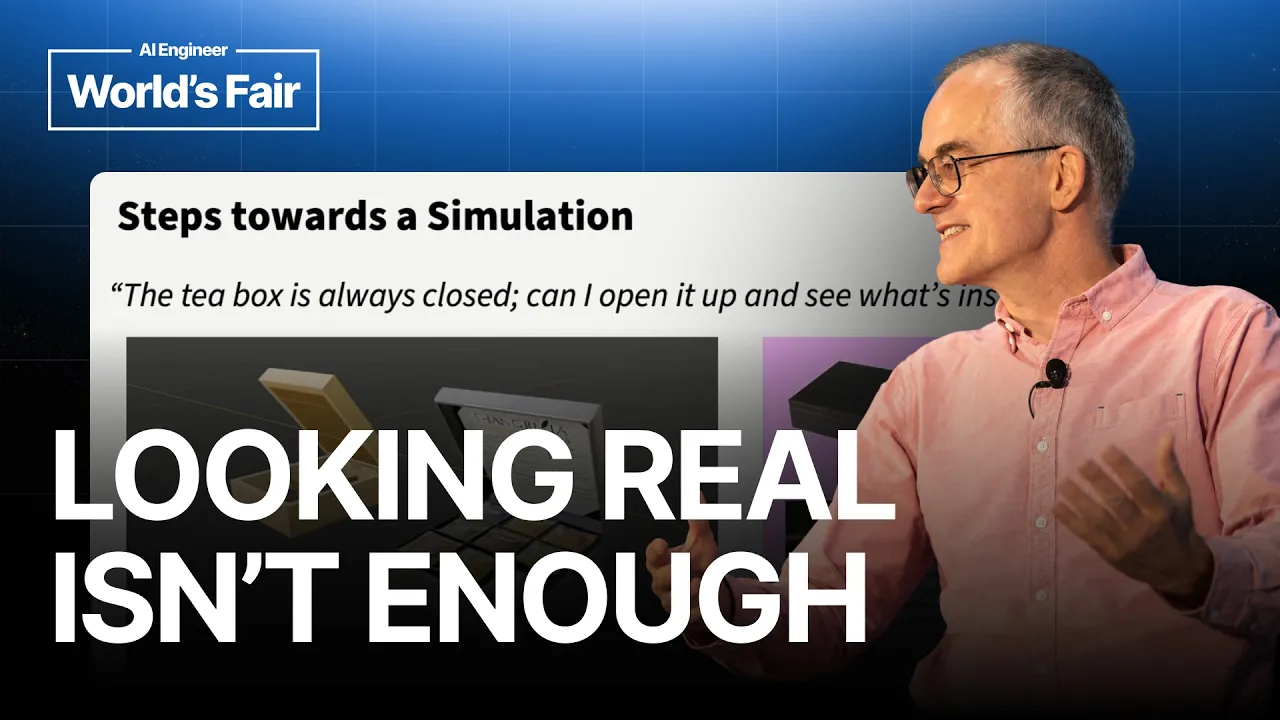
So we separate out a background and then objects inside that background with then being able to sort of have the background world in a representation that's similar to marble. But then in the foreground there are various kinds of objects that we can manipulate and move around. Now, well, that's a start, but um in the previous picture, um the tea box was always closed. And we might wonder if you can open up the tea box and see what's inside it.
Um and well, this is sort of a part of how observations of a world are always partial. Um for what we could see in the actual photo, there was a closed tea box. We couldn't even see the tea box very well. How could we possibly know what's inside it? And well, the answer to the way we can know what's inside it in the 21st century is we go off and do a little bit re of research. We fire up um getting information um off the web um in a a rag style fashion um to work out what's there.
And then we can find images of this um tea um box on the web which show it in more detail. They show a picture of what it's like when it's open. There are descriptions of it. Organic luxury tea bag collection, leather gift box. It gives its size. We can find all about it. So therefore, we can build um in our simulation um a tea box with an understanding of the contents of that tea box. Well, that's really good. Um, so how now we have um the tea box with tea bags inside it.
But if we do nothing else, um, they're just sort of sitting there and movable. So we'd like to realize the fact, well, wait a minute, tea bags you can lift up and you can take out of a tea box. So then we need to start having these teaags also um be objects that are modeled in our simulation that they have a size and an ability to be manipulated as well. Um so how are we doing all of this? And so a distinctive part of what's happening at Moon Lake is building although part of this is in the world of vision a lot of what we're doing is actually back in the world of code.
So this is picking up on the idea um that what's normally referred to as language models but these days are really symbolic models which work on not only human languages but also math code and things like that that they that has been just a very powerful substrate with which to make progress. And so we are producing controllable manipulable world models by generating the controllable parts of these worlds by putting code under them.
And in particular, um, we can train these code models using the same kind of loop engineering that many of you will have seen, um, with Claude that we're having a loop where we're writing code to render objects, um, and put on that um, diffusionbased textures, etc. We can then assess how good our render is against physical reality and then we can work out the deviations. We can revise the code and make better and better um renders of what goes along.
And so that's the way that so we're building this detailed action conditional world model so that we can take actions on the objects in the world. Um so that means that we have a kind of neuros symbolic representation of the world here and neuros symbolic representations have a big advantage that the symbolic representation can be easily interfaced controlled edited and maintained in our human world. Um, and so the message I'd like to give as a little delta of a message here, um, is most of you are probably familiar with Mark Andre's famous statement 15 years ago, software will eat the world.
And you know, that was mostly right. Um but I think it wasn't completely right because it's just not the case that software ate the physical world. Um it, you know, a lot of the world went virtual and um a lot of the world is inside computers now and yeah it could eat all of the processes of managing, counting, supplying all um records of suppliers, all the stuff that's in the virtual world. But we hadn't had the power for software to eat the physical world.
Whereas the hope is with this new ability of being able to build verifiable simulations powered by code of the sort that I've just sketched for a moment there that this will allow us to actually have verifiable simulation which will also eat the physical world. And so that's the kind of thing we built. And we can go on from here and um you know keep on making further steps of this. Right? So we maybe don't want to only have tea bags um in foil containers, but we'd like to be able to um take them out of the foil container and we don't we somehow want to actually get the tea bag inside the cup because that's a useful step for making tea.
And then of course we also want to have um the jug of um water which we want to be able to boil and then be able to pour that into the tea. Um and once we have a good world simulator like that, the idea of this is that we are building in all of the parts of the simulated world which will allow effective transfer into the real world. And it's important to think about that as to sort of what's necessary for different kinds of transfer.
And the argument um that I we'd like to make is that you know normally uh simulation isn't complete and accurate in every detail because there are sort of parts of the world that are important to you and parts of the world that aren't important to you. I mean, this is the same with human world models, right? That a lot of the world we're not actually modeling at any time, but we're modeling the bits of it that are important to us.
And it's having that control of which things you need to model and use is what needed then to give you the actual simulations that will be allowed to be effectively used um in the real world. So, what kind of applications um is this going to allow us to do? So the hope is that um rather than having to collect 10,000 hours of data in by teley op in the real world, we can instead build accurate simulations which will allow transfer to real.
So let me show you the kind of progress that we've been making on this. So this is um not highuting robotics um but is the kind of physical AI that you find everywhere in the real world that there are things happening in physical processes um which you'd like to be able to um understand and automate. And so in particular, um, if we're going to realize any of the dreams of bringing back America as a great manufacturing economy, it seems like we have to work out how to be able to automate much more in the physical world.
Well, um, using the Moonlake AI technology, what we can then do is say, so from this short video, we can automatically produce an accurate simulation of that world, turning it into a 3D world with enough detail about how things move and what objects are in the world that we can start to build on this and use it as a basis of simulated data which transfers refers accurately to the real world. So we then have this model which allows us to get 10,000 hours of simulation um for free.
And so on the basis of that um we can then train up a robotic system that can operate um to actually um explore what you can do in this world and learn the way to operate in the world so it works. and then we can have the effective and cheap training of robotic systems. Okay. Um so that's the story. Um thanks a lot everyone. [applause] And I do have time for questions I believe. >> Thank you very much for the conversation.
Um, super deep. My first question is, would this be applied to something like the gaming industry and how could they use it for we're seeing GTA 6? Everyone is talking about this new game. Um, I could see a very application there where you could have endless interaction with the world model that they're building. U, have you been working with the gaming industry at all or this is more applied to robotics? >> Um, so yeah, absolutely.
Um, another hugely good area for this is in the gaming industry. And you know, the real world is then kind of a virtual world, but you can have a simulation of your gaming world um, and then be building the same kind of embodied intelligence. And the gaming industry has some really appealing attributes. Well, you know, there are millions and millions of game players, so there's lots of easy data to collect. Um the people who are gaming have goals which are fairly clearly known.
So you can sort of learn in a reinforcement learning loop good ways to act. And so absolutely one of the applications that Moon Lake has explored is in the gaming industry and there's likely to be more of that. Um but recently we've been actually particularly emphasizing physical infrastructure and doing simulations in the physical infrastructure world. >> Thank you so much. Uh so it's fascinating to me that that you're turning back to neurosy symbolic representations and um the part of the original kind of old school AI involved a lot of ontology development and knowledge representation and logic and representation of that.
Do you see a role for uh deepening the neuros symbolic representation using kind of like what we how ontologies have been developed previously to model um a representation of the real world? Um and do you see that as being a kind of an area of expansion and development for the type of tools that you're working in? Yeah, I mean I don't think we're quite going to go back to old style ontologies and knowledge bases, but I mean effectively that is what we're doing, you know, apart from it's in new clothing of um having it being um code that I mean I I do you know this is an interesting space and we can talk about it in more general right there is you know there's sort a purely neural approach in which your latent representation of the world is purely neural and so that's the kind of thing that the jeoper architecture is after I mean in some ways that's a good pure neural approach but on the other hand that's very hard for humans to connect to in any way or for other applications to connect to in any way and so our bet is that the sort of practical ical way to have a physical AI simulation infrastructure for the foreseeable future is to base it on symbolic representations.
Taking advantage of sort of the huge power of code that we see everywhere around us in the sort of um codeex cla code era that those kind of symbolic representations allow um neural eye systems to reason, plan and do all of these things excellently well. And so to some extent yes that will be bringing back notions like older fashion knowledge representation. Mic keeps on. Hello. Hello. Oh hi. Um so a lot of our existing um it seems like industrial robotics use cases or to sort of automate existing sort of human manual intensive processes.
Um would investment in development of like world models would that allow us to go explore novel new uh processes or activities where they're currently not accessible by human labor or by even the kind of existing um industrial manufacturing processes that we have. >> I mean sure absolutely. Yeah. So for the example at the end I showed a very old school um conveyor belt system but I mean you know we're also in this world of amazing things happening in humanoid robotics and for any of the new forms of robotics automation other cases you could think about doing things in space well you'll have exactly the same problem that You want to train up AI agents to be able to act in different scenarios and it's extremely costly and difficult to do that training in the real world.
Um and it's very hard when training in the real world to get out into the sort of tale of rare cases. I mean you've seen that um for autonomous driving, right? There's a reason why autonomous driving kind of took 20 years to arrive. Um from you know Stanley breakthroughs of yay autonomous car wins the race to actually having Whimos um widely deployed is because you have this enormous tail and the way to get out to that tail for all of these new applications with um humanoid robotics, space robotics, etc. is to have good simulation. >> Hey, uh thank you for your talk.
I love the energy. Uh my question is you showed a video of water. Uh so is everything like learned from videos or is like physics ingrained in anything like for example does your model know any physical properties of water like viscosity, Bernali's laws or like for example friction. uh for some use cases like self-driving maybe those things are like not important right you just need to know the velocity and stuff but like for other use cases I would imagine these physical properties are important so >> and we absolutely know physics I mean this is the sense in which this neurosyolic approach is you know you call a conservative approach if you will you know that this is absolutely using physics engines and knowledge of physics um to in its generation and control of movement, right?
That if you're what you know when you've just started off with an image of water or and you want to understand how that's behaves, you're using a physics model to predict how it's going to behave. Okay. Um I know is there time for Oh, there's someone else at the mic. Hi. >> Hey. Uh, Professor Manning, thank you for this presentation. Um, I have a question about seem to row gap. So, I mean, simulation is great. It's cheap, is scalable.
Um do you have a suggestion for um how we close the simulation to real gaps [snorts] encounter you know like the like fix part that we are not able to accurately simulate and like mechanical tolerancing back latches like all those things that we are not able to put into the simulations. Um yeah so traditionally the problem has always been the simtoreal gap and the simtoreal gap seeming too large so that a lot of the training has had to happen in the real world and we believe that the answer to that is you know effectively claude code loop we're now in this world in which we can do neural optimization.
So we can have the simulation compared to behavior in the real world with video and we can automatically learn to shrink the sim to real gap in a way that just wasn't possible when you had people trying to handr write a physics simulation of something. This this was a great discussion. Thank you. Um tangential to the question that was just asked, how do you see like what do you see the biggest challenges are to adding like the sociote techchnical layer, the pieces, the the processes, the people, the authorities that make decisions on the objects that you're looking to simulate.
What are the biggest challenges to developing a system that has accurate representation? So for example, if we want to model uh EV tolls or um doing you know forecasting of energy at airports uh you know things like that not necessarily extending beyond the robotics into these other um use cases areas. >> Um yeah that's a great area. Um in all honesty it's not something we've been um really dealing with at Moon Lake.
Um, you know, at the there are still some limitations, but you know, large language models with their slurping up of enormous amounts of human behavior data that they're actually getting better and better at being able to simulate how human beings, different kinds of human beings are going to behave and react in different circumstances. So I think we are starting to approach the point in which we can have fairly good human behavior simulators that are being powered by the knowledge of large language models and there are a couple of companies that are now starting to look at that. >> Cool.
Last question. Yeah. person over here has one for a long time. [laughter] >> Thank you. Um so if you look at um analog chips for instance right the physics is understood but as you go higher up the chemical operations then the heat and those things are still people are working on it. So that's not what you call completely um understood. Now I'll give you another example of say I'm looking at kidney related uh literature and stuff and then liver related stuff these things it gives a pretty good answer the kidney stuff it gives answer but when you look at the relations between the two people have somewhere u doctors have made a link and that's why you are able to see my take is if we operated completely in the latent space and we did not know the connection connections at a human level.
Can we explore in the latent space completely and be able to find hidden connections over there that could translate into the real world or am I thinking something crazy? >> Yeah, I mean absolutely. I mean to the extent that we have a pretty good simulation, we can hope to find surprising discoveries that turn out to be correct in the simulated world. I mean, you know, things go both ways, right? There are also likely to be things that turn out to be true in the real world that weren't in our simulation, right?
There's this famous statement about all models are wrong, but some models are useful, right? And that so anybody's world model, regardless of whether it's the one we're building or the world model in a human head, right, they're not always right. Sometimes we think a person's going to react in one way and they react in another way. But nevertheless, a lot of the time it can let us explore much more widely and discover new facts and new connections that we weren't aware of in the real world.
Okay, >> awesome. That's a wrap everyone. Thank you so much, Chris.
The words are the caption track's own and nothing is reworded or re-transcribed. Paragraph breaks are placed between sentences so the text reads as prose.
Free tools for your own script. No signup, no login.
Paste your draft and see where viewers are likely to drop off, with a rewrite for each weak line.
Paste the first 30 seconds of your own draft for a hook score and rewrites.
Check your draft against YouTube's advertiser-friendly guidelines before you record it.
Read this channel's public videos and transcripts, and download a writing brief for it.