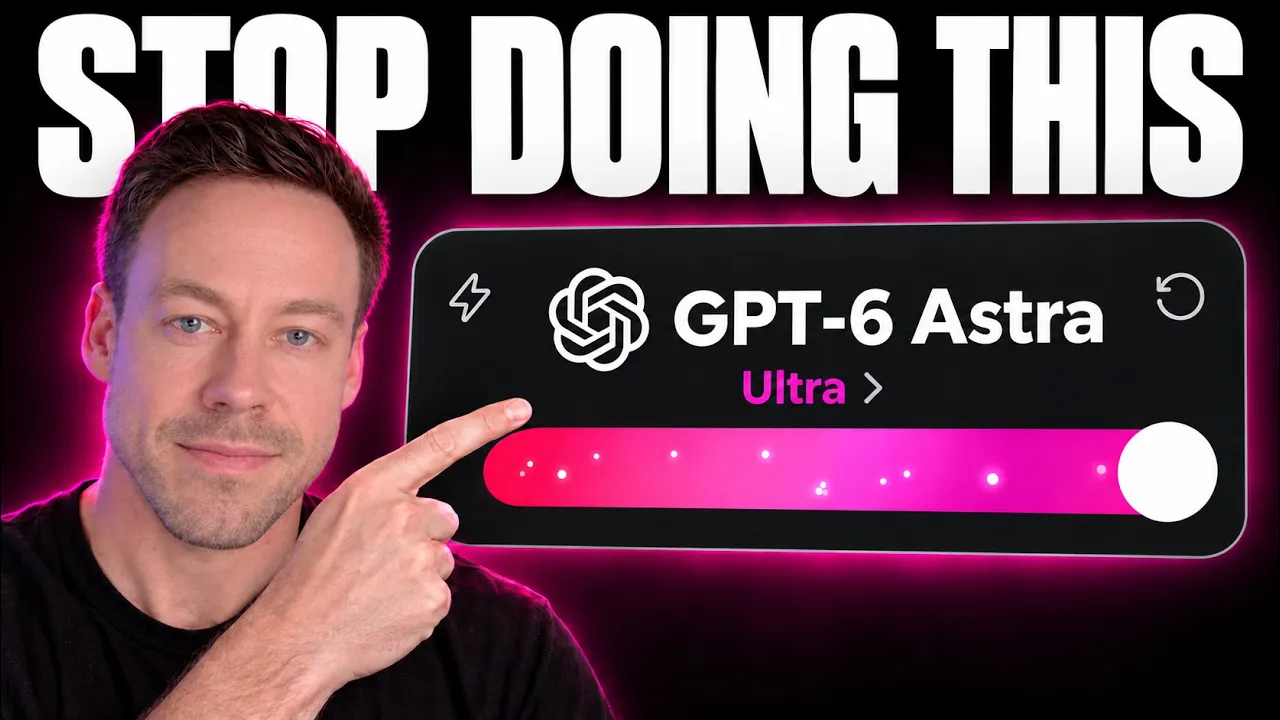
You're Using GPT 6 Astra Wrong (Here's How to Fix It) transcript
Chase AI · @Chase-H-AI
Words
3,699
Runtime
17:47
Speaking pace
208wpm
Reading time
15min
208 words per minute, above the 201 75th percentile of 349 measured videos. That distribution comes from the 349-video hook study.
Opening (first 30 seconds)
GPT-6 Astra is giving Anthropic a run for its money, and for good reason. This is the greatest AI model we have ever seen. But, if you are using this model the same way you've used older models in the past, you are severely hamstringing your results. But, today in this video, I'm going to be going over the five mistakes you are making when it comes to your Astra usage, and more importantly, I'm going to show you how to fix them. Now, the first mistake you're making when it comes to Astra is you are using the wrong effort level. It is
104 words, the words spoken in the first 30 seconds at 208 words per minute.
Sentence shape
| Measure | This transcript |
|---|---|
| Sentences | 205 |
| Average words per sentence | 18.0 |
| Longest sentence | 97 words |
| Questions asked | 16 |
| Sentences containing a number | 20 |
Most used terms
- astra34
- voice19
- sort17
- chat16
- skills16
- effort13
- codex12
- high12
- max12
- inside10
- mode10
- probably10
Filler phrases
62 in total: like 22 · sort of 17 · actually 8 · kind of 8 · basically 2 · you know 2 · I mean 1 · right? 1 · um 1.
A literal whole-word count of the same phrase list the Prepublish browser extension uses, so a phrase inside another word is not counted and a phrase used in its ordinary sense still is. It is a count and not a judgement.
What this transcript is
Every word below is the caption track YouTube publishes for this video, pulled from the video itself and reproduced unchanged. It is not Prepublish's writing, not a summary, and not a re-transcription: it is the video's own published captions. English captions, generated automatically by YouTube, in the video’s original language. Source: the video on YouTube. A channel that would rather this page did not exist can ask for its removal through the contact page, and it is removed.
Transcript
GPT-6 Astra is giving Anthropic a run for its money, and for good reason. This is the greatest AI model we have ever seen. But, if you are using this model the same way you've used older models in the past, you are severely hamstringing your results. But, today in this video, I'm going to be going over the five mistakes you are making when it comes to your Astra usage, and more importantly, I'm going to show you how to fix them.
Now, the first mistake you're making when it comes to Astra is you are using the wrong effort level. It is unfortunate how many people I have seen open up Codex, throw effort level to max, or even if they're complete freak shows, throw it to ultra, and think this is going to automatically get you better outputs. Spoiler alert, it is not. We need to be very conscientious of what sort of effort level we are taking for our particular project, and unless you're doing some sort of wild, extremely complicated projects, you probably shouldn't ever be going above high, and in many cases, you should probably be on medium or even light.
And the stats kind of prove this. This is illustrated very well here with the deep sweep benchmark, which is a benchmark that's all about long-running agentic tasks. The type of task that you would expect the much higher effort levels to really thrive in when we compare it to the lower effort levels. Yet, looking at deep sweep, and I am on the max setting, I get a score of 73%, and my average cost per task is $12. However, on the exact opposite side of the spectrum, if I go to low, I'm at 67%, which is only a 6% drop-off, yet I've gone from $12 per task to $2.19 per task.
Now, I know most of you are on a subscription plan, we're talking about usage, but the fact remains, the amount of weekly usage you will burn on something like low will be significantly less than on high, or on max, rather. And as we go down the line from max to extra high, you see we actually got better results on extra high. Yet the cost per task was almost half. We see that again when we go to high. We are at the same exact score as max.
Yet we go from $12 to $5.72. And at medium we're basically the same exact place. What's the point here? The point is Astra is extremely efficient even at lower settings. And if we compare that to something like Fable 5, the low setting on GPT-6 Astra is basically right in between Fable 5 high and medium. So that would be about a $7 price point on the Anthropic side. Again, $2.19 with Astra. And this idea is repeated across multiple benchmarks.
Here's the artificial analysis coding agent index at low setting, we're at a $1.50 at a 62.6 score. On max, we're at 498 for cost and a 67 score. So a difference of 4.4 for the score. Yet the price jumps up, you know, almost three dollars and 50 cents. Now, on some of these other benchmarks, we see there is a dip as we go from low to max. Like max will give you better outputs on these far ends. But even here, right, on terminal bench, high gives us a better score than max.
And again, much cheaper. So what's the takeaway here? When you are inside of Codex, don't just automatically throw this bar for effort level all the way to the right. In fact, you can probably get away on average with high. Now I went ahead and tested this out on front end design, which is a common use case for Astra. I gave Astra the same prompt with two different effort levels. This was the prompt on light. I said I wanted to create a homepage for Dune House, a fictional boutique desert hotel in Joshua Tree, California.
And this is what it created for us. Honestly, pretty solid. Again, this was using the light effort level. In terms of the time it took, it I gave it the prompt at 3:41 and 13 minutes later it was complete. Total tokens used was 91,000. And here's a look at the same result on max setting. This time it took 30 minutes to complete. We used 152,000 tokens and this was the end result. And I mean this looks pretty good, but is it significantly better than light?
Mm, you can make an argument for both. Point being is there a huge difference in the outcome here for this particular task? Not really. So when in doubt, when we're working with effort levels, less is more. If you aren't getting the output you like, go ahead and begin incrementally bumping up that effort level. But there is essentially zero reason why you should start at extra high, max, or ultra. Now the second mistake you are making when it comes to Astra is you are completely underutilizing its browser and computer use.
These two things allow us to sort of connect Astra to applications where we don't have a readily available CLI, MCP, or API. For example, let's say we want to improve on this website we created. This was the version we got with the max effort level. And instead of me manually going out on the web, finding new references, and feeding it to Astra, why don't I have Astra do it on its own? Why don't I send it to a website like Dribbble, which doesn't have an API that I have access to at least, and have it find references for other hotel type websites, download the images or take screenshots of the images, and bring it into the fold for its next iteration.
It can do all that automatically. I don't have to touch anything. So, that prompt will sound something like this. Hey, so can you, in the browser on the right-hand side, head to Dribbble, that's d r i b b b l e.com, and then look up some websites, some references for hotel websites, because what I want you to do is I want you to go on to Dribbble, I want you to search for hotel websites, and I want you to find references of other hotel websites that look very visually stunning.
Take screenshots of them, do what you need to do, so then you can bring those reference images back into Astra, back into Codex, and then come up with a new version of our website. So, we can see here over on the right it is now pulled up Dribbble, and it has my login because it actually saves those when you log in at all. It's now searching for hotel website. It's then clicking on individual websites that were listed there.
It's capturing screenshots, and then it's continuing this process with more websites that it thinks sort of fits the bill. It then put all that together to create this website, and I'll turn off my camera so you can see it better. So, it generated a brand new website, and like Codex always does, it also made sure it worked on mobile, ran all the tests. But, we got something a little bit different. And to be honest, I kind of like this version better, and I like the very prominent image it generated as well.
And normally, we would do this completely manually in terms of finding all these references, but you could see how it would be so easy to scale this where maybe it wouldn't just work at look at Dribbble, it could look at Pinterest, it could look at Twitter, or we could apply this to really any scenario where we have some sort of application that we want to grab information from and bring into Codex. But again, we don't have an API, we don't have an MCP.
This is where these browser automations and computer use tools are so handy. Astra even created sort of a reference table so I can see which screenshots it actually used as well, sort of its notes and links to the original source on Dribbble, which is also nice. Now, before we go into the third mistake, a quick word from today's sponsor, me. So, inside of Chase AI Plus, I have released not only a brand new Cloud Code Masterclass, I also have a Codex Masterclass as well.
So, no matter your technical background or lack thereof, I will teach you how to master these AI tools. Focus on real use cases. I post updates every single week. So, if this is something you really want to dive into, Chase AI Plus is the place for you. There's a link to it in the pin comment. Now, the third mistake you are making when it comes to Astra is that your skills are all wrong. Your skills are holding you back because we are in the same place now with Codex that we were at with Cloud Code just a few weeks ago.
Remember when Boris Cherny, the maker of Cloud Code, came out and said, "You need to delete your cloud.md. You need to delete your skills." Well, the idea there wasn't that we should just delete them for the sake of it. It was that these models, Astra and Fable, have gotten so good that many of the skills that acted as scaffolding for older models we used to play around with just are irrelevant now. And in fact, in many cases, they are holding you back.
Now, this isn't black and white, although I will say a lot of the super heavy scaffolding skills, things like superpowers and GSD, should probably go by the wayside. But even if you disagree with that statement, your context window is probably clogged with a ton of skills that you just don't even use. How many skills did you install 9, 6, 3 months ago that you haven't touched since then? Have you gotten rid of them? If you haven't, they're still there.
Like it's just their description, but these add up. You might have 30, 40, 50 skills that have nothing to do with what you do anymore, and they're just clogging up your context window. So, what do we need to do? Well, we need to do an audit, and I created a skill that does that for you. This is the skill audit, and this is actually based on Anthropic's skill creator skill because it has benchmarks and testing in place where if you point it at a specific skill, it will run a test to see does this skill make sense with the current model.
Codex has its own skill creator skill, but it wasn't as robust as Anthropic, so that's why I created this, and this is what it does. So, I'll put a link down below to where you can find it. I show you the install, and then I also give you a prompt you can run. This prompt will then go through all of your skills and your logs and figure out which skills have you not been using at all and that we should probably prune, and it's going to take a look at the front matter of your skills, see what descriptions make sense, and then also have a list of skills for you to take a look at where if you want to, you can go one by one through these skills and actually run this skill audit benchmark test against them to see do they make sense with Astra.
And so it groups all of your skills into a bunch of different buckets, either fix now, review for retirement, text next, test later, or preserve. Again, this is super simple for you to use. You're just going to install the skill and then run this prompt. And this will buy you a few things. One, it's going to free up some of our context window that has been bloated through skills we don't even use. And then, two, for those skills that are in the gray area of well, we still want to use them, but we're not sure if they're legit or can we improve them, it's going to improve them, it's going to benchmark them, and you're no longer going to have a question of do these actually help me?
Now, the fourth mistake you are making when it comes to Astra is you are not using its voice mode, and its voice mode is best in class. What we get here inside of Codex destroys its cousin inside of Anthropic's Claude code desktop, and it got improved with Astra. Before when you use voice mode and you use it by just clicking this little thing right here and this bubble's going to pop up. Before it was powered by GPT Terra, and I believe it was Terra on the light effort setting.
Now, you can use it with Astra, and you can use it with Astra high or Astra low. Furthermore, if I wanted to use voice before, so let's say I want to start a new voice chat, it would be in an entirely different chat panel like you see here, and I'd have to use it as an orchestrator. So, I would say, "Hey, go do X, Y, and Z." And now it's kind of listening to me right now. I would say, "Hey, go do X, Y, and Z." And it would open up a new chat and do that.
Now, what I can do is I can go into an individual chat, like the one we were just at, and I can use voice mode inside of here. So, I have multiple options, orchestrator that controls multiple chats, or I can use it inside an individual chat, and I have Astra. So, for example, if I wanted to use it inside of here, I'm just going to click this thing, and let's say I wanted to Mhm, let's say I wanted to adjust something.
Let's say I wanted it to add some sort of like form somebody could fill out on this webpage over here on the right, and then I also wanted it to test it out. So, let's try that. So, I'm going to click on this. And I will say when it comes to how you should best use it, if you are using it to do things. So, I'm inside a chat right now. I'm having it do something, which is add a form. I'm probably going to put it on high effort.
If I'm using it as an orchestrator, or I just want to kind of talk to it back and forth, I'll probably just put it on light. So, I'm going to do voice. Throw this on high. And then I'm just going to click it and talk. So, what I want you to do right now is I want you to take a look at this website we built on the right-hand side of the browser. I kind of would like some place where people can fill out just a form if they want more information, probably at the bottom near the footer.
And kind of figure out what best practices are for that, what sort of information they should put in there. Right now, we don't need the functionality to actually work. I don't need you to hook it up with Resend or anything. I kind of just want to see what it will look like on the webpage. Can you go ahead and do that for me? >> Sure, let me take a look. >> I also want you to notice Oh, kind of stopped that for a second.
I also want you to notice how quick and snappy that was when it said, "Sure, let me take a look." If you haven't played with the voice mode here, it is extremely snappy and very responsive. And so, while that voice mode is working, let me sort of demo what else we can do with it. So, I'm here in a new voice chat. I'm going to set this to light cuz I'm going to have it act as an orchestrator, and I can pretty much tell it to like open up a new chat over here on the left.
Use Astra, and we'll say something like, "Hey, can you figure out what the top five GPT voice, you know, use cases are?" Can you go ahead and spin up a new chat window over on the left-hand side? Doesn't need to be new project. Um, get Astra working on doing some research for us to figure out what are the top five use cases for the new GBT 6 Astra voice mode. Specifically looking at the voice mode, so open for a new chat with that.
And I also want you to tell that agent to write up a little document for us like HTML or something. >> On it. Setting that up now. >> So, you can see here it's now created that chat. I can open up that chat. It's over here on the left-hand side, top five voice models. And you can see right here and it says sent by chat GBT. >> task. Focus on the top Astra voice mode use cases plus a short HTML write-up with examples and sources. >> And so, you can see here the prompt that was sent to this chat.
And inside of this chat window, like I said, this can act as an orchestrator. I can have it create a bunch of different chats. I can control everything from this one voice pane. So, this is super useful if you're someone who's like has two, three, four, five, six plus agents going on all at once. So, instead of trying to track all those manually, again, have Astra track all of them for you and just talk to this one orchestrator.
And we can see over here with our original command, it is now added and it's working on our little sign-up sheet right here, more information sheet. And you can see sort of the browser control in action with a little cursor. It's actually testing it out as if it was a person. >> Done. The HTML brief is ready to open and it separates live voice handling from Astra's role during the underlying work, which is a handy way to frame it. >> So, here you can see the five use cases it found.
And really, I think the big unlock with voice chat is using it as an orchestrator. Now, the fifth and final mistake you are making with Astra is you are prompting it wrong. Now, this model is extremely effective, but there are some differences with how GBT 6 Astra handles things compared to GBT 5.6 Soul. Specifically when it comes to making assumptions, when it comes to forks in the road, this is coming from OpenAI themselves.
And what they tell us is that Astra is more likely to ask for clarification where older earlier models would make assumptions. What does this mean for you? Well, this means when you are coming up with your prompts, especially when we're talking about long-running agentic complex tasks, you should probably put in some sort of verbage there about how you want it to handle these forks in the road. Do you want it to always ask you questions or do you want it to sort of carry the user's intended task to completion?
Now, OpenAI gives us a specific prompt you can use, which is listed right here. Or you can use a template I'm going to put on the screen right now to help guide you for some of these bigger tasks. The big thing here is that you just need to know how you want it to behave. Are you someone who likes it when AI is constantly checking in, which Astra will tend to do on its own, or when we're doing longer stuff, do you want it to just do its thing?
I'm going to give you a North Star, I'm going to give you some sort of end state, go forth and conquer, don't ask me questions, figure it out. There's pros and cons to both of these solutions, just know when you take the route of just, "Hey, go ahead and figure it out." That's when you tend to get sort of a regression to the mean unless you set up a lot of scaffolding that sort of point it in certain directions when it reaches said forks in the road.
Another good option you have here is this prompt that OpenAI gives us where we're going to tell the model to ask for approval only after preparing a concrete reviewable result. This enjoys blocking the task if it could already have done it. Right? Don't just come to me with a problem, come to me with a problem and your potential solution. So, I think some combination of all these and what I showed earlier will get you to a good place if you're having some problems with Astra so it's just like stuttering its way through tasks.
So, those are the five mistakes that are holding you back when it comes to GPT-6 after. This model is extremely powerful, especially when we look at it inside of Codex, because Codex has so many cool little features that I think Anthropic and the Claude code desktop app are sort of falling behind on. Namely, browser use, computer use, and the voice mode. So, make sure to try those out. Let me know how they worked for you.
As always, if you want to learn more about Codex and Claude code, make sure to check out Chase AI Plus. I'll put a link to that down in the pinned comment. And I'll see you around.
The words are the caption track's own and nothing is reworded or re-transcribed. Paragraph breaks are placed between sentences so the text reads as prose.
Use this transcript
Three free tools that work on the material around a video like this one. No signup, no login.
Hook Analyzer
Paste the first 30 seconds of your own draft for a hook score and rewrites.
Policy Pre-Flight
Check your draft against YouTube's advertiser-friendly guidelines before you record it.
Channel Skill Generator
Read this channel's public videos and transcripts, and download a writing brief for it.