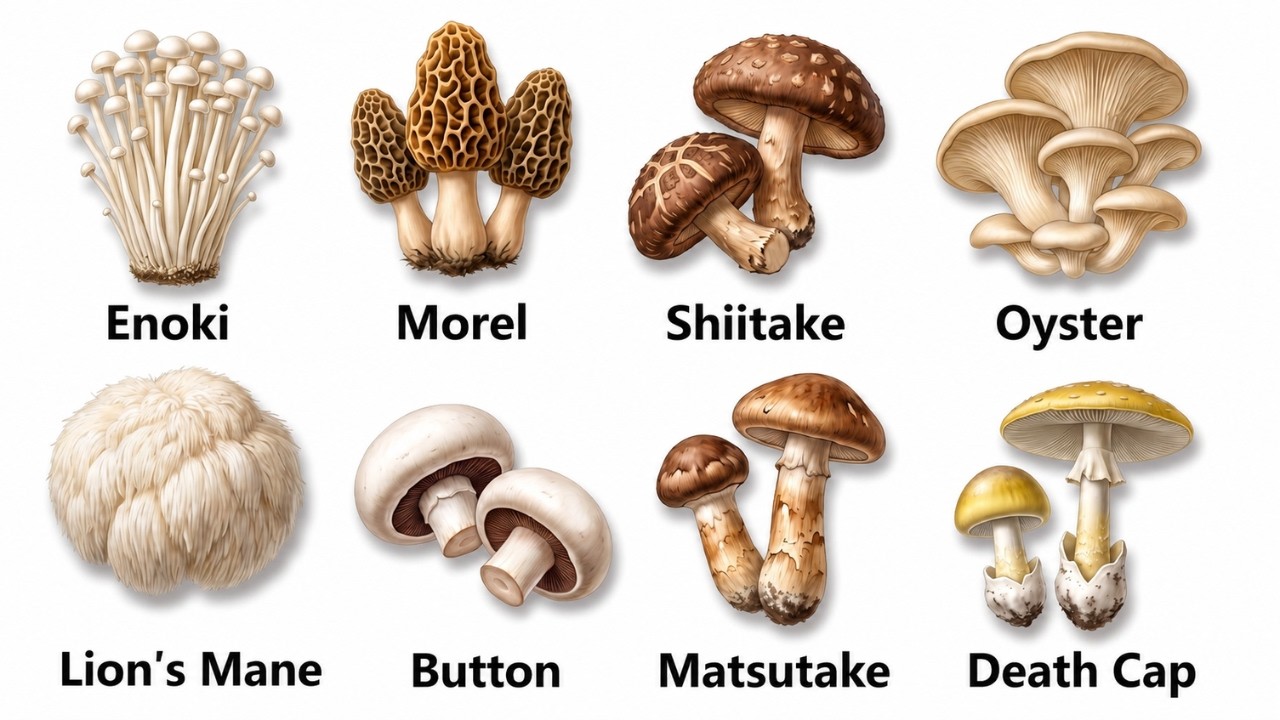
Know Every Mushroom Before You Eat transcript
Deep Explained · @DeepExplained-j3p
Words
4,006
Runtime
24:55
Speaking pace
161wpm
Reading time
17min
161 words per minute, between the 160 25th percentile and the 181 median of 349 measured videos. That distribution comes from the 349-video hook study.
Opening (first 30 seconds)
There are over 38,000 species of mushrooms on this planet. Some of them taste incredible. Some of them will kill you before you even feel sick. Some of them have been used by shamans, emperors, and Olympic athletes. And one of them is so expensive that a single chunk sold for $330,000 at auction. Here are 15 mushrooms you need to know about. Button mushroom. Let's start with the one sitting in your fridge right now because there's something about it
81 words, the words spoken in the first 30 seconds at 161 words per minute.
Sentence shape
| Measure | This transcript |
|---|---|
| Sentences | 300 |
| Average words per sentence | 13.4 |
| Longest sentence | 53 words |
| Questions asked | 0 |
| Sentences containing a number | 43 |
Most used terms
- mushroom44
- mushrooms27
- people18
- cap14
- flavor13
- white11
- years10
- forest9
- looks9
- trees9
- america8
- american8
Filler phrases
21 in total: like 19 · actually 1 · kind of 1.
A literal whole-word count of the same phrase list the Prepublish browser extension uses, so a phrase inside another word is not counted and a phrase used in its ordinary sense still is. It is a count and not a judgement.
What this transcript is
Every word below is the caption track YouTube publishes for this video, pulled from the video itself and reproduced unchanged. It is not Prepublish's writing, not a summary, and not a re-transcription: it is the video's own published captions. English captions, generated automatically by YouTube, in the video’s original language. Source: the video on YouTube. A channel that would rather this page did not exist can ask for its removal through the contact page, and it is removed.
Transcript
There are over 38,000 species of mushrooms on this planet. Some of them taste incredible. Some of them will kill you before you even feel sick. Some of them have been used by shamans, emperors, and Olympic athletes. And one of them is so expensive that a single chunk sold for $330,000 at auction. Here are 15 mushrooms you need to know about. Button mushroom. Let's start with the one sitting in your fridge right now because there's something about it that almost nobody knows.
The white button mushroom is the most consumed mushroom in the United States by a massive margin. 2/3 of the entire American supply comes from farms in Pennsylvania. The average American eats about 4 lbs of mushrooms a year and most of that is this one. But here is the thing. The button mushroom, the cremeni mushroom, and the porttoella mushroom are all the exact same species. Every single one of them is a garicus bisperous.
The only difference is age. Button is young, harvested before the cap opens. White, mild, tender. Prini is the same mushroom a few days older. The cap has darkened to brown. The flavor has deepened. The texture has firmed up. Porttoello is the fully mature version. The cap has opened completely. The gills are exposed and the flavor has become rich, meaty, and almost beefy. Three different names, three different price points, one mushroom.
So, every time someone at the grocery store picks up a porttoelloo, puts it back, then grabs a pack of buttons instead because they seem more versatile, they are choosing between a kid and an adult of the same species based almost entirely on marketing. The flavor of a good button is mild and earthy with a slight nuttiness. It absorbs whatever it is cooked with. It does not demand attention. It just shows up and does its job.
Which is probably why it became the most popular mushroom in the country. Portoelloo. Speaking of which, the porttoelloo has a secret origin story that the mushroom industry is not particularly proud of. By the 1980s, American farmers were growing enormous quantities of crei and porttoelloo mushrooms, the brown mature version of the button, and struggling to sell them. Americans wanted white. White mushrooms looked clean and familiar.
Brown mushrooms looked like something you found under a log. So, someone in the marketing department made a decision. They stopped calling them brown mushrooms. They started calling them porttoellos. The name had no historical roots. It did not refer to a place or a tradition. It was invented specifically to make a mature brown mushroom sound expensive and Italian. It worked instantly. Porttoello sales exploded. Restaurants started putting them on menus as a meat substitute.
Chefs started grilling them whole and serving them as burgers. The porttoello became a thing, a real culinary identity built on a name that someone made up in the 1980s to solve a sales problem. The mushroom itself is genuinely excellent. The cap is thick and meaty. The gills are deep. And when you roast or grill it, the flavor concentrates into something rich and satisfying. It deserves its reputation. It just did not earn it the way most people assume.
Shiake. The shiakei has been cultivated in East Asia for over a thousand years. The earliest written records date to the Song Dynasty in China around 960 AD. Chinese farmers figured out that if you drilled holes into hardwood logs and inoculated them with mushroom spores, you could reliably grow shiakei year after year. That technique developed over a thousand years ago is still the foundation of how shiakei is grown today.
In the 12th and 13th centuries, Buddhist monks traveling from China to Japan brought the mushroom with them. It became popular among Japanese nobility and monks. Valued for its deep umami flavor and its perceived health benefits. The name itself is Japanese shei is a type of hardwood tree. Take means mushroom. American awareness of shiakei grew slowly through the 1960s alongside rising interest in Asian food and commercial cultivation in the US started in the 1970s in Pennsylvania and California.
Today it is the second most consumed mushroom in America and one of the most widely grown mushrooms on earth. The flavor is what separates it from button mushrooms. It is deeply savory umami in a way that most western mushrooms are not with a slight smokiness and a meaty texture that holds up beautifully in stir fries, soups, and brazes. The dried version is even more intense. A handful of dried shiakei added to a broth will do more for the flavor than almost anything else you can add.
Drop a like if you are enjoying this. It genuinely helps. And let me know in the comments where you are watching from and what time it is there right now. I read every single one. Oyster mushroom. The oyster mushroom showed up in Roman cookbooks almost 2,000 years ago. It grows wild on dead and dying hardwood trees across North America, Europe, and Asia. And it looks exactly like its name. Wide, fan-shaped, layered like oyster shells cascading down a log.
The flavor is mild and slightly sweet with a faint oceanic quality. Delicate enough that it works in almost any dish without overpowering anything. The texture is silky when cooked with a tenderness that makes it one of the most satisfying mushrooms to eat. But here is the part that makes oyster mushrooms genuinely unusual. They are one of the only mushrooms that will eat almost anything. They can grow on cardboard, straw, coffee grounds, corn husks, even old blue jeans.
They are natural decomposers and researchers are now studying them for micromediation, which is the use of fungi to clean up contaminated environments. Oyster mushrooms have been shown to break down diesel fuel, certain pesticides, and agricultural waste in controlled settings. A mushroom that tastes good and cleans up oil spills is not something most people expect to find at the farmers market. They are also the easiest mushroom to grow at home.
Kits are widely available, require almost no equipment, and can produce a full harvest in a matter of weeks. If you have ever wanted to grow your own food, but thought it was too complicated, oyster mushrooms are the place to start. Morel, every spring across a two six state stretch of the United States, something close to a religious event takes place in the woods. Morels emerge from the forest floor between March and May, and only then.
They grow for a few weeks and disappear. They cannot be farmed at commercial scale despite decades of attempts. Every effort to reliably cultivate morelss has either failed entirely or produced yields so small they are not economically viable. The only way to get them is to go find them. And Americans do go find them. Moral hunting is its own subculture complete with secret spots passed down through families for generations.
Communities that swap information in code to avoid tipping off other hunters. and a genuine emotional attachment to the ritual of finding one. People will take a day off work to walk through wet forests in April searching for something the size of a thumb. The market price is anywhere from $200 to $800 per kilogram fresh, depending on the season and the region. Restaurants pay whatever is asked. The flavor justifies all of it.
Morals taste like the forest floor. If the forest floor were delicious, intensely earthy, nutty, deeply umami with a honeycomb texture that holds butter and cream in a way no other mushroom can match. You sauté them in butter with a little salt, and that is genuinely one of the best things you can eat in the month of April. Ask a morel hunter where their spots are. They will smile at you and change the subject. Shantrell.
The chanterel is the mushroom that makes people who do not care about mushrooms start caring about mushrooms. It is bright golden yellow, almost orange with a cap that ruffles and waves rather than sitting flat. It smells faintly of apricot. It tastes sweet and fruity and peppery all at once in a way that no other mushroom does. It is visually striking enough that chefs use it as much for how a dish looks as for how it tastes.
It also cannot be cultivated. Chanterels form what micologists call a microisal relationship. With trees, their underground network grows into the roots of forest trees and the two organisms sustain each other. Without the trees, no chanderels. This means every single chanterel in every restaurant and market in the world was found by a person walking through a forest. There is no factory version. The Pacific Northwest Oregon in Washington produces some of the best chanterels in North America and professional foragers sell directly to restaurants there.
A good chanterel patch in Oregon is worth thousands of dollars over a season. People who find them do not tell anyone where they are, which is a pattern you will notice with good mushrooms in general. The price runs $30 to $40 per kilogram. For a wild mushroom that tastes the way it does, that is not unreasonable. Lion's mane. Lion's mane looks like someone glued a white waterfall to the side of a tree. It has no cap, no gills, no stem.
It is just a cascade of long white teeth flowing downward from a central point, dense and almost luminous. If you had never seen a mushroom before and someone handed you a lion's mane, you would not immediately know what it was. It grows wild on hardwood trees across North America, Europe, and Asia. Traditionally, it was used in Chinese and Japanese medicine for digestive and neurological health. And for centuries, it was more valued as medicine than as food.
Now, it is everywhere in American wellness culture. It is in the mushroom coffees, the brain supplements, the gummies, the tinctures, and unusually for a trend ingredient, the science is actually interesting. Current research shows that lion's mane produces compounds called herosin and arerinosines that can stimulate the production of nerve growth factor in the brain. Animal studies have shown potential in slowing or reversing nerve damage.
Human trials focused on Alzheimer's and Parkinson's are ongoing. The flavor is one of the strangest things about it. It tastes like crab or lobster, a mild, sweet oceanic flavor that has nothing in common with how it looks or how most mushrooms taste. Saute it in butter. And most people will ask what kind of seafood you are using. Rayi. For over 2,000 years, people in China, Japan, and Korea have treated rayi as something close to sacred.
Dowist monks wrote about using it to deepen meditation and cultivate calm. Chinese royalty called it the mushroom of immortality and consumed it in hopes of extending their lives. Depictions of Rayi appear in imperial Chinese art going back at least a thousand years. It shows up in paintings on carved furniture embroidered into royal clothing. It was not just medicine. It was a symbol of divine favor. The mushroom itself looks nothing like something you would eat.
It is hard and woody, shaped like a kidney or a fan, glossy and reddish brown, like something lacquered. You cannot bite into it. It is too dense and too bitter. Everything that comes out of rayi comes from the dried powder extract or tea. Today it is the most researched functional mushroom in the world. Some countries including China include rishi based supplements in cancer treatment protocols alongside conventional chemotherapy.
Research into its betalucans, a type of soluble fiber, has shown immune modulating effects in human trials. It is not a cure for anything. But after 2,000 years of people claiming it does something, scientists are finding that some of those claims have a basis. You can find rayi in powder form at nearly every health food store in America. The same mushroom that Chinese emperors guarded like a state secret is now in a $30 bag next to the protein powder.
Now, here is one of the strangest things in the entire mushroom world. Cortiseps. Cortiseps is a fungus that finds a caterpillar hibernating underground on the Tibetan plateau, infects it, consumes it from the inside over the course of the winter, and then in spring sprouts a small dark fruing body out of the dead caterpillar's head and pushes it up through the soil to release spores. In Chinese, it is called dong chong shao winter worm, summer grass, because in winter it is a worm and in summer it is a plant.
Traditional Chinese medicine has documented its use since at least the 15th century. And during the Ming dynasty, access to cortiseps was restricted exclusively to the emperor and his inner circle. The price in 2008 was up to $18,000 per kilogram for the highest quality specimens. People in rural Tibet collected by hand on their knees, searching alpine meadows above 15,000 ft, picking individual fungus caterpillar combinations one by one.
In some Tibetan regions, Cortiseps accounts for 40% of annual household cash income. In 1993, the Chinese women's distance running team destroyed five world records at the World Championships. The coach, when asked about doping, said the only supplement his athletes used was derived from Cortiseps. Whether you believe that or not, it put Cortiseps on the map for Western athletes. Today, you can buy Cortiseps capsules at Target.
The supplement market version is lab grown and contains zero caterpillars. It is not the same thing, but it is dramatically more affordable than picking something off a dead moth larvae at 15,000 ft. White truffle. In 2007, a 1.5 kg white truffle found in Tuscanyany, Italy was auctioned at a simultaneous event held in Macau, London, and Florence. A casino billionaire from Macau bought it by phone for $330,000. That is $220,000 per kilogram for a fungus.
White truffles grow underground attached to the roots of oak, beach, and hazel trees in a small number of areas in northern Italy, primarily around the town of Alba in Piedmont. The season lasts roughly 2 months, October through December. They cannot be cultivated. They grow when and where they want and the only reliable way to find them is with a trained dog whose nose can detect them through several inches of soil.
The French gastronome Brios Saver called truffles the diamond of the kitchen in the 19th century. Before that, the ancient Sumerians were writing about them. Egyptians ate them coated in goose fat. And during the Middle Ages, the Catholic Church officially declared truffles a creation of the devil, which slowed consumption for several centuries, but did not stop it. The flavor is impossible to accurately describe to someone who has not experienced it.
It is earthy and garlicky and musky and intensely aromatic in a way that fills a room. A few shavings over a plate of pasta or eggs transforms the dish into something unrecognizable. The aroma is the product, which is why truffle oil made with synthetic compounds rather than real truffle is considered an insult by anyone who has eaten the real thing. Matsutake. In Japan, the matsutake is not just a mushroom. It is an event.
Every autumn for generations, the arrival of matsutake has been celebrated in Japanese culture. The way Americans celebrate the first corn of summer or the first apples of fall, but with significantly more reverence, it appears in poetry written over a thousand years ago. It is a traditional gift given at the highest levels of social and business relationships. A beautifully boxed matsake presented to someone in Japan is the equivalent of a very expensive bottle of wine in the west.
It signals respect, care, and financial investment. The problem is that Japan's Matsutaki supply has collapsed. Production has fallen by more than 99% since the 1950s as Japanese pine forest declined due to changing land use and a destructive pine nematode. The Matsutek has a microisal relationship with Japanese red pine and without healthy pine forests, there is no Matsutek. Japan now imports matsutake from South Korea, China, Canada, and Oregon.
The domestic product still commands extraordinary prices. A single premium Japanese matsutake can sell for the equivalent of $1,000 during peak season. The imported version is significantly cheaper, but carries lower prestige. The flavor is unlike any other mushroom, spicy and piny, with a cinnamon quality and a deep woody aroma that people either find transcendent or overwhelming depending on how they were raised around it.
For Japanese consumers, it smells like autumn itself. If this video is hitting right, hit that subscribe button. We have a lot more of these coming. Now, for the ones people are really curious about, psilocybin mushrooms. The use of psilocybin mushrooms predates written history. In Meso America, the Aztec called them tanana cattle, flesh of the gods, and used them in religious ceremonies, healing rituals, and divination for centuries before European contact.
The Mazitech people of Waka Mexico maintained these traditions continuously through colonization and into the 20th century, performing healing ceremonies with psilocide mushrooms led by Kurander's traditional healers. In 1955, an American banker and mushroom enthusiast named R. Gordon Wasson participated in one of these ceremonies in rural Waka facilitated by a Mazitech healer named Maria Sabina. Two years later, he published an article in Life magazine describing the experience.
It was one of the most widely read pieces in the magazine's history and effectively introduced psychedelic mushrooms to the American mainstream. Timothy Liry read the article. The 1960s happened. What is less discussed is what is happening now. The FDA has granted psilocybin therapy, breakthrough therapy designation for treatment resistant depression and PTSD. Clinical trials at John's Hopkins, NYU, and Imperial College London have produced results that are by clinical research standards remarkable.
Oregon and Colorado have passed measures allowing supervised therapeutic use. The mushrooms that Aztec priests used for divine communication and that a Mexican healer showed to a banker from New York in 1955 are now being studied as the most promising treatment for some of the most difficult mental health conditions in modern medicine. Death cap. The death cap is responsible for approximately 90% of fatal mushroom poisonings worldwide every year.
It is the most deadly mushroom on Earth. Half of a single cap contains enough toxin to kill an adult human. Cooking does not help. The toxins are heat stable and survive any temperature you could apply in a kitchen. There is no antidote. Treatment is supportive, meaning doctors can try to keep you alive while your liver fails, but they cannot neutralize what has already been absorbed. The mechanism is particularly brutal.
Symptoms do not begin for 6 to 12 hours after eating long enough that the connection between mushroom and illness is not always immediately made. The first phase feels like severe food poisoning. There is then a period where the person feels better. This is called the honeymoon phase. Then the liver and kidneys begin to fail and there is very little that can be done. Pope Clement IIIth died of death cap poisoning in 1534.
The Roman Emperor Claudius is believed to have been poisoned with it in 54 AD. More recently, three people died in Australia after being served death cap mushrooms at a family lunch in 2023. Here is the part that should concern Americans. The death cap is not native to North America. It arrived most likely in the soil of cork trees imported from Europe for California's wine industry in the 1930s. It has been spreading steadily through California and into other states ever since.
It looks like several edible mushroom species. And most people foraging wild mushrooms for the first time do not know what it looks like. Chaga. Chaga does not look like a mushroom. It looks like a chunk of burned charcoal growing out of the side of a birch tree. Black, rough, lumpy, and completely without any of the characteristics people associate with fungi. If you walked past one in a forest, you would assume it was damage to the tree, not something growing on it intentionally.
People in Siberia and Eastern Europe have been brewing chaga into tea since at least the 16th century. It was folk medicine before folk medicine was a concept collected from birch trees, dried, ground into powder, and steeped in hot water as a daily tonic. In regions of Russia and Scandinavia during World War II, when coffee was unavailable, people drank chaga tea as a substitute. In 1967, the Russian Nobel Prize-winning author Alexander Soljenitsen published a novel called Cancer Ward.
The main character, a cancer patient in a Soviet hospital, describes how peasants in his village had used Chaga for generations to treat cancer and other illnesses with apparent success. The book was translated worldwide and became one of the primary reasons Chaga entered Western awareness. Today, chaga is one of the fastest growing ingredients in the American supplement market. Sold as powder, tea, capsules, and extract in every health food store in the country.
Whether it does everything its advocates claim is still being studied. What is not in question is that it has the highest measured antioxidant content of any food that has ever been tested. That number is real. What it means clinically is still being worked out. Amanita Muscaria fly agaric. You already know what this one looks like. You have known since you were a child. The bright red cap, the white dots, the cartoon mushroom that shows up in Mario, in Alice in Wonderland, in every fantasy forest, in every piece of visual media produced in the last hundred years.
This is the cultural archetype of what a mushroom is supposed to look like. And almost no one knows anything real about it. Amanita muscaria grows across the northern hemisphere, North America, Europe, Siberia, under pine and birch trees. Viking warriors may have consumed it before battle to induce a frenzied state. Siberian shamans almost certainly used it in religious ceremonies to enter trance states and communicate with the spirit world.
Some researchers have proposed controversially that the image of Santa Claus dressed in red and white flying through the sky distributing gifts from a bag traces back to these Siberian shamanic traditions involving ammonita mascaria. It is psychoactive but not in the way most people assume. It does not contain psilocybin. The active compounds are musiml and ibotenic acid which produce effects described as dreamlike, disorienting and deeply strange.
Not the colorshifting visual experience associated with psilocybin mushrooms. Historical accounts describe it as unpredictable, occasionally euphoric, and frequently nauseating. It is not deadly in the way the death cap is, but it is not safe either. What it is undeniably is the most visually recognized mushroom on Earth. A symbol that has embedded itself in human culture across dozens of civilizations over thousands of years in a way that no other fungus comes close to matching. 38,000 species.
Some have fed armies. Some have been reserved for emperors. Some are worth more per pound than gold. Some will kill you before you even feel sick. The mushroom section at your grocery store is three shelves. That is not even the beginning of what is out there. Next time you walk through a forest and see something growing on a log or pushing through the leaf litter, take a second look. You probably cannot eat it, but it has a story.
And it has been telling that story a lot longer than you have been around to hear it. And before you go, drop a comment and tell me which mushroom on this list surprised you the most. And tell me where you are and what time it is right now. Last video, someone left a comment at 3:00 a.m.
The words are the caption track's own and nothing is reworded or re-transcribed. Paragraph breaks are placed between sentences so the text reads as prose.
Use this transcript
Three free tools that work on the material around a video like this one. No signup, no login.
Hook Analyzer
Paste the first 30 seconds of your own draft for a hook score and rewrites.
Policy Pre-Flight
Check your draft against YouTube's advertiser-friendly guidelines before you record it.
Channel Skill Generator
Read this channel's public videos and transcripts, and download a writing brief for it.