Getting the transcript
Reading the captions from YouTube. A video nobody has opened here before takes 10 to 30 seconds; this page fills in on its own.
Getting the transcript
Reading the captions from YouTube. A video nobody has opened here before takes 10 to 30 seconds; this page fills in on its own.
Alexander Lyon Communication Coach · @alexanderlyon
Where viewers went back to watch this video again, from YouTube's public Most replayed graph, lined up with what was said at that moment.
Most replayed moment #1
1:242.3x the video's typical replay level
approach, the researchers that developed this say that we are both simultaneously senders and receivers. That means that we're always giving each other feedback both verbal and nonverbal and so in that way we're always sending messages. Paul
Said at 1:21
Most replayed moment #2
2:301.9x the video's typical replay level
situation and you come into a situation with a whole set of life experiences, values, and beliefs. And that's going to shape how we send and receive and interpret the messages that we are exchanging. So that's a really
Said at 2:26
Most replayed moment #3
2:191.9x the video's typical replay level
You're in a context. Let's say you're in a work setting. And that work setting shapes the way you send and receive messages. Another aspect of this is what we call the "field of experience." I come into a situation and you come into a situation with a whole set of life experiences,
Said at 2:13
The graph counts replays. It does not show where viewers stopped watching.
Words
773
Runtime
4:32
Speaking pace
171wpm
Reading time
3min
171 words per minute, between the 160 25th percentile and the 181 median of 349 measured videos. That distribution comes from the 349-video hook study.
Opening (first 30 seconds)
In a previous video, I talked about Shannon and Weaver's basic model of communication that involves a sender with a message that sent along a channel to a receiver. This is a very one-way or linear model of communication. It works pretty well for explaining information technology but it doesn't capture the face-to-face dynamics that most of us experience and feel. So several years later, some other researchers like Paul Watzlawick and his colleagues as well as Barnlund came up with what we now call the
86 words, the words spoken in the first 30 seconds at 171 words per minute.
Free, no signup. See how the first 30 seconds hold attention, with rewrites.
Sentence shape
| Measure | This transcript |
|---|---|
| Sentences | 52 |
| Average words per sentence | 14.9 |
| Longest sentence | 48 words |
| Questions asked | 3 |
| Sentences containing a number | 0 |
Most used terms
Filler phrases
5 in total: like 4 · kind of 1.
A literal whole-word count of the same phrase list the Prepublish browser extension uses, so a phrase inside another word is not counted and a phrase used in its ordinary sense still is. It is a count and not a judgement.
What this transcript is
Every word below is the caption track YouTube publishes for this video, pulled from the video itself and reproduced unchanged. It is not Prepublish's writing, not a summary, and not a re-transcription: it is the video's own published captions. English captions, published by the channel, in the video’s original language. Source: the video on YouTube. A channel that would rather this page did not exist can ask for its removal through the contact page, and it is removed.
In a previous video, I talked about Shannon and Weaver's basic model of communication that involves a sender with a message that sent along a channel to a receiver. This is a very one-way or linear model of communication. It works pretty well for explaining information technology but it doesn't capture the face-to-face dynamics that most of us experience and feel. So several years later, some other researchers like Paul Watzlawick and his colleagues as well as Barnlund came up with what we now call the Transactional Model of Communication.
And that's the one we're going to unpack in this video. So let's get into the details. Hello again friends. I'm Alex Lyon. If we haven't met yet, this channel, Communication Coach is here to help you increase your personal impact so you can lead the people around you to higher levels of excellence. And a huge part of that is becoming a little more educated on the communication process. Probably one of the most helpful models of communication to understand face-to-face interaction is the transactional model or the transactional approach to communication.
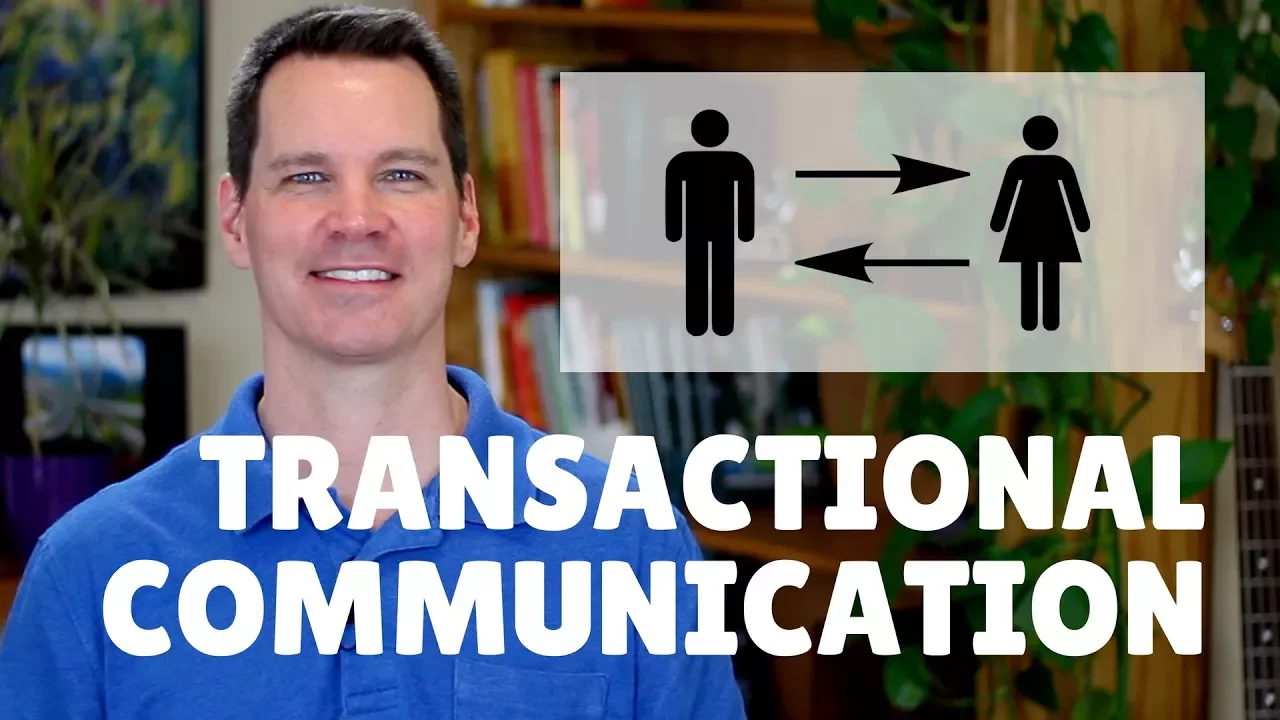
So let's dig into that. First, I want to talk about how this differs a little bit with Shannon and Weaver. In the Shannon and Weaver one-way, linear model, you have a sender and a receiver. But in the transactional approach, the researchers that developed this say that we are both simultaneously senders and receivers. That means that we're always giving each other feedback both verbal and nonverbal and so in that way we're always sending messages.
Paul Watzlawick uses the phrase you cannot not communicate. Which is another way to say you're always sending and receiving messages whether you realize it or not. So let's say somebody is giving you the silent treatment and they're deliberately trying not to verbally communicate. You're still getting a message. It may not be easy to determine exactly what that message is but there's still messages going back and forth.
So you're always communicating. You cannot not communicate. Another aspect that this model brings into the situation is the context. So anytime you're interacting with someone, it's not isolated and pure. You're in a context. Let's say you're in a work setting. And that work setting shapes the way you send and receive messages. Another aspect of this is what we call the "field of experience." I come into a situation and you come into a situation with a whole set of life experiences, values, and beliefs.
And that's going to shape how we send and receive and interpret the messages that we are exchanging. So that's a really interesting aspect of this that the other linear Shannon and Weaver model does not capture. Another aspect of this is the notion that in any kind of interaction we have both content that's being exchanged, like information, and we also have relational dynamics that are being built and established and reinforced.
So even if I'm just saying to my wife "Hey, how was work today?" And she says, "Oh, it was okay." Now there's information that's going back and forth but there's relational work happening at the same time. And, in fact, a very simple example like that, "How was work today?" "Oh, it was okay." There's a lot going on there because you can read the other person's nonverbal and there's feedback going on you can hear tone of voice and you can read into what's happening.
In fact, you probably know this from personal experience. If someone says, "Oh, it's okay today," It depends HOW they said it, not just the information or the content. There's that relational dynamic. So this model through and through is much more sophisticated and layered and that earlier video on the Shannon and Weaver model I talked about how the model is simple but people are complicated. And in this Transactional Model, the researchers came along and rounded out their notion of how communication happens face-to-face and came up with a model that's much more sophisticated and layered to help make sense of that human interaction, in that dynamic that we experienced day to day.
So question of the day, what are your thoughts on this Transactional Model of Communication. I would love to hear your comments in that section below. I would also like to hear how you see this applying to professional settings specifically. How, as a leader, can thinking in terms of this model help your leadership develop to the next level? I look forward to seeing those comments below. So, thanks. God bless. And I will see you in the next video.
The words are the caption track's own and nothing is reworded or re-transcribed. Paragraph breaks are placed between sentences so the text reads as prose.
Free tools for your own script. No signup, no login.
Paste your draft and see where viewers are likely to drop off, with a rewrite for each weak line.
Paste the first 30 seconds of your own draft for a hook score and rewrites.
Check your draft against YouTube's advertiser-friendly guidelines before you record it.
Read this channel's public videos and transcripts, and download a writing brief for it.