Getting the transcript
Reading the captions from YouTube. A video nobody has opened here before takes 10 to 30 seconds; this page fills in on its own.
Getting the transcript
Reading the captions from YouTube. A video nobody has opened here before takes 10 to 30 seconds; this page fills in on its own.
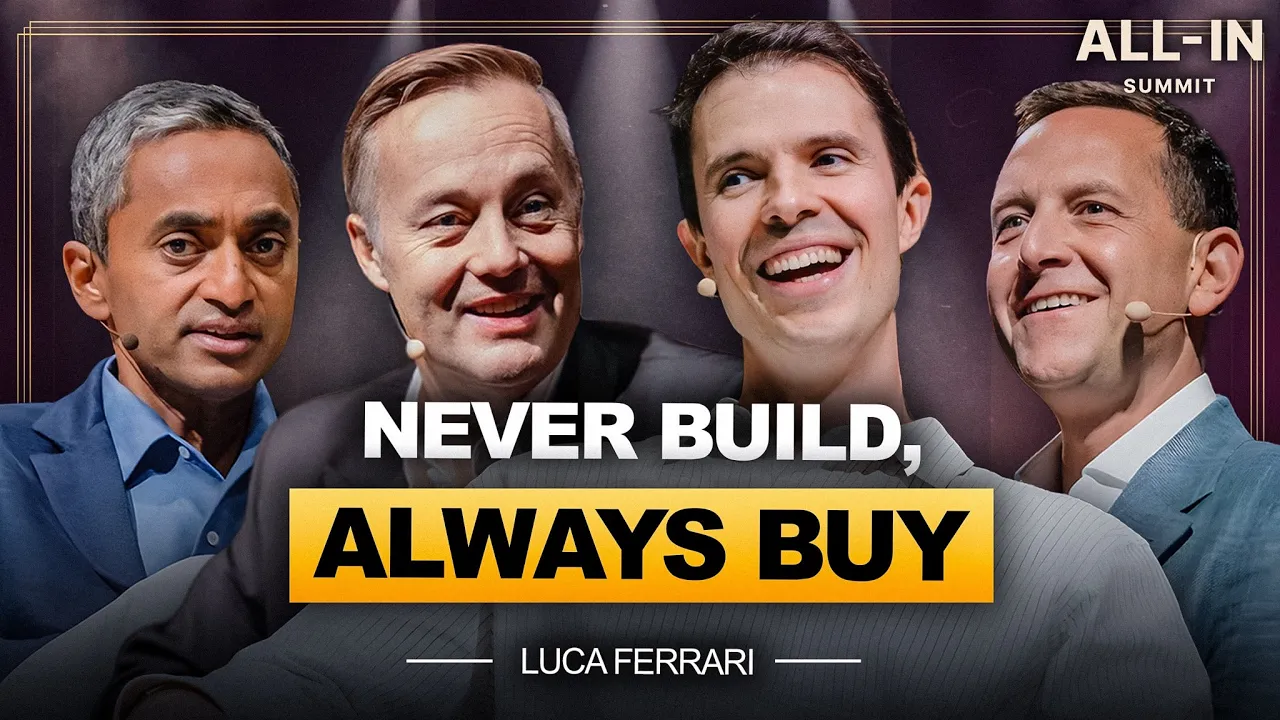
All-In Podcast · @allin
Words
5,064
Runtime
25:30
Speaking pace
199wpm
Reading time
21min
199 words per minute, between the 181 median and the 201 75th percentile of 349 measured videos. That distribution comes from the 349-video hook study.
Opening (first 30 seconds)
You are the reason that Nasdaq exists. [music] >> They went from zero to $1 billion in revenue in just 10 years. >> Bending Spoon's CEO, Luca Ferrari. >> We have never lost a bid before. >> Well, AOL has a new parent again. [music] >> Milan-based tech company Bending Spoons announced it will buy ticketing platform Eventbrite. >> Bending Spoons is stirring up the market. [music] >> They go from fixing one zombie app to reviving 20 of them. >> Half a million people use our products. We're trying to build a generational company. >> Please welcome Luca Ferrari.
100 words, the words spoken in the first 30 seconds at 199 words per minute.
Free, no signup. See how the first 30 seconds hold attention, with rewrites.
Sentence shape
| Measure | This transcript |
|---|---|
| Sentences | 319 |
| Average words per sentence | 15.9 |
| Longest sentence | 75 words |
| Questions asked | 53 |
| Sentences containing a number | 38 |
Most used terms
Filler phrases
188 in total: uh 66 · you know 38 · like 30 · um 26 · I mean 11 · kind of 7 · actually 6 · basically 2 · right? 1 · sort of 1.
A literal whole-word count of the same phrase list the Prepublish browser extension uses, so a phrase inside another word is not counted and a phrase used in its ordinary sense still is. It is a count and not a judgement.
What this transcript is
Every word below is the caption track YouTube publishes for this video, pulled from the video itself and reproduced unchanged. It is not Prepublish's writing, not a summary, and not a re-transcription: it is the video's own published captions. English captions, generated automatically by YouTube, in the video’s original language. Source: the video on YouTube. A channel that would rather this page did not exist can ask for its removal through the contact page, and it is removed.
No Script X-ray for this video: YouTube shows a Most replayed graph only once a video has enough views.
You are the reason that Nasdaq exists. [music] >> They went from zero to $1 billion in revenue in just 10 years. >> Bending Spoon's CEO, Luca Ferrari. >> We have never lost a bid before. >> Well, AOL has a new parent again. [music] >> Milan-based tech company Bending Spoons announced it will buy ticketing platform Eventbrite. >> Bending Spoons is stirring up the market. [music] >> They go from fixing one zombie app to reviving 20 of them. >> Half a million people use our products.
We're trying to build a generational company. >> Please welcome Luca Ferrari. >> [music] >> Hey, here he is. Nice to see you. >> Ciao, Luca. >> You got fans. >> All right, Luca. And you have a great company. >> Don't make fun of Luca Ferrari. >> I'm not. I'm just >> This is a great Italian entrepreneur, so shut the up. >> Absolutely. >> Absolutely. I I asked Luca >> yelling like a Super Mario Brothers in the audience. >> We could have another presidential moment here at the All-In podcast.
So, if she picks it if she if she calls you, then just run the phone over. >> I've [laughter] got my phone here. >> Okay, just in case. >> It's ready. >> Um I mean, there's a lot of us that have actually been tracking you for a while. Um I I originally heard about you because you were in Milano, uh where, you know, my wife's family's from. Uh and you had this incredibly progressive, methodical approach to growth. You did this fantastic um podcast with um uh Patrick O'Shaughnessy, which was great.
I encourage all of you to listen to it. And you explained uh the arc of Bending Spoons. And I'd love for you to explain to folks the first few years and just all the misery and failure, the the nadir of the company, and then the beginning of the ascent. >> Yeah, so the you know, most of the I mean, the pain, there's been plenty of pain throughout as for most entrepreneurs, I think, but the the the biggest failures were in the previous startup.
So, with my co-founders, we launched an AI company in 2010, very early, too early, clearly. Uh crashed and burned um 3 years later. Uh we're left with about $40,000 in capital we'd raised from the VC and um um we you know, clearly, there wasn't a lot to salvage other than our relationship being stronger uh and uh and and that money that the VC uh pretty much uh gifted to us as they, you know, didn't want to go through the liquidation process to to much in legal fees and too many headaches.
They had seen us work pretty hard uh and so they told us, "You guys keep it. We'll sell our shares to you for $1, like uh nominal value, and you go and get a nice vacation." Uh we're clearly a little bit sick in the head, and so we took the money and enthusiastically turned it into uh seed financing for Benny's Foods. And and we, you know, we came up with >> with $40,000. >> $40,000 exactly in 2013, and we we had this strategy, which has remained pretty much the same, obviously.
You get smarter, you refine it in time. Uh but that was The idea was we we are not very good at finding product market fit, or maybe, you know, luck plays a big role, probably both things are true. Uh but we have become pretty good at engineering, uh design, monetization, marketing in just 3 years of hard work, and so we should be able to be among the best in the world at that. And we should be able to buy product market fit from people, and uh and and you know, they get a good price, we get a good asset we can make more valuable, and then we we deploy more capital into making our our platform more competitive. >> acquisition, and how much did you pay, and how did you get the deal done? >> So, the first acquisition uh was uh we paid $10,000, give or take and it was a um a mobile app for iPhone specifically that you used to personalize your your keyboard.
Very simple. One uh one uh uh man kind of developer uh sold it to us obviously a very amateurish operation. Not that difficult at the time to to make it better and more successful. Uh but you know >> What were you buying? Like you're buying one times revenue? You're buying the revenue? You're buying the app? >> That one specifically I think had a negligible revenue. It wasn't even really monetized. >> Okay. >> Uh which of course is never the case for for scaled businesses whatever. >> but it had users. >> It had users.
So what we bought at the time was uh an app with a bunch of users and a good positioning on the app store so they it would get an influx of new users. Um and that's you know remained broadly speaking similar over time and you know we keep looking for great brands, user and customer bases where we can uh uh you know improve everything ideally and make those assets even more valuable over over time. We just do it at a much bigger scale these days but the the underlying concepts have not changed. >> Did Did you rebuild that app?
Did you take over the code base and redo it? Just help us understand technically what's going on in the organization from that business through to some of the bigger ones today. >> Yeah. >> Is it a Is it a code base Are you Are you doing engineering, product design, marketing, all of the above? >> Yeah, most of what we do is is engineering and product. We have a core team of this point about 800 people and uh I would say probably three quarters of them are either engineers or yeah researchers or product designers, product managers.
Most of what we do is actually improving technologies and products. Uh and and of course you know that yes that app we we wrote it completely and but it's you know it's very early days. Today we're much more sophisticated. We we So what we do is we we bring in a call it an operating system of 50 plus proprietary technologies we built kind of an engine to run technology businesses very effectively and efficiently and really our core product.
We swap out the technological foundation of the businesses we buy with that one so we can run it much better and also the people we transition across our various businesses always play by the same rules. They're more efficient cuz they find the same tool. >> these tools cut across what like HR, finance, tech ops, dev ops? >> Pretty much everything. Yeah, I mean orchestration of AI models check, recruiting tools check, AB testing platforms check. >> And then do you bring all of the technology spend up to the top co so that you're doing one deal with AWS, one all the licensing becomes scaled across one entity? >> Yeah, that's a that's a lever for quality creation.
I'd say that's a relatively small one and probably adds I don't know one to percentage points in EBITDA margins. The you know, the more important aspects are being able to drive revenue increases through better product tech and monetization, sometimes marketing, cost reduction through leaner teams so more talent dense teams and but yes, vendor optimization is is helpful. >> You were doing the Elon X playbook before he did it.
I mean like there's some stories that were written about how you right-sized Vimeo's workforce, you right-sized Brightcove. >> He called me before doing the X. No, I'm joking. >> Oh, he did? >> Oh, no. Okay. >> [laughter] >> Advice? >> But explain explain >> How do I cut all the people? >> No, no, he didn't [laughter] he didn't do that. I don't know Elon so. >> Luka, how did you figure out that you could cut 80% of a team and it still works?
How do how do you figure that out? Is that accidental where you just pushing to a threshold? >> I think it's it's something we we learned partially because early early days where we were acquiring smaller businesses typically these people would sell us the assets say the product but not the team cuz for them it was very small teams they you know, wanted to move on to whatever other project they had and so we didn't really know any better.
We were establishing teams internally to carry on the work and the number of FTEs was much smaller than >> In the original footprint? >> No, no, no. Well, also that, but then when we ended up buying businesses with established teams, we had perhaps naively built teams to run comparable businesses that were much smaller. And so we couldn't explain why you necessarily needed more people. Partly, yes, through experimentation we have found call it the sweet spot.
Obviously, it's never perfect. We we Overall, let's say the the key thing for us is we want our businesses to be, you know, run at a 10 out of 10 level. And we find that generally you're more likely to get that that level of performance if you have very very small teams, super high bar for talent, and sensible ownership. >> a 40-odd billion-dollar market cap-ish right now, I think, plus or minus. Um >> I don't know, actually.
I haven't checked the the ticker since we IPO'd. >> it's roughly roughly in that zone. Um which is incredible from starting with a $10,000 acquisition. When do you trans- when did you transition from uh scaling on cash flow to then using debt and using more sophisticated financial engineering so you can go after these bigger fish? And how how has it gone so far? >> So, historically, uh we started using debt in 2017, I believe, either 2017 or 2018.
Uh very basic bank loans, TLAs. And then as we So, free cash flow, their investment of free cash flow had always been a thing for us. We have redeployed pretty much 100% of our free cash flow toward acquisitions since the beginning. Uh that from 2017, and you know, and and as we as we scaled, we got more credible, a little bit wiser, and more sophisticated, we went for, you know, TLBs. And maybe in the future there'll be bond issuances and other more complex instruments.
We haven't used a whole lot of equity. Actually, when we IPO'd, we had only {quote} only raised about half a billion dollar in primary equity. And we were at roughly 20 billion in valuation and even that half a billion dollar we had raised pretty much all of it in the previous 6 months or so. So, almost all of our track record we've achieved through reinvestment of free cash flows and and that. But, going forward I think particularly as a public company using equity tactically here and there could be a good good >> So, with that equity um you are taking loans, I guess, five, six points over LIBOR, so 10%, 12% loans, and then you buy a business like Airtable, but that that means you have to pay a hundred million dollars in a debt payments per year.
If interest rates go up and it's a 90-some-odd chance they're going to start going up, what what does that do with the business? Does it throttle a little bit? And then my second question, people have been pretty enamored by the progress you're making, uh and I think you're now facing uh some Bending Spoons competitors. So, maybe you could talk Are you seeing more people show up at these auctions and it's not just you and like two other players? >> Yeah, so um debt is an an accelerant to our growth.
Uh we would still grow up pretty fast if we only use free cash flows, but our free cash flows, but definitely being able to use that is is a good thing. Uh prudent levels of that. And and and I would say uh I will give you like two parts. Uh first, the the risk with the existing indebtedness. So, all of our debt currently the the average cost of blended cost is about 9% give or take and it's fully hedged. So, increases in interest rates would not uh impact our cost of debt.
Uh it matures in 2031. So, we are in a position to pay pay back completely before maturity. We're currently at two and a half times leverage approximately. Now, if uh interest rates were to go up substantially, then new debt would be would be more expensive. Um I think that would be under most scenarios a net positive for us for a couple of reasons. Uh our returns unlevered historically have been pretty high consistently above 25%.
Again, unlevered. So, whether we pay 9% or 12% of course I'd rather pay nine, but it's not it doesn't break the model. And you know, in the second one aspect is typically when interest rates go up the value of of of assets go goes down and so as a serial acquirer I think we're more likely to benefit more from the lower valuations than the higher that now that depends I'm generalizing and simplifying a bit, but uh overall we feel we are fairly well protected and you know, robust when it comes to to indebtedness.
When it comes to competition for acquisitions, we have all of the processes we have participated in have had other other buyers or almost all of them. I'm sure competition will intensify or I'm sure it may intensify who knows. It could also get weaker. We're seeing private equity we have historically downsized after actually raised less capital to do the same and so on balance we may be better off. It's also I think important to to note that it's it's really painful and time consuming to replicate what we've built cuz a lot of it is based on you know, those technologies which you can't build overnight.
You don't even know what to build really if you haven't gone through many years of painful experimentation mistakes trying to repeat. Um you a lot of the value we create is thanks to those $800 people we have painstakingly selected over time the culture of high performance and and a scientific approach to business we have developed. Those things are there's no shortcut. I still remember hiring the first one person and then two people and then four people.
You could probably do it in five years rather than 13, but not in two months. So, I I think we will face competition, but I'm pretty optimistic. >> Follow up if I may. In our industry, the venture capital industry and even going into public markets, we covet the founder. And if a company loses its founder and the founder authority they have like Elon to say hey, we're not going to make the Model X. We're not going to make the Model S.
We're going to convert those to Optimus." Those kind of bold bets only made by founders. You have a slightly different philosophy here. You don't want founders inside the company. You're not looking for that founder authority in each of these brands based on what I've I've heard you say. Um so, what is the expectation for your brands? Do you want to create cutting-edge, you know, version twos of Eventbrite's and Vimeo, or do you just want them to grow at a predictable rate and throw off that cash flow.
So, talk about the founder role. >> Yeah, so I think if if you can have a founder with that, you know, level of of passion and and that mentality is, you know, nine times [clears throat] out of 10 will be a major net positive. Uh the generally when we end up acquiring companies, these are businesses that that have been around for 10, 20 years, even more than 20 years in some cases. And and for the founders, if they're still on board, sometimes they aren't on board, for them it's really a moment of, "Okay, this is a chapter I'm closing.
I'm I'm I'm going to move on." So, the the the real question there, for for us we win if that business does better with us than it would have uh under previous ownership. Uh obviously, if we could have uh exceptional founders stay on board and pour their hearts into it, it it would be even better, but we can still do well by being a better home for that business than that business staying with the same uh ownership group and maybe losing the founder anyway.
Um so, it's not that we don't want founders, but what once you know, companies are sold, the people are generally looking to move on. >> Can you bring us into the M&A deal desk? So, like in the room, walk us through your screening process. Are we How do we How are we doing this? What are we looking for? Are we looking for synergy and integration with the assets that we've bought before? Are we looking purely at cash flow?
How do we stack rank these things? Just walk us through the deal desk. >> Yeah, so I think there's a qualitative criteria we use to uh slim down the the long list of businesses that we would be interesting targets. Uh one is scale. We the that process of any very deep integration uh and and and profound transformation takes a lot of operational effort, so we can't do a million of these. And by the way, the amount of time and effort it takes to transform a business we found it doesn't really scale linearly with revenue, so we're much better off acquiring relatively few sizable companies than a million small ones.
So, we look we look for scale. We look for predictability in in earnings, and it's a big topic in and of itself, but we like businesses where we are pretty confident we can project at least you know, the next 5 or 6 years directionally. Um and then we look for businesses where we can create a lot of value. It could be technology, org, uh product, monetization, marketing. Ideally, most of these. >> Does value include the integration with these other assets that you have, or value just means economic value operating? >> Well, let me just ask a detailed point of that.
Like if if you own AOL, you can put ads for Vimeo or Eventbrite or Miro on AOL. Um if you own Vimeo, you could probably have a sales team that's selling ads on AOL that you can use. How much synergistic effect is there? And if there is synergistic effect and you've got all this capacity to do design, build, product management, agentic orchestration, testing, AB testing, why not also build organically at the same time and leverage the network effects of the existing businesses? >> So, historically, we have created almost no value from let's say customer-facing synergies, what what you described.
Uh plenty of behind-the-scenes synergies. Like I said, it's all built on the same technological foundations and then there's there's this large core team of people we move around fluidly. Uh going forward and and by the way, the reason why we haven't unlocked a lot of value through customer-facing synergies has been that um we I think the portfolio wasn't necessarily large enough for good overlaps to materialize, but as it grows more and more, for example, now Airtable and Miro are both quite appealing to a lot of enterprises.
I think what you are describing could become an additional value creation uh uh dimension. >> You haven't tried or you've tried and it hasn't worked. >> No, we've we've tried and it's worked, but marginally. So, maybe it's helped uh 3%, but not like the bulk of it has been bringing uh 10 out of 10 excellence in operations, product, monetization, uh technology. >> Look at when >> On an individual business basis. >> And if Why not build organically products?
Yeah. >> Yeah, so the First of all, you can't do everything. I mean, Elon can't I I you know, my colleagues colleagues and I we don't think we can. Maybe we should be more ambitious with ourselves, but um And so >> a lot on your plate. >> Yeah, yeah. >> There's so many different kinds of products already. >> We we launch a lot of new things on top of existing brands, but it's not like completely radical innovation. We don't do a lot of that.
We try to stay focused on on one thing to try to be the very best in the world at it. Also, the at the scale we are at at this point where, you know, on a pro forma with Miro close to a run rate of $4 billion in revenue, it's difficult. Like if you look at the percentage of new startups or products being launched that would move the needle, it's it's very very small. So, what's the you know, we would have to deploy a lot of our resources and very unlikely to work. >> I I Sorry, let me just Can you just talk about the thing you and I talked about this um point on the talent exodus that happens in Silicon Valley companies when they start to stall out.
And that the talent maybe that's working on the business isn't the quality of the talent that you've built in your your core platform. How much of that is assessed in that M&A process that you might have mentioned? >> Uh well, it's it's I mean, it's difficult to assess from the outside in, but you can form a uh first principles opinions. Uh businesses that again are more in a saturation phase, they tend not to be as appealing to some of the entrepreneurial engineers or designers.
Um And [clears throat] so you can assume that the level of talent will be maybe good, but perhaps not, you know, what Anthropic would have. Not saying anything shocking here. >> They have a very unique kind of talent, but we'll talk about that another time. >> Yeah, okay. We we have a big advantage in attracting talent cuz if you work at Bending Spoons, it may be one of the very few places in the world where you can spend say one year rebuilding the email infrastructure for AOL and then 7 months helping rethink subscriptions on on the email and then build a platform technology to manage payments all with the same employer, mostly the same colleagues, same culture. >> You get broad technical scope. >> Exactly.
So career opportunities just stay motivated because it's fun and new. Very high talent density begets high talent density, so there is an element of virtual cycle. So we have been able to attract ton of people last year, 800,000 applications, we hired fewer than 300 people. >> Are they all in Milan? Where are they? >> No, no. We we are fully, you know, very international as a company. Milan for historical reasons remains like the biggest pool of of talent, but London for example is coming up faster, Madrid.
We'll we'll be hiring people, plenty of people in the States, I think starting starting next year. >> Bring up an interesting question. Europe as a tech center isn't exactly something that venture capitalists, even late stage investors are pursuing. They kind of look at the market there as maybe slower and maybe just not as good of an opportunity. It's I think their decision. Rather be in Silicon Valley or American companies or perhaps Asia.
So what's it like being the most aggressive, successful company then in Europe or one of them? Is there >> I think you're right. No, I think it is the >> I mean I Well, I mean Spotify obviously is much better, but Klarna. You're you're in the top 10 probably. Clearly in the top 10, so what's the talent pool like there? How is it different? Specifically Italy. I I notice when Chamath goes to Italy, maybe the there's a little bit less working going on. >> An extra button he he goes from three on buttons to four. >> Yeah, the buttons go down and the number of hours in front of a laptop goes down as well. >> Chamath, we see it. >> you keep these Italians working?
How do you do What's the secret? >> No, but tell us about the talent pool in running a company in Europe. >> So, I I think I think Europe has a lot of problems, but I think there's a pretty good talent half a billion people living let's say the main part of Europe. So, it's a lot of people with pretty good education. It's not Stanford, but it's solid and and a lot of these people have a chip on their shoulder to prove we're not necessarily less smart or capable.
So, you do find a lot of good people. I I do think there is a the fact that Italians don't want work hard is mostly a false stereotype. >> Yes. >> I we find that I mean my wife she doesn't work with me. She works in another company. She works a lot long hours. At our company we work pretty hard. We generally find that when we acquire companies and we work with existing teams more often than not the team we we bring in works substantially harder.
So, um I don't know. We just try to hire people who are intrinsically motivated, very ambitious, you're just hungry, entrepreneurial and and then give them you know a good reason to to do their best work because they see that they can have a unique career. >> anywhere other than Milan and that it might be an accelerant for the business? New York City where the banking capital is, Silicon Valley the tech capital. Have you thought about moving the headquarters? >> Why?
Lucas totally right. You get like these people the problem with people in in the like you go to these typical places, typical schools, they think they're geniuses and it's like when you actually like just look even just look at AI. Who are the major contributors? These are not like the they're not from MIT, Stanford per se, you know? They're at UFT. >> It's like McGill. >> It's like CMU. >> It could well it could be an advantage. >> Well, that's sort of what I'm getting at.
It's a huge advantage. I mean, when I when I interviewed Charles Koch, you know, I talked about this. What I found so fascinating is he built that business, probably the most extraordinary wholly-owned business on Earth, from nothing effectively, in Wichita, Kansas. And I say it's like the Wichita mindset cuz he basically kind of ignored everything that was conventional, and he was able to do things his own way. I don't know anyone that thinks and does things the way you do them that are based in Silicon Valley, and that might be the reason cuz you're in Milan and you're not kind of indoctrinated into cultural thinking. >> look, I'll just say what's what what I find so incredibly interesting about your company and what you're building is in in all of our generations, we've seen this these incredible examples of companies that have run your playbook but in traditional industries.
Um Amphenol, Roper, Danaher, Berkshire. And we've never seen a successful implementation of it in tech. And uh I think you're the best-scaled example. I mean, Expedia tried, Barry tried. I think it was a little complicated. Um so, it's really exciting to see that this thing can work because the the the structural issue was always how do you underwrite these cash flows? And I think you're proving that they're underwritable, that these things can go out for 7, 8, 9 years.
And especially now, if you look at PE, the PE guys are basically like, "We don't know what the going on." Right? Yet, you're still able to go and transact, and you're announcing deals at a pace where these, you know, a lot of the PE folks are So, how how do you how do you manage this risk? Like, it's clearly not a risk. You think it's a tailwind for you. >> Yeah, I think the you know, the private equity is completely different cuz they keep these companies separate for the most part to sell them, and so they could never have that technological foundation because once you plug it in in a company, what do you do when you sell it to to your private equity competitor?
Do you license it to them? So, that's, you know, remove that. They can't have a pooled team of engineers, designers because if they put them on the on the on a business and then they sell it, what do they do? They they the team out, and that means the team the the business is almost worthless or do they sell the team with it? So, it just the model is completely different and and I believe these structural differences are a big reason why we have been I I'd like to say successful.
So, it will never work with the traditional private equity which has other advantages. You can deploy maybe a lot more capital cuz it's a little bit more, you know, hands-off. But but you can never achieve the returns I think we we have. >> Look, I wanted to say thank you. An incredible business you're building. Congratulations. >> Well done.
The words are the caption track's own and nothing is reworded or re-transcribed. Paragraph breaks are placed between sentences so the text reads as prose.
Free tools for your own script. No signup, no login.
Paste your draft and see where viewers are likely to drop off, with a rewrite for each weak line.
Paste the first 30 seconds of your own draft for a hook score and rewrites.
Check your draft against YouTube's advertiser-friendly guidelines before you record it.
Read this channel's public videos and transcripts, and download a writing brief for it.