Getting the transcript
Reading the captions from YouTube. A video nobody has opened here before takes 10 to 30 seconds; this page fills in on its own.
Getting the transcript
Reading the captions from YouTube. A video nobody has opened here before takes 10 to 30 seconds; this page fills in on its own.
AI Engineer · @aiDotEngineer
This video has no Most replayed graph yet: YouTube shows one only once a video has enough views. These are the moments viewers replayed most in AI Engineer's most watched videos.
Most replayed moment at 18:45
4.8x that video's typical replay level
that they're they're changing they're changing things in the database not yet. You want to run them through the ontology first and make sure that works. Okay. I only got an I've got I've got another I've just a short time. I'm going to try to show you some of the things that um that you can
Said at 18:37
Most replayed moment at 16:13
3.6x that video's typical replay level
method signatures, the program layout and the call stacks. So here's some examples. I don't think you'll be able to read this one, but this is like the level of abstraction we're at. It's how we're actually going to lay this stuff out and how these systems are going to interact. Dylan Mulroy from Cloudflare talks a
Said at 16:06
Most replayed moment at 13:49
2.3x that video's typical replay level
Fable uh and it runs into an unknown, ask it to log it, right? So that um you uh you can see where the deviations happened and then you can sort of figure out why as well, you know? It will usually give you some context about what happened.
Said at 13:43
The graph counts replays. It does not show where viewers stopped watching.
Words
1,325
Runtime
7:13
Speaking pace
184wpm
Reading time
6min
184 words per minute, just over the 181 median of 349 measured videos. That distribution comes from the 349-video hook study.
Opening (first 30 seconds)
An agent opens a pull request. It passes the tests. It updates the documentation. It closes the issue and comments, "Looks done to me." But is it actually done? Is it done enough to merge? Is it done enough to deploy? Is it done enough to announce to your customers? These are fundamentally different operational claims, and most agent systems just flatten it to a single green check mark. I'm Dota. I'm the creator of Paperclip, and I'm going to give you some hard-earned lessons that we've learned in creating Paperclip's liveness
92 words, the words spoken in the first 30 seconds at 184 words per minute.
Free, no signup. See how the first 30 seconds hold attention, with rewrites.
Sentence shape
| Measure | This transcript |
|---|---|
| Sentences | 79 |
| Average words per sentence | 16.8 |
| Longest sentence | 56 words |
| Questions asked | 8 |
| Sentences containing a number | 1 |
Most used terms
Filler phrases
24 in total: actually 16 · um 3 · like 2 · you know 2 · kind of 1.
A literal whole-word count of the same phrase list the Prepublish browser extension uses, so a phrase inside another word is not counted and a phrase used in its ordinary sense still is. It is a count and not a judgement.
What this transcript is
Every word below is the caption track YouTube publishes for this video, pulled from the video itself and reproduced unchanged. It is not Prepublish's writing, not a summary, and not a re-transcription: it is the video's own published captions. English captions, generated automatically by YouTube, in the video’s original language. Source: the video on YouTube. A channel that would rather this page did not exist can ask for its removal through the contact page, and it is removed.
An agent opens a pull request. It passes the tests. It updates the documentation. It closes the issue and comments, "Looks done to me." But is it actually done? Is it done enough to merge? Is it done enough to deploy? Is it done enough to announce to your customers? These are fundamentally different operational claims, and most agent systems just flatten it to a single green check mark. I'm Dota. I'm the creator of Paperclip, and I'm going to give you some hard-earned lessons that we've learned in creating Paperclip's liveness model.
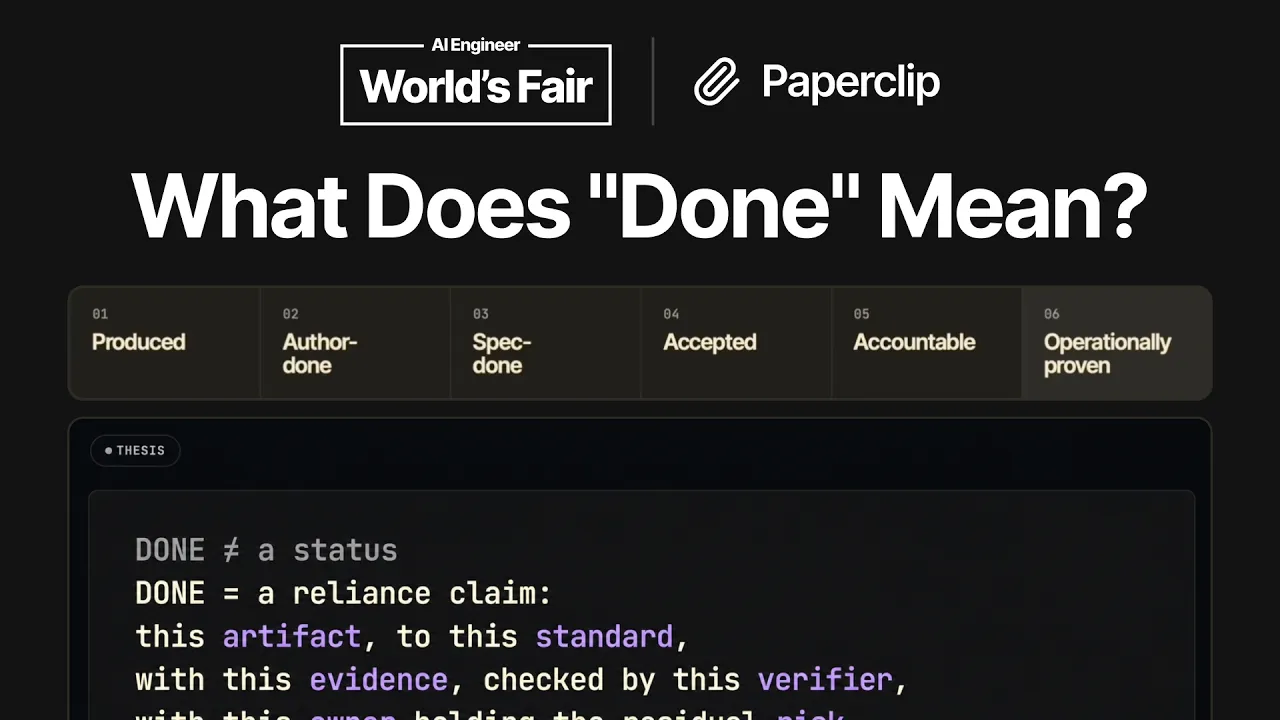
What does done even mean? Here's the thing. Programming is solved, and agents can now produce more code and documentation faster than any human can ever verify. And this actually gives us a new failure mode, is that agents can actually create more work than humans have time to verify. So we need a way to verify that our agents are done more than just letting them check a checkbox. Done doesn't mean that an agent just changed the status of a task being done.
Saying that something is done is actually a bundle of claims. You're saying that an artifact was produced, that you have evidence that the task is actually complete, and you have a rubric in which you can verify against. You know exactly who the owner is for the next step, and you know exactly what the next step is. There's different levels to how done something is. The producer might claim something is complete, but you need to have a reviewer, another party that looks at it and finds no obvious issues.
You want to verify and make sure that the evidence actually meets a specified standard. You want to make sure that a person who is authorized to approve it actually approves that the work is done. And you want to make sure that there's somebody who actually stands behind the decision. And ideally, what you want is that the outcome has actually survived real-world conditions. Because exhaustive human verification fails at high volume.
You might be able to verify a few tasks per day, but essentially, if you have humans verifying all the tasks and they have to sign off on it, you eventually what you just get is a form of verification theater. What you need is a protocol for defining how tasks actually progress through a system. You want to make sure that tasks are always kept moving, but they don't get stuck into invalid states. You need a control plane that actually has the execution of the tasks being tied to specific contracts and constraints about what the system will do and what agents it will hand off your next task to.
Because really what you're trying to play against is this idea around keeping work moving, but also having it verified. When a task has been reviewed by a human, you get the assurance that it's correct. But having a human verify it means that the task is dead in its tracks. You also want to keep liveliness. Liveliness means that the work is continuing with no blockers. And you're always trying to keep these two things in balance.
If you have tasks that are completely alive with no approvals, then what you get is this classic AI slop because you're producing a lot of things with kind of no quality control and it's worse than creating nothing after a long period of time. But if you have peer review, um then you have this enormous review queue where humans can't actually review it by hand anyway. These agents will be creating far more than you can ever actually review, and so we have to find a way to tease apart the bundle of claims that are involved in saying a task is done.
With Paperclip, we have a number of mechanisms to keep this going. You might think that you can easily just write a for loop over your task manager and have your agents work, but quickly you'll find that falls apart. As soon as you start integrating task dependency trees, blockers, multiple agents, item potent checkouts, like locks on checkouts, you find that this tension between liveliness and verification actually gets quite complicated.
There's really three invariants that are extremely important when you're thinking about what you want out of a control plane for your agentic work. You want to ensure that productive work continues. You want to make sure that only real blockers stop work. And you want to make sure that infinite loops are bounded. In Paperclip, we have built a number of mechanisms to deal with this problem. So, for example, every time you have a task, there's clear transitions to what the next state could be.
We have first-class blockers between tasks, and the control plane enforces those blockers. We have moments of interactive human approval, where human choices leave an audit trail. You can set reviewers and approvers on tasks explicitly, meaning when this task completes, another agent can review it. We also have the idea of watchdogs, which is this maximizer mode, which says, um, try as hard as you can to make sure that this happens.
When you have a watchdog, it's another agent, um, who is given a goal, and it enforces that all of your agents continue to work until that goal has been achieved. The important thing here is that the watchdog within Paperclip is harness agnostic. You can use it with Pi, OpenGL, Hermes, Claude Code, Codex, whatever you're using, you have one consistent interface for ensuring that goal is complete. So, one of the best pieces of advice we have is that you stop treating done as a Boolean and treat it more like an object.
This isn't specific to Paperclip. It's just advice on how you think about what is done. Humans automatically paper over these details, but when we're building agentic systems, it's important that your agents can distinguish between the different pieces of what they're claiming when they say something is done. The artifact that they're saying is complete, the scope, the rubric or the standard, the evidence that it's done, who verified the work, who has the authority to sign off on the work, And what risk might be left?
And really, what's the next action going to be? So, you want to make sure that when you define done, it's not just a checkbox. So, if you want to get 100 times more work done, you should steal this checklist. You need to define exactly what does done mean for this task. You definitely want to separate the verifier from the author. Often, this means you're using a different model. So, if you're coding using Claude, have Codex verify.
You want to ask your agents to provide evidence. Don't just ask them to say, "Is this done?" But, give them the tools they need to verify that the work is done. Write the code to have the custom browser harness. Write the code to take the screenshots. Make sure they have access to a browser. Make sure that they have custom agent hooks or custom agent tooling to actually run through and click the buttons and try it out themselves and verify that the work is truly done.
Make sure you have a clear chain of custody, that every agent knows that as soon as they're done, who they're supposed to give the work to next. It can be easy to just fire off a single-line instruction and vibe with whatever comes back. But, if you have serious work that you're accountable for, it's very important that you define what done really means in as much detail as possible, and that you have a structure for your agents, so that way they can verify that all of the claims that are involved with something being done are actually met.
Thank you.
The words are the caption track's own and nothing is reworded or re-transcribed. Paragraph breaks are placed between sentences so the text reads as prose.
Free tools for your own script. No signup, no login.
Paste your draft and see where viewers are likely to drop off, with a rewrite for each weak line.
Paste the first 30 seconds of your own draft for a hook score and rewrites.
Check your draft against YouTube's advertiser-friendly guidelines before you record it.
Read this channel's public videos and transcripts, and download a writing brief for it.