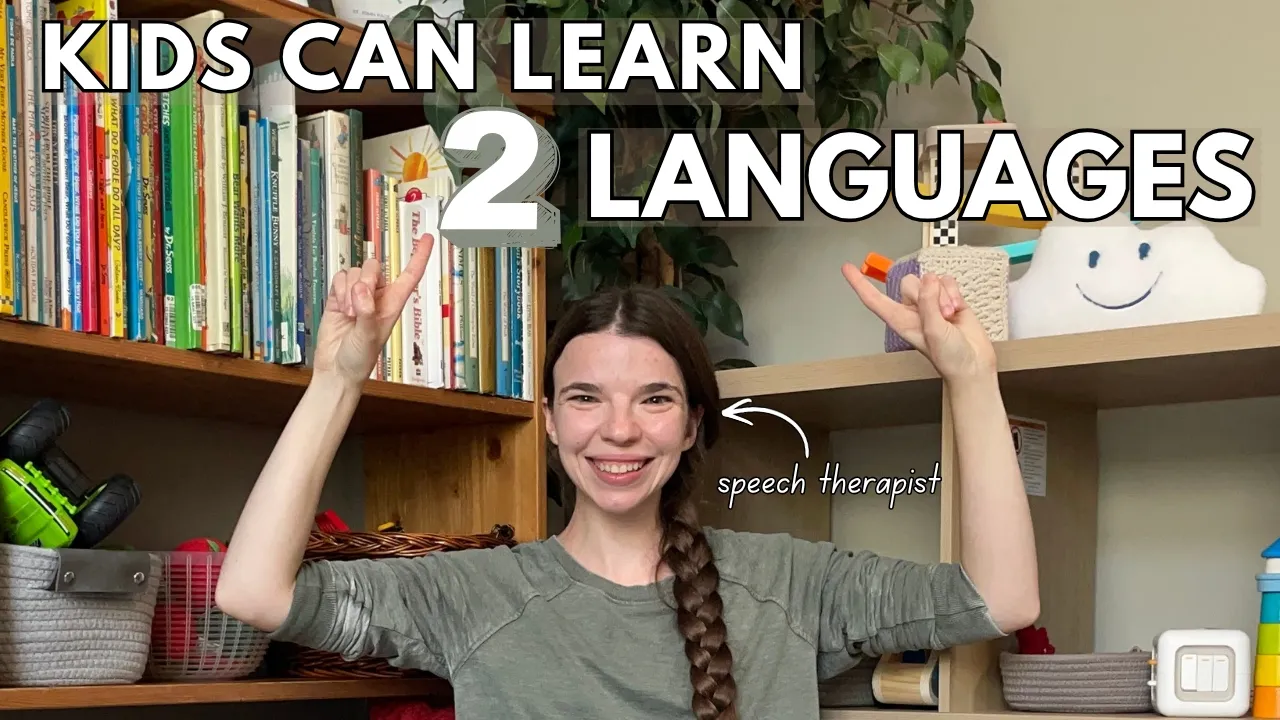
You Should Teach Your Child A Second Language | A Speech Therapist Explains transcript
Green Tea Playful Mom · @GreenTeaPlayfulMom
Words
4,250
Runtime
28:49
Speaking pace
147wpm
Reading time
18min
147 words per minute, below the 160 25th percentile of 349 measured videos. That distribution comes from the 349-video hook study.
Opening (first 30 seconds)
As a mom and speech therapist, I am here to tell you that you should teach your child a second language. For one, children are remarkably qualified and equipped to learn multiple languages. And second, there are some remarkable benefits to your children's cognitive language, social communication, and emotional development. Like, it just superpowers your child's brain to learn a second language. If you are new here, hi. My name is Teresa. I am
74 words, the words spoken in the first 30 seconds at 147 words per minute.
Sentence shape
| Measure | This transcript |
|---|---|
| Sentences | 273 |
| Average words per sentence | 15.6 |
| Longest sentence | 76 words |
| Questions asked | 16 |
| Sentences containing a number | 9 |
Most used terms
- language91
- child56
- learning36
- languages29
- ba19
- english17
- children16
- spanish16
- ba ba15
- brain14
- french14
- speak14
Filler phrases
88 in total: like 43 · you know 8 · kind of 7 · um 7 · right? 6 · basically 5 · uh 5 · actually 4 · literally 2 · sort of 1.
A literal whole-word count of the same phrase list the Prepublish browser extension uses, so a phrase inside another word is not counted and a phrase used in its ordinary sense still is. It is a count and not a judgement.
What this transcript is
Every word below is the caption track YouTube publishes for this video, pulled from the video itself and reproduced unchanged. It is not Prepublish's writing, not a summary, and not a re-transcription: it is the video's own published captions. English captions, generated automatically by YouTube, in the video’s original language. Source: the video on YouTube. A channel that would rather this page did not exist can ask for its removal through the contact page, and it is removed.
Transcript
As a mom and speech therapist, I am here to tell you that you should teach your child a second language. For one, children are remarkably qualified and equipped to learn multiple languages. And second, there are some remarkable benefits to your children's cognitive language, social communication, and emotional development. Like, it just superpowers your child's brain to learn a second language. If you are new here, hi.
My name is Teresa. I am a mom. I'm also a speech therapist. And if you want to build a languagerich home for your child that nurtures and fosters their development, be sure to like this video and subscribe to my channel. So, go ahead and get yourself a fancy cozy drink. I'm drinking my electrolytes. This is Element, and this just superpowers my brain every single day. I love it. So, if you want to try this out, I've got a link in my description.
You can get a free sample pack with your purchase if you use my link down below. All right, let's dive right in. All right, so let's talk about why kids are uniquely qualified and just amazing at learning language. And it all has to do with how plastic their brain is. And no, I'm not talking about plastic like Tupperware. I'm talking about neuroplastic. Your child's brain is so flexible and adaptable. That is the concept of neuroplasticity.
And especially from the age of birth to three, your child's brain is extremely flexible. Like the neuroplasticity in a birth to threeyear-old's brain is on a whole another level to us as adults. Like think about it. Like kids are constantly taking information in through their senses. So their brains are just uniquely adaptable and flexible and they're amazing at taking information in, taking in the patterns around them and learning from all of that.
Birth to three is where the most development, the most language learning happens in your child. So let's contrast that with say adults. All right, our brains. Yes, they are still actually very flexible and very adaptable. But we have gone through however long, however many years old you are, you have gone through that much learning and adapting and hardwiring, right? Your brain is already kind of formed and hardwired.
Whereas a child especially up till age three their brain is still being developed. It is still learning. It is still being hardwired. Um so adults yes we can we can [clears throat] learn things like actually it is amazing how much even older adults can can learn. When I was a speech therapist, uh, working as a speech therapist, I saw some incredible recovery and healing [snorts] from patients that I worked with. I worked with kids, but I also worked with adults.
And I would work with adults who were in their 80s, 90s, I even worked with a hundred year olds. And they were learning new things and their bodies were changing and adapting. Yes, it was slower [snorts] and it was not as set in stone like that learning had to be repeated a lot, but they could learn. So, let's contrast that with a newborn infant. And this is where I'm going to get into a little bit of a nerdy talk on uh neural development and language acquisition.
So, if you want to skip through this section, if you're not into that sort of thing, go ahead and use the uh table of contents or whatever, I've got I've got marker. I've got I've got timestamps. Time stamps, that's the word I'm thinking of. Go ahead and use the timestamps uh below and you can go ahead and skip through the section, but basically a when a child is born, their brain is what we call a tabula raza. And that is Greek or is it Greek?
Is it Greek? Let's check my notes. It is I don't have it in my notes. Anyway, it's Greek, probably Greek, maybe Latin for blank slate. Meaning, when your child is in the uterero and born, their brain is basically like a blank slate, a blank canvas that is just ready and primed to be filled with information. So babies are not born knowing English or French or Spanish or German or anything. They aren't born with a set in stone language system.
It's a blank slate. But babies can distinguish between languages very very early. There was this really cool study by uh Patricia Cool. Patrica cool um where she used what we call the high amplitude sucking method. And so what that high amplitude sucking method is is basically it is a way of measuring whether or not a baby like a newborn infant finds something new or novel. So basically what they do with this way of measuring is they put a pacifier in a child's mouth and that pacifier measures their rate of sucking.
And in initial studies that kind of tested this theory, they would play syllables for that child to listen to. Like they would play ba ba ba ba ba ba ba and they would measure the sucking rate of, you know, that child. And the longer that they played that baa ba ba ba ba ba ba syllable, their rate of sucking slowed down. As that syllable became familiar to them, they slowed their sucking down. And then the researchers would introduce a new novel syllable.
So they would go ba ba ba pa ba ba ba. And when that pa when the baby heard that, their sucking rate increased. And then as they became habituated to that new syllable, they would slow their rate of sucking back down again. We can measure how well a very very very young child knows information and knows stimuli. So Patricia Cool did something really really interesting with this. So she took newborns like I think it was as young as 6 hours old like hours after they were born.
She took newborn infants and she did the high amplitude sucking paradigm with these newborn infants. She had two groups. She had infants born to American Englishspeaking parents and then she had infants born to Swedishspeaking parents. And she played both Swedish and English language syllables out loud to the infants. And guess what? The American-born English-speaking infants had slower sucking rates when listening to English and higher sucking rates when listening to Swedish.
The Swedish infants had lower sucking rates when listening to Swedish and higher sucking rates when listening to English. So what does that mean? That means that in uterero when a baby is literally being developed in the womb they are learning and habituating to the native language of the parent. So the children of the Englishspeaking parents had faster sucker rates when they heard Swedish, meaning it was a new language.
And the Swedish speakaking infants or the infants of Swedish-speaking parents had faster sucker rates when they heard English, meaning it was a new language for them. So that just like blows my mind because that means that babies in the womb are already listening and forming those language patterns. Just it's just super crazy. Okay, so nerdy tangent aside. So the takeaway from this is that children start learning language incredibly early.
All right, need to boost my brain a little bit here. All right, so let's talk about why would you teach your child a second language? What is the benefit to that? Cognitive and linguistic benefits. We've got increased memory because you have to remember words in both languages, right? Attention and executive function. You are switching your attention between two languages. That requires a lot of mental flexibility, which is the next um big benefit.
An increased awareness of how language works, right? you're getting more exposure to a variety of languages, vocabularies, and grammatical structures. So, kids who are learning two languages have an increased awareness of how language works and an increased funological awareness. So, funological awareness is an understanding and an ability to manipulate sound systems of language. So think rhyming, syllable segmentation, onset.
All of these skills are phological awareness. And so think about it. If your child is being exposed to English and German and French and Spanish, think of how many different sound systems they are being exposed to and they are soaking it all in. So their ability to understand the sound systems and manipulate them in language is going to be super boosted by learning multiple languages. All right. Next, let's talk about actually let me also mention this.
So research has also kind of explored a potential link between learning multiple languages and slowing or delaying cognitive decline later in life. So, it's just overall amazing for your brain. Let's just say that. Next, let's talk about the communication and social benefits. So, children who are bilingual, they communicate with a wider range of people, right? Because a lot of times with linguistic changes come cultural changes as well.
So, they are used to communicating with a wider range of people, a wider culture of people. They can connect with other family members who might be monolingual like a grandparent. A greater awareness of how communication depends on person and context. So a lot of kid a lot of little kids have trouble with this where they don't understand that when you're talking with different kinds of people, you might have to communicate in different ways.
Like the way that you talk to your sibling can't be the way that you talk to your teacher, right? But bilingual children understand earlier on, oh, I'm talking to my grandmother right now. She only speaks Spanish. I need to speak Spanish with her. I'm talking to my cousin right now. He speaks French. I should speak French with him. They earlier grasp that concept of different people require different kinds of communication.
It also improves perspective taking and a greater cultural awareness. Different cultures around the world, different languages. Because a lot of times too when you are learning another language, you often learn about the culture as well. Like when I was taking French classes in grade school and through high school, we had like cultural days where we would, you know, eat crab cakes and fondue, you know. All right. So, let's talk about academic and future benefits of raising your child bilingual.
So we I already kind of talked about funological awareness and funological awareness is a foundational skill for reading and writing. So if your child has improved better funological awareness, then that is a good indicator of learning to read faster, learning to write faster. It's not like a causation, but you know it it really really helps improve those reading and writing skills. Another one would be access to educational opportunities and study abroad program if your child speaks another language.
Going on a study abroad program is a great opportunity in that native country. And then even more down the road, potential employment opportunities like um employers might want bilingual applicants. It just widens that range of future job possibilities and job opportunities for them. Okay, let's talk about cultural and personal benefits. So, we've got a connection to family heritage. So, if you are teaching your child a family language, then your child is way more likely to appreciate, connect with your family's history, your family's culture, and that can be a beautiful just way to connect your family together. exposure to different cultures, just a broader world view because again, when you're learning those languages, you're often learning those cultures, you're immersed in the language, increased confidence, right?
So, kids who are bilingual, they can become better speakers, more confident speakers because they're like, "Well, I speak." Have you guys ever seen um so when I was in high school, I was in the 25th annual Putnham County Spelling Bee musical and there was a child who could speak six languages and she was like so confident [clears throat] and like just put herself out there just super confident speaker and person and so she had a whole song about I speak six languages all American and hockey and yeah anything like that.
But anyway, learning multiple languages can increase their confidence. It increases their creativity, too, because you have to think in multiple languages and just a good sense of identity and belonging. All right, so you might be thinking, awesome. I'm convinced I want to teach my child a sudden language. But how do I start? Well, I would start early. But don't panic if you haven't started yet. I was recently reading a book about creating healthy attachments with your children and it was saying like it's never too early to create a healthy attachment, but it's also never too late to fix your attachment with your children.
So, same thing for teaching a second language. It's never too early, but it's also never too late. The first few years of a child's life are a uniquely sensitive period for language learning. So if you can start that early exposure in the first 3 years of life, absolutely go for it. But there is no expiration date on language learning. Kids can still be exposed to a second language and learn it and pick up on it very very quickly older than 3 years old.
Now, you're not too late if you haven't started yet and your child is older than three. The biggest thing for teaching your child a second language is consistent immersion and exposure. So again, if you are a bilingual parent or there are multiple languages being spoken in your household, you're at a pretty good advantage here. [laughter] Um because just naturally as you are talking and communicating with your child, they are going to be getting that exposure and that immersion in multiple languages.
If you are a monolingual parent, this might seem [laughter] really really intimidating and it is a lot of work. Like I have not done it yet and I I'm really convinced that I should but I'm also finding it a little bit intimidating because I I only speak English. So in order to teach my child a second language, I would have to learn the second language as well. But if that's something that you find very enjoyable and very exciting, like this is a great opportunity for you to learn something with your children.
This immersion and exposure can can look like a bilingual parent speaking a native language. It could be a bilingual child care or a bilingual preschool, other family members, bilingual playgroups. So, you know, having play regular playdates with families who speak other languages. I've often heard this phrase or this recommendation of one parent one language. Meaning, if you've got parents who speak different languages or like one parent speaks Spanish, another parent speaks English, that Spanish- speakaking parent only speaks Spanish to the child, having the English- speakaking parent only speak English to the child.
I've heard of that recommendation as well. So, what does this look like in your home? Well, from birth to about 3 years of age, I would say that the teaching is going to be through lots of natural exposure to the language. So, the same way that you would just teach naturally your child one language, just teach them the second language, too. So that would be looking like narrating everyday routines, labeling objects, talking during diaper changes or meal times, using simple directions, narrating their play, singing songs, doing nursery rhymes, reading books.
I actually had a commenter on a recent video talk about how she um is getting a like my first bilingual library book set for her child where it has board books of multiple different topics in each topic. It has English and Spanish. So you can read to your child in multiple languages as well. One issue that I could see running across is balancing. Okay. Well, how much do I speak one language and how much do I speak another?
What I would recommend for this is time blocking when you are going to be immersed in the target language. So, let's say that you are trying to teach your child Spanish on top of English throughout the day. Go ahead and do your routine in whatever your native language is, but then have a set time every single day where you only speak in Spanish. So, say from 12 to 2:00 is Spanish time. So, that will just give you some structure and help you feel a little bit less overwhelmed with trying to get in all of the exposure to all of the words in all of the languages.
As children get a little bit older, then we can get a little bit more intentional with teaching them a second language. So from three from around 3 years old and older, you can do a little bit more structured activities. And this would just be like the structured activities that you would naturally do with your toddlers, you just do them in a different language. So arts and crafts, have arts and crafts time in Spanish.
Reading time, have reading time in French. outdoor activities, cooking, songs, games, pretend play. If your kids are reading, you could label like write physical labels of things and put them around the house, put them on the objects in the house. And then just simple vocabulary practice with flashcards. If you are not fluent in the in the language you are trying to teach them, then simple things like labeling objects during everyday activities and maybe doing some flashcard practice or reading books.
Those are very simple activities that you can do for even older children like school age children, elementary, middle school. This is when we get to actual classes. So taking high school French or high school Spanish schools with language programs. The school that I went to from kindergarten through 8th grade, we started Spanish in 2 grade and then in fifth grade I switched to French. And I took French from fifth grade all the way through senior year of high school.
So I had a lot of exposure to French growing up. So for older kids it takes that very structured more academic approach but you still want to get immersion. Okay. So next let's talk about yes children are great language learners but can they ever get confused and yes they can but this confusion is just a natural part of the language learning process especially if you are learning two languages. So if you are interested in teaching your child a second language and you go about teaching your child a second language, you are going to see some signs of confusion, which is just natural language learning.
So let's go through those signs really quick. So the first one is code switching. So this is basically mixing up or switching between languages. And a lot of times this happens in a conversation, in a single conversation or even in a single sentence. So your child might be talking in one language and then they say a few words in another language and then they switch back to the first language and they kind of float in between.
This is perfectly natural especially as you know you're talking out loud in a language. Maybe you get to a word that you're not as familiar with in the language you are speaking but you know it in another language you just switch over. You code switch over to the language that you know the word for. So, so kids will use whichever language comes most easily for that communication need. So, another normal sign of confusion is called language interference.
So, this is where the grammatical structures and rules of one language kind of interfere with another language. So, let's say your child is talking in English and they accidentally assign a gender to a noun like you would in Spanish or French. That is a classic sign of language interference where they're taking a grammatical rule from Spanish and applying it to English. And these are grammatical errors that you wouldn't see in a monolingual child.
Obviously, if you've got a child who is just speaking English and you only speak English to them, that's what they're exposed to, they are not going to just naturally be like, "Ah, yes, la cat." No, because they are not exposed to feminine distinction or masculine distinction between nouns. The next sign of confusion or I guess I should probably call these more like barriers or natural learning hiccups. Okay, I like that.
The natural the next natural learning hiccup is to favor one language over the other. So when you are learning two languages, the language is not going to be evenly distributed between both of the languages. You your child will naturally favor or know more words in another language. And then the last natural learning hiccup is what's called a silent period where your child is just absorbing all of the information. They are taking everything in and they might not speak in the language that you are trying to teach them.
They are just simply taking a lot of time to learn absorb and then when they are ready to start speaking in it then they will start. It's kind of like how before a child starts babbling in their native language they are not talking at all. They are going through a silent period of language learning where they're just absorbing and taking everything in. So, if you're teaching your child a second language, they're naturally going to go through that period of silent learning as well.
I do want to add a big reassurance here if your child is bilingual that bilingualism does not cause a language disorder. These natural hiccups, these natural learning curves of learning multiple languages, those are not signs of any language delay, any language disorder. [snorts] If your child genuinely has a language disorder or a delay, those delays would manifest in both languages. You would see a limited vocabulary in both languages.
You would see grammatical errors in both languages. So if your child is meeting language milestones in one language but not meeting them in another language, they are meeting the language milestones. Okay? So it doesn't matter which language they are meeting the milestones in. If they're meeting them, they're meeting them. So you might think that since I took French from fifth grade all the way till senior year of high school that I am a fluent French speaker.
No, I remember some French, but I definitely cannot hold a conversation. I've definitely lost that language skill. And that leads me to this final caveat of bilingualism and teaching your children a second language is that they very well might forget and lose the language. Language requires ongoing and consistent exposure and use. So teaching your child a second language and helping your child retain that second language is years and years and years of just natural exposure.
You have to keep using it or you lose it. But if your child does forget or lose the second language, like that is not your fault as a parent. Children will just naturally become dominant in one of the languages that you were teaching them. They might naturally just lose interest in learning the the second language. They might just lose the vocabulary and the grammar over time as the context that they learn those those words in disappear.
But this doesn't mean that that time spent learning the language is a waste of time. I spent a lot of this video talking about the crazy benefits of learning a second language. It literally just there it boosts your child's brain. It is just such a superpower. So even if your child doesn't become perfectly fluent, you are still giving them a lot of the benefits of learning the second language, those cognitive, communicative, social, and personal benefits that I outlined earlier in the video.
A child's brain is remarkably equipped to learn language. Yes, there are some natural learning hiccups that occur, but children's brains are very flexible and very adaptable. But if you put in the work to teach your child a second language, it can improve their language skills, their funological awareness, their cognitive abilities, problem solving, mental flexibility, their academic achievement, and their cultural awareness.
So, I'm convinced that I need to teach my son a second language, and I hope this video convinced you as well. So, thank you so much for watching. I want to give a special thanks to a subscriber, Eveina, who requested this video. So, thank you so much for requesting this. This was so much fun to do research on and discuss with you guys. So, thank you so much for watching. Be sure to like this video, subscribe to my channel if you haven't already.
Comment down below if you are currently teaching your child a second language or if your child lives in a bilingual household. I would love to hear your experiences. Until next time, have a cup of tea for me and I will see you in the next one. Thanks. Bye.
The words are the caption track's own and nothing is reworded or re-transcribed. Paragraph breaks are placed between sentences so the text reads as prose.
Use this transcript
Three free tools that work on the material around a video like this one. No signup, no login.
Hook Analyzer
Paste the first 30 seconds of your own draft for a hook score and rewrites.
Policy Pre-Flight
Check your draft against YouTube's advertiser-friendly guidelines before you record it.
Channel Skill Generator
Read this channel's public videos and transcripts, and download a writing brief for it.