Getting the transcript
Reading the captions from YouTube. A video nobody has opened here before takes 10 to 30 seconds; this page fills in on its own.
Getting the transcript
Reading the captions from YouTube. A video nobody has opened here before takes 10 to 30 seconds; this page fills in on its own.
AI Engineer · @aiDotEngineer
This video has no Most replayed graph yet: YouTube shows one only once a video has enough views. These are the moments viewers replayed most in AI Engineer's most watched videos.
Most replayed moment at 11:58
4.6x that video's typical replay level
issues. Uh I also invented OS certification. I just close the tracker whenever I want, so I have my life back. So, does this work? Yes, sort of. >> [laughter] >> Which leads me to act three, slow the down. Everything's broken.
Said at 11:52
Most replayed moment at 18:45
4.8x that video's typical replay level
that they're they're changing they're changing things in the database not yet. You want to run them through the ontology first and make sure that works. Okay. I only got an I've got I've got another I've just a short time. I'm going to try to show you some of the things that um that you can
Said at 18:37
Most replayed moment at 16:13
3.6x that video's typical replay level
method signatures, the program layout and the call stacks. So here's some examples. I don't think you'll be able to read this one, but this is like the level of abstraction we're at. It's how we're actually going to lay this stuff out and how these systems are going to interact. Dylan Mulroy from Cloudflare talks a
Said at 16:06
The graph counts replays. It does not show where viewers stopped watching.
Words
3,356
Runtime
18:08
Speaking pace
185wpm
Reading time
14min
185 words per minute, between the 181 median and the 201 75th percentile of 349 measured videos. That distribution comes from the 349-video hook study.
Opening (first 30 seconds)
[music] [applause] >> Coming guys, can you hear me just fine? All good? Okay, awesome. Just so I can contextualize this talk a little bit, can I get a show of hands of who here is an engineer or is a forward and in a forward deployed motion at all? Okay. Okay, so I'm in my minority. Okay, awesome. Uh sounds good. So yes, um I'm Sunny. I'm the uh CTO of Forward Deployed Engineering here at Decagon. And today I'll talk about what it is that we do, why we have a
93 words, the words spoken in the first 30 seconds at 185 words per minute.
Free, no signup. See how the first 30 seconds hold attention, with rewrites.
Sentence shape
| Measure | This transcript |
|---|---|
| Sentences | 181 |
| Average words per sentence | 18.5 |
| Longest sentence | 66 words |
| Questions asked | 19 |
| Sentences containing a number | 15 |
Most used terms
Filler phrases
178 in total: uh 55 · like 44 · um 31 · sort of 16 · actually 10 · you know 10 · kind of 6 · I mean 2 · literally 2 · right? 2.
A literal whole-word count of the same phrase list the Prepublish browser extension uses, so a phrase inside another word is not counted and a phrase used in its ordinary sense still is. It is a count and not a judgement.
What this transcript is
Every word below is the caption track YouTube publishes for this video, pulled from the video itself and reproduced unchanged. It is not Prepublish's writing, not a summary, and not a re-transcription: it is the video's own published captions. English captions, generated automatically by YouTube, in the video’s original language. Source: the video on YouTube. A channel that would rather this page did not exist can ask for its removal through the contact page, and it is removed.
[music] [applause] >> Coming guys, can you hear me just fine? All good? Okay, awesome. Just so I can contextualize this talk a little bit, can I get a show of hands of who here is an engineer or is a forward and in a forward deployed motion at all? Okay. Okay, so I'm in my minority. Okay, awesome. Uh sounds good. So yes, um I'm Sunny. I'm the uh CTO of Forward Deployed Engineering here at Decagon. And today I'll talk about what it is that we do, why we have a forward deployed motion, how it has changed over time as we've gone from 50 people to 500 people over the course of a year.
Um how it changes if you're working with a Fortune 20 versus a more mid-market brand. Uh thank thank you all for coming. I hope it's useful. And um yeah, let's get started. So, Okay. Uh okay, so just to give context on what Decagon is. Um for those of you unfamiliar, Decagon is a 24/7 AI customer service agent. So, we've all had the experience of calling into your favorite brand and being told to press one for billing, press two for membership options, etc.
Or you email into your brand because you need urgent support and you hear back in two or three business days. Decagon replaces all of that. So, instead you pick up and you call your brand of choice and you get a human-like agent who is helping you. You email in, you get a human-like reply right away. So, that's what Decagon does in a nutshell. Um multilingual, omni-channel, etc. Um and then importantly, and again I you know I I I I say this to to help contextualize what our forward deployed motion does.
But, you know, we land in our customers to help them with the kinds of complex support workflows that today have to go to humans. Um but once we are there and our agent is learning about the customers and has a relationship with the customers, then we also work with our customers to figure out, "Hey, how can we actually make you more money?" So, one example, you'll see this in the bottom of the slide here, but Hertz, you know, we're all familiar with.
Hertz came to us because they had these kind of complex inbound support workflows that indeed it to be offloaded it to an agent. But once we were there, uh it turns out, "Hey, we already have like these integrations to your back-end systems. What other communications are you doing with customers?" And one that Decagon now does for them is to reach out proactively to a customer when it's time to renew their car lease or extend it or whatever, and they can do that from within Decagon.
So, it is you land We typically we land and help them deflect these sort of inbound support cases, and then we expand into, you know, how do we make you more money? Um Now, we work cross-vertical. We also have really large enterprises, more mid-market brands. These are a subset of what I was approved to talk about. Uh there were way more I wanted to add in there, but our our marketing had got mad at me. We have, you know, the the top left we have our financial institutions, the bottom right we have our, you know, your favorite tech brand.
Uh and this is relevant because, as I'll talk about briefly, uh the kind of forward deployment you have to do is vastly different based on both the size of the enterprise and also the vertical. Okay. So, I imagine this is the case for a lot of agentic companies, but Decagon has effectively two kinds of forward deployment engineering. Number one is taking that AI customer service agentic brain and making it work for your enterprise.
So, the same way that you train a human, you give it instructions on what to do when a user asks X, how you respond back to it, what sort of brand tonality you have, what actions do you take on behalf of the user. All of this like configuring of that human of the of that [clears throat] agent brain is one form of our forward deployment motion, where we work with the customer, we figure out what does success look like for you, how do you want the agent to speak, what sort of user intents do you actually want the agent to hand off to a human instead.
That's the left half of this diagram. And we have a team, which I'll talk about briefly, who is like really good at configuring the agent. Largely, this can also happen within the UI. And then on the right side is um the the previous speaker alluded to this as well. Forward deployment forward deployment engineers are the front line for customer product asks. And it is their job to figure out, "Hey, enterprise A made this ask.
I know in 2 weeks enterprise B is also going to have the same ask." And this happens with stunning regularity. So, I want to make sure when I solve enterprise A's problem, I'm solving it for B, C, D, and E before they've even had a chance to express it. So, there's the two kinds of forward deployment engineer that we have internally, configuring the agent and then making sure all the problems that you interact with the enterprise that that come up in that in in in in the context of conversation also get brought back into the product.
Which brings me to a really important point. In fact, it's so important I wish I had a slide for it, but uh at Decagon, forward deployment engineering is identical to product engineering. Uh it's the same bar, it's the same reporting structure, uh often like the same team, because the the the the delineation between what is historically forward deployment versus product engineering is super super blurred now. Uh when I'm speaking with a Fortune 20 and they express a pain point, that is often a product feature that needs to get built and prioritized.
And so that line between I'm a forward deployed person and I'm a person who works on the product um is gone. Uh it's the same it's the same person and and that's represented in our in our in our org chart. So, um early on, I mean, Degagon is is an example of sort of canonical hypergrowth. A year ago we were at 50 people. >> [snorts] >> Now we're at 500. And uh the scale is not slowing down. So, actually shameless plug, if you are interested in uh a new role, sunny@degagon.ai is my email.
Please let me know. I'll make sure your your resume {slash} profile gets front of my people. Anyway, back to the back to the talk. Um so, historically we had agent software engineers and they did it all. They did that configuring of that agent brain sitting side by side with our customer. Uh this is again things like what is the tonality of the agent, what sort of voice do you want it to have, both literally the voice, but also the the way it speaks.
Um how do I integrate it into your back-end systems so that it could take action on behalf of the users? This can be something simple like I want to reset my password, so the agent needs to have back-end access into your, you know, authentication system. And it can be something sort of far more complex than that. And they also did some of that like platform work like customer A has this feature request and then building that back into the product.
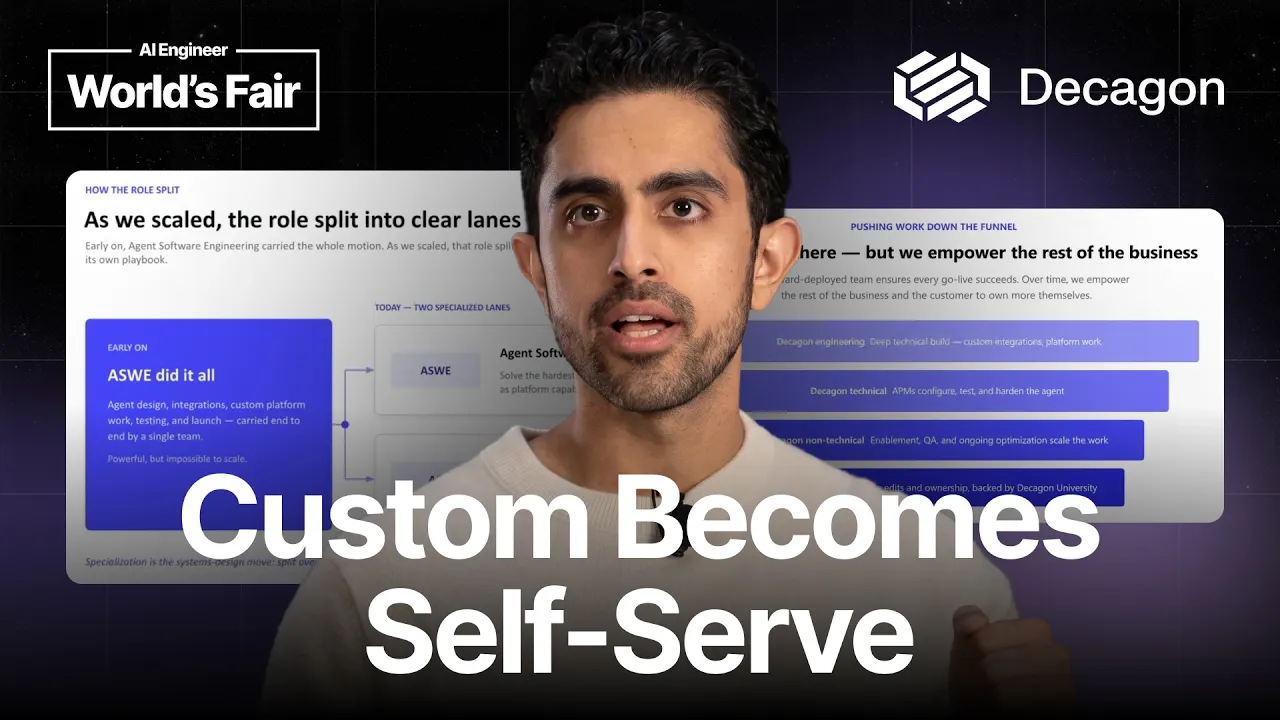
Now that we're 500 people, uh we start thinking a lot more about how do we design the Degagon system so that it can scale. And effectively we we we broke apart this agent software engineering role into two specialized lanes. One is the agent builder and these are like Degagon pros. They have a lot of intuition for the various models that power our platform. How do you make them work for the use case that the enterprise requires?
Um largely living within the UI to the extent possible, flagging when things need to go off UI and how do we bring that into the product. And then secondly, we have agent software engineers. Again, these are the front-line enterprise makes product request. Making sure that gets incorporated back into the product. And um, this is I think like a super super uh, important insight, uh, which is there is routinely this temptation of Okay, customer A made this request and they're so important to us and they want it done ASAP and maybe I'll just go prompt Codex and Cloud Code to just do it for me.
But the scarce skill now that AI coding is so good, the scarce skill is actually exercising restraint. Uh, and saying, you know, really thinking about how does this going to scale to sort of future customers? And part of this is our ethos. Like we we build agents to be owned by the customer and so if it turns into a black box of like prompts and patches and that's not good for us or them. It's far too brittle. Um, but also, uh, when you're a forward deployed person, this is this is kind of uh, this is incumbent upon you to to be exercising this restraint of like, let me not do the easy one-off thing, but rather make sure whatever I am building is architected in a way that future customers benefit from.
So this will come up in in the remainder of my 10 minutes here, which is uh, always thinking about how do I make this one ask benefit the remainder of the customers? Um, so I I I put this slide here not to sort of toot our own horn, but to actually talk about what it looks like to achieve success. Uh, and in in our case, we've learned like early on when you're scoping the deal, like literally when the very first conversations, you want to figure out ahead of time what does success look like for the customer.
And really narrowing that down, ideally getting it in writing so that there is like no miscommunication along the way. Like and when I say what does success look like, I mean what are the metrics you're trying to hit, what sort of channel that you want support on, maybe that's a phone call, maybe that's email, maybe that's text, maybe it's WhatsApp, whatever. But really narrowing like what is your pain point, what is the ideal outcome you want, and then we can race to go build that out.
Um but I think again, back to sort of lessons for forward deployed folks, uh there especially when you're dealing with a large company, there's a temptation to just get started. And uh and this is partly a reflection of how AI coding has changed engineering generally, but now there's a lot of effort that has to go up front in requirements gathering, making sure you're aligned on what actually has to get built uh before before going to do it.
Uh this has been a really good learning for us. So, uh we try now, given that we have like a a ton of customers across various verticals, we have found it's really helpful to have industry experts that get staffed, the same kind of deal. So, if I am working on financial service A, B, and C, when financial service D company comes around, ideally I have a core core group of folks who have experience with those customers uh working with this new logo.
And the idea here is like a lot of that knowledge compounds. Like A, you can like speak in the lingo of this customer, and therefore there's a lot more credibility there. There's a lot more There's a lot like a much faster ramp up. And [snorts] uh a lot of the agent building, sort of the way you think about success carries over. So, uh this has been very helpful for us, and and ultimately it's all about, you know, uh making every deployment uh faster than the last one.
Um I mentioned earlier that as a forward deployed and and by the way, I say forward deployed engineering, but really it's just like all forms of forward deployment. I mentioned earlier that one of the big things you have to do is to always think about how do I solve this customer problem in a way that extends to other customers. The other thing that I think is always helpful to keep top of mind is how do I make it so that I'm empowering the rest of the business to solve this problem?
And this is specifically if you're an engineering. So, for example, uh Deckagon's ethos is you should be able to configure this agent completely via natural language. And so, if you ever have an engineer needing to do something that needs to get upstreamed back into the product. Uh and so, this is sort of a funnel that we have of like, "Look, Deck front forward play engineering, they're the front line for customer asks." Um but really it should get it should get sort of scaled across the business.
And one example of this, and I mentioned it later as well, is like, let's take an integration. Let's say Deckagon needs to integrate into like some some CRM. Uh early on in our history, we were actually like building custom integrations time and time again. And then we thought enough is enough. After like the 25th one, we're like, "I don't know how many more are coming up." Uh so, let's just like build it a self-serve way.
And now what took an engineer custom code writing can now be self-served by the customer or built by our agent building team. So, it's all about how do you scale the work that you're doing. Um also very relevant, depending on the kind of forward deployment work you do, is especially in the enterprise, wanting to prove value as fast as possible. For those of you who work especially in the Fortune 500, you're going to get hit with the entire What's the expression?
Kitchen sink or the entire kitchen? Something like this. Uh but the idea is how do you prove value as fast as possible? So, in our case, Deckagon can become arbitrarily complex. You can support all sorts of channels, all sorts of very complex user intents. We try to figure out how do we demonstrate value ASAP and not have like a multi-month deal or sorry, multi-month uh time to prove value. And once we're there and we're adding value, then we expand, right?
Because ultimately all of our customers are a multi-year partnership. And so, we want to make sure we're we're helping you across your entire support flow and in your revenue generating workflows, but it's important as a forward deployed person to figure out, how do I prove value right away and build your build your motion around that. Um So, customers will often come to you come to folks and say, uh I want you to do XYZ.
And and often they're right. But, I think as a forward deployed engineer or forward deployed person of any sort, you're you should treat yourself as an advisor rather than just an executor, right? You're you're both. So, um you're also on the front line of, "Hey, how do I make AI work for the enterprises?" And you have so much knowledge because you're seeing it repeated across every single customer. And so, what we do at Akkio gone is we actually ingest your historical support data uh and we tell customers that hey, like if you automate this first or this first, this is where actually you'll see the highest ROI.
Um and sometimes that's not actually what the customer had reached out about. Uh and I imagine there's analogs to this across all sorts of verticals, but it's important to keep in mind that your job isn't just an executor. It is of course to be an executor, but it is also to be an advisor. Uh and to not underrate the fact that you have this domain expertise by being forward deployed across many companies so that you have this knowledge base that's really valuable for the customer to tap into.
Every time at Akkio gone, someone has to do something manually, we try to make sure it gets upstream back into the product. So, I mentioned the integration earlier, but this is I think a good mental model for folks to have if you're on the front lines. How do we smoothen out that path? Custom becomes self-serve. Custom becomes self-serve. Um this has become like a guiding ethos for us uh and I suspect it is the case across every kind of forward deployment motion.
So, I'd encourage everyone in this audience to to um to to keep this top of mind. Like, okay, I'm doing this I'm doing this one-off thing. Presumably other people in the company also are bringing it back into the product. Okay. So, um Decky on is really interesting in that it was started by I think now they're in their early 30s, but it was I think at the time they're in their early 20s. Oh, sorry, late 20s. Um and so, what did what did we do right uh to to sort of deserve the place that we have?
And I think one is we're known in the industry to move really really fast on customer asks. And part of this is just like it's a very hard-working group of folks. Um so, that's like a big reason that we got here uh is that we just move really fast deal by deal. Thing number two, we've earned trust with customers that we are advisors, not just executors. So, we'll we'll we'll we'll we'll be able to tell you based on what we're seeing across all the customers, based on the data you give us um what is going to be the highest ROI for you.
And then number three, we've been really good at um making sure we productize custom work. But, the way we think about this has changed a lot in the last year because again, a a year ago we were 50 people, could all fit on, you know, a lengthy lunch table. And now we're 500. So, now we think a lot about designing the system. So, every time now now we're very rigorous about sharing knowledge across deployments, but uh making sure you extend uh the field the people in the field feed information back to the platform, making sure the agent compounds every single time it interfaces with the customer.
So, if the agent interfaces with customer A, you improve that for customer B. And it's all about sort of taking knowledge from the field and bringing it back into the product. Uh and so, just to wrap up here, uh sort of the a few of the few of the themes. Number one, obviously you have to make sure you can figure that agent, do whatever the customer wants. But number two, uh make sure that it gets fed back into the product.
And three, mind that funnel that I mentioned earlier. You're on the forward, you're on you're on the field, but you want to make sure it scales and make sure it improves uh every every uh future customer interaction. Uh again, my my email is sunny@deciagon.ai. I'll also be out here. Folks have questions. Thank you for coming to talk and I hope this is helpful. >> [music]
The words are the caption track's own and nothing is reworded or re-transcribed. Paragraph breaks are placed between sentences so the text reads as prose.
Free tools for your own script. No signup, no login.
Paste your draft and see where viewers are likely to drop off, with a rewrite for each weak line.
Paste the first 30 seconds of your own draft for a hook score and rewrites.
Check your draft against YouTube's advertiser-friendly guidelines before you record it.
Read this channel's public videos and transcripts, and download a writing brief for it.