Getting the transcript
Reading the captions from YouTube. A video nobody has opened here before takes 10 to 30 seconds; this page fills in on its own.
Getting the transcript
Reading the captions from YouTube. A video nobody has opened here before takes 10 to 30 seconds; this page fills in on its own.
AI Edge · @AIEdgeHQ
This video has no Most replayed graph yet: YouTube shows one only once a video has enough views. These are the moments viewers replayed most in AI Edge's most watched videos.
Most replayed moment at 4:10
6.2x that video's typical replay level
different sections, but I think it came out super cool. And my plan is to make it better over time. So, once I was happy with the design, I exported it into Claude code. This is how you actually take it from a design into a functional website. And I got Claude code to mock the entire architecture,
Said at 4:03
Most replayed moment at 10:36
3.5x that video's typical replay level
up agents on your behalf. So, by understanding looping and scheduling, I'm also going to give you a bunch of loop ideas as well to actually show you some examples of what you can do in your, you know, life or your business, um you're actually using AI agents already. You don't need to build an agent, they're built
Said at 10:28
Most replayed moment at 15:58
3.4x that video's typical replay level
people do is they you guys just set up a local folder. You just voice prompt, you use Whisper flow, you use the voice transcription feature, whatever you want. You voice prompt everything about your situation, everything about your business, everything that it needs to know. You put that into a documents folder, so
Said at 15:51
The graph counts replays. It does not show where viewers stopped watching.
Words
6,378
Runtime
26:48
Speaking pace
238wpm
Reading time
27min
238 words per minute, above the 201 75th percentile of 349 measured videos. That distribution comes from the 349-video hook study.
Opening (first 30 seconds)
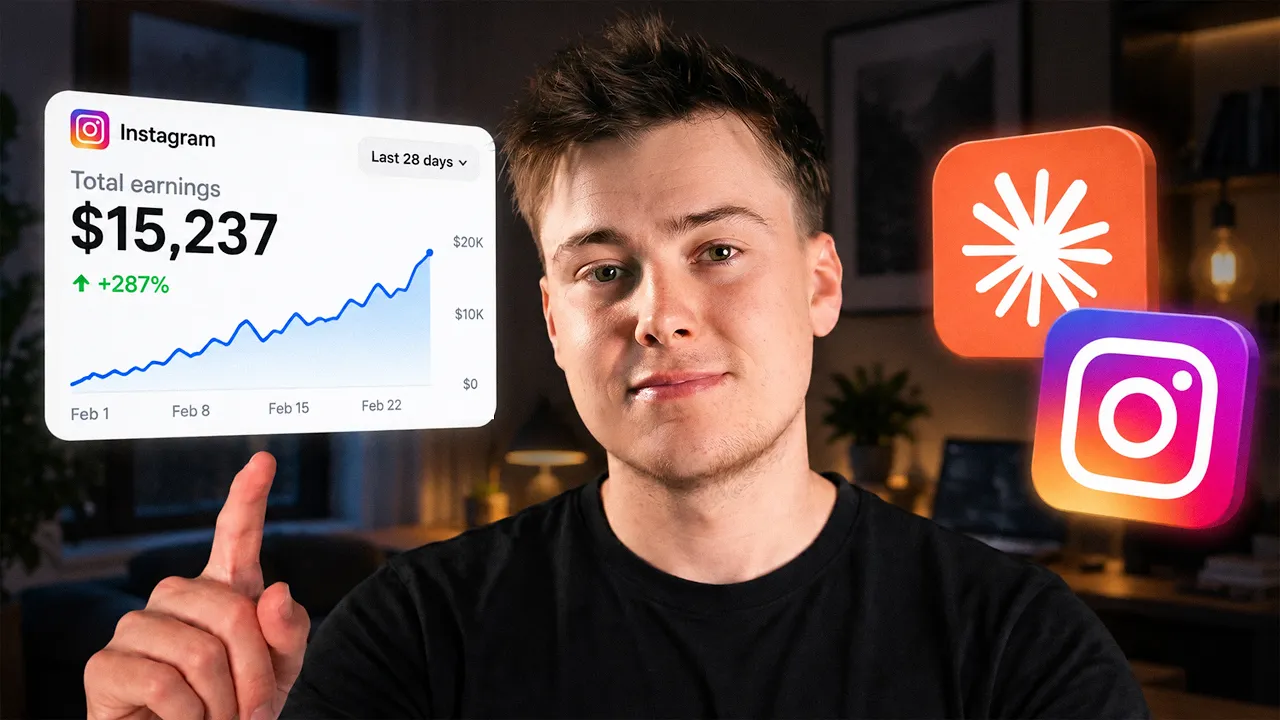
In today's video, I'm going to show you the best way to combine Claude and Instagram to make at least $15,000 a month. This is the most effective way, I believe, you can reach that dollar amount per month and actually far exceed that like I'm doing. I'm going to explain exactly how I'm doing it in today's video. As you can see in front of you, my Instagram account has 101,000 followers. We make well in excess of $15,000 a month just through Instagram alone. If you go through my videos, you can see one I uploaded yesterday is already at 70,000. The one from a couple of weeks ago was on 68K, and we've had some very,
119 words, the words spoken in the first 30 seconds at 238 words per minute.
Free, no signup. See how the first 30 seconds hold attention, with rewrites.
Sentence shape
| Measure | This transcript |
|---|---|
| Sentences | 338 |
| Average words per sentence | 18.9 |
| Longest sentence | 91 words |
| Questions asked | 6 |
| Sentences containing a number | 37 |
Most used terms
Filler phrases
152 in total: like 51 · actually 41 · you know 29 · literally 8 · basically 7 · kind of 5 · um 4 · I mean 2 · sort of 2 · uh 2 · right? 1.
A literal whole-word count of the same phrase list the Prepublish browser extension uses, so a phrase inside another word is not counted and a phrase used in its ordinary sense still is. It is a count and not a judgement.
What this transcript is
Every word below is the caption track YouTube publishes for this video, pulled from the video itself and reproduced unchanged. It is not Prepublish's writing, not a summary, and not a re-transcription: it is the video's own published captions. English captions, generated automatically by YouTube, in the video’s original language. Source: the video on YouTube. A channel that would rather this page did not exist can ask for its removal through the contact page, and it is removed.
In today's video, I'm going to show you the best way to combine Claude and Instagram to make at least $15,000 a month. This is the most effective way, I believe, you can reach that dollar amount per month and actually far exceed that like I'm doing. I'm going to explain exactly how I'm doing it in today's video. As you can see in front of you, my Instagram account has 101,000 followers. We make well in excess of $15,000 a month just through Instagram alone.
If you go through my videos, you can see one I uploaded yesterday is already at 70,000. The one from a couple of weeks ago was on 68K, and we've had some very, very big viral outliers, 233K, 329K, 308K, 1.1 million, 1.3 million. And these videos and the system that we use has helped us build on ManyChat using our AI automations a contact list of almost 80,000 people. That's 80,000 potential community members. And the system is not just applicable to a personal brand like mine.
It's also applicable to a variety of other use cases that we're going to discuss today. So, I believe pretty much anybody will get value out of this video, whether you are scaling your own personal brand, whether you want to get into UGC content, whether you want to help another brand scale through the AI concierge or consulting model, or even if you just want to run ads for businesses, this video is going to help you understand the principles of using Claude and Instagram.
And at the end of the video, I will break down the $15,000 figure, explain why I've used that figure in the title of today's video, and then run some math around the different types of projections you can be looking at if you run the system. And I could honestly be gatekeeping some of this stuff just to grow on social media faster, but I do want to share my knowledge with you, and that's, you know, a big mission here on the channel, actually helping people level up their lives and their businesses with AI.
So, I do think ultimately, if I can just provide as much value as possible to you guys by showing you what is actually working for me, that is going to bring the most value back and allow me to give the biggest impact. So, if you do enjoy content like this and you want to level up the AI, make sure to subscribe to the channel. And the full breakdown of this entire system from today's video will be available down below in my free school community.
If you join, once you join, click on the free assets library under courses, and you will be able to access all of the assets from these videos. This is the system that you can literally plug into your own Claude to brainstorm the applications for your business, and then furthermore, apply these concepts to your business. So, firstly, let's begin by mapping out how the system I run on Instagram actually works. The first thing that I do is I use Claude as my ideation engine.
So, I use Claude Co-work, and I structure each part of my business. So, YouTube and short-form for this example into project folders, and then I have a custom folder, which has all of the skills for that specific task and all of the instructions and memory. So, every time I speak to Claude, it has my context. So, for example, I have a folder with my transcripts. You can actually get Claude, and I'll show you the best tool to do this in a second, to actually scrape all of your Instagram videos and put them all into a transcripts folder.
And what I recommend doing is actually have it done as a spreadsheet, so it has the views and the engagement rate and the statistics, or at least what's available publicly, so Claude can actually pattern recognize between certain hooks, certain phrasing, and virality. Now, if you haven't started Instagram already, what you can actually do is go to your competitors. So, if there is a content creator that you are niche adjacent to that's crushing it, ask Claude to scan their most viral videos.
And if you use Co-work, or if you use code, or even this video applies to Codex, honestly, the majority of this video will apply to most LLMs, and I sometimes actually use Grok Bot for this. So, occasionally, I'll pull transcripts from other creators on Grok Bot. I was doing this, for example, with an Eisenberg podcast that I really liked the other day. So, I'll use a variety of methods, but the bottom line is you'll pull viral transcripts into a folder, so Claude can start to pattern recognize what's actually working.
Then, what you want to have is a context file or or file, which just basically outlines what your branded entity is, what you're trying to achieve. If you're doing this on behalf of clients, it'll be their entire business mapped out, so Claude can make sure its scripts are actually in line with your brand identity. And when I say scripts, I'm not just talking about personal brand. We'll get into this in a minute. This could also be for UGC content creation.
For example, right now, whether you like it or not, a form of content that's going really viral, you could see with TJR, are these AI videos of these AI avatars basically running through a mini story like a come-up story. This is obviously to sell presumably like day trading or prop trading courses or referral links, but these are going very, very viral. So right now, I think there's a massive opportunity with UGC content, which is why I think the methodologies in this video apply to anything.
You know, if you wanted to start UGC pages and, you know, do stuff like this, they are going very viral right now. And then you could have a comment trigger in the caption to actually start getting leads. So if you have developed a product or an info offer, you basically need to create content. You need to top of funnel, so awareness for that offer, and then content like this can actually funnel into it. So these principles apply to a variety of things, but everything will stem from your offer.
So when it comes to content creation, I think it's always really good if you're ideating a personal brand, if you're helping a client market, or if you're starting a UGC page from scratch, having an idea of what your final destination is will actually help you create content because oftentimes your content will be tailored to your final destination. For example, if I have an AI trading school community and my goal is to funnel people into that school community, but I'm making content on sport, I'm obviously not going to convert anyone.
Whereas if I make content on how I build AI trading bots, then I am going to convert really well, and I am converting really well to that community right now. We have an extremely high opt-in rate. So I think sometimes reverse engineering what you actually want to sell or what you want to offer or what you want to provide first is a good way to go about it. Of course, there's always just the approach of making content organically in the beginning and just seeing what works.
I mean, to be honest, I did that in my early days as well, but because I went that route, it actually probably took me longer to get to my end destination. So, it's not that you can't get to your end destination by going completely organic and just making content about stuff you like, but it will just take longer and I think we have a lot more knowledge now of algorithms. We have a lot more knowledge about how to structure offers.
If you're watching this channel, you're probably a bit more AI native. You can probably skip a lot of the grunt work that took me a lot of time and fast-forward to converting really well from an early stage. So, essentially, you want to create this folder. You also want to create an instructions.md file to actually tell your chats how to behave. And then on Claude, under co-work, you can start a project. For example, this is called show scripts and planning, but yours could be short-form planning where you connect it to this folder.
So, if you click on co-work, you add the local folder that is on your computer, so it's tapping into the information in your folder. This is a very basic memory system, but it's a big level up from people that just keep opening new chats. Like, you do need things organized somehow. And yeah, you can get into more complicated memory systems later, like using a custom Postgres solution, but it's probably not needed in the early days.
Like, even for me, when I'm scripting, because I've dialed in my skills so much and because it's pulling off my real context, it's generally pretty good. And then you can just, you know, curate from there. So, the next thing that's really important is that you develop custom skills. So, pretty much the secret sauce when it comes to content creation, scripting, ease of scripting, friction, creativity, etc. Pretty much the secret sauce of content creation in terms of using AI is generating custom skills which you refine over time.
Now, if you don't know how to build one from scratch, there are actually amazing repos for this. For example, Open Montage has an open-source video production system. So, it comes with 12 production pipelines, 100 tools, 700 agent skills. You can actually go through and pick a skill that you would like for this. They have different voices, they have different a pre-built pipeline, so you can paste in a reference video, an agent will analyze the script, it'll give you different concepts, and you could use this for anything, not just YouTube.
You could literally take an Instagram reel and run it through the system, and then you could give it feedback, start to develop a brand voice or an identity, and then you could tweak your skill over time. And then what you can do is you can just have your own skill library, either in a folder system, like we discussed, or you could even create your own GitHub repo. People think of GitHub as this scary thing. It's literally just a repository.
So, just like people can upload stuff to YouTube, it's just like Google Drive, but public, and you can even make it private, where you just have all of your skills listed really nicely. You have your folders. So, it's all online. It can't get lost. Your computer gets damaged. It's not on your computer. And you just have everything in one place, and then you can just link Claude code to the repository. So, anytime you make a change, it makes a change to the repo.
So, I have my entire custom repo with all of my content creation skills and everything that evolve over time based on new data and based on changes that I make. So, that is the content side of Claude. The next side is the offer. Now, I'm not going to go in too much depth into producing offers with Claude in today's video, but there are a variety of ways that you can actually build an offer with Claude. For example, there's a seal line out, so you can literally in the terminal build a digital product in Claude that connects to a real payment processor.
Wop's based in New York, so you have payment processing. You have all their product features. I've generated over 5.5 million dollars in digital product revenue with and now you can manage your entire product, create the product, set up the offer all within the CLI. So, that is very, very cool. But ultimately, you need to make sure there's alignment between the offer and the type of content you're creating. Obviously, if it's for a client, that's pretty straightforward.
It's whatever the client's business is. But you'll have to do some brainstorming, and I regularly do brainstorming sessions where I'll just go back and forth with Claude in a chat using Whisper Flow voice transcription for like hours. And, you know, usually I do this every weekend. We kind of evaluate the business. I feed it the numbers. We have a bit of a discussion about where we're at, and I try and identify, you know, the one to two highest leverage things that I can do in my business and then I take that into Notion and I look at the priorities for each week.
You can run a system how you would like to, but I pretty much run my business system as a Notion database and then Claude taps into the database. Notion's brand positioning is kind of interesting because it's almost a version of like Postgres or super memory now. It's almost a memory system, right? And there's just a database where you can plug in other AIs. So, I do find it quite functional. Of course, for my content, I'm doing this with my face, but we are scaling up to other faceless accounts which in a few months I'll reveal what they are and I'll show you how they've gone, but there are some great examples of people, for example, Seb AI.
I know he uses his face, but the majority of the content that's going viral is faceless and he's putting out some of these AI generated images or carousels that are getting crazy results. His carousels actually do much, much, much, much better than his reels. Like and the comments on these are crazy. He basically uses the comment DM system. I think on this one he got 900 comments, so he's probably getting at least 100 people actually going through his ManyChat funnel.
If you go down further, this one has 1,000 comments. Basically, seven prompts that turn Claude code into a money-making machine. He's probably just generating these with AI. He's having a comment with a CTA. I think in the last slide, yeah, he has a CTA comment code. Bunch of people are commenting code. He's auto DMing them. It's all set up on ManyChat. ManyChat is running them through an automation funnel which is likely, I haven't gone through the funnel, but either a funnel to a newsletter or a product as we just discussed.
That's something else that's worth mentioning. You don't even need to do a product in the beginning. You could do a newsletter because a newsletter in itself is a product and it's also an email list, so you're generating assets that you can then sell a product to later. So, you don't always need to be like selling from day one. You can just build community from day one and that's actually what I've done. So, if you look at, you know, my my story to account, we're not pushing anything paid right now.
We're just pushing into the school community because I want it to be very deliberate that when I offer a product, it's very, very, very good. So, I'm working on some AI products right now, but I want to make sure the offer itself is industry-leading. So, then when I offer it to people, it's an absolute no-brainer, and it's like a net value add, rather than like doing an extractive course, because I could easily just do, you know, a course on how to build a trading bot, um that, you know, I just put together, uh I do some slop, I read off a script, but that's not really what I want to do with my brand.
I'd prefer to build up more demand for longer, keep things more organic, and then really launch a product which I'm very passionate about. So, that is another the you can also take you're into personal brand building. But, I wanted to point out Seb, cuz he's an example of the fact that you can actually run this faceless, which means there's a lot you can do in terms of building up pages in different niches. Now, I don't really have the time to be doing this, and even though I have the resourcing technically to like hire account managers and do this at scale, it's something that I'm doing in a more limited fashion, so only with a few accounts, because I'm not trying to build my entire business off this.
The things that I'm focused on, and I do believe in Pareto principles, so the majority of the effort going into something that is going to generate the majority of rewards. And I'm a believer in the Pareto principle, so 20% of your efforts will result in 80% of the rewards. And if you reverse engineer that, you should just skew more time into the thing that has asymmetric upside. And for me, that is building my own products and having ownership of them.
But, if my goal was just to make 100k, 200k a month, and that's it, I didn't want to make tens of millions, hundreds of millions, then I could easily do that just with faceless accounts. I have multiple friends in the AI scene that are literally doing this. They just run AI-themed pages. They clip viral clips, they do carousels, and they're making a ton of money. We'll discuss the financials at the end, but, you know, off sponsorships, either on their page directly or on their newsletter, off product sales, off affiliate deals.
Like, there are so many ways to command attention once you have attention. I'm a big believer in skewing the majority of your time to top of funnel, though, because I do believe that's what gives you optionality later down the track if you want to adjust your offer. Now, in In of content production, there's a tool that I think is really interesting called Firecrawl. This is also a free GitHub repo and this is an API that allows you to search or scrape the internet at scale.
For example, Instagram that I can then repurpose into content because it goes directly in the browser rather than your LLM using computer use. So, basically just taking like visual screenshots, the process is just a bit slower. So, I just wanted to give you a tip that if you're doing anything requiring browser use, then Firecrawl is a genuinely very strong option and it's a free GitHub repo. You want to build some sort of feedback loop with Claude.
So, once you upload a video or carousel or whatever it is, why it worked, get that data and you could have this data being scraped on a continuous scheduled loop by Firecrawl giving feedback to Claude on why it worked. You can then use that to adjust your skills and your memory and D files. So, it remembers and keeps this stuff in mind for future. The copy that works, I like to keep things clean. So, I like to bring the hooks that work, the concepts that work into a notion copy bank.
We have a notion bank for all of our content and then you can use this information, Claude can connect to notion, and then you can use that to create, you know, new scripts, new carousel ideas, new UGC ideas, whatever it may be. And if you are doing UGC, you can do it all within Claude through the Higgs Field Claude connector. Higgs Field is freaking amazing for video cuz it has seed dance 2.5. It has an MCP and CLI for Claude.
It has Nano Banana Pro. They have also their Cinema Studio so you can create all sorts of different things whether it is like the carousel stuff that I discussed or whether it's one of those videos like you saw from TJL or like the more storytelling type of videos you can do it all with Higgs Field and it's very good because then you can connect instead of just like prompting manually on higgsfield.ai, if you actually go into Claude and do it on Claude, then it can connect to all of this, your skills.
Obviously, Claude's connected to your notion. So, Higgs Field is ultimately going to be tapped into all of this and that's why I believe using the CLI is better because the inference, so what it actually tells Higgs Field to do and the critical thinking behind it is just going to be, you know, way stronger. And then, I'm going to give you some more sauce, another GitHub repo that I love using. You can actually repurpose the content not just on Instagram, but across multiple platforms through Poster.
So, Poster is is an agentyc social media scheduling tool. It allows you to post across everything like YouTube, um, TikTok, everything. This is open source, meaning it's going to plug much better into AI. You don't need to build any, you know, weird MCP connectors or use any APIs. I know there's softwares like Metricool, but they're a little bit buggy once you start to try and connect Claude to them or use browser use.
It's just not that fast whereas if you use Poster, it's literally open source, so you're going to be able to schedule directly through Claude using Poster. By the way, all of these repos, everything I've discussed in this video are going to be linked in the ultimate guide that I'm going to link below. It's in my free school community. You'll get all of these resources and, you know, the entire strategy behind this video.
So, you can use Poster to post, and that enables you to schedule posting, and then the loop goes back around in terms of scraping the data, looking at how those posts perform, so on and so forth. So, this is a content ideation system with a very tight feedback loop that I think is really effective no matter what you're doing uh in terms of your posting. Now, before we get into the numbers, I think something important to touch on is the ManyChat funnel.
This is where you can build automations to actually build up your contact list. There are many things you can do. You can follow gate, that's what I'm doing so I can gain a follower count faster. You can do an optional email opt-in, that's what I'm doing. You can even do a gated email opt-in. You can literally just send them something for free and just take their contact and then market to them later. You can even gate or see some people gating with paid straight off the bat.
I'm not really a believer in that because I think the Instagram attention span is lower than other platforms, so I don't think you can direct sell. I think you have to build a relationship organically over time, build trust, and then sell later. But, there are many things you can do. And I guess it all depends on your bottom of funnel offer that will affect how you structure your top of funnel automations, but the key premise here is essentially someone will comment a keyword to get something that you've promised in the video.
So, it could be a free asset, it could be a guide, it could be a link to a private or an unlisted YouTube video, and you can use that in order to generate traffic towards whatever you want, and then you can have a funnel that can give you auxiliary benefits like, you know, farming phone numbers, emails, or followers if you, you know, you want to do a follow gate. Everyone's different, depends on the brand you're trying to build.
I think just a follow gate and then send them the asset is good, or a follower gate, free opt-in to something, and then sending them the asset. They can skip the opt-in if they don't want to opt-in. And then you can push them even you don't even need to push them to a product, you can just push them to a free community on Telegram, on School, on WhatsApp even, but I don't really like WhatsApp communities because they don't scale very well.
They're in a hidden part of the app, like you have to click on the left-hand side of the app, on the chat side. They're not scalable above 2,000. I guess if you're doing high ticket, then it would make sense. You're only going up to 2,000, but if you're doing low ticket, we tried them, and we just found it was a big nightmare. So, the ManyChat funnel is what takes viral content and then makes it applicable for your offer.
So, it's extremely powerful, and you'll see a lot of the biggest creators in the space are using that funnel at the moment. So, I wanted to touch on it today. And obviously Claude can help you optimize the exact copy that you use, the exact flow that you use. And personally, I do a lot of brainstorming with Fable, and I just go back and forth, and we, you know, make tweaks and adjustments based on what I want to achieve as a business.
Now, I want to discuss the financial side, now you get the concepts of Instagram, what can you actually sell to make money? Or how can you offer this skill set to make money? I mean, there are many ways. I'll give you some examples. The first thing you can do is actually learn the system and run it for clients. So, if you are doing AI concierge or AI consulting like we've discussed on the channel, this is a way to bring in new leads.
So, any business that wants new leads, you can create content for them, UGC, real content. You can even hire real hosts if you want. You can use this system to actually get them clients through a DM funnel. You could also run an AI agency, so you could do this for clients, or you could literally do it for yourself, so you could start a bunch of faceless pages if you don't want to put your face out there. Of course, you could build a personal brand.
It's something I actually recommend. It's gotten me to where I'm today, so how could I come on here and say that I'm not a fan of the personal brand model? If you have a skill set, if you're smart, it's going to be amazing to share that knowledge publicly, but I do feel like you need to build up some reps in private first, get some wins, so you can actually have the authority to come on here, because I can come on here, I can show you my Instagram.
It's got 100,000. They're real followers. You can see it's real engagement. It's hard to argue with that. It's hard to argue with the $30 million in agency revenue we've done. It's hard to argue with the five and a half million dollars in digital product sales we've done. So, it is harder to build a personal brand without doing that, but something you can do is just give free value along the way and document the process, cuz in the beginning of building my personal brand, it wasn't like this.
I was just sharing thoughts on a niche, on financial markets. You could just share your thoughts about AI, and then you could actually use that to kind of self-fulfill. You can build up an audience just through sharing your thoughts, giving free value, free knowledge, use that as a way to get clients, and then once you start earning some money, then you can use that as a hook to get more people in, and it's a positive flywheel, so you can start the personal brand without much social proof, and you can build up the social proof just by giving a lot of free value.
And it doesn't necessarily need to be with you starting with your face in the beginning. You could start with faceless, you could start running this stuff for clients, and then once you have a few success stories, then start making content you did it. That's just an idea. You could also be a growth operator for creators. A lot of creators don't even know about this. Maybe someone watching this video is like, "Wow, Miles, that's really smart.
I'm going to start doing this." You can growth operate for other creators and and help them set this stuff up. Like, I've helped to many of my creator friends on free calls. I've actually thought about making it a service, but I just don't think it's worth my time right now, but if you're actually good at social media, if you're good at funnels, there are so many creators is need growth operators. Even I'm hiring, I'm always open for talent in specific niches.
Like I'm really good at top of funnel content. I'm not so good at meta ads, for example. That's not something I'm really deeply experienced in. I have worked with partners to scale up that side of business or, you know, I'm good at creating content for myself and managing a few editors. I'm not good at clipping at scale. That's just not something that I've developed or really want to put the time into. So, I've hired agencies for that.
So, you'd be surprised. Even the biggest creators need operators in certain areas of the business and so many creators are lacking on Instagram. So, you could go to YouTube creators. You could go to X creators and you could just pitch Instagram for them. Like, let me run your Instagram. Let me handle everything. Let me handle the funnel. Let me handle the automations. Let me handle the brand identity. Let me handle the scripting.
All you need to do is record. Or even if you don't want to record, just let me do carousels. Just let me post with your brand identity and, you know, I want to split of the upside. Or you could just charge them a monthly retainer, prove yourself, and then go for a split of the upside later. This is underrated because it allows you to ply your trade before you build a personal brand yourself. Local businesses need this, as we discussed in the concierge model.
And then there are many other ways you can monetize pages. You can do sponsors and affiliates. You can do DM flows. Um, you can have a setter service within your DMs. So, what a lot of creators will do is they'll have, you know, a course or a product or some sort of consulting implementation. They'll qualify people through DMs and then they'll have a setter. As soon as they get a phone number, they'll basically call someone and, you know, try and book them into an appointment or try and sell a product.
So, you can also run everything in the back end. People on the front end won't even know what your offer is. You're just posting content about a certain thing and then on the back end you have setting taking place and you can scale that up. There are many creators who are crushing with this model. I know like Brett Scales and other creators are making hundreds of thousands of dollars a month through the setting model.
So, all you really need to do is pick one and implement the concepts that we've discussed today. And there's a lot of money on the table. And, you know, just to look at some of the results that I've gotten through this system. We recently launched school. We have 3,000 members. This is very new. This will probably scale to 100,000 over the coming months. We have over 50,000 active contacts on ManyChat, um 80,000 total contacts, and you have to think like 15k a month, which is the title of this video, that's only five clients.
Like, you're getting all this top of funnel. We're only talking about five clients at 3k a month. You think that if I do a reel, you know, that gets 100,000 views, I can't find three people out of the 100,000 views that the video got through the funnel to potentially be a high-ticket client? You think this video that gets so 33k, don't think I could set up people's custom agentic trading and investing systems? Of course, there's huge demand with that.
In fact, that's a niche where people have a lot of money. So, by top of funnel content, you open the doors up. Five clients is really, really, really small, but I wanted to show you how you can actually get to 15k. It's also one sponsor. Most of our sponsors pay well in excess of that, and I think that is good for you to know, just to understand that there's a lot of money out there if you are running the right business, if you're creating content about the right thing.
AI, for example, is definitely the right thing because that's where the world is heading. Every single business needs it. Every single individual needs it. Now, if you go for the retail offer, so not high-ticket, we're talking about memberships, that's 75 members at $199 a month. I think my X subscriptions alone at one point were doing this, and I wasn't even marketing them at all. We do have 700k on X. My Discord at one point was doing almost 50 times this amount.
So, you can definitely do it at a much smaller scale to make 15k a month. Recently, this hasn't been my main focus cuz we've been pivoting to bigger enterprise plays. So, we've kind of traded off some short-term income, but I'm sure, you know, I could launch a course right now at $199. Probably just this YouTube video, I'd get hundreds of sign-ups, let alone if we started running Instagram comment CTAs, I'd probably make a lot of money.
But once again, I'm being a bit more careful because I want to make sure my offers are really good, and I don't want to rush offers like a lot of other creators. But it's to show you that 15k is very achievable. But it's to show you that if you start building a brand, you don't need to be nearly as big as my brand, you know, to start looking at numbers like 15k a month. Or you could even go for for low-ticket, that's 550 people on low-ticket.
I think the easiest way though, if I had to pick anything, is high ticket. I think it's much easier to sell to the rich. I think if you go for serious people, it's easy to get five clients at 3K than, you know, run a product of 550 people at $27 because not only are you attracting more difficult customers because for some reason the less people pay, the more picky they are. And that's typically because the more people pay, the more serious they are, the more committed they are, the less they probably care about the money because they probably have more money, and generally the more educated they are.
So, it's going to be easier to fulfill actually a high ticket client than a low ticket offer, which is kind of counterintuitive cuz some people think, "Oh, you know, if you sell to the rich, they're going to be really picky." Or if you charge a lot of money, someone's going to be really picky. No, actually most of the issues that I've seen caused are from people that have opted into the lowest ticket offer. And over time, I've started to skew my opinion a bit on how we actually do our offers.
I'm almost of the mind that it's better off for a lot of people going free and then going high ticket and not focusing so much energy on the middle ground, but obviously depends on your brand. If you have a big brand like mine, there clearly is a lot of money in the middle ground, which is why, you know, you shouldn't deny it. But I think if you're starting from scratch, you have the optionality to, you know, target things a little bit better.
So, I've chucked a lot of information at you today. I'm going to leave it at that because if you guys enjoyed this video, I can break down more stuff. I can go through my content systems. I can give more real examples. I can show you me scripting a video live. Just let me know what you want from me next. I can break down my offer in more depth. I can break down how I did over 5 and 1/2 million dollars in digital products.
I can probably do a full thing on that. I can break down how I'm making over 50K monthly consulting. I could do a video on that. So, there's lots of things to break down. Let me know in the comments what you want from me next. Subscribe to the channel if you do want more content like this. And of course, if you want the full resource from today's video with all of this packaged nice for you guys to be able to take it, chuck it into your own LLM, I'll leave a free link in the description below to my free school community, and you can claim it in the courses section under the free asset library.
I'll see you in the next video. Have a lovely rest of your day. Peace out.
The words are the caption track's own and nothing is reworded or re-transcribed. Paragraph breaks are placed between sentences so the text reads as prose.
Free tools for your own script. No signup, no login.
Paste your draft and see where viewers are likely to drop off, with a rewrite for each weak line.
Paste the first 30 seconds of your own draft for a hook score and rewrites.
Check your draft against YouTube's advertiser-friendly guidelines before you record it.
Read this channel's public videos and transcripts, and download a writing brief for it.