Getting the transcript
Reading the captions from YouTube. A video nobody has opened here before takes 10 to 30 seconds; this page fills in on its own.
Getting the transcript
Reading the captions from YouTube. A video nobody has opened here before takes 10 to 30 seconds; this page fills in on its own.
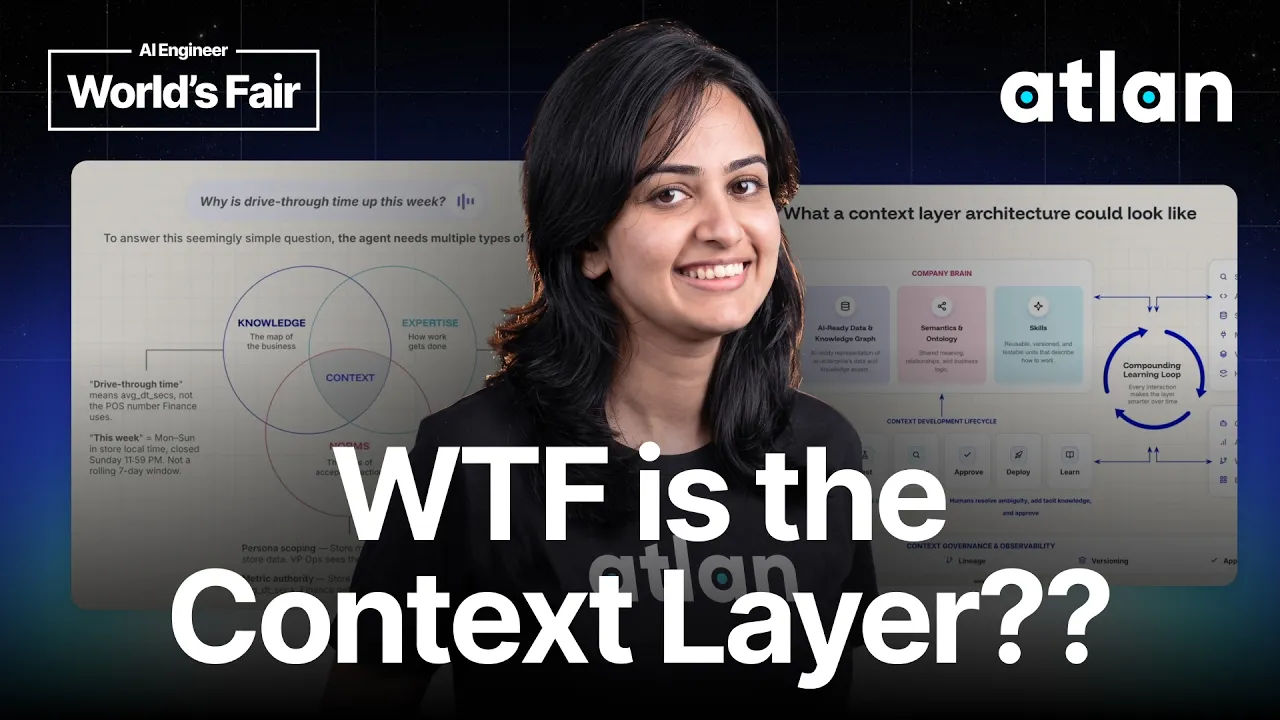
AI Engineer · @aiDotEngineer
This video has no Most replayed graph yet: YouTube shows one only once a video has enough views. These are the moments viewers replayed most in AI Engineer's most watched videos.
Most replayed moment at 18:45
4.8x that video's typical replay level
that they're they're changing they're changing things in the database not yet. You want to run them through the ontology first and make sure that works. Okay. I only got an I've got I've got another I've just a short time. I'm going to try to show you some of the things that um that you can
Said at 18:37
Most replayed moment at 16:13
3.6x that video's typical replay level
method signatures, the program layout and the call stacks. So here's some examples. I don't think you'll be able to read this one, but this is like the level of abstraction we're at. It's how we're actually going to lay this stuff out and how these systems are going to interact. Dylan Mulroy from Cloudflare talks a
Said at 16:06
Most replayed moment at 13:49
2.3x that video's typical replay level
Fable uh and it runs into an unknown, ask it to log it, right? So that um you uh you can see where the deviations happened and then you can sort of figure out why as well, you know? It will usually give you some context about what happened.
Said at 13:43
The graph counts replays. It does not show where viewers stopped watching.
Words
3,374
Runtime
20:53
Speaking pace
162wpm
Reading time
14min
162 words per minute, between the 160 25th percentile and the 181 median of 349 measured videos. That distribution comes from the 349-video hook study.
Opening (first 30 seconds)
[music] >> Hi everyone. My name is Prakalpa. I'm the founder of Atlan. And today I'm going to talk about this thing where context is having its moment. And so my goal today is to talk about like WTF is the context layer? Just before I start and I promise this is the last time. Um I don't know if the clicker is working. Atlan, we it's it's working. Thank you. Um the problem we solve is we say AI doesn't
81 words, the words spoken in the first 30 seconds at 162 words per minute.
Free, no signup. See how the first 30 seconds hold attention, with rewrites.
Sentence shape
| Measure | This transcript |
|---|---|
| Sentences | 250 |
| Average words per sentence | 13.5 |
| Longest sentence | 47 words |
| Questions asked | 56 |
| Sentences containing a number | 16 |
Most used terms
Filler phrases
177 in total: uh 52 · like 50 · um 25 · you know 20 · right? 12 · kind of 8 · actually 7 · basically 2 · sort of 1.
A literal whole-word count of the same phrase list the Prepublish browser extension uses, so a phrase inside another word is not counted and a phrase used in its ordinary sense still is. It is a count and not a judgement.
What this transcript is
Every word below is the caption track YouTube publishes for this video, pulled from the video itself and reproduced unchanged. It is not Prepublish's writing, not a summary, and not a re-transcription: it is the video's own published captions. English captions, generated automatically by YouTube, in the video’s original language. Source: the video on YouTube. A channel that would rather this page did not exist can ask for its removal through the contact page, and it is removed.
[music] >> Hi everyone. My name is Prakalpa. I'm the founder of Atlan. And today I'm going to talk about this thing where context is having its moment. And so my goal today is to talk about like WTF is the context layer? Just before I start and I promise this is the last time. Um I don't know if the clicker is working. Atlan, we it's it's working. Thank you. Um the problem we solve is we say AI doesn't know your business, we fix that.
We work with an incredible group of companies around the world ranging from GitLab and Zoom and Discord and Affirm to large enterprises like MasterCard and General Motors. Um And about a year ago my co-founder and I went on stage and we said uh at the dawn of the internet era Bill Gates had written this very famous blog post and it said content is king. Um and as we are the dawn of the agentic era, context will be king.
Since then, it feels like 2026 is the year of context. Context graphs, anyone? Uh you know, every every two days you see some version of context popping up. And so what is going on? Um I believe the answer to this kind of is in this reality distortion field that we live in. I live here in the Bay Area. Every day or two I have conversations with people which kind of go like, "How far are we from AGI?" and we have a debate and we're like, "Well, 1 year, 3 years, so on." There is no doubt that the models are getting exponentially smarter by the day. 2 years ago they couldn't pass the bar.
Today, if they were to take the bar, it was they're the top 1% of test scorers. On the other hand, they're not exponentially more useful by any benchmark. 1 out of 5, you know, AI use cases actually make it to production. You know, 56% of CEOs say that there's zero financial benefit from AI today. So, what's going on? I believe hidden in plain sight is actually how performance is measured in the human world. Cognitive intelligence doesn't really determine real-world effectiveness.
In fact, only 10% of job performance variance is explained by IQ. Like, just think about it. Would you say your smartest, you know, teammate who scored the highest on the SATs is also your best teammate? Or would you say, "No, it's the person who works the most and takes the most feedback and learns the fastest?" In the real world, we care about performance and performance is outcomes that you deliver in the real world.
And performance is a function of two things. It's a function of intelligence, which is cognitive horsepower. That's what the model benchmarks measure every day. But, it's also a function of context. This is what they say in the human world as learning on the job, right? Knowledge and skills and expertise that you learn over time. And in the last decade, we have compounded on one of those parameters. Intelligence has 1,000x'd in the last decade.
Just in the last 6 months, we have 2x'd on that axis. On the other hand, context, the situated knowledge of your business, that's barely moved. We've moved some data to the cloud, uh but that's about it. It's otherwise logged in dashboards and Slack threads and uh the head of that analyst who might be leaving next week. Um And so, the question ahead of us then, I really believe this is the next frontier, is how do we help AI build context about our business?
Um And every time I'm faced with a question about how do we help AI do this, I always like to go back and understand how did we help humans do this? Uh I'm going to take you into the life of, you know, uh uh exemplar employee, Maya. Uh let's say she's a data analyst at Mac Context Burgers, cuz I thought I was going to be creative and I'm not very creative. Um And, you know, let's say she's that analyst that everybody, you know, pings in your company.
Uh right? She's the person that everybody sends a message to every morning when they're trying to solve a problem. So, let's say this morning, uh there's a franchisee owner who sends her a message and says, "Why is my drive-thru time up this week? Why is this metric up this week?" Sounds like a really simple question. Um But, it's actually a really complicated question to ask. Just to answer this one very simple question, Maya first needs to know, uh what is drive-thru time?
Uh and who's asking? Is it finance or is it, you know, my ops team? And it might mean different things. Uh But, not just that. What does this week mean? Is the cut-off period Monday to Sunday? Is it Pacific time? Is it Eastern time? Uh That's knowledge. Like, that's facts. That's the map of the business. Um But, not just that. Uh there's expertise. Uh right? There's um you know, a diagnostic playbook. What What does a great analyst do?
They know that, you know, quarter three is a season seasonal quarter because of weather patterns and they know to go check if the reason there's a spike is because of seasonality. They also know that the company launched a product just that previous quarter and so they know to check if that's why the root cause analysis failed. This is expertise and skills that people pick up over time as they learn on the job. And then there's norms, right?
There's, you know, persona scoping, who's asking the question, how do I answer this question? And Maya, she's one of those like cool people, she nails it, she sends an answer not just with the answer but with the why and the root cause and she finds the reason for it. How did Maya learn to do this? Um she just joined the company a year ago. First, Maya, you know, has for like she joined and she got some training like all of us do, but that's not where any of us learn, right?
In our companies. How do we learn? We learn because you shadow like the best teammate and then you see why they're doing something and then you learn from that and then you make a mistake. Who here has learned more from a mistake than anything else? Right? You make a mistake and then you learn. You your manager gives you feedback and you learn not to do that again. You deal with an edge case and then you learn from that.
That's how all of us humans learn at work. And so then the question is how do you help build the agentic Maya? And now I want to walk you through our experiments and learnings as we've built this at Atlan. Era one and this was roughly about 18 months ago now. We started on the the track of bootstrapping agents. And the way we went about it was and we started this with our customer experience team and we did this jobs to be done analysis map, right?
And so we said, "Hey, if you are someone on our customer experience team, what are all the things that you do on a day-to-day basis?" And then we made some hypothesis. We We said, you know, for example, one part of the job is documentation and meeting prep. Uh we said, "Well, AI could probably do that job pretty well." Uh and so we built the scaling factor. So, on the other hand, relationship management is something that our customer experience team does.
And we said, "Hmm, that doesn't sound like something AI is going to be able to do anytime soon." And so we built the scaling factor. >> [snorts] >> And then we basically started bootstrapping these individual agents that were like built for that specific topic. Uh our team got creative, so we had Hermione, who is our health intelligence lead, and then we had, you know, MoneyPenny, who was our financial risk analyst, and we just made that particular agent really good at doing that one thing.
Um and that worked for some time. Um but then we realized there were some challenges with this approach. The first, context engineering. Uh we got to the point by middle of last year where building an agent was really easy. Took like 5 minutes. Uh but giving it the business context that it took to actually get it to be accurate took forever. Uh quality of the agent often dependent uh on the quality of context engineering, and that led to a lot of weird lost trust cases with our stakeholders. >> [snorts] >> Um then, as we started taking this into production, we started seeing that these agents basically were kind of like living on their own island.
Uh now imagine, for example, if you're in a human team, and your marketing changes positioning on your, you know, and then they come to the town hall and they tell you that they changed positioning. And so then, you know, the SDR on your team or your sales development rep, they know that they should use is new positioning. This is like the infrastructure that we've built for humans inside our organizations. Agents didn't have them.
So, our marketing team had these agents and they started making changes to that and then our SDR agent on our website was still pitching the old version. Uh we had no idea how any of these things were even connected. So, we didn't even know how to like run this as as a team of agents. Uh when an agent gets something wrong, this is hard. Uh it was really hard to like trace back what happened. Was it the model? The agent?
Was it the context? Like where How do we even go back and fix this? Um and over time we started dealing with context sprawl. Uh we had the The hard part about this was agents all had their own memory systems to a certain extent. So, they were learning They were all learning separately and they were learning differently. Uh it became very, very difficult very quickly to say, "Okay, what does the single version of truth here look like?" Um and then over time we actually went through In the last 12 months we've gone through cycles of at the agent tech layer.
About 12 months ago we were using one of these no-code type builders uh called Relevance. We went from there into Google ADK, then we tried Glean. Uh start of this year we moved to Claude Code. Now we are kind of like 50/50 Claude and Codex. Um and every single time as these changes happened, uh our context got trapped in each of these individual systems. Um So, starting this year as general purpose agents started to become a thing, we said, "What if there was a different approach with general purpose agents?" Uh again, going back to the human world, well, Maya, she's not an individual star.
She's part of a team, right? And you know, you talk about these dream teams like Maya and someone who runs customer support and someone who launches ads. These people work really well together. And often these dream teams are built on shared context, right? They have a shared language. They have a shared picture of what's true today. They have shared playbooks. They have shared norms, who's allowed to make what decision.
And then they learn together. I think this is the most important part of it. They have compounding learning loops of what good looks like. And they have shared memory that, you know, oh, we launched this thing last quarter and it like was terrible and we're not going to make that mistake again, right? And so we said, is there a way to bring that into the way we think about AI in our companies? And so the mental model we started working on was we said, okay, we have these teams of humans and they're across the board and can these people essentially start building domain skills.
So each of them is responsible for a certain set of skills. All of this goes into this common one place, which is this one company brain of sorts, right? I like to think of this as the context layer. And then this has a bunch of retrieval mechanisms, which then talks to the general purpose agent across the ecosystem. So then we started the experiment. This is some version of what our marketing team ended up building.
So you'll see on the left, those are all the systems that our marketing team uses. So data systems, our social and community platforms, our ad platforms, our analytics platforms. And then you'll see this agent block. We built this very specifically for having openness. So [snorts] we had Cloud Code and Co-work. We also had our own claw that we deployed, which has, you know, essentially talks in our Slack channels. And then we used some external products like Qualified and Artisan. >> [snorts] >> In the middle is kind of this context layer that our team started building.
So think of it as our best SEO person was building the SEO skill. Uh our best competitive intel person was building the best competitive intel skill. And that kind of became this common repo that we were building into and pulling out from. >> [snorts] >> This sort of became our living brain. Over time, we realized there were some things that we needed in this brain, right? Uh we realized we needed a data graph. Like if For example, our autonomous ads agent we realized it needs to do analysis on a daily basis.
So, like which table should I go pull from? Uh we needed a library of skills. We also needed some other things, semantics, metrics, what is ARR, how do you measure that, uh what is a qualified lead in our company, uh and org structure, entities, things like that. Over the last 6 months, we ended up creating about 300 skills and 40 agents in this team, uh which has been incredible. Uh but then, with this approach, too, we realized that there were some challenges.
We realized that context kind of needs to be managed like code. Um so, some challenges. Let's pick skills. Uh dependency management became really complicated. So, for example, we have this competitive intelligence skill, and it learns from the market on what's changing in the market, and it improves. Um it feeds our category positioning skill, which then feeds our sales battle card skill. Uh now, each of these skills is learning and evolving, uh but every time they learn and evolve, it breaks something downstream.
Uh and these skills very quickly start getting outdated and start drifting. Uh who owns skill quality became another thing. Like who eventually owns the quality of this? Security and governance was a nightmare. Uh we had secrets hardcoded in .env files. Uh it was People were downloading these public skill repos, this the whole thing was like a nightmare. And then I talked about context portability across all these multi-agent systems.
I started this talk by saying WTF is a context layer. These are the problems that a context layer is meant to solve. The question I like to ask is what does the GitHub for context look like? Few thoughts. Company context needs life cycle management and collaboration and versioning just like code does. You know, there's questions like what's local context, what's global context, how do I keep this updated, so on. Some thoughts in this, can skills have a profile just like code does?
Can that have a self-learning loop that's baked into it? What does quality management look like? Can you have security and postures posture management associated with that? That's really like the first step. I see this as like having something that has built-in versioning and quality and dependency management. So, you should be able to say, "Hey, this thing impacts all these other things. This is the approver, this is the maintainer, these are the contributors.
How do you build that kind of human plus AI workspaces that these that these skills are managed via?" >> [snorts] >> Second thing, every AI interaction creates more context and harnessing this is gold. There's been I know a lot of talks about self-improving loops. We have found that with traces deploying a specific harness that actually is specialized in being able to go and reverse construct from that. So, think of it as AI that's reading through all your traces and almost brings it back to your maintainer loop and says, "Approve, reject.
Approve, reject. Improve this over time." That's the compounding learning loop. And the third, often a lot of people ask me this question, which is like, how do I start? Because my business is like really disparate, and I have all these like 60 systems, and how do I even start? One of the biggest learnings we've had is context is hidden in these in business systems. Uh and across this context quality can really compound.
So, for example, if you're able to connect your Salesforce and your HubSpot to your data warehouse, to your application layer, and then you're able to reverse construct how these things are actually connected one to another, context today gets lost in every one of those hops. But if you can reverse construct that, and then deploy AI on top of it, we've seen incredible accuracy in being able to reverse construct the first version of your company brain. >> [snorts] >> So, I'll end with this.
Uh the way I think about a context layer is it's a system that turns knowledge and expertise and norms that we talked about, that Maya knows, into a machine usable context for AI systems. Uh At a very high level, the way I like to think of it is it looks like this. Uh It continually is mining context from your business systems. It's feeding this in to that one company brain. It's harnessing this in skills and context development life cycles as your teams go and deploy these agents.
And then it has a bunch of ways you can retrieve it. So, MCP, SQL, vector retrieval, hybrid assembly, all these different ways that you retrieve it, and pull back from traces and build this compounding learning loop. >> [snorts] >> Today, we're largely building agents by hardcoding context. The scale of this problem I truly believe is underhyped, because with scale this can become really unsustainable. Uh And a little dangerous.
Like all of us know this this old joke, which is if you ask sales and finance the revenue number, you're going to get two different numbers. We're fast approaching a moment of starting to deploy autonomous systems where the same thing is starting to happen. So, I'll end with one last thing. I started this presentation by saying context is king. I'd like to end it by saying context is also IP. Something I think a lot about is in a world where you and your competitor have access to the same models and the same intelligence, what differentiates a company?
What differentiates a customer support agent at American Express versus Amazon? That's how you do business. That's what makes your company special. Context is how we take and encode our culture and our norms into something that we will be proud of as we build autonomous frontier firms. Um And that's all I had. Um you can find me at Prokalpa on Twitter um or write to me. We are actively working with folks on the frontier on going and shipping and building company brains.
Um so, if you'd like to talk to us, feel free to reach out. Thank you. >> [applause] [music]
The words are the caption track's own and nothing is reworded or re-transcribed. Paragraph breaks are placed between sentences so the text reads as prose.
Free tools for your own script. No signup, no login.
Paste your draft and see where viewers are likely to drop off, with a rewrite for each weak line.
Paste the first 30 seconds of your own draft for a hook score and rewrites.
Check your draft against YouTube's advertiser-friendly guidelines before you record it.
Read this channel's public videos and transcripts, and download a writing brief for it.