Getting the transcript
Reading the captions from YouTube. A video nobody has opened here before takes 10 to 30 seconds; this page fills in on its own.
Getting the transcript
Reading the captions from YouTube. A video nobody has opened here before takes 10 to 30 seconds; this page fills in on its own.
Jane Street · @janestreet
Where viewers went back to watch this video again, from YouTube's public Most replayed graph, lined up with what was said at that moment.
Most replayed moment #1
8:227.0x the video's typical replay level
wiring done and it's also worth noting like most of the wires you see here out of the cages are fiber, but the stuff inside of the the fastest stuff is all is all copper. Light moves more slowly in fiber than electrons move in copper. So you really are at many different
Said at 8:15
Most replayed moment #2
12:483.6x the video's typical replay level
and down, you're going to have a kind of a movement of temperature. So, this helps dampen that that effect out. These are the traditional air cooling units that you'll see in almost every air cooling data center. Really just pulling that hot air back and supplying it back into the data hall. Those wheels up there are
Said at 12:41
Most replayed moment #3
12:103.4x the video's typical replay level
controlled way. If somebody switch one of these switches, would there some training workload stop right now? Yeah, I mean, this site's been been >> [laughter] >> The site is currently live, so yes. >> [music]
Said at 12:03
The graph counts replays. It does not show where viewers stopped watching.
Words
3,408
Runtime
15:48
Speaking pace
216wpm
Reading time
14min
216 words per minute, above the 201 75th percentile of 349 measured videos. That distribution comes from the 349-video hook study.
Opening (first 30 seconds)
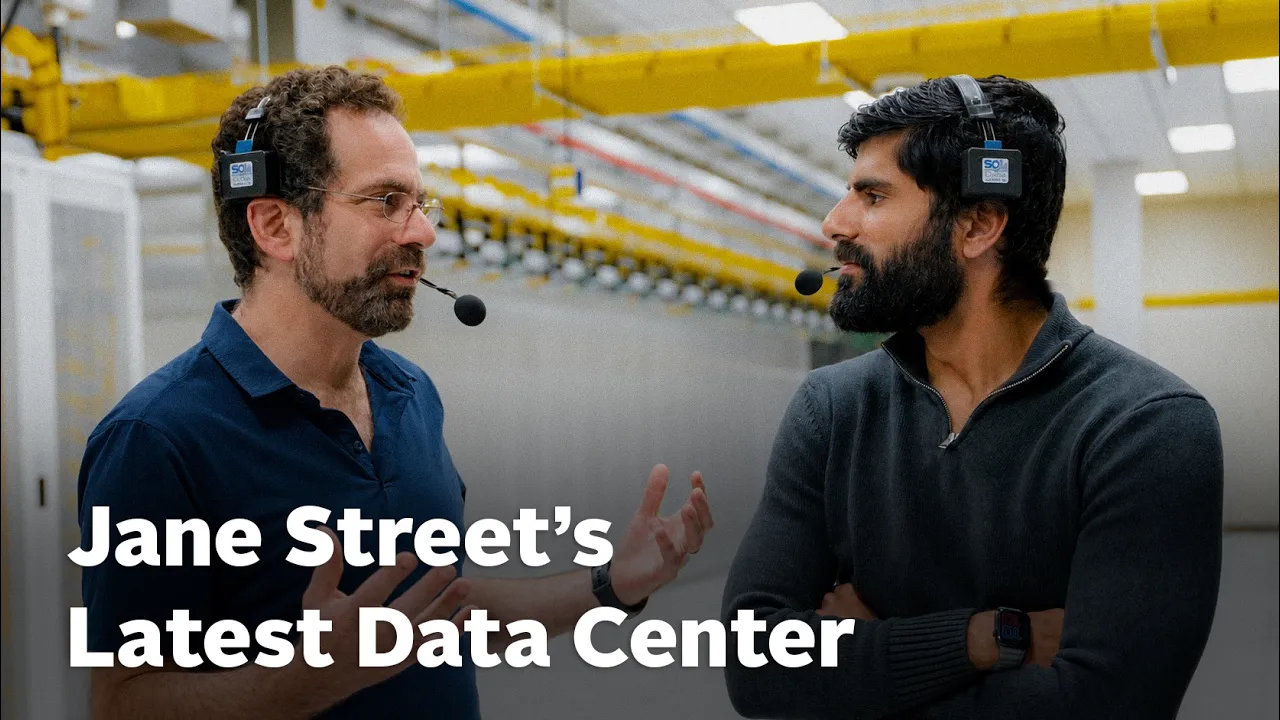
Today I'm getting a tour of one one of Jane Street's training data centers here in Texas from [music] Ron Minsky who co-heads a technology group and Daniel Pontecorvo who has the physical engineering team. Thanks for coming out here to do this. Thank you. Well, let's get started. So here's one of where we have our our training cluster of GP300s and VL72. >> Are you allowed to say what is currently happening on this cluster? >> What actual training jobs are running right now? >> High-level. We do a bunch of different kinds of models. Some of the models are for training LLMs. Some of the
108 words, the words spoken in the first 30 seconds at 216 words per minute.
Free, no signup. See how the first 30 seconds hold attention, with rewrites.
Sentence shape
| Measure | This transcript |
|---|---|
| Sentences | 184 |
| Average words per sentence | 18.5 |
| Longest sentence | 67 words |
| Questions asked | 25 |
| Sentences containing a number | 15 |
Most used terms
Filler phrases
124 in total: like 55 · you know 22 · kind of 13 · actually 9 · right? 7 · uh 7 · um 5 · I mean 3 · literally 3.
A literal whole-word count of the same phrase list the Prepublish browser extension uses, so a phrase inside another word is not counted and a phrase used in its ordinary sense still is. It is a count and not a judgement.
What this transcript is
Every word below is the caption track YouTube publishes for this video, pulled from the video itself and reproduced unchanged. It is not Prepublish's writing, not a summary, and not a re-transcription: it is the video's own published captions. English captions, generated automatically by YouTube, in the video’s original language. Source: the video on YouTube. A channel that would rather this page did not exist can ask for its removal through the contact page, and it is removed.
Today I'm getting a tour of one one of Jane Street's training data centers here in Texas from [music] Ron Minsky who co-heads a technology group and Daniel Pontecorvo who has the physical engineering team. Thanks for coming out here to do this. Thank you. Well, let's get started. So here's one of where we have our our training cluster of GP300s and VL72. >> Are you allowed to say what is currently happening on this cluster? >> What actual training jobs are running right now? >> High-level.
We do a bunch of different kinds of models. Some of the models are for training LLMs. Some of the models are for training all sorts of custom architectures that are more adapted to the trading problems in the trading data sets. Earlier you were explaining to me that this is originally not a facility that was built to handle 200 kilowatt racks. And so you had to retrofit it to be liquid cooled and everything. You know, these cabinets, these GP300 cabinets, consume at peak about 140 kW each.
Compare that to traditional air-cooled you're talking about 10 to 40 kW. It's a lot more. So on the perimeter here you can see some of this air cooling equipment here that would have have fed a traditional air cooling. Some of it remains, we use some of it for the air air-cooled load that we have. About 15% of these cabinets are air-cooled. In here inside the GPU you can see how the how the cooling kind of flows from these quick disconnects on the back taking a fluid in, routing it to these cold plates that are sitting on top of the GPU, and then coming back out at a warmer temperature.
So when you slide this sled in, it automatically connects to liquid supply and return and 54-volt power. Right? So these just slide in, powered and cooling all within the sled. There are still some components in here that are air-cooled, but about 85 to 90% is cooled via those cold plates of the heat load. To what degree have we had concerns about leaks, right? I feel like you spent, you know, decades worrying about not having water in our data centers and now we're like putting it on on purpose.
Like How big of a deal is that? So, inside they have something there's underneath there's there's these ropes set to detect leaks. So, there's a management side of the switch of this server that will send out an alert if they they sense a leak in there. Furthermore, there's leak detection underneath the floor. If it drips and falls under the floor, we'll be able to sense it there and isolate via valve. But, it is true that if something here fails, you are at risk of destroying the server.
How often is there a leak? Not often, but this stuff is new. You know, it's yet to be seen over time how this how this works out. So, I guess it's a surprising to me that like it was not a problem to get this get a liquid cooling going in a facility that was originally built for air cooling and like lower power densities. I don't know how Why did it work? >> How do you define problem? I mean, it was an engineering challenge. >> I feel like you're hearing the version of the story after all the problems have been worked out.
These guys have spent a huge amount of effort figuring out like this place would feel in a kind of intermediate point where we knew we had to scale up a lot, but we didn't know what the shape of the coming compute was. And so, I think one of the things that the guys here did really well was like take to heart the importance of optionality of like, "Oh, yeah, there's a lot of different futures and we need to build some stuff that will work for multiple different ones." And I think that works really well, but required a lot of hard thinking and planning to make it land well.
You know, one thing I'll say is there's a couple of ways to do liquid cooling. So, we have fluid coming from the roof from the chillers on the roof down here, maybe about 18° C. >> [music] >> We use the same fluid for the air cooling, so it's fungible within the data center. We can move the fluid around. Oh, that's nice. So, what we do is we send this in. This device here makes sure that every single cabinet has the right amount of flow.
You don't want the ones at the beginning of the row to receive too much flow and the ones at the end to be starved. So, what these devices, these valves, they control how much fluid goes to each cabinet so that they're balanced. How How do they measure whether they have the right amount of fluid? >> Ultrasonic flow meter here. So, ultrasonically it's measuring the fluid and measuring how much flow in liters per minute and capping that at some rate that we predetermine based on the heat load that it's rejecting.
Um that liquid comes in, it goes to this heat exchanger here. So, there's inside that heat ex- inside that CDU is a heat exchanger that transfers heat between this building loop, building cooling loop, and a what we call a technical water loop inside there which is needs to be very, very clean and filtered down to 25 microns so you don't plug the cold plates on the GPUs. You want very good efficient heat transfer there.
Um it's filled with a liquid uh a mix of distilled or deionized water and uh propylene glycol, 25% of propylene glycol. Um that's to inhibit any bacteria or algae growth. Um and that bacteria could grow in there if you don't have the right ratios and plug the cold plates and plug with the uh the heat exchange between the GPU and the cold plate. I don't love the world where we have to worry about bacteria growing in our servers. >> So, you have you have leaks, you have bacteria, all these different new things to worry about.
Um making sure you have proper flow between all the devices. Uh air-cooled data centers, you you know, you put the cabinet in and just flood the room with air and and and heat and and transfer that heat. So. Was there just an area underneath that you could have used? Raised floors traditionally were used to to supply air. Uh so, there's ways you could supply air. That air would come out here. A lot of the the new solutions are going to overhead piping cuz it takes time to build these raised floors and it's it slows down projects.
So, a lot of the piping system's going above overhead now for for speed of deployment. But, we like this here because you see that blue uh that blue wire there, that'll sense a leak. If one of these connections is dripping, it'll touch that that rope there and send a signal to say that there's a leak. So, we're able to contain a leak under the floor and and and measure it where overhead it's kind of right into your data center.
So, we have 4,032 GPUs here in 56 racks. What we try to do on the on the power side is make sure we balance our power. You can't overload certain areas, so you kind of you can see how we have this bus way here distributing power and we're very conscious about how many racks are on each bus. Make sure you don't go over amperage and trip a breakers and you could be in the middle of a training run and overload a breaker and you'd have to go back to some book worth.
What is the hourly price on a black wall rack? There's two ways of pricing it, right? There's how much does the hardware itself cost and the power and all of that and then there's the opportunity cost. >> That's right. That's right. And we actually think about opportunity costs when we think about all of this compute stuff very intensively and like because we're in a world where compute is relatively inelastic, you end up in places where there's a real crunch even internally where it's like, "Oh, it's you know, it takes time to get new compute online and available." And you can get to a case where it's like people are all kind of bidding for the same compute and you're like, "Wow, it's become incredibly expensive." Because the stuff that we get out of this is super valuable to the business.
And so the opportunity cost tends to dominate the hardware cost. Even though the hardware costs are not small. >> [laughter] >> Yeah, so that's the other question. If this facility is connected to the grid and you presumably had asked the grid beforehand for a certain amount of power and now you move to much denser compute, how are you and this is still like using the grid it's not behind the meter. How are you able to get the power in here?
So, because as the compute is moving denser, what is what you know, if we have some power allocated from the utility, we end up just using less space within the data hall, right? So, you know, like everything just gets smaller and you can see in this data hall it's got a lot of space that we don't need. You know, so you're trying to respect that that power capacity you have from the utility whether it's utility or behind the meter, you still have to respect that overall value, but you want to ride as close to it as possible.
That's why you can afford to put a podcast studio in this place. Although there are reasons to want higher density like the networking setups themselves are incredibly complicated and like I don't know one thing I always feel when I go into one of our data centers is like what a beautiful job people have done getting the wiring right. That's actually quite hard and the more you have stuff splayed out the harder it is to get all the wiring done and it's also worth noting like most of the wires you see here out of the cages are fiber, but the stuff inside of the the fastest stuff is all is all copper.
Light moves more slowly in fiber than electrons move in copper. So you really are at many different levels of optimizing for the latency of all of these networking rigs. There's about 8,000 km of fiber in this deployment. >> [music] >> And there you go. This is what happens when you go really dense. But you you you do have enough power to fill everything there out? >> So it depends how we move power around, you know, one of one of the ideas of of being flexible and fungible with our power and cooling is that we overbuild our distribution.
So while we're limited on the upper end, you're able to move power around by loading up different rows, right? So we have these UPS's that supply power to our site, but when we distribute that power out if we can move it around Yeah. it allows us to say hey we're going to you know, we're going to grow some CPU here or we're going to grow some GPU here. So you know, we have some headroom in there to do other things and this is just opportunity areas for us to do that.
We want to be ready to go if the business needs some more computer where we have a place to put it. So you you do some amount of pre-building for future you know, future opportunities that come up. So what are these things? So these are breaker panels. These these distribute out to those bus bars that you've seen, so this is where, you know, power comes in and you're going to have to break that power out to to go in different paths.
So, there's a lot of distribution, you can see all this overhead conduit that we had to put in. This is all carrying power cables out to the data hall. So, you're you're very conscious when you're distributing power. It's it's less fungible than than than cooling. With the cooling, you can kind of oversize the pipes and move it around. With with power, you have breakers and and current limits. So, you're very you have to be very careful with with what you load up and where and making sure that you don't end up in a situation where you're tripping a breaker.
We have protections in place, so if we we trip one of those four buses, we're still good, so there's some redundancy, but still it's still an interruption, something we want to avoid. >> What would cause you to trip a breaker? Just high current. So, adding too much load on a single busway or single connection, or pushing too far in the over subscription and saying, "Oh, well, you know, we think we're going to be over subscribed by 10% and actually things kind of shoot up to 50% or 20%." There There are times when you do have time to respond, but if you're you're too far over the limit, the breaker's going to trip and you're going to And is the is the current pattern determined by software or by by hardware alone?
It's It's by hardware. It's controlled somewhat by by software. I think So, what Nvidia is doing, they have this kind of LPS system, it's a a load management system that they're rolling out in some of their new cabinets. Really, what they want to do is keep that load profile flat. They're building in more bulk capacitance in those power cells, those capacitors in there, and they're also trying to get the software to allow it the the peak load and the average load to be much tighter, so you have this flat profile.
A place where software comes in is monitoring. We actually put a huge amount of effort into building our own monitoring tools so that we can in one pane of glass, as they like to say, like we can monitor every aspect of the system and look for problems and sometimes even drive reactions to the system where like sometimes we might want to shut off a workload if it is drawing too much power. And having like a unified system that can see all the things has been a huge kind of step up in being able to run these things in a highly reliable way. >> So, that that software system Ron mentioned is actually pulling information from these breakers and performing some logic behind the scenes.
It's It's topology aware. And what it will do, like Ron said, it can shut down nodes, so we don't trip that. Because you want to run as close to the edge as you can, cuz like the hardware is incredibly valuable. So, you do want to oversubscribe. You do want to kind of run near that edge, but you also need to be safe, and so you build in these safeguards to let you pull back in a controlled way. If somebody switch one of these switches, would there some training workload stop right now?
Yeah, I mean, this site's been been >> [laughter] >> The site is currently live, so yes. >> [music] >> So, here you can see a little bit of the scale of of of our liquid cooling. So, you know, these are we we call it buffer tanks. So, they're here to to help with a situation where maybe there's a interruption in power and the chillers on the roof free start and lose cooling. This is almost like a thermal battery storing some energy for us to keep those GPUs cool while the chillers come back online.
Also, as these workloads come up and down, you're going to have a kind of a movement of temperature. So, this helps dampen that that effect out. These are the traditional air cooling units that you'll see in almost every air cooling data center. Really just pulling that hot air back and supplying it back into the data hall. Those wheels up there are are valves. So, you mentioned leaks, right? What happens if there's leak?
Well, you have places where you can isolate the system to kind of work on it, to fix a leak or something. These orange things just have more chain in them. So, they're not hitting you in the head. Now, you can reach them with a ladder, take more chain out, and turn the valve closed or open. That's great. Such a simple solution. You know, it's it's interesting as these data centers and and the compute gets so dense, where the place where you have the compute is getting smaller and smaller, and the places where you're supporting that computer is getting larger and larger.
The infrastructure, the transformers, the the chillers are getting bigger and bigger. So, the sites are are very much this much compute and this much infrastructure to support that compute. What did the analogous system to this 20 years back look like? So, yeah, it was like dramatically more primitive. Like early on we literally just had like computers like sitting out with us in the room with all the people. Like the one of our computer clusters we called the hive and I remember the first version of the hive was literally like six Dell boxes stacked on top of each other like at the end of, you know, the row.
That's why they're called hive bucks. Yes, that's right. Yeah, like hive was the name like a very like actually the first the first work that I did at Jane Street was doing like quantitative research on trading strategy strategies and I was like, oh, yeah, I guess we need like a cluster and like that pile of six Dell boxes was our first cluster. And the trading systems themselves we also had there and that actually was like more important to have out with us and it took us time to convince ourselves okay to like actually go and put it in another room in a rack because we actually wanted the ability to make sure we could turn the damn thing off.
Like if something went wrong just the comfort of like I could unplug it was there. And, you know, it took time to convince people that we had enough control over the systems and we understood enough about where things were and just would be able to find them if we had to go in there that things were cleanly labeled enough >> Yeah. that we were comfortable taking these things and moving them in the back. Yeah. I mean, there were ups and downs.
Like literally at some point, you know, one of the people who was like cleaning the office like unplugged one of the trading systems in the middle of the day like as they were vacuuming. So, you know, in the end it is in fact better to have it all in a data center, but I don't know, early on it was more of a shoestring operation and we were just kind of figuring things out. >> did did not need to be even back then co-located with the exchanges?
So, an important thing to understand about our early uh trading is like we were super not fast, right? Like there there trading like latencies matter at lots of different orders of magnitude and like sometimes it matters whether you're responding in you know, seconds or milliseconds, sometimes microseconds. Like these days the very fastest systems we care about you you're talking about whether you can turn around a packet in under 100 nanoseconds. >> Yeah.
Okay, definitely want to ask you more about that when we get to the podcast studio. Yeah, interesting.
The words are the caption track's own and nothing is reworded or re-transcribed. Paragraph breaks are placed between sentences so the text reads as prose.
Free tools for your own script. No signup, no login.
Paste your draft and see where viewers are likely to drop off, with a rewrite for each weak line.
Paste the first 30 seconds of your own draft for a hook score and rewrites.
Check your draft against YouTube's advertiser-friendly guidelines before you record it.
Read this channel's public videos and transcripts, and download a writing brief for it.