Getting the transcript
Reading the captions from YouTube. A video nobody has opened here before takes 10 to 30 seconds; this page fills in on its own.
Getting the transcript
Reading the captions from YouTube. A video nobody has opened here before takes 10 to 30 seconds; this page fills in on its own.
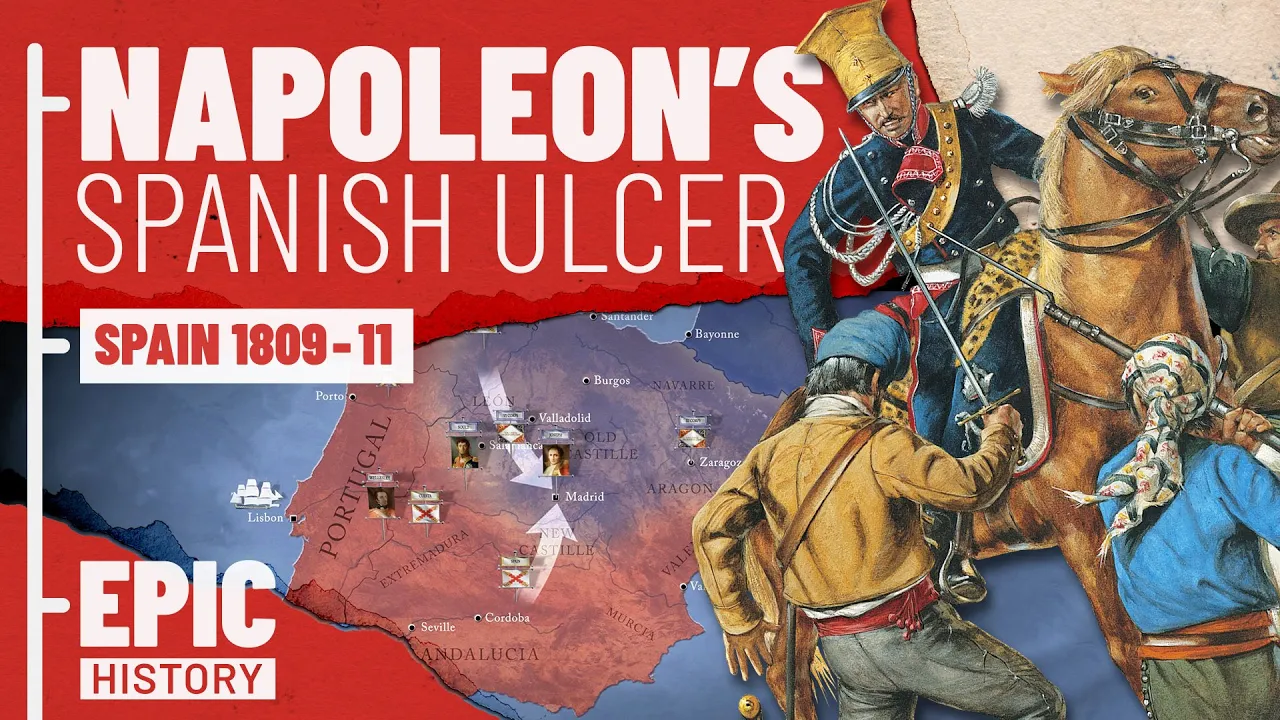
Epic History · @EpichistoryTv
Where viewers went back to watch this video again, from YouTube's public Most replayed graph, lined up with what was said at that moment.
Most replayed moment #1
4:227.1x the video's typical replay level
Warned of Soult’s approach from captured despatches, the victorious Anglo-Spanish army… retreated. … while King Joseph and Fourth Corps marched against Venegas’ army, which they smashed
Said at 4:18
Most replayed moment #2
1:592.8x the video's typical replay level
advance, and were soon in headlong retreat, back through the mountains into Spain. Having secured Portugal, for the time being, Wellesley planned a joint campaign with General
Said at 1:51
Most replayed moment #3
16:402.8x the video's typical replay level
for the French, capturing convoys and couriers on the strategic Burgos-Bayonne road, and branding ‘Viva Mina’ on the forehead of collaborators.
Said at 16:39
The graph counts replays. It does not show where viewers stopped watching.
Words
2,233
Runtime
19:50
Speaking pace
113wpm
Reading time
9min
113 words per minute, below the 160 25th percentile of 349 measured videos. That distribution comes from the 349-video hook study.
Opening (first 30 seconds)
In 1809, Napoleon Bonaparte, Emperor of the French, was at the height of his power. He had just won another crushing victory against Austria at Wagram, and imposed a humiliating peace treaty. But the war he’d started in Spain and Portugal, with his ill-judged invasion the previous year, continued to rage. Napoleon had placed his own brother
57 words, the words spoken in the first 30 seconds at 113 words per minute.
Free, no signup. See how the first 30 seconds hold attention, with rewrites.
Sentence shape
| Measure | This transcript |
|---|---|
| Sentences | 118 |
| Average words per sentence | 18.9 |
| Longest sentence | 44 words |
| Questions asked | 0 |
| Sentences containing a number | 22 |
Most used terms
Filler phrases
1 in total: like 1.
A literal whole-word count of the same phrase list the Prepublish browser extension uses, so a phrase inside another word is not counted and a phrase used in its ordinary sense still is. It is a count and not a judgement.
What this transcript is
Every word below is the caption track YouTube publishes for this video, pulled from the video itself and reproduced unchanged. It is not Prepublish's writing, not a summary, and not a re-transcription: it is the video's own published captions. English captions, published by the channel, in the video’s original language. Source: the video on YouTube. A channel that would rather this page did not exist can ask for its removal through the contact page, and it is removed.
In 1809, Napoleon Bonaparte, Emperor of the French, was at the height of his power. He had just won another crushing victory against Austria at Wagram, and imposed a humiliating peace treaty. But the war he’d started in Spain and Portugal, with his ill-judged invasion the previous year, continued to rage. Napoleon had placed his own brother Joseph on the Spanish throne – uniting a proud country against him. His troops had dealt ruthlessly with popular uprisings, while routing a succession of Spanish armies.
In February 1809, Marshal Lannes overcame the heroic defence of Zaragoza, in a brutal siege that cost 54,000 Spanish lives and 10,000 French. But still… the Spanish and Portuguese remained defiant. And 3 months after their escape from Corunna, the British were back. In April, Sir Arthur Wellesley landed in Lisbon to lead a small Anglo-Portuguese army: British redcoats would fight alongside Portuguese troops, who, with the help of British training, would soon prove themselves highly effective.
Three weeks after arriving in Portugal, Wellesley moved against Marshal Soult’s Second Corps, which had recently taken Porto. Soult and his troops, preoccupied with plundering the region, had no warning of the British advance, and were soon in headlong retreat, back through the mountains into Spain. Having secured Portugal, for the time being, Wellesley planned a joint campaign with General Cuesta, commanding the Spanish Army of Extremadura.
On 10th July, the two commanders met at Casas de Miravete to discuss strategy. Relations between these two allies were not straightforward. Britain and Spain had a long history of conflict: The Spanish were deeply suspicious of British intentions in Spain, while the British had a low opinion of the Spanish army, which they considered poorly trained, and badly led. Wellesley’s request to take over command of Spanish forces was rejected.
But the generals agreed to a joint advance up the Tagus valley towards Madrid, to be supported by General Venegas, advancing from La Mancha. In the face of their advance, Marshal Victor’s First Corps withdrew to Talavera, where he was joined by King Joseph and General Sebastiani’s Fourth Corps. The French plan was for Joseph’s army to defend Madrid, while Marshal Soult led three corps down from the north, to get behind and trap the Anglo-Spanish forces.
But Joseph, worried by Soult’s slow progress, and General Venegas’ advance on Madrid, The Battle of Talavera saw British infantry bear the brunt of the French assault: they stood firm, and repelled the enemy with disciplined musket-fire and bayonet charges. Talavera was a small battle compared to the great clashes fought that year in Austria. But it proved that under Wellesley, Britain’s small, well-drilled army was a force to be reckoned with… even though in the short term, victory achieved little.
Warned of Soult’s approach from captured despatches, the victorious Anglo-Spanish army… retreated. … while King Joseph and Fourth Corps marched against Venegas’ army, which they smashed at the Battle of Almonacid. That autumn the Supreme Junta in Seville, free Spain’s effective government, raised two new armies for another attempt to liberate Madrid, planning to converge on the capital from north and south. But Wellesley, ennobled as Viscount Wellington for his victory at Talavera, had been so disgusted by the lack of Spanish co-operation that summer, that he refused to risk his army.
Predictably, Spain’s inexperienced armies met with disaster: at Ocaña, they suffered their biggest defeat of the war, when a smaller force under Marshal Soult routed the Spanish army, taking 14,000 prisoners and 50 cannon. A week later, the Army of the Left was heavily defeated at Alba de Tormes. There was more bad news when Girona fell to the French, after an epic 7 month siege. The Supreme Junta’s plans to retake Madrid were in tatters...
And Southern Spain was now wide open to French attack. In January 1810, King Joseph marched south with an army of 60,000 men. In the face of his advance, Spanish resistance... evaporated. Spain’s Supreme Junta was overthrown in a coup, as Cordoba and Seville fell without a fight. Joseph, who still hoped to win over the Spanish with his progressive reforms, was welcomed by many as a saviour from anarchy. Only Cadiz held out - its defences reinforced by a British naval squadron - and was besieged by Victor’s First Corps.
Meanwhile Napoleon sent Marshal Masséna to Spain with 65,000 reinforcements. He was reckoned one of Napoleon’s best marshals, and had just been made ‘Prince of Essling’ for his heroics in the recent war against Austria. Masséna was to lead a third French invasion of Portugal, take Lisbon, and chase the British back into the sea. He laid siege to Ciudad Rodrigo, a fortified city controlling one of the main routes into Portugal, which surrendered after two weeks’ bombardment.
Wellington, with only 33,000 men to face Masséna’s 50,000, retreated. Masséna crossed the Portuguese frontier, and besieged Almeida. After just 13 hours of bombardment, a lucky French shot hit the Portuguese magazine… 70 tons of gunpowder went up in a devastating explosion, that made all further resistance useless. It was a serious blow to Wellington, who’d been relying on Almeida’s strong defences to buy him time. At Buçaco, he found a strong defensive position and made a stand.
Masséna’s uphill, frontal attack failed at a cost of 4,000 casualties. But the next day, the French found a way to outflank Wellington’s position, and his retreat continued. As Masséna’s army neared Lisbon, his scouts reported something completely unexpected: Stretching across the Lisbon peninsula, protecting the city from attack, they found a new chain of fortifications, in two major lines. Known as the Lines of Torres Vedras, the British and Portuguese had been constructing these defences for more than a year.
Now the Lines bristled with more than a hundred forts, redoubts and batteries, manned by 30,000 troops and 250 guns. Masséna soon discovered the Lines were far too strong for him to attack. What’s more, a ‘scorched earth’ strategy had stripped the surrounding countryside of anything that might help the French… While Portuguese partisans attacked French supply columns, as they struggled through the mountains to reach Masséna’s army.
Masséna faced a grim predicament: starved of supplies, too weak to attack… unwilling to retreat. But throughout this stand-off, it was Portuguese peasants who suffered most of all. When their villages and farms were burned, many took refuge in Lisbon, where thousands died of starvation and disease. Back in France, Napoleon had been preoccupied with his divorce from the Empress Josephine… and then a new marriage Archduchess Marie Louise, daughter of the Emperor of Austria.
She was now expecting their first child. Nevertheless, from Paris, Napoleon sent frequent orders to his Marshals in Spain and Portugal, urging them to take more aggressive action. But when these orders arrived, weeks later, they were usually out of date, and showed little understanding of the problems his Marshals faced. He now ordered Soult, based in Andalucia, to go on the offensive, to draw enemy forces away from Lisbon, so Masséna could take the city.
Soult laid siege to Badajoz, a fortified city that controlled the southern route into Portugal. When 12,000 men of the Army of Extremadura marched to its relief, they were routed by Soult… after which the city tamely surrendered, giving up 8,000 prisoners and vast quantities of stores. It was another heavy blow to Spain’s armed forces. But remarkably, despite such disasters, and their many blundering generals, Spanish troops remained willing to fight, the courage of the rank-and-file undimmed.
Victor’s First Corps, besieging Cadiz, had now been so weakened to support other operations, that the Anglo-Spanish garrison decided to attack. The allies landed along the coast, to strike at the French siege lines from the rear. But they were ambushed by the French at Barossa. Despite heavy losses, the Anglo-Portuguese rearguard fought off the enemy - but a furious falling out between British commander Sir Thomas Graham, and his Spanish counterpart General La Peña, threw away any advantage.
Soult, alarmed at these developments, marched back to Andalucia. Meanwhile Masséna, out of food and with no prospect of reinforcement, had no option but to retreat. Wellington’s army pursued, discovering evidence of several appalling atrocities, committed by the French against Portuguese villagers. There were running battles with the French rearguard, brilliantly commanded by Marshal Ney, until he was sacked by Masséna for criticising his leadership.
Having chased the French out of Portugal, Wellington besieged Almeida. Masséna’s army, now rested and reinforced, marched to its aid. The two armies clashed again at Fuentes de Oñoro. In two days of heavy fighting, Masséna failed to break through Wellington’s position to relieve Almeida. The fortress fell the next week, but to Wellington’s fury, British bungling allowed most of the French garrison to escape. Masséna had lost 25,000 men in Portugal.
Now he’d lost Almeida too. And a string of bad decisions, not least to bring his mistress with him on campaign, had cost him the respect of his officers. The Marshal, whom Napoleon had once nicknamed ‘the dear Child of Victory’, was recalled to France in disgrace, never to hold senior command again. Napoleon sent Marshal Marmont to replace him. Meanwhile Marshal Beresford, the British commander of Portugal’s army, was sent to retake Badajoz with 20,000 British and Portuguese troops.
When Soult approached with a relief force, Beresford marched to meet him at Albuera: it was one of the bloodiest battles of the war – around 6,000 casualties on each side, with more than a third of the British infantry killed, wounded or captured. Marshal Soult declared... "There is no beating these troops, in spite of their generals. I always thought they were bad soldiers, now I am sure of it. I had turned their right, pierced their centre and everywhere victory was mine – but they did not know how to run!" Soult had been checked, but he was determined to save Badajoz.
The newly-arrived Marshal Marmont marched to his aid, and they advanced again. This combined army forced the British to abandon the siege - But when Wellington withdrew to a strong defensive position across the Portuguese border, Soult and Marmont did not pursue. French commanders in Spain had learned grudging respect for Wellington, and for the steadiness of his troops. For now, the war in Spain had entered stalemate.
While British, French and Spanish armies criss-crossed Spain and Portugal, another war was fought every day in the mountains, hills and woods. From 1808 Spanish and Portuguese civilians, militias and ex-soldiers began taking up arms against the hated French invader. They waged a war of ambushes and hit-and-run raids, known in Spanish as la guerrilla - ‘the little war’. Its fighters became known, in English, as guerrillas.
Britain’s Royal Navy supplied vital weapons, stores and money, often landing them behind enemy lines. Much of Spain’s rugged countryside fell under the control of the guerrillas: North of Madrid, Juan Martín Diez, an ex-soldier known as El Empecinado, ‘the Stubborn’, led a guerrilla band 6,000 strong. In Navarre, Espoz y Mina, a former peasant, ran a highly organised band that caused havoc for the French, capturing convoys and couriers on the strategic Burgos-Bayonne road, and branding ‘Viva Mina’ on the forehead of collaborators.
While in the west Julian Sanchez, known as El Charro, led the self-styled ‘Lanceros de Castilla’. El Charro himself wore a French hussar’s cap, its eagle symbolically turned upside down. There were dozens more bands operating across Spain – though a few were no better than bandits, terrorising civilians as often as the enemy. The guerrilla war was merciless, marked by hideous atrocities on both sides. A French soldier’s greatest fear was to be taken alive by the guerrillas, who often tortured their prisoners before killing them.
Tens of thousands of French troops were tied down by this ‘people’s war’ – guarding outposts, or patrolling the countryside. The roads were so dangerous for French messengers that they required cavalry escorts of 200 men or more. Many still didn’t get through - their valuable despatches forwarded to Wellington, for whom they became an invaluable source of intelligence. The war in Spain would ultimately cost the lives of 240,000 French soldiers: As was typical in wars of this era, most died from disease – but more died fighting guerrillas… than in battle against the British and Spanish armies.
However, it was the twin threat - a well-led, regular army under Wellington, and a popular insurgency, that left the French facing an impossible strategic dilemma: If their armies remained dispersed, to fight the guerrillas – Wellington could attack. But if they concentrated to defeat Wellington in battle – huge swathes of the country would quickly fall to the guerrillas. This was ‘Napoleon’s Vietnam’ - or his ‘bleeding ulcer’ as he called it – a war that cost his empire an average of 100 casualties every day, with little prospect of victory.
And in 1812, as Napoleon launched his gigantic invasion of Russia, Wellington and the guerrillas launched their own offensive... that would turn the war in Spain on its head. Thank you to all the Patreon supporters who make this channel possible. If you’d like to join their ranks and get early access to new videos and other perks, please visit our Patreon page. You can also support Epic History TV by buying official branded clothing at our store – follow the link in the video description.
The words are the caption track's own and nothing is reworded or re-transcribed. Paragraph breaks are placed between sentences so the text reads as prose.
Free tools for your own script. No signup, no login.
Paste your draft and see where viewers are likely to drop off, with a rewrite for each weak line.
Paste the first 30 seconds of your own draft for a hook score and rewrites.
Check your draft against YouTube's advertiser-friendly guidelines before you record it.
Read this channel's public videos and transcripts, and download a writing brief for it.