Getting the transcript
Reading the captions from YouTube. A video nobody has opened here before takes 10 to 30 seconds; this page fills in on its own.
Getting the transcript
Reading the captions from YouTube. A video nobody has opened here before takes 10 to 30 seconds; this page fills in on its own.
Clive Thompson · @clivethompson-jc9my
Words
3,585
Runtime
23:16
Speaking pace
154wpm
Reading time
15min
154 words per minute, below the 160 25th percentile of 349 measured videos. That distribution comes from the 349-video hook study.
Opening (first 30 seconds)
Hello dear friends. My name is Clive Thompson. Today is Thursday, September 3rd, 2026 and it's coming it's just after midday in Europe. The gold price is moving up today and that's after some significant news yesterday which created a lot of interest in gold. Before I go any further, don't forget that nothing I say in this video is meant to be investment advice. I'm not recommending buying, holding, or selling any investment. I'm not a
77 words, the words spoken in the first 30 seconds at 154 words per minute.
Free, no signup. See how the first 30 seconds hold attention, with rewrites.
Sentence shape
| Measure | This transcript |
|---|---|
| Sentences | 190 |
| Average words per sentence | 18.9 |
| Longest sentence | 155 words |
| Questions asked | 6 |
| Sentences containing a number | 35 |
What this transcript is
Every word below is the caption track YouTube publishes for this video, pulled from the video itself and reproduced unchanged. It is not Prepublish's writing, not a summary, and not a re-transcription: it is the video's own published captions. English captions, generated automatically by YouTube, in the video’s original language. Source: the video on YouTube. A channel that would rather this page did not exist can ask for its removal through the contact page, and it is removed.
No Script X-ray for this video: YouTube shows a Most replayed graph only once a video has enough views.
Hello dear friends. My name is Clive Thompson. Today is Thursday, September 3rd, 2026 and it's coming it's just after midday in Europe. The gold price is moving up today and that's after some significant news yesterday which created a lot of interest in gold. Before I go any further, don't forget that nothing I say in this video is meant to be investment advice. I'm not recommending buying, holding, or selling any investment.
I'm not a registered investment adviser, and you should always consult with a qualified investment adviser before you take any decision about buying, holding, or selling anything. So the announcement yesterday concerned some significant movements in the holdings of the Dutch central bank's gold. In the coming days, you're going to see some very sensational sounding videos with titles like Dutch central bank panics or Dutch central bank doesn't trust America or Dutch central bank prepares for war.
Ignore all of those. It's nothing to do with any of those. and I'm going to give you the facts and what's going on and why it is important, but it's not the reasons you'll see in many of the videos. Let me explain what they have done first and then we'll look at the Dutch central bank's announcement and then we'll look at the motives for why they've done it. Effectively, they have reduced their exposure to the United States and to Canada in terms of gold and increased their exposure to London.
The exposure to gold via the Netherlands has remained the same. But I'm going to talk about the moves because it's quite complex as to what they did and why they did it. The net result of what they have done is that they now hold much less gold in the North American continent and much more gold in London. Before the move, 31.3% of the Netherlands gold was held in New York. After the move, only 18.5% of their gold is in New York.
They have also reduced their exposure to gold in Canada, in Ottawa. In this case, they've reduced it to the same level as the New York gold down to 18.5%. The previous percentage in Ottawa was 19.7. So the move in Ottawa was much smaller than the one in New York. As a consequence of these moves, gold in London has increased from 18.1% to 32.1%. Gold in the Netherlands held by the central bank has not changed. It was 30.8% before and it's 30.8% after.
The total holdings of the Dutch Central Bank therefore remain completely unchanged from before. What has changed is the location where they hold their gold or the locations. And the way they did it is quite convoluted and takes some explaining. So I'm going to talk it through and you'll see why they've done what they've done which seems quite strange at first. Let's start with the New York move. The Dutch central bank has effectively moved and it's not physical movement uh as I describe it there 78 tons of gold from New York to London but the gold did not physically move in that way and they also effectively moved 7 to 8 tons from Otdora to London and again we'll talk about whether that gold physically moved in a second.
Let me break the moves down. The first move they made was to sell 59 tons of gold in New York and simultaneously purchase 59 tons of gold in London. I'll come to the reasons for that in a second. The second move they made was to physically ship 27 tons of gold from New York and Ottawa to the Netherlands. And the third move they made was to ship 27 tons of gold, but not the same bars, from the Netherlands to London. Before I go on to explain why they're doing these moves and what the motives are, and they are quite surprising motives, but I'm going to use the Dutch central bank's own words rather than the madeup words you'll hear some on on the internet somewhere.
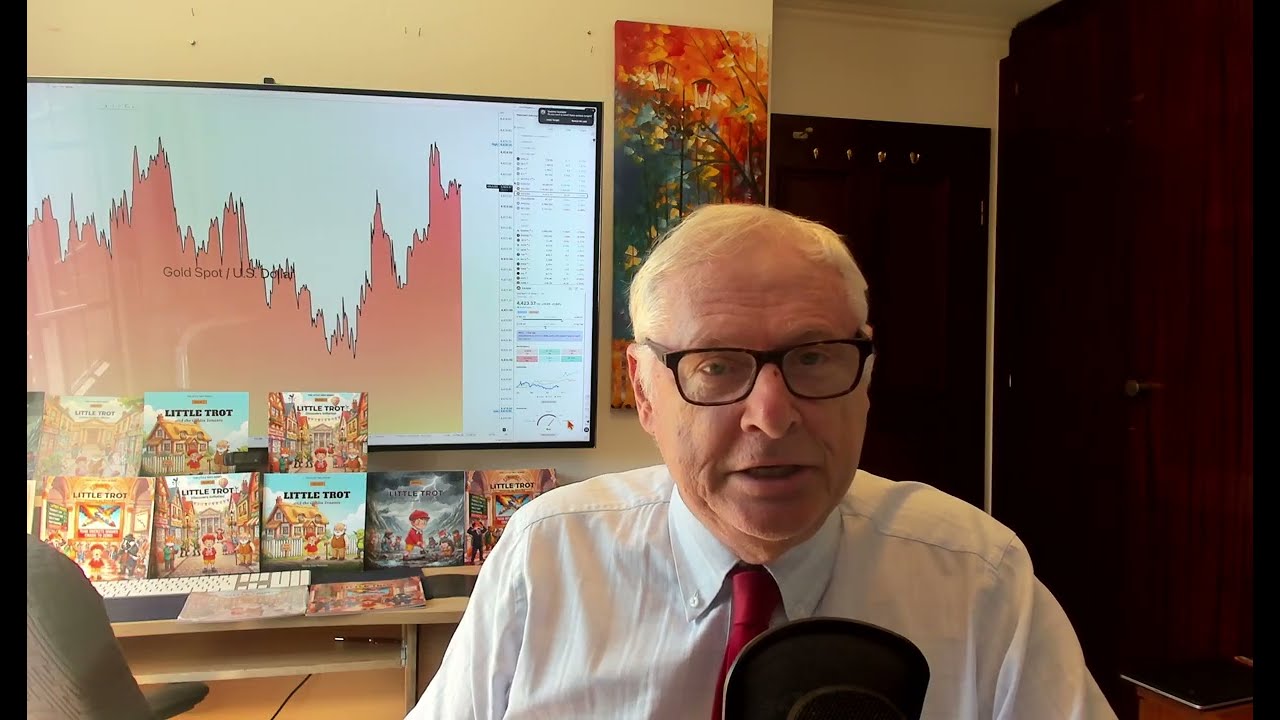
Let's look at the gold price first and see what effect this is having on the gold price. So now you should see on the screen the gold price and you can see it's uh the blue line is the break between yesterday and today. Um so that's basically midnight uh the blue line there. Gold price at the moment is up $ 38.5 compared with yesterday and I think that's largely because this news about the Dutch central bank's uh move of gold has created some interest in the community and people are thinking gold shall I buy some and there's been a little bit of interest because of that.
I think that when people break down the Dutch central bank's actual announcement and their actual words, the interest will grow and that's in my view possibly going to happen in the coming days. Before I look at the Dutch central bank's own words, I'm I think I'd like to explain what they've done and why they've done it. And then we'll look at the Dutch central bank's own words, which uh have some quite interesting comments, which I think will get people very wound up in terms of what they've said and their motives.
So let's start with the first move which was the sale of 59 tons of gold in New York and the purchase of 59 tons of gold in London. Why did they do that? The gold in New York was not of today's international standards. If you want to be able to deploy your gold quickly and sell it at the market price without any questions, you need to have it to meet the international gold standards in the major one of the major gold markets which is specifically London.
London is one of the principal centers of the world for the trading of gold and they have international trading standards. the bars must meet certain criteria and it seems that the bars in New York weren't meeting the international standards. So rather than melt the New York bars down and then ship them to London, it was a lot easier to sell the New York bars and buy bars in London. The bars that they bought in London meet the international standards, which means they can be bought or sold in huge quantities at very short notice.
That was not the case with New York bars, which are not so easily tradable. They also shipped 27 tons of gold from New York and Ottawa to the Netherlands and those bars would not have been of international standards in prob in all probability. So why did they do that instead of melting the gold and repurchasing it? The reason I think is that they wanted to test various methods of mobilizing their gold because in a crisis situation you don't know what options will be available to you.
Perhaps certain options might not be available to you. You might not be able to sell gold in London or you might not be able to ship gold out of New York. So they wanted to put both methods to the test. How easy is it to test? what's the procedure to uh to sell or to have gold in London which is easily sellable and what's the procedure and how easy is it to ship gold from New York to Lond uh to the Netherlands in case of need.
Uh so by doing both they're putting in place procedures uh so they know how to do both in case of need. But then they simultaneously shipped 27 tons of gold from the Netherlands to London. So they took 27 tons of gold from New York and and Ottawa into the Netherlands and they shipped 27 tons from Netherlands to London, but not the same 27 tons. The reason they shipped different bars from the Netherlands to London was that the bars in Netherlands do conform to the international standards and therefore are easily tradable in London. whereas the ones they've received from New York and Otter would not be so easily tradable.
In other words, it's a different quality of gold. Uh it doesn't mean to say there's any less gold. It just means that maybe the London bars are of a certain finness and the bars from New York are not the same finness or they may not be the same shape or maybe not the same size. I have a feeling that in due course they will melt those bars from New York down just to see uh if they can turn them into uh internationally tradable gold.
Well, of course they can, but it'd be useful to do so just to make sure that the gold is absolutely there and it's 100% pure. I think it's time for us to go and look at the actual words that you were used by the Dutch central bank. the known as the D netheranchia bank DNB and see what they said. So we'll go over to the DNB and it's the headline from press release yesterday is DNB improves tradability of gold reserves and I'm going to read this to you and I'm going to break it down uh when I see something important.
D. Nidalanchia Bank DNB has improved the tradability of its gold reserves by transferring part of the gold holdings from New York and Ottawa to London. This ensures that the DNB is better prepared for severe crisis. I repeat that. Severe crisis. Now, they're not suggesting that there's one around the corner. They're just saying they want to be better prepared for severe crisis. in view of increasing geopolitical unrest and I repeat in view of increasing geopolitical unrest and that's the world we're in and that's why people are starting to become more interested in gold especially central banks it says in view of increasing geopolitical political unrest DNB is strengthening its crisis preparedness and again some YouTubers are going to have a field day with words like crisis preparedness uh because it's smacks of uh emergency or urgency but I don't think that is the case myself but I'm just reading it to you the way it was written here improving the liquidity and tradability of the Dutch gold reserves is part of these preparations preparations for crisis preparedness or geopolitical unrest that is moreover a more balanced distribution of these reserves between North America the United Kingdom and the Netherlands helps spread the risks and make them more readily available for use in a crisis situation.
That's about the third time we've seen the at least the second time we've seen the word crisis. So, what's interesting here, if I just scroll down to the percentages as shown on their website, Zeiss is the uh Netherlands. There's is a town in the Netherlands. There's no location where more than 30% of the Netherlands gold is held. is now held uh between Netherlands less than 30%, London less than 30%, New York only 18 and a half and Ottawa only 18 and a half.
So no location has more than one/ird. That gives the central bank lots of options in a crisis as to which gold it's going to mobilize and how it will mobilize it. And this is what they say they've done. Between March and August 2026, approximately 86 tons of gold were transferred from the combined total of approximately 313 tons held in the United States and Canada to London, which is regarded as which is regarded worldwide as a major trading center for physical gold.
Gold that is held with the Bank of England must meet modern international trade standards and is regarded as the world's most easily tradable gold and will therefore be the most readily available for DNB in a crisis situation. So that's the third time we see the word crisis in the announcement. The gold reserves held in New York and Ottawa cannot be used as quickly and directly in such a situation. In other words, if there's a crisis, they to deploy gold in some way, i.e. they have to sell it to defend their exchange rate or they have to sell it uh to buy weapons or who knows what in a hurry.
Um it's a lot easier to sell it through London than through New York or Ottawa. They're saying keeping a larger share of the gold reserves in London strengthens the function of gold as an anchor of trust. I repeat that. Gold as an anchor of trust. Well, this is interesting because it reaffirms one of European's largest central banks belief that gold is an anchor to the financial system. They say it's an anchor of trust.
And now the next bit is really important and I I I have to say gold bugs are going to love these words. Gold is seen as the ultimate reserve asset. Ultimate reserve asset. I repeat that. Ultimate reserve asset because it is ideally suited to hedge extreme systematic risks. And again I think I have to repeat those words. uh it's ideally suited to hedge extreme systematic risks and that it perhaps explains why portfolio managers all around the world should definitely consider having some gold in every portfolio.
Uh how much? Well, that's down to them to see, but uh there have been recommendations that these days it should be a 60 2020. That means 60 in equities, 20 in bonds, and 20 in gold. Let's go on. With this reallocation, we have improved the tradability of our gold reserves. So that's absolutely true. Uh with gold in London of international standards, they'll be able to sell it much more quickly if they need to. They go on to say, "We expect that we will never need to use them." So no panic.
We don't expect to use them. We we expect that we'll never need to use them, but we do need to strengthen our resilience and preparedness. Another exciting word for the you YouTubers who want to make it make something that's resilience and preparedness, said DNB Governor Olaf, and I can't pronounce his name, but it sounds like Slage Slage Pen, amounting to 612.4 tons worth 72.2 2 billion at year end. That's end of 25.
The Dutch gold reserves are part of DNB's official foreign reserves. For many years, the Dutch gold reserves have been spread over different locations around the world as part of a risk diversification strategy, including DNB's cash center in Zeiss and central banks in the United Kingdom, Canada, and the United States. Following the recent reallocation, the geographical spread of the Dutch gold reserve is now more balanced with both the United States and Canada each holding 18.5%.
And then we have this little table which shows us how much was gold held in each location before and after. So in Zeiss in the Netherlands, it was 30.8 and it still is 30.8. London has gone up from 18.1 to 32.1%. New York has gone down from 31.3% to 18.5 and Ottawa has gone down from 19.7 to 18.5. And the last bit is where they describe how they did it. The relocation strategy the or rather the relocation was largely affected by first selling approximately 59 tons of gold in New York and then buying gold in London. 59 tons.
I guess that meets international market standards. In addition, more than 27 tons of gold were physically transferred from the United States and Canada to Zeiss and a similar quantity of gold that meets the international market standards were transferred from Zeiss to London, preventing the need to remelt gold bars. Better tradability also means that the quality of the gold reserves has improved. Why has it improved?
Well, because don't forget in New York they uh sold 59 tons and they bought in London 59 tons. So basically that means that the gold they bought was better quality gold than the gold that they sold. Uh it doesn't mean to say there wasn't the same quantity of gold. It was just perhaps one was 99.9% pure and the other was 99.99% pure. I I haven't got the precise uh London specifications, but clearly what they bought is internationally um international standard gold bars.
Better tradability also means that the quality of the gold reserves has improved. The total size of the gold reserves has remained the same. Combining the processes of buying and selling and physical transport has allowed DNB to spread the risks associated with such a complex physical gold relocation operation while also ensuring efficiency and cost consciousness. Moreover, experience of both approaches will be useful in the event that another relocation is required during a potential future crisis.
In other word, crisis turning up. That's must be the fourth time I think. And one of the two approaches proves impossible due to circumstances at the time. So there may be a situation where you can't trade London gold perhaps in a crisis maybe or there may be a situation where you can't move gold out of New York perhaps due to uh war risks or some other problem. So they're basically hedging their bets with lots of ways to access some gold if they have to in what they say could be a crisis.
This also fits with DNB's efforts to increase its crisis. That's the fifth time now. Preparedness. For more information, please contact blah blah blah. So, ladies and gentlemen, make what you want of that announcement, but clearly what the Dutch central bank is doing is a sensible move. They're putting their gold into multiple locations with the most gold held in the place where it's easily most easily tradable, i.e.
London. They're not changing the amount of gold that they're keeping them in the Netherlands. And you might wonder why why wouldn't they ship it all to the Netherlands? Well, first of all, um if it's in the Netherlands, it's not so easily tradable. It's not in the right place if you need to turn it into uh money quickly for some emergency like defending the currency or perhaps uh you need to uh buy weapons or something for some uh crisis.
Sorry, I used the word crisis. I should stop using that word. Uh but if you have to do something in a hurry, Netherlands isn't the right place. But the second point is when if there were an invasion, and nobody's suggesting there would be one, but in the unlikely event of an invasion, one of the things that foreign invaders often go for is they go straight to the central bank and seize the foreign country's gold. So if all the gold were sitting in the Netherlands central bank, it makes it a much more attractive target to some invader.
In the days which follow, I think there's going to be some discussion and debate about the move by the DNB and why they've done it and what their motives were. Uh though I think their motives are absolutely clear on their website. They're preparing for a potential crisis which they don't think is going to happen, but they need to be ready for something which might go wrong. And uh having a gold in the right place is good uh a good move in advance.
I think we can also draw comfort as gold investors from their comment that gold is an anchor to the financial system. Uh is it what they call it an anch was an anchor of trust and they also said that gold is the ultimate reserve asset uh because it's ideally suited to hedge extreme systematic risks and that should be a lesson to any portfolio manager who's thinking how the portfolio should be constructed. If you're thinking your portfolio should be 100% in uh equities, well, that might be good while the going is good.
But if there is a systematic crisis, equities won't be doing you much good because they'll be going down and the gold price will be going up. So, you know, the having a balance, a more diversified portfolio between those two asset classes does make sense. But the reality here is that many portfolio managers have less than 5% gold and probably that's not enough to move the needle or at least balance things out in uh systematic um dislocation of some kind.
Um so ladies and gentlemen, that's basically all I've got to say today. Um please like and subscribe. I will keep you notified if I see any more important news like this one or if I see another central bank moving their gold in a hurry. Don't forget we've had a few make some moves recently. We've had uh a few years ago there was Germany and then more recently France and now there's the the Dutch. Let's see if any other central banks in Europe decide to move some gold around.
I'll be sure to let you know if you've liked and subscribed. You'll get to hear it first from me. Ladies and gentlemen, my name is Clive Thompson. Thank you for tuning in. And I'd like to say goodbye. And don't forget to buy my little trop books if you can. That would help support my efforts to do this sort of work.
The words are the caption track's own and nothing is reworded or re-transcribed. Paragraph breaks are placed between sentences so the text reads as prose.
Free tools for your own script. No signup, no login.
Paste your draft and see where viewers are likely to drop off, with a rewrite for each weak line.
Paste the first 30 seconds of your own draft for a hook score and rewrites.
Check your draft against YouTube's advertiser-friendly guidelines before you record it.
Read this channel's public videos and transcripts, and download a writing brief for it.
Most used terms
Filler phrases
61 in total: uh 39 · like 8 · um 7 · basically 4 · you know 2 · sort of 1.
A literal whole-word count of the same phrase list the Prepublish browser extension uses, so a phrase inside another word is not counted and a phrase used in its ordinary sense still is. It is a count and not a judgement.