Getting the transcript
Reading the captions from YouTube. A video nobody has opened here before takes 10 to 30 seconds; this page fills in on its own.
Getting the transcript
Reading the captions from YouTube. A video nobody has opened here before takes 10 to 30 seconds; this page fills in on its own.
AI Engineer · @aiDotEngineer
This video has no Most replayed graph yet: YouTube shows one only once a video has enough views. These are the moments viewers replayed most in AI Engineer's most watched videos.
Most replayed moment at 18:45
4.8x that video's typical replay level
that they're they're changing they're changing things in the database not yet. You want to run them through the ontology first and make sure that works. Okay. I only got an I've got I've got another I've just a short time. I'm going to try to show you some of the things that um that you can
Said at 18:37
Most replayed moment at 16:13
3.6x that video's typical replay level
method signatures, the program layout and the call stacks. So here's some examples. I don't think you'll be able to read this one, but this is like the level of abstraction we're at. It's how we're actually going to lay this stuff out and how these systems are going to interact. Dylan Mulroy from Cloudflare talks a
Said at 16:06
Most replayed moment at 13:49
2.3x that video's typical replay level
Fable uh and it runs into an unknown, ask it to log it, right? So that um you uh you can see where the deviations happened and then you can sort of figure out why as well, you know? It will usually give you some context about what happened.
Said at 13:43
The graph counts replays. It does not show where viewers stopped watching.
Words
2,704
Runtime
15:28
Speaking pace
175wpm
Reading time
11min
175 words per minute, between the 160 25th percentile and the 181 median of 349 measured videos. That distribution comes from the 349-video hook study.
Opening (first 30 seconds)
workshop setup, so um there are some people who kind of have like never installed open claw, and I want to kind of get them set up. And then the other people like want to try an experimental thing, which I haven't even fully gotten working, but I think for more advanced people that'll be cool um to get like a sort of staging environment and run two open claws. So, I think if I'm not, you know, too busy helping new people set up, then I'll try
88 words, the words spoken in the first 30 seconds at 175 words per minute.
Free, no signup. See how the first 30 seconds hold attention, with rewrites.
Sentence shape
| Measure | This transcript |
|---|---|
| Sentences | 220 |
| Average words per sentence | 12.3 |
| Longest sentence | 50 words |
| Questions asked | 30 |
| Sentences containing a number | 10 |
Most used terms
Filler phrases
223 in total: like 93 · um 46 · kind of 20 · you know 20 · uh 16 · right? 15 · actually 7 · sort of 3 · basically 2 · I mean 1.
A literal whole-word count of the same phrase list the Prepublish browser extension uses, so a phrase inside another word is not counted and a phrase used in its ordinary sense still is. It is a count and not a judgement.
What this transcript is
Every word below is the caption track YouTube publishes for this video, pulled from the video itself and reproduced unchanged. It is not Prepublish's writing, not a summary, and not a re-transcription: it is the video's own published captions. English captions, generated automatically by YouTube, in the video’s original language. Source: the video on YouTube. A channel that would rather this page did not exist can ask for its removal through the contact page, and it is removed.
workshop setup, so um there are some people who kind of have like never installed open claw, and I want to kind of get them set up. And then the other people like want to try an experimental thing, which I haven't even fully gotten working, but I think for more advanced people that'll be cool um to get like a sort of staging environment and run two open claws. So, I think if I'm not, you know, too busy helping new people set up, then I'll try to help people like finish debugging the last part, or maybe someone else will get it.
And I think uh 10 minutes Q&A, 10 minutes some more advanced topics, and then just more Q&A. And uh probably after every 5 minutes or so, we can do a bit of a few minutes of discussion. So, I'll just set some timers to make sure I don't go off track. All right. Let me start. All right. Can everyone see this presentation? >> Yes. >> All right, cool. >> Yeah. >> So, this kind of describes like my setup. Um I'll just keep it really high level for this part where when everything works, you know, maybe like 70% of the time, you describe your task.
And then what's nice is open claw will have like context and memory about what you're talking about. So, for example, like let's say I'm like, "All right, fix this thing." It's a very brief Slack message, but open claw can remember like what I've asked it to do before. So, for example, I'm working on this thing I'm calling a skeptic agent, and it's a custom code review thing. But if I'm like, "All right, fix the skeptic agent." or whatever, right?
It kind of knows what that is, which is nice. You don't have to re-explain a lot. Um I use multiple agents with work trees, that's very key for parallelization. Uh, CI code good integration. But you can kind of see you can talk to it and be pretty brief and then, you know, usually get reasonable outcomes, but sometimes you'll have to debug it. So, then it's like, all right, there's some time out thing. I'm like, give it a longer time out, right?
And then I asked that here like like uh, you know, what are the priorities and what we're working on. And I'm reading it here. And then I might have just said like, uh, I just made code for it, right? So, another interesting thing about this is you can kind of see from like, um, >> [clears throat] >> the types of responses I give, they're not that like, um, special. As in I I actually think an agent could replace me.
So, that's kind of what I'm working on right now to like get things even more autonomous. You know, and you and you'll see this with LLMs like you're working with them and they'll be like, "Hey, I've got this thing ready." And I'm like, "Okay, we'll run the test, right?" Uh, all right. So, I'll share the next slide now. Oops. Okay. We're going to some concepts right now. Like, what is Open Claw? So, I think what's cool about Open Claw is it's not just about a particular repo or the code, but more of the concept.
So, you know, I've got this cool super diagram, but first concept is frictionless communication. So, I know we have other things like Claude co-work or whatever, but I think they still have a similar concept where it's like, can you like easily talk to your AI versus like you've got a, um, remote desktop into your computer or you have to go sit down. So, that kind of enables certain really higher level of velocity. Um then I think the central axis is very important.
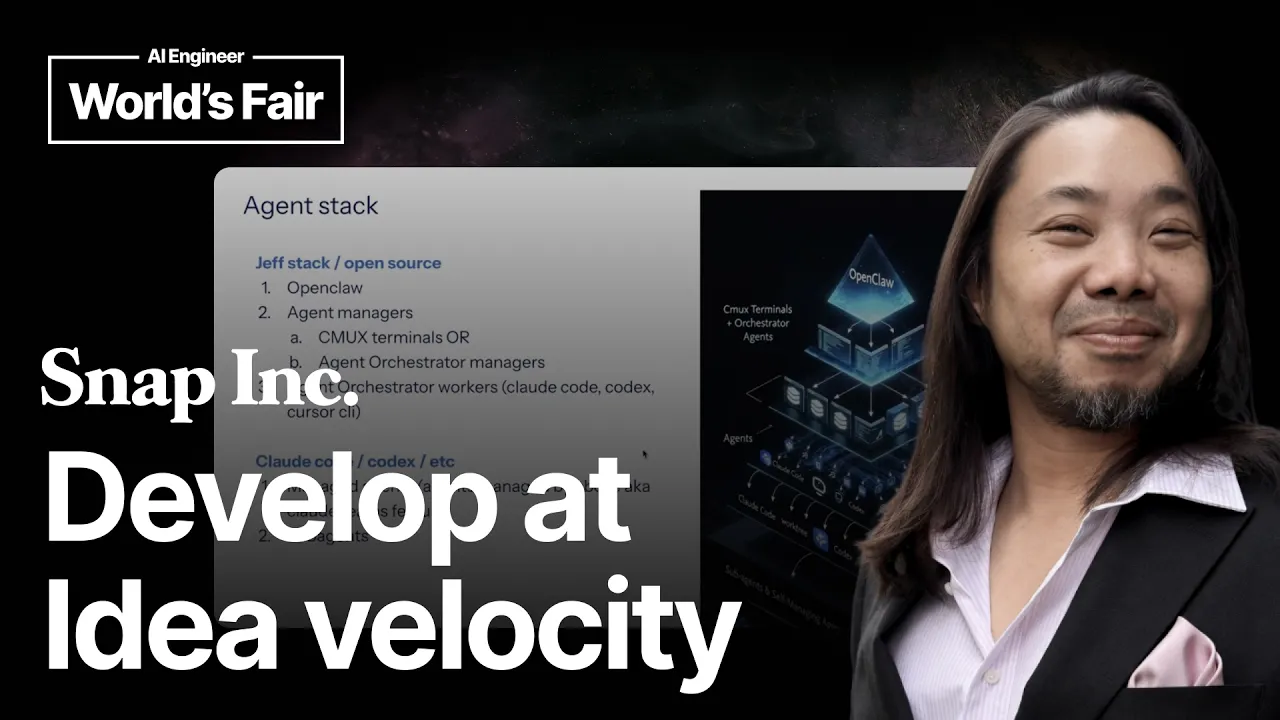
So, you know, there's a spectrum like I kind of go like a little more cowboy and I give it act. Open Claw has these agent orchestrator managers that manage your workers for you. Uh or sometimes when I want more personal control, I use tmux terminals. So tmux is like a terminal program, but it's pretty good for parallelization and AI development. Then I use the open source framework that I forked agent orchestrator to do the workers.
And then once it gets to here, this part is like not really controlled by me as much anymore. Um so, I'm calling them managed agents, but basically like you have a worker that runs Claude code and Claude code itself can run agents and those can have sub agents. So once you get to this Claude code part, right? This part is not exactly my stack, just stuff I use, but this part of the stack I'm changing a lot more. Um I'll pause here to see if anyone has any questions or thoughts. >> Um can you hear me?
So I I have a question. So the the real question is, you know, why why use Open Claw versus directly use Claude? >> So yeah, that's that's definitely a good question. Um >> [clears throat] >> The reason I use Open Claw as specialization. So when Open Claw makes a decision, I want that context to be more about like the spec or the goals or like the history of what I want in the task rather than the code. And you can just imagine this, right?
As soon as you open up Claude, it reads Claude MDs, it reads skills, it reads um MCPs. A lot of those things are sort of independent of like the actual task. It's more about how to do the task. Um so imagine like 25% of your context already taken up by implementation. Versus like when you think about open claw, you're like, okay. I want to think about exactly what I want to do and how it relates to all the other slacks Jeffrey sent me in the last 2 weeks and put it all together and give me like a reasonable spec.
Does every single thing a player does, but it does it without a browser, right? So you could use MCP, which usually is JSON or whatever or HTTP. Doesn't really matter actually. And then the final thing is the browser test. So some things like are visual. I mean, maybe you could even have CSS tests or JS tests, right? And that kind of goes here. But then the final thing is visual. So I would recommend you like try um similar approaches to this and be like, okay, like which problems truly needed that human or not.
Um and I think what's kind of cool is like every quarter or you maybe even every month like it improves. So before like I had to really manually test a lot because like you know, this worked fine, right? But these things didn't work that well with agents like last year but like a year ago even 6 months ago. But now like um agents are pretty good at like nailing down a lot of browser tests for me. Versus like when I started my agent would have a lot of problems, you know, finding a pop-up and entering a password.
Now no problem. Um that was a little long, but does that kind of address the theme of your question? >> Yeah, I think this is good. Good. Thank you. >> Okay. >> Thank you very >> Just just remind me for all these slash commands. I'll put um links here instead. All right, cool. Anyone have any other questions related to some of that stuff? All right. If not, I will go here. All right. So, here's a two websites that I've built. >> [clears throat] >> Yeah, while that loads, I'll show this one.
So, this is like a AI RPG. Um what's cool about this is you can I've got a default campaign, for example. Um >> [clears throat] >> Yeah, pick some options. You've got a avatar. And uh what's cool about this is it builds a custom world for you that reacts to you. So, you can like kind of say whatever you want, do whatever you want, you'll get a story back. Um the main difference between playing this versus like um you know, you could just always go into the Gemini chat or or chat GPT or whatever is that um I have like a D&D system.
So, if you play your own like games or novels, like you kind of just win too much. Versus like with this, you'll actually do like dice rolls and be like, you know, did the person actually um did you actually succeed in your action or not? All right. So, while this is going, I'll also um show this thing. Yeah, so this is funny. Um this website is like a multi-AI analysis website. Um so, what I found was like whenever I was doing research or or whatever, I would go to multiple models and I'd be like, what's the answer?
Then I copy and paste them all. I put them into one model. Um so, pretty simple concept, but this does it for you. So, usually I like these answers better than like asking one model. And I'm like, okay, how do I do this workshop? So, I can be like, okay, what's the status? Uh what's the latest PR now? And um what I like about this is it has that sort of vertical tab type of thing. Cuz when you go horizontal, it's really easy to lose track of your tabs.
Um but we've got notifications, too. So, when this thing is finished or this is finished and I need to look, it'll give me a notification. And I can just focus on clearing the notifications. So, here um the way of using these terminals, usually it's more like a manager rather than a coder. Um and it's kind of interesting, but it gives you a certain benefit where I feel I feel like the work is not biased anymore. So, when I when I code with these directly, um I usually feel like there's a bias, where it wants to say things are really working or whatever, right?
Versus like, you know, um I'll show this. Let's look. If this had been working on PR 294 by itself, I think it would have been like, "This PR is amazing. Like, we got to merge it, right?" But then this one was like, "No, like, there's another PR that should supersede it, and probably we should just close this PR." Right? So, that's kind of the benefit you get, where the manager has a different context um than the workers. >> [snorts] >> Uh let's see.
All right, so this is compacting whatever. So, it will take some time to complete. Don't want to wait for it, but when it completes, you see these notifications, and I think my efficiency has improved a lot with tmux. Um I think is Austin or someone from tmux here? >> Yeah, here. What's up? Go. >> Yeah, so Austin is uh >> [clears throat] >> one of the guys behind tmux. Um you know, big fan of it, and I'm not I'm not paid to say this or anything, but big fan of tmux.
Uh been using it a lot. I don't know, you can spend a minute if you want to talk about anything cool about tmux. >> Yeah, so yeah, one of the creators of tmux. Really happy to have Jeff as one of our power users. And also like kind of endorsing it for free. But yeah, lots of uh yeah, lots of things that we're shipping. We shipped a Cloud Code Teams integration. So, if anyone is using Cloud Code Teams and wants to actually see what the salvations are doing, we'll automatically spawn terminals for that.
We also shipped Cmux SSH. So, if you do any SSH work, you can use our native Cmux SSH to you know, do your tailscale and etc. To other computers. You can even use it to run your own open claw in your Mac minis. But yeah, just one of the creators. Please feel free to email me if you have anything that you think is a bug or any feedback, feature requests. I'm always available and yeah, just love seeing people using Cmux and always want to take as much feedback as I can to like get them as get them >> Okay, so just download that. >> Yeah.
They actually have an app too. So, the app might be nice. >> Yeah. Okay. And then use that to help me get back in and set set up. >> Exactly. Yeah. >> Okay. Okay, cool. Thanks. >> All right. Is using the sandbox, it should not. Where would you Have you had Have you run into any troubles Aaron about sandbox token usage? >> Uh no. I'm just I'm not technical at all. I have open claw installed, so I'm >> Okay. >> very newbie questions. >> No no no bad questions.
All good. Yeah. Uh they're not the sandbox wouldn't do that. I think if if everything's working well for you, you know, keep using the sandbox. For me, I just you know, don't use a sandbox and so so far nothing bad has happened. But I think if I had an external bot, then I would use a sandbox too. >> You changing the model testing a new model like it'll go down then I have to figure out how to get it back up again. So I think I want to set up this sandbox because >> Oh, sorry.
Sorry. Um okay, wait. There's two kinds of things. Okay. The sandbox that most people talk about means like they run it in Docker or they like have it running in isolated part of their system. But the other one was the one where I made the staging instructions where I was like oh >> Yeah. >> Okay. So that could double your token usage if you send the same work to both of them. If you have two of them, right? Um but I think the way I would use it is not like that.
Like I think I would do local development and then I would run integration tests on the um sandbox or staging one, right? So I have two of them. And then once like everything's good, then I would merge the code and deploy to the production one. >> I see. >> It wouldn't double your usage, but it would definitely increase it. But then the benefit is you might have some more reliability. So >> Yeah. >> I I made some instructions and I was kind of in the middle of setting it up, but then, you know, it's like competing with the other one, so I got to debug it. >> Yeah. >> But I think, you know, it's it's worth trying out though.
So I had that for more advanced people to give it a give it a try. >> Cool. Thanks. What >> Or if you're not as advanced, if you want it, you know, you can try it. >> Yeah, I'm definitely going to play around. But what a what model do you use? Like do you have a something that like a default orchestrator model and then you say for this you use >> use Codex 53. Um I found I found uh GPT 54 to just use more tokens. Um and even 53 like like I I just get destroyed all the time, right?
So I might have to adjust that. Um so basically I use this until like this is getting low and then I just switch to MiniMax, which is not as good, but it kind of gets the job done. And then this is more about money than like preference, but some some work I can still kind of just do um um here. So, I don't always have to
The words are the caption track's own and nothing is reworded or re-transcribed. Paragraph breaks are placed between sentences so the text reads as prose.
Free tools for your own script. No signup, no login.
Paste your draft and see where viewers are likely to drop off, with a rewrite for each weak line.
Paste the first 30 seconds of your own draft for a hook score and rewrites.
Check your draft against YouTube's advertiser-friendly guidelines before you record it.
Read this channel's public videos and transcripts, and download a writing brief for it.