Words
4,621
Runtime
23:57
Speaking pace
193wpm
Reading time
19min
193 words per minute, between the 181 median and the 201 75th percentile of 349 measured videos. That distribution comes from the 349-video hook study.
Opening (first 30 seconds)
A lot of people we've talked to, all pointing to AI as an important tool in whether it's cancer research >> Healthcare is one of the biggest uses of ChatGPT. >> Oh, bro, we got ChatGPT curing cancer now. Now, gamers are human, I I would hope. Gamers hate AI for the most part because it's taking away all the things that we used to play the games. But then gamers, since we're human, we also tend to not like cancer. We're completely wrong. We've been completely wrong about AI because AI just cured cancer. >> mRNA
97 words, the words spoken in the first 30 seconds at 193 words per minute.
Sentence shape
| Measure | This transcript |
|---|---|
| Sentences | 314 |
| Average words per sentence | 14.7 |
| Longest sentence | 51 words |
| Questions asked | 29 |
| Sentences containing a number | 43 |
Most used terms
- ai53
- cancer44
- data27
- people18
- stuff16
- music15
- actually14
- cells13
- price13
- able12
- basically11
- vaccine11
Filler phrases
122 in total: like 65 · actually 14 · basically 11 · kind of 11 · you know 11 · uh 4 · literally 3 · right? 3.
A literal whole-word count of the same phrase list the Prepublish browser extension uses, so a phrase inside another word is not counted and a phrase used in its ordinary sense still is. It is a count and not a judgement.
What this transcript is
Every word below is the caption track YouTube publishes for this video, pulled from the video itself and reproduced unchanged. It is not Prepublish's writing, not a summary, and not a re-transcription: it is the video's own published captions. English captions, generated automatically by YouTube, in the video’s original language. Source: the video on YouTube. A channel that would rather this page did not exist can ask for its removal through the contact page, and it is removed.
Transcript
A lot of people we've talked to, all pointing to AI as an important tool in whether it's cancer research >> Healthcare is one of the biggest uses of ChatGPT. >> Oh, bro, we got ChatGPT curing cancer now. Now, gamers are human, I I would hope. Gamers hate AI for the most part because it's taking away all the things that we used to play the games. But then gamers, since we're human, we also tend to not like cancer. We're completely wrong.
We've been completely wrong about AI because AI just cured cancer. >> mRNA vaccine prevented the deadly skin cancer from returning or spreading. >> Now, you could argue maybe it's just AI trying to keep humans around longer so we can make something that kills everybody instead. Everything did just change. Obviously, the big companies like Nvidia have been making an absolute killing on this stuff. That isn't even compared to some of the other companies.
AMD has been obviously prioritizing AI like crazy, too, in the past year. >> Advanced AI enabling AI-driven across gaming, AI PCs. >> It's up there. They did it. >> [music] >> We did it, Chad. >> 180% in their stock price. Intel, for example, too. Not only did they get acquired partially by the US government, of all things. That's awesome, so we all partially own Intel, I guess. Intel's stock price has gone insane because Intel's also prioritizing AI, and all of a sudden people need CPUs more than GPUs, as well.
That doesn't even mention Micron, the company who makes a lot of the memory that is in the United States. You know, we've seen this entire shift to AI because AI makes money. If you compare to just the last quarter, freaking Micron is making like Nvidia numbers or some because their revenue 41.46 billion versus last quarter, that was 23.86 billion. They're making like a extra 10 something billion dollars every single freaking quarter.
And if you compare it to last year, they're literally up four times what they were last year. But then things start to get kind of weird when you see another company and their stock price also just shot up. The company is Moderna. W- what what the hell? Moderna, the people who made the COVID vaccine that made everybody sick? I know when I got the freaking COVID vaccine, I got sick as I would if I got COVID. >> [laughter] >> It wasn't very great.
But if you check their stock price, they just shot up in August here, 128% in like a day. What the hell is happening there? It's like, "Oh, did Moderna also hop on this AI with OpenAI he's doing? [music] He's going to change the world." You know, there's been all of this all about AI. It's okay if they spend all the money and redirect things and not give things to consumers anymore, deprioritize people because in the end they can use it for medical technology. >> Now you could study images in a way that [music] radiologists can't easily do, and you can study a lot more of it.
And because they're able to serve more patients, the hospital does better. >> By 2035, you anticipate AI will [music] be able to cure or treat most diseases. Really? Mitigate something like that. >> treat, mitigate, something like that. >> Right. [music] Right. >> Which sounds kind of freaky as well because it's looking through all of our data. That's that's kind of weird. They are able to use AI to parse a lot of data.
The same type of thing where AI could now be used to hook into all of those flock cameras and analyze all of the footage and track people around different cities and stuff. It gets really freaky. Th- those things wouldn't be possible before because there is just way too much data for humans. But the thing is, we've been hearing about that for years and years and years, but has anything actually ended up happening? There's been all these cool advancements with AI in medical tech, but it starts to make you wonder, where the hell did they get all of that medical data to train on?
Oh. And that's why Incogni is here to help. So, Gamers Nexus recently posted a video about LG Smart TVs and they're all freaking spying on you. It is insane. This stuff is getting so bad that this should be illegal. And hopefully it will be. But Incogni can really be used to put the hurts to this stuff. Basically, they can go to all of these data brokers that companies like LG sell your data to and they can get your data taken down.
And for me, they've done 281 takedowns. They're doing 14 right now. Like they're working for me behind the scenes. They can be working for you, too. This also protect you from data breaches, identity theft, and so many targeted ads that are out there. Now, there's definitely more precautions you can take on your own like not owning an LG TV. But Incogni is like having a personal hitman always watching out for you. And if you find something specific that they somehow missed, you can even do a custom request just to get that taken down.
And we can trust Incogni. They've been verified by Deloitte and if you don't like them for whatever reason, you can get your money back. So, Incogni's great and you can check the top of the description for my link, incogni.com/vex. And you can get 60% off the annual plan. It is actually a really good deal. So, check them out. They're making videos like this possible. But let's jump back into all these AI shenanigans.
Well, this is where the story of curing cancer begins. And the company to do it, the reason why their stock price went up like crazy, is Moderna. [music] They partnered with another company that makes Uh sorry, did I flash bang you? They make Keytruda. And this is where I think we need to just talk about what the hell cancer exactly is. And I'm assuming you probably got an idea of what cancer is. I you know, we're humans.
We're gamers. We're humans. But essentially, cancer is completely natural. It's a malfunction of the body. When your cells replicate, there's a chance that the genes in them could get mutated. And in a bad case, there could be a mutated gene that ends up making it rapidly expand and make more and more cells. Yeah, that could not be a good thing when you get a giant growth of cells in a random spot in your body. It's a It's a little bad.
Or it could take so many different forms because it is a complete mutation. It's very unique to every single individual. And that's been the really tough part about cancer. You know, cancer's a little bit difficult to solve. It's not like we've been working on it for dozens and dozens, maybe even hundreds of years now. I'm not 100% sure. And one of the interesting parts to me about cancer is because we're living longer, we actually are more prone to get cancer because it's only a matter of time before something mutates in your body can't stop it.
That's the interesting part about cancer. Is our body actually destroys cancer cells like every single day. There is errors in our cells replicating every single day and our immune system destroys these things. But the cancer ones, when when things get bad and they turn cancerous, it's when our immune system wasn't able to detect it. So basically what this drug is trying to do is tell our immune system to fight those cancer cells.
This is a by a company called Merck and they're partnering with Moderna because >> So how does this vaccine work? It's an mRNA vaccine that mRNA is in fact a recipe for making protein that [music] matches the mutation in somebody's tumor. >> And this is where things get really interesting because cancer treatments are usually very very destructive because we can't be precise with it. Unless you could surgically remove the cancer and it's relatively easy to get to and make sure you get all of it.
Usually people have to take like chemo which is literally poison. Like I think most people know. People have gone through chemo, it is extremely rough. There's also other treatments like radiation where they try to apply radiation to a specific area, try to target that area and kill the cancer cells. But even the radiation, if you can access the area with radiation in the first place, even that is still very destructive to the other cells in the area.
So everything that we've been doing so far to treat cancer, try to get rid of it. Yeah, it's very advanced, but at the same time, it's also very destructive to the human body and you know, until AI can replace all of us, it kind of needs to keep us around, right? Yeah, we need to pay its subscriptions. That's where this whole thing of using your own body's systems and actually telling your body to target the cancer, it'd literally be a vaccine.
That's the really interesting part. I don't even know if that'd be applied to the specific area where the cancer is, but you could take a shot and it would be able to train your body to use its immune system to fight off [music] cancer cells. Okay, but where does AI come into this? >> So, it can actually customize to each patient based on the genetic material of their individual tumors. >> Basically, what they're using AI for is they take a sample of the cancer cells in your body and then they use an AI model to train what message needs to be sent to your immune system to be able to locate these cells, target them and kill them off.
Because everybody's cancer cells are different, so it needs to be unique to every single person. That is what also help because it's probably going to be cheaper, as well. I think it'd be a little bit cheaper to make a custom thing and then have somebody take a shot instead of doing like chemo for months and months or even years or treatments for so long. That gets really expensive, especially in the US healthcare system.
We love that. If you go to like Merck's website, they said that they've also gone through the stage three trial. Basically, the first thing that got approved is they're doing it on melanoma. This is a skin cancer and they did it first because it's [music] rapidly mutating, so they can get a lot of samples for it and it's like a skin cancer, so you can kind of more visibly see what the hell's going on. And it passed this this trial.
That's actually pretty crazy. Like they're able to make a vaccine custom made for each person using AI to make that vaccine and then you could cure melanoma from people. To me, this is pretty incredible. Have you checked this article from CBC? We are really hopeful that the magnitude of benefit will be substantial, but it's still early. >> Do we have any sense of a timeline for when this could be available? >> Mhm. So, Moderna and Merck have shared their data with the FDA, are sharing it now.
Assuming everything looks good, the next step would then be to apply for approval of the vaccine, and the FDA, importantly, has already agreed to fast-track its review. So, the companies are somewhat optimistic that this vaccine could hit the market as soon as next year. >> So, basically, it's still going to take some time to get this out there, but even the fact that there is progress being made with curing cancer. Legitimately, you take a shot >> [music] >> and cure a cancer is pretty insane.
I think it's important to note, too, that they did this with melanoma. And melanoma is probably the the easiest one that they would want to go for at this point, but they're also working on other treatments for cancers, like ones that are very, very destructive, as well, like pancreatic cancer. Honestly, the KD of pancreatic cancer is pretty high in people. And here's just like one of the clinical trials that Moderna is doing right now.
So, this is more of like a solid tumor cancer. But, you can be a part of this trial and stuff as they test this. So, this is the promise of AI, that it's going to solve medicine. I feel like every day we're getting just one step closer to being cyberpunk. And we'll just have a microchip in our body that detects all of where the cancer cells are, and you know, they just give you your specific drug, and you fix the cancer cell.
Give me the like jumpers that I can jump like really high, dude. I'd be so good at basketball, it's crazy. But, it's funny because this can cure cancer, in a way, I guess. But, you do stuff to be able to detect it. And I think that this is the next step for this whole treatment, is how the hell do you know if somebody has cancer? And this is also where, funnily enough, AI is supposed to be really good, okay? >> So, one of the the big applications was image recognition.
And one of the most important image recognition applications is radiology. AI has swept the whole field. Just about every radiologist is using AI in some way. The fact that you could study the images more quickly and more precisely without ever making a mistake and never gets tired, you could study more images, and so the number of tests that people are able to do increases. >> And you see chat GPT always talking about this like it's better at diagnosing than an actual doctor.
I don't know how much I would trust that. >> I am pretty sure though that people, even if they know the human doctor is going to perform worse than the AI doctor, will significantly prefer the human doctor. I certainly would. >> There's already been papers and this was like back This was in 2023. And they actually cite down here the future of AI-based medical diagnostics is likely to be characterized by continued growth and and development as open AI more advanced AI technologies are being introduced into the research domain such as quantum AI and speed up conventional training and all that stuff.
Basically, they're citing even in 2023 that open AI would be leading to a future where they could diagnose medical problems much earlier or even faster. Now, I don't know if this could realistically end up happening, but I did think it was funny and this is just kind of a personal story. My mom and my dad, you know, they're getting like as you get up in age, you need like a colonoscopy and stuff. Basically, what my mom was able to do is she actually did participate in a study where they're trying to see if before colonoscopy, where they look up your butt, if they could detect within blood markers.
So, if they just draw some blood, that you could detect if people have colon cancer without having to do a colonoscopy, which is probably a pretty good thing. I don't really want to have a colonoscopy. It doesn't sound very nice. Unless you're into that So, and this was in like multiple phases. This was in a late-stage phase thing. So, this might end up working. And then there's a system in like 2025. This was in October, almost a year ago now.
This is a Harvard paper about talking about how AI can be used to diagnose [music] things. Researchers have developed an AI system called Dr. Kbot. That spells out its reasoning as it works through challenging medical cases and reaches a diagnosis. For the first time, the New England Journal of Medicine has published an AI-generated diagnosis [music] produced by Dr. Kbot alongside one from a human clinician. Clinician?
I think that's how you say it. And it's medical case studies for use education and research. Essentially, they're using AI to diagnose things and to me that sounds a little bit scary. As long as to me, the AI is being used as a tool basically as an assistant so the doctor can actually look at it. So there's clearly been some pretty crazy improvements and this is the future that every AI company has promised us that AI is going to make our lives better in every way possible.
While at the same time, AI is being used as military targeting systems for missiles. That could be a little bit of a double-edged sword, you know? You know, you cure cancer one day and one day you're bombing a country in the Middle East. But I think it's worth looking at is all of this stuff worth it? Because in some ways, this helps us and in some ways, it makes our life hell. RAM This is liquid gold. Check that price on there.
Just straight up $600 kit of RAM. As you guys know, ChatGPT GPT-6 Astra recently came out. GPT-6 Astra is incredible. GPT-6 Astra is finally here and it's really good. Is this actually AGI? OpenAI claims GPT-6 Astra is an ethereal alien mind with AGI-like qualities and it's done some pretty impressive stuff. Apparently there's a very very hard math problem and it's called uh the the Navier-Stokes Millennium Prize Problem.
Astra solved this problem after like 90 years of research. it's is apparently this. It's like talking about liquid fluid simulation and It's just force equals mass times acceleration, so I don't know how why that gets so complicated, to be honest. And then you also see GPT Astra doing some goofy You look at the thumbnails of these is like, oh wow, GPT 6 can basically just make a triple A video game, right? But you look at some of the games they're actually showing off and these are very, very bland games.
I I don't know. It doesn't look that fun to me. And Unreal Engine has been talking about, you know, integrating different models into games to help you assist with making the game development itself, which maybe could be useful as if it's used as a tool but doesn't take over the creative direction. Maybe it's okay, but then you see all the games, the slop games that are getting pumped out. >> [music] >> And I don't really know how I feel about that What really gets my goat on this is that this model, GPT Astra, what it's trained on is the thing that caused the memory crisis.
When OpenAI secured what, 40% of all the memory production in the world, it was for this project called Stargate, OpenAI Stargate. This is a data center that's in Texas and apparently it's super efficient because they save their water. >> With Stargate though, Crusoe says it's bypassed this problem using what's called a closed-loop system. >> You can put a million gallons in and then you don't need more or forever. >> Yeah, that's that's essentially right. >> But now this data center is up and running, so this is where all of our RAM has been going.
It was used to train GPT 6 Astra. This model cost like a billion dollars. GPT 6 Astra heralds the age of AGI, according to Nvidia Jensen Huang. >> Love you guys. >> Thanks, Jensen. So this was trained on 100,000 GPUs in Texas and the next one could be trained on 400,000. Like, yippee! those are all GPUs, all with memory, all SSDs that we don't have access to. When a GPU, for example, like the RTX 5080, a GPU that launched at $1,000, this was an expensive GPU.
But, you see the prices on this stuff right now, a 5080 is like 16 or 1700 dollars at the moment. It's insane. And if you look at the actual GPU die, this is equivalent to like a freaking 70 class card just years ago. But, now this GPU, like why would you sell this to consumers? First off, jack up the price because us consumers aren't allowed to have hardware anymore. Whereas a normal 5080 only has a measly 16 gigs of freaking VRAM.
What is that? Gamer level VRAM? Well, this data center one, just because they doubled the VRAM, it is dollars if you want to get the data center version. Ju- just for 16 more gigs of VRAM. So, those are the kind of price increases that you can expect with this. We've seen things with a 5090, which was supposed to cost what? 2000 dollars? And nowadays, a normal 5090 with actually the same amount of VRAM as this data center 5080, a normal 5090 now costs like over 6000 dollars because they're completely out of stock, you can't buy them.
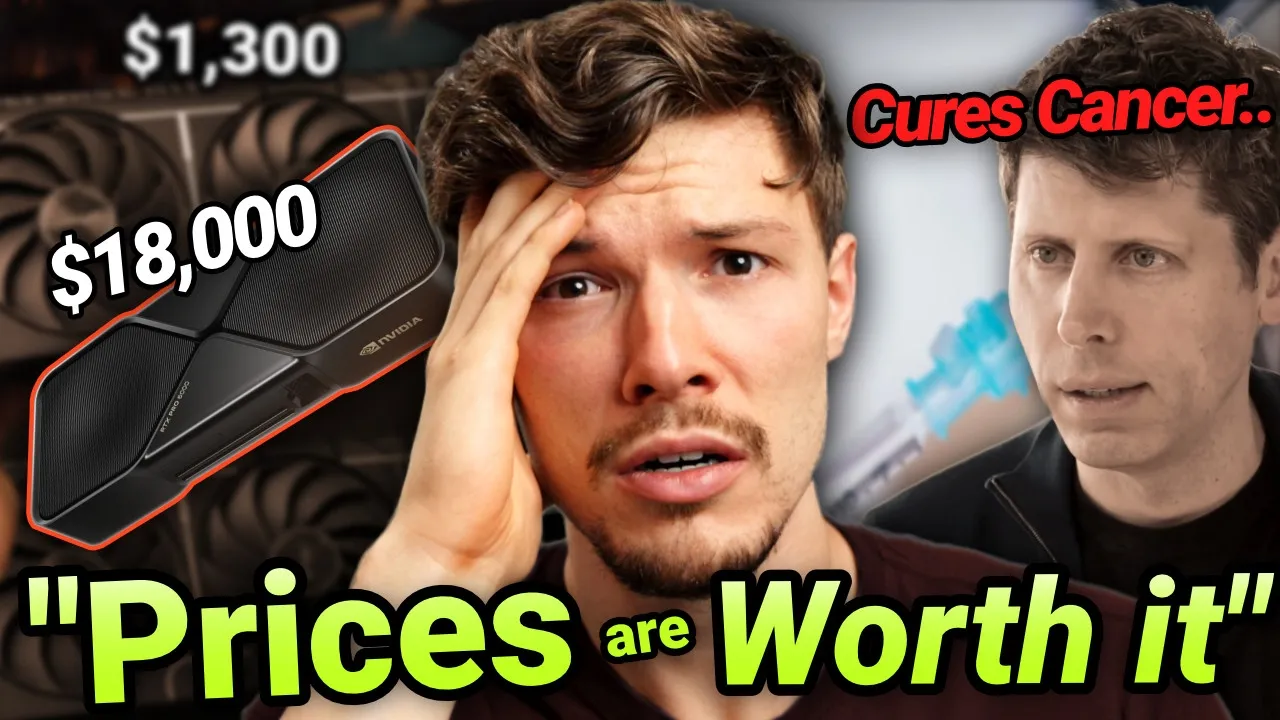
But, there's another level to the 5090. There's the data center version of that graphics card, too, called the RTX Pro 6000. It's like 17000 dollars. That's the price I used to say things like you could buy a graphics card for the price of a used car, that's the price of a new car. And just the graphics card is like is that really worth it? And don't think that any other company is getting away with this and not doing a similar type of thing, just to a lesser degree.
AMD also makes consumer GPUs. Here's an RX 9070 XT. This is a very, very good gaming graphics card. It is a gaming graphics card because it has a measly 16 GBs of memory and gamers could never ever use more than 16 GBs, right? There's also a pro version of this graphics card, which basically the only difference between these two is that the Radeon Pro AI Pro There's two two names of AI in this. The Pro R9 700. This one has 32 GBs of VRAM and just because of that, it costs more than double what the RX 9070 XT is.
It's driven up all of our prices even on moderate GP appears like an RTX 5060 is now like $450. It is 50% above its MSRP. Our DDR5 DDR4 memory kits are insanely high priced and just an average PC now costs 70% more just to buy a normal computer for gaming or normal use. Not only do data centers also take our hardware, they also take our power. And the opinion has shifted about data centers. Used to be that a lot of people were okay with data centers being built out, but now just one in nine Americans support AI data center construction in their local communities.
So it's like maybe people are okay with data centers, but maybe not next to their house. Because once the data center is actually built, it doesn't need that many people to man the thing. So it doesn't really create long-term jobs and then you get all the downsides of having a data center near you. So clearly if you were to talk to a normal person seeing the price of the new iPhones, seeing the price of consoles and of GPUs and RAM, most people seem to be against AI in that way and building out data centers and stuff because it affects us so poorly.
A little bit interested in where things are going to end up going in the future because these data centers really suck, but they aren't entirely necessary, at least if you want to use AI. I think these are where interesting developments can really take off because Qwen, for example, is releasing Qwen 3.8 flash. This is like their whole new AI model. Run this stuff kind of locally on your own hardware. You don't have to use the cloud models.
You don't have to tap into these data centers. It's still expensive and there's still a way to go on this, but that's why another company like DeepSeek is also coming around and they're introducing V4.1 Flash. And this is like basically a frontier class model. It's very, very smart and it's supposed to be able to run on consumer hardware for the most part. So, the memory requirements that you need are kind of insane for this.
I'm not going to lie. But, it's getting kind of interesting and this is just developing more and more because now there is a software called free token that allows you to run larger and larger models on your own hardware. So, it does start to look at these like big data centers, these big AI companies that run in the cloud and it starts to be like, "Uh, there's a lot of money pouring into this and then I don't even know if it's going to be necessary." Now, the funny part about this whole medical innovation with cancer research is right now it's being touted as it's been made by the new deep learning models, the new machine learning and AI models made this possible.
But, at the same time the development for this cancer research and stuff started well before any of the new AI models came out. >> Right, so this vaccine is about a decade in the making. >> And even though we see these models doing some really, really crazy stuff, I'm not sure if it was really necessary in order to do the cancer research that has happened here. Now, let me know what you guys think about all this. Like, obviously it's pretty amazing that this is happening, uh, but I don't know if it's worth the cost at a certain point.
Like, how much do we disregard normal people in order to justify all of this AI research? I also don't like that they always advertise it. The big models out there, ChatGPT and Anthropic and stuff, that they're only being used for medical technology and they're going to provide a brighter future for humanity. >> I remember a lot of these companies saying, "We're here to help humanity." and I thought, "No, you're not." You're not really.
How do you push back against the idea that health goals is just marketing? >> I would bet it's a top three use case of ChatGPT at this point. Like, it's a significant >> Mhm. >> It's a significant thing. It like we're not a health company. It's one of many things, but it is a significant part of the human experience. >> Because it's a double-edged sword. There's some things that are good, and then there's also a lot of things that are very bad.
Honestly, it is incredible that we can kind of cure cancer in a way. Seriously, this is probably the most likely way that you'd be able to safely treat cancer in almost every human being. So, yeah. I think that's where we're at. I'm going to see you guys in the next video. Check out Incogno in the description below. Keep you safe. [music] Maybe keep your data out of these AI companies as well. You have a good one, and peace. >> [music]
The words are the caption track's own and nothing is reworded or re-transcribed. Paragraph breaks are placed between sentences so the text reads as prose.
Use this transcript
Three free tools that work on the material around a video like this one. No signup, no login.
Hook Analyzer
Paste the first 30 seconds of your own draft for a hook score and rewrites.
Policy Pre-Flight
Check your draft against YouTube's advertiser-friendly guidelines before you record it.
Channel Skill Generator
Read this channel's public videos and transcripts, and download a writing brief for it.