Getting the transcript
Reading the captions from YouTube. A video nobody has opened here before takes 10 to 30 seconds; this page fills in on its own.
Getting the transcript
Reading the captions from YouTube. A video nobody has opened here before takes 10 to 30 seconds; this page fills in on its own.
AI Engineer · @aiDotEngineer
This video has no Most replayed graph yet: YouTube shows one only once a video has enough views. These are the moments viewers replayed most in AI Engineer's most watched videos.
Most replayed moment at 18:45
4.8x that video's typical replay level
that they're they're changing they're changing things in the database not yet. You want to run them through the ontology first and make sure that works. Okay. I only got an I've got I've got another I've just a short time. I'm going to try to show you some of the things that um that you can
Said at 18:37
Most replayed moment at 16:13
3.6x that video's typical replay level
method signatures, the program layout and the call stacks. So here's some examples. I don't think you'll be able to read this one, but this is like the level of abstraction we're at. It's how we're actually going to lay this stuff out and how these systems are going to interact. Dylan Mulroy from Cloudflare talks a
Said at 16:06
Most replayed moment at 13:49
2.3x that video's typical replay level
Fable uh and it runs into an unknown, ask it to log it, right? So that um you uh you can see where the deviations happened and then you can sort of figure out why as well, you know? It will usually give you some context about what happened.
Said at 13:43
The graph counts replays. It does not show where viewers stopped watching.
Words
2,737
Runtime
18:16
Speaking pace
150wpm
Reading time
11min
150 words per minute, below the 160 25th percentile of 349 measured videos. That distribution comes from the 349-video hook study.
Opening (first 30 seconds)
[music] Hi, thanks for coming everyone. Um, I'm the co-founder and CEO of Elorium and I'm here to talk about some of the issues with current models, current frontier models. This includes um Claude Chat GBD and Gemini um and how they handle visual problems and um uh this might be new to some of you who don't work in the visual space but actually there's quite a big gap between how these models handle
75 words, the words spoken in the first 30 seconds at 150 words per minute.
Free, no signup. See how the first 30 seconds hold attention, with rewrites.
Sentence shape
| Measure | This transcript |
|---|---|
| Sentences | 130 |
| Average words per sentence | 21.1 |
| Longest sentence | 166 words |
| Questions asked | 5 |
| Sentences containing a number | 16 |
Most used terms
Filler phrases
228 in total: uh 90 · um 86 · like 26 · kind of 12 · actually 11 · basically 1 · right? 1 · you know 1.
A literal whole-word count of the same phrase list the Prepublish browser extension uses, so a phrase inside another word is not counted and a phrase used in its ordinary sense still is. It is a count and not a judgement.
What this transcript is
Every word below is the caption track YouTube publishes for this video, pulled from the video itself and reproduced unchanged. It is not Prepublish's writing, not a summary, and not a re-transcription: it is the video's own published captions. English captions, generated automatically by YouTube, in the video’s original language. Source: the video on YouTube. A channel that would rather this page did not exist can ask for its removal through the contact page, and it is removed.
[music] Hi, thanks for coming everyone. Um, I'm the co-founder and CEO of Elorium and I'm here to talk about some of the issues with current models, current frontier models. This includes um Claude Chat GBD and Gemini um and how they handle visual problems and um uh this might be new to some of you who don't work in the visual space but actually there's quite a big gap between how these models handle visual reasoning and how humans deal with it.
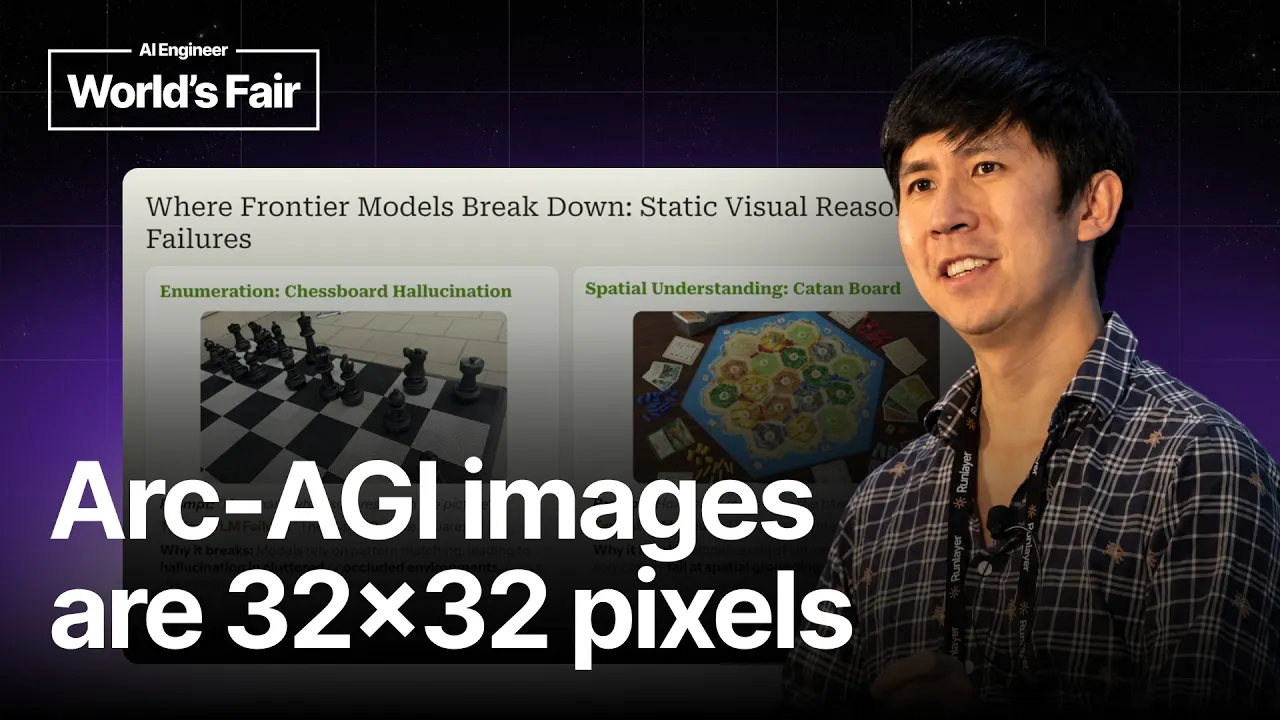
And you will see that we're actually quite far away from any definition of AGI for visual reasoning. So here are some examples of where uh how easy it is to find where models break down. And um you can find these examples yourself. Just takes a few minutes. Uh in this first example uh we have a chessboard hallucination and we give the models um this picture and ask how many white squares are in the image and any ordinary person uh who doesn't hallucinate would probably not say it's 32.
So 32 of course the models say this because they see part of the chessboard and they hallucinate the complete board and as a result they give the wrong number and you see this quite a lot that models rely a lot current models rely a lot on pattern matching. That's what makes them so good at identifying plants and animals and flowers uh in the real world. But when it comes to like complex questions that part hurts them.
So the pattern matching is actively hurting them in this case. Um so in their in what's going on in their reasoning is that oh this is a chess board. Chess boards all have 32 squares. Therefore this one must have 32 Y squares too. On the right example um I'm a big board game player. Have quite a collection. Um so you can see there's a a board game theme going on here. And actually you can uh reproduce this outside if you just go to you know outside the talks.
It's a ball game area there. There are chess boards. Um I will bet if any of you uh place the pieces in some kind of random position, no frontier model will be able to tell you where those pieces are located, where all those pieces are located. Um and then another example here is katan. Um here another very simple question. How many rows does the blue player have? Um, these frontier models think extensively about this problem.
Uh, one response I've seen is that, oh, the the guy has uh 10 blue rows off to the side of the board. Therefore, there must be five uh blue rows on the can board. Uh, but obviously that's not true. There's seven if you actually count. So these models um again are great at guessing uh great at pattern matching but they are not very spatially grounded and they just can't handle any kind of detailed questions. Um and then finally um we have this example where it actually um affects robots where here you have a robot arm uh manipulating this uh cup and um uh cooker basically and the state-of-the-art models today they miss the fact that the uh robot arm lifted the lid um and at the end they also missed the fact that the robot is turning on the stove like right now.
So there's uh essentially context amnesia happening. Um and this is because these models can't maintain consistency um across long videos and they very easily lose track of what's happening. And a very common question I get is how do you define a visual reasoning problem versus a visual understanding problem? Um or you could say like visual thinking um compared to visual understanding. I think a very simple way to do it is just um ask yourself the same question.
If you looked at an image or a video, how long would it take you to answer the question? So uh for example, in both of these cases, I doubt anyone in this room would be able to give an answer uh if they were only allowed one second to look at the image. So 1 second isn't enough to do these kind of like complex questions also called like system two um kind of thinking in Daniel Canon's book. But if I asked you what game is this uh or similarly what flower is this or if there are only three pieces on the chessboard if I asked you how many pieces are there those questions uh I'm sure all of you would be able to answer in less than a second and similarly all the frontier models would get that kind of question right.
So that is the distinction um that we make between what is understanding uh what is like pattern recognition versus what is reasoning where you actually have to look in detail at the picture and um look at various things and this is exactly where frontier models uh fall apart today. So as you are designing your own systems uh that's something to keep in mind keep these visual tasks very simple otherwise you will have hallucinations a lot and a lot of hallucinations um so uh this leads into evals of course um frontier models there are already a bunch of multimodal reasoning evals or visual reasoning evals some that you might have heard of is arc agi this is uh quite often brought up to um people saying oh we the frontier models are 85% or 90% on RKGI therefore we are 90% of the way to a uh to AGI itself uh but I think these people they haven't really looked at any of the benchmark data because if you actually look at the data you will notice that the images are only 32x 32 or 64x 64 pixels and I would challenge anyone uh to give me like a real world complex task that can be reduced to a 32x 32 pixel problem.
Um I think you'll very quickly realize almost no tasks almost no interesting tasks can be reduced to that kind of resolution. Another eval that people commonly uh bring up is MMU. Uh this is the massive multiddiscipline multimodal understanding. This is a step up from MMLU because it has um images rather than just pure text science questions. This is science questions based on images. But still images are a minor part of a lot of these questions.
A lot of the questions you can just answer without looking at the image or just doing some pattern recognition just knowing roughly what the image is about. So what we really need is new visual reasoning benchmarks in the industry that really target the things that people care about like geometric align alignment, spatial intelligence, um object terminus and these are really critical for AI to be deployed in these visual use cases.
And you might have noticed that still in a lot of industries that uh are primarily visual um which I will go into there isn't much uptake of AI right a lot of the AI uptake has been in the software engineering world and in the mathematician world um and in like documents um document handling etc. But this uh there is actually a huge gap huge opportunity that is just being looked over right now um based on the interest in coding.
[clears throat] And so the missing paradigm in visual AI is thinking. So we have generation models very high quality generation models like bite dances seance model. Um, so we have these very high fidelity models and they look great, but they lack actual physical grounding um and causal logic. So you will you probably notice that if you ask these models to produce a a picture um a video of a some like uh something blowing up like um or a building falling down or these things they look very cartoonish they look Hollywood style kind of things and that's because they are just outputting what was in the training data and a lot of disaster videos um a lot of like action kind of videos on the internet are just going to be from Hollywood or game engines.
So they're working to reproduce that and that's fundamentally a problem because it means they can be no better than those kind of uh videos. Um on understanding the what we are where we currently are is we have lot of tools that can map pixels to semantic labels like Google lens is obviously great to identify plants and flowers and I use that all the time. The SAM 3 for segmentation, YOLO for uh object recognition detection, mascaras CNN.
These are of course highly robust and they're used everywhere in the industry, but they're fundamentally passive. So there's no reasoning capability to them. So they can't answer more complex questions. Um and really where the frontier is is uh with thinking visual thinking models. These models will have active spatial and temporal intelligence. They can extract actional logic for planning uh agentic workflows and physical execution.
And so our approach uh is uh four stage. So we are collecting and generating our own uh multimodal data uh visual reasoning specific data. This this kind of data we found you just can't uh get online. Uh we have a synthetic data flywheel using evals agents SFT and RL to improve the model. We're making some uh we made some advances to the architecture um in terms of uh various different time um advance various different improvements on top of the transformer-based architecture and we're also enabling visual chain of thought reasoning and this is one of the key things that humans have that no frontier model has today since the frontier models are only textual uh chain of thought based um and this is one example of a visual chain of thought.
So the question is like how many red hotels are built in this photo? Then the model realizes oh uh first we need to identify all the hotels. So it draws boxes around hotels um and other objects and then uh it reduces that to the red hotel. So it's this multi-step uh process happening in the visual space natively. So um about our company um I'm the co-founder and CEO. I spent the last 12 years at Google Brain and Deep Mind.
Um I developed a lot of the foundational techniques for the model for modern LLMs. 11 years ago I was the first author of the work that introduced pre-training and fine-tuning. That's the work when combined with the transformer paper in 2017 led to the GBT series of models. So all the GBT uh papers site our paper. Um I co-led the earlye models uh the first model that was state-of-the-art called glam and then um more recently I co-led the palm to 2 pre-training architecture and I was co-lead for the gemini data area and my co-founder info and Google research he led research for Apple's first public multimodal model MM1 and he's has a a lot of experience in visual reasoning um across uh language as And this is our team.
So we're roughly 20 people now. Um we've also have a chief reasoning architect Dustin Tran. Previously he was lead of post training at XAI. Um and we've hired a world-class team um across uh many other uh companies like Apple uh XAI um deep mind Amazon and so on. Um and in terms of the uh use cases that I mentioned, robotics is one primary use case. So robots have uh really critical bottlenecks performing complex real-time physical actions uh in these kind of like dynamic environments.
Uh but existing vision models uh you probably realize are trained from static images and very directed videos. They are not like act they don't have active physical interaction. So existing methods are overengineered and brittle. Um and uh we are planning to release a model API available uh by the end of this year. Um and at that point the API can be used to deliver action relevant uh scene understanding into existing um planning and control systems for these um robots.
Another important use case for uh visual reasoning um is construction. So construction sites they have these very complex zone specific safety rules. Um and uh computer vision can't adapt fast enough to changing safety rules. They also can't interpret things like OSHA policy language and match the that language to what's actually going on at the site or understand the spatial relationships that are important there. For example, like how many of these workers are wearing helmets or like is the construction um happening according to the plans that uh were defined earlier.
And um currently enforcing these rules require training separate models for different use cases uh because they're very these models as I said before are very brittle. So you constantly have to do uh retraining. Um and our approach uh with the video um understanding capabilities that we are building into our models is um allows you to um ground these video streams in the safety regulations. And of course the safety regulations are in text, they're in language.
So you have to be um the model has to manipulate both language and vision very well. And um yeah uh this will allow these models to interpret uh site policies using the current camera infrastructure that they have. Um and then finally architecture and design we think is also a very uh promising use case here. Uh this is exactly the use case where you need to be very detail oriented. So back to the board game example around counting spatial relationships.
This shows up a lot in architecture and design. Uh like if you design a if you design a house with with four bedrooms instead of three, that homeowner is going to be very angry, right? Um so obviously counting is actually important. Um and also just understanding these spatial constraints, real world constraints is uh is a very manual process uh these days. We spoke to a mechanical engineering company just a few weeks ago and they said to design one small part of a robot testing platform takes 100 to 200 hours uh of the time to design the entire testing platform.
Um, I believe it takes 2,000 to 3,000 hours of human uh time there. And they've uh a lot of these places they've tried frontier models, but they just don't work for these use cases. They really struggle to understand uh visual context across these like architecture blueprints, 3D CAD, CAM files. Um, and so there are lots of errors there. Um and similarly we believe that this can be useful useful for other kinds of design as well not just um architecture and engineering but maybe like designing um yeah for the web or fashion or other things and our approach is uh we're using multimodal reasoning to uh to extract um this uh geometric logic that's important.
We're allowing programmatic validation or simulation validation. Just like in code, you can run code against unit tests. You can also run u mechanical devices through simulators that have been developed through seammens um and uh v various other companies to see if something will work in the real world. So there's a lot of parallels actually between uh this kind of like mechanical design and coding itself. But mechanical design is still relatively untouched by AI.
Um and yeah, CAD CAM quality control is another potential use case and ultimately we believe that this is going to be a critical step to the future of mechanical design where the where AI can make faster cars, more efficient rockets, better batteries and all these things cannot be done just with code. Uh people are not coding up the next iPhone or coding up the next uh SpaceX rocket. It's all fundamentally very visual.
So, um you can find out more about us through our website um lauren.ai, our Twitter page xx.comai or our LinkedIn uh page. And yeah, happy to take any questions. I'll be standing around here for for a little bit. Thanks. [applause]
The words are the caption track's own and nothing is reworded or re-transcribed. Paragraph breaks are placed between sentences so the text reads as prose.
Free tools for your own script. No signup, no login.
Paste your draft and see where viewers are likely to drop off, with a rewrite for each weak line.
Paste the first 30 seconds of your own draft for a hook score and rewrites.
Check your draft against YouTube's advertiser-friendly guidelines before you record it.
Read this channel's public videos and transcripts, and download a writing brief for it.