Getting the transcript
Reading the captions from YouTube. A video nobody has opened here before takes 10 to 30 seconds; this page fills in on its own.
Getting the transcript
Reading the captions from YouTube. A video nobody has opened here before takes 10 to 30 seconds; this page fills in on its own.
Karen Styles · @karenstyles7603
Words
2,285
Runtime
13:10
Speaking pace
174wpm
Reading time
10min
174 words per minute, between the 160 25th percentile and the 181 median of 349 measured videos. That distribution comes from the 349-video hook study.
Opening (first 30 seconds)
Hi, everyone. The purpose of this video presentation is not to focus on Classical Greek sculpture in general, but rather to focus on how Classical sculpture illustrated the Greek value of kalokagathia. Before we move on to that, though, I want you to know the names of the three most important sculptors of the 5th century BCE. Here they are on the screen in front of you: Polykleitos, Myron and Phidias, along with the names of their most significant works. We should also do a quick review
87 words, the words spoken in the first 30 seconds at 174 words per minute.
Free, no signup. See how the first 30 seconds hold attention, with rewrites.
Sentence shape
| Measure | This transcript |
|---|---|
| Sentences | 125 |
| Average words per sentence | 18.3 |
| Longest sentence | 64 words |
| Questions asked | 7 |
| Sentences containing a number | 11 |
Most used terms
Filler phrases
33 in total: like 16 · kind of 5 · basically 4 · you know 4 · right? 2 · actually 1 · uh 1.
A literal whole-word count of the same phrase list the Prepublish browser extension uses, so a phrase inside another word is not counted and a phrase used in its ordinary sense still is. It is a count and not a judgement.
What this transcript is
Every word below is the caption track YouTube publishes for this video, pulled from the video itself and reproduced unchanged. It is not Prepublish's writing, not a summary, and not a re-transcription: it is the video's own published captions. English captions, published by the channel, in the video’s original language. Source: the video on YouTube. A channel that would rather this page did not exist can ask for its removal through the contact page, and it is removed.
No Script X-ray for this video: YouTube shows a Most replayed graph only once a video has enough views.
Hi, everyone. The purpose of this video presentation is not to focus on Classical Greek sculpture in general, but rather to focus on how Classical sculpture illustrated the Greek value of kalokagathia. Before we move on to that, though, I want you to know the names of the three most important sculptors of the 5th century BCE. Here they are on the screen in front of you: Polykleitos, Myron and Phidias, along with the names of their most significant works.
We should also do a quick review of what Archaic sculpture from the 6th century BCE looked like before we move on to the Classical and kalokagathia. You might recall that the sculptures of the 6th century usually were in the form of these kouros figures if they were male. there were female figures also called "kore" statues but these are called "kouros", and they were created to mark the graves of fallen warriors. And they were made of stone, marble, and usually they're around six feet tall.
These are just two examples of kouros figures, but you can see the commonalities between them, most notably the very stiff, rigid positioning of the body with the arms straight down, fists clenched, one leg forward, foot pointed down. The face is not individualized; it's just kind of a general looking face with these big almond-shaped eyes. It's the same over here, and the out-turned lips known as the "Archaic smile".
This sculpture looks to be a little more developed than this one. This is a little bit later. And you notice over here the abdomen is just not realistic at all; as a matter of fact it's very symmetrical, whereas over here the muscles are defined a little bit better, but it's still pretty symmetrical. I love the the calf muscles down here, and the kneecaps. But they're still very rigid with their arms straight down, fists clenched.
The ancient Egyptians had a big influence on these Archaic figures. If you were to compare sculptures of the Pharaohs of Egypt to these kouros figures you would see that they're very similar in the positioning of the bodies. This is the statue that marks a turning point in Classical Greek sculpture. He's known as the "Kritios Boy" or the "Kritian Boy" from around 480 BCE. I've seen the date of 490 BCE for him, so I don't know if anybody really knows that for sure.
But he's definitely from the beginning of the Classical period. And as you can, see he's in bad shape. He's missing his arms and most of his legs, his feet, and the empty eye sockets here were one at one time filled with glass eyes, which I think would have made him look very realistic. And you'll notice the the difference here, the many differences here, hopefully, between him and the kouros figures. So we lose that long fancy braided hair, and instead of the face turned straight forward, he's kind of looking off to the side slightly.
And notice the softening of the muscles-- a little bit more realistic depiction of the abdomen. And most notably, although it is hard to see because he's missing his legs, all of the weight of the statue is on this one leg, and you can even see the flexing calf muscle there. Whereas this leg was relaxed, the knee is bent there, and because of that, there is this very slight downward shift of the hips. Can you see that this side, the hip is lower than that side.
So this basically results in this very gentle, s-shaped curve of the body. And later on in the Renaissance, they will give a name to that s-shaped curve. They'll call it 'contrapposto', which basically in English means 'counter-poised'. So again 'contrapposto' will be the word that we'll use from this point on to refer to that s-shaped curve. But basically the "Kritios Boy" is all realistic; there's nothing idealized about him at all.
And something very strange happened. Within about 20 years of the creation of this statue, sculptors started doing something very different, very dramatic, and one interpretation, that I think is kind of shallow, but one interpretation is that they got bored with realism. They decided, "Well, who needs art if you're just going to make it all realistic? You can just go around looking at things!" Again, I consider that kind of shallow.
I think that the change would have more to do with the the value of kalokagathia that was basically firmly entrenched in Greek culture at that time. And here in these images you can see the dramatic change that would occur. On the left, there's the "Kritios Boy" again, and on the right, the famous "Doryphoros" or "Spear Bearer" statute by Polykleitos. Before we talk too much about the differences in these sculptures I first want to point out something to you about what you're looking at over here.
This is a Roman marble copy of the original bronze statue that was made in the 5th century by Polykleitos. Sadly, we don't have very many original Greek bronzes anymore. What happened here probably was the Romans, once they conquered Greece, they scoured Greece and and took all kinds of artworks back to Rome with them, notably statues that they wanted to put in the gardens of their big fancy villas. And when they started to run out of the original Greek bronzes, Romans employed artists to make marble copies of those original bronze statues.
And then later in history, the bronzes were melted down so that the material could be used for things like coins and ammunition and such. So it's lucky for us that the Romans did make these copies, otherwise we wouldn't know very much about Greek sculpture at all from the Classical period. But because this is a marble statue, now, and it has this very dramatic weight shift, you see how moreso than the "Kritios Boy" you can really see that bent leg, and you can really see all of the the weight shifted there on that one side, and because of this, there has to be this extra support on that side of the statue. (So it looks like some kind of a tree trunk or something.) And then so the arm doesn't snap off, we have support there, and here under the raised heel, we have support there.
So it's not very appealing to look at it at the statue with all of those support features, but again, at least we have the sculpture. Now what's missing here, of course, is the what's missing here, of course, is the spear, and hence the name "Spear Bearer", or in Greek, "Doryphoros". So let's take a look, now, talk more about about the differences between the two sculptures. So remember this is all realistic, there's nothing about it that is very dramatic.
Certainly it's more realistic looking than those kouros figures. But can you see what happened over, here how much more dramatic that is? Let's go to a different image so that I can point out to you what indeed has changed. I'm sorry for the graininess of this image. I could not find a clearer image online to work with, but I think that we can at least work with this one for this purpose. Notice the line through the the statue this way.
And what that's trying to indicate to you is how on this side of the sculpture we have a body at rest, and on this side of the sculpture we have a body in motion. Notice how the leg is bent like he's taking a step, this arm that holds originally held the spear is raised, whereas on this side the arm is down, it's relaxed. The head is sharply turned, and notice the line here that indicates the, uh, how the hips are tilted down on that side because this leg is relaxed.
But I think what Polykleitos was trying to do here was show the potential of the human body. Now a human isn't going to be simultaneously at rest and in motion-- that's not realistic. But rather what we have here is an idealized form. He's showing the ideal human form, both at rest and in motion. So it gets, it gets a little bit more dramatic from there. This this is considered to be a very important statue because it's the, as far as I know, this is the first one that did something like this.
But now let's take a look at what will happen with the "Riace Warriors". I love these sculptures, these are my favorite Greek sculpture. Notice they are original bronzes, not Roman marble copies, from the 5th century BCE. And they were found in the water off the coast of Riace, Italy, in 1972 by a diver. I can't imagine what it must have been like to be a down in the water and see these, you know, faces staring up through the silt!
It took about ten years to clean them up. Imagine how much, you know, stuff was corroded on the sculptures. They are, interestingly enough, not even on display in the National Museum in Rome. They are on display in a little civic museum down in southern Italy, close to where they were found. I have personally never seen these sculptures. I would love to go to that museum and see these sculptures for myself. I would love to take some close-up pictures of their feet and their hands to show you the very realistic details: toenails, and veins running across the tops of their feet.
Unfortunately I can't find good pictures like that online, but I know that they're incredibly detailed. But the thing is, is the "Kritios Boy" was all realistic. Beginning with Polykleitos' "Doryphoros" sculpture, we see something very different happening. What we'll see is kalokagathia at work-- the attempt to reconcile opposing forces. And the opposing forces will be realism versus idealism. Now I'm going to move on to another image.
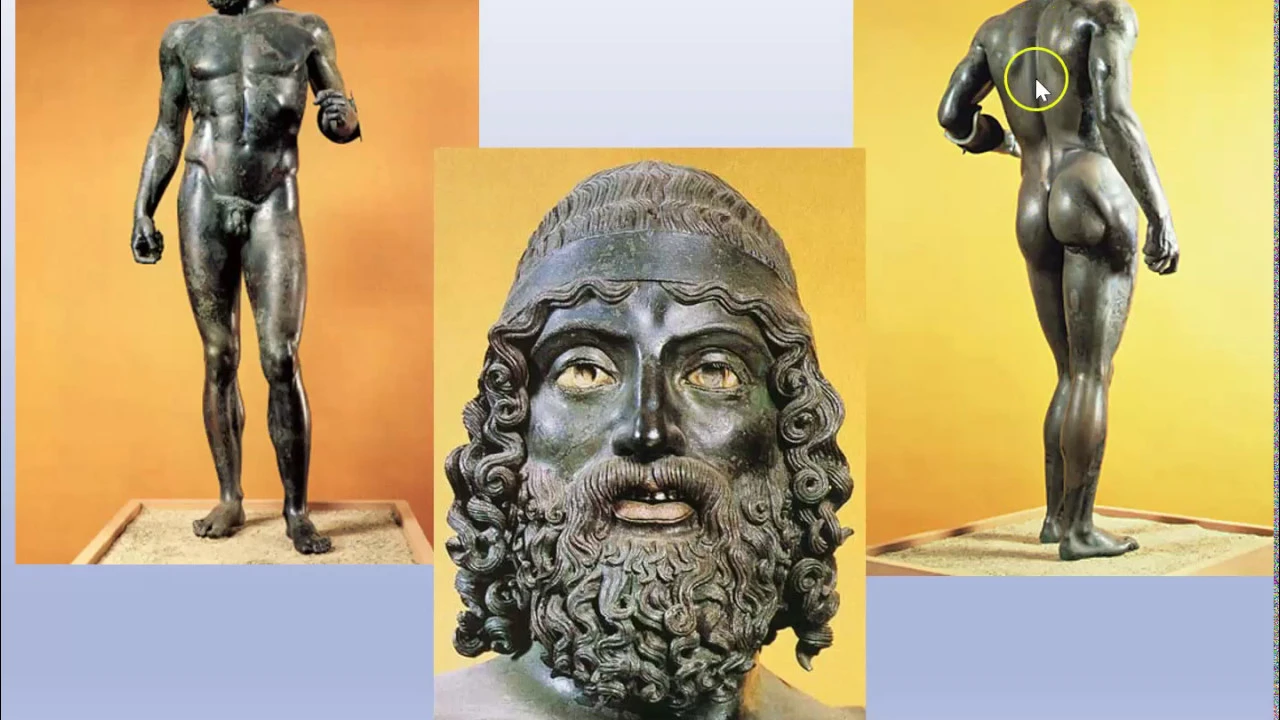
I'm not going to work with this this gentleman here because he's missing one of his glass eyes. I like to just show more images of this sculpture. And here are multiple views of "Mr. Riace", I will call him. And in the close-up of his face, again you can see great realism: silver teeth, glass eyes. It looks like the glass is broken out, but at least you can see more realistic looking eyes, the detailed facial hair, the leather strap going around his forehead which warriors would have worn.
And on the back side you see this very smooth, young looking figure. And you would not know this, I don't think, unless I told you, but he has no coccyx bone, no tailbone, and he has this very unrealistically deep groove for the spine. And another thing you might not know unless I told you is his back muscles are flexed, but yet his chest muscles are relaxed. Now I purposely did not put the dimensions of the statue on the on the slide, but this sculpture is over six'8" inches tall, and I'm sure that that was not the average height of a Greek male back in the 5th century BC.
That is certainly larger than life. And notice how the weight shift here is so dramatic that it almost looks like he's dancing, not just taking a step, but it looks like he's dancing. He probably had a spear in this hand, or maybe even a sword. And then you see this plate here, apparently there was a shield attached to that plate. So what we have in this figure is a lot of realism, as I said, with the details I pointed out to you.
But idealism--why the deep groove of the spine? Also this deep groove down his chest. Why this deep ridge of muscle here, almost making it look like the statue is in two parts? And he's got these really long legs that run all the way up here. His legs are about as long as his torso. So the proportions are almost unrealistic, in a way. It's like they're perfect proportions, and as I suggested, the body looks like that of a younger man, but his face to me looks older.
You don't have to agree with me on this. Maybe it's just the facial hair, but I think his face intentionally looks older. And so what we have is simultaneously an older man and a younger man. And remember just like the "Doryphoros" that is simultaneously at rest and in motion, what we have here is the perfect warrior, the perfect ideal warrior. If we could have him, what we would have is an older man who has wisdom and experience, but of course the youthful vigor of a younger man.
And unfortunately that's not the way it works, right? In in our culture today, we send young men into war, right? Young men they like to train as warriors the army way. Older men with wisdom and experience are usually, you know, commanding the forces, but they're not the ones actually fighting. But if we could have both at the same time, an older man with wisdom and experience, and a younger man with youthful vigor, wouldn't that give us the perfect ideal warrior?
Along with the towering height, you know, the 6'8" of height so he could tower over his enemies. So that's what's really going on here by the middle of the Classical period. We've got the attempt to reconcile the opposing forces of realism and idealism in sculptures.
The words are the caption track's own and nothing is reworded or re-transcribed. Paragraph breaks are placed between sentences so the text reads as prose.
Free tools for your own script. No signup, no login.
Paste your draft and see where viewers are likely to drop off, with a rewrite for each weak line.
Paste the first 30 seconds of your own draft for a hook score and rewrites.
Check your draft against YouTube's advertiser-friendly guidelines before you record it.
Read this channel's public videos and transcripts, and download a writing brief for it.