Getting the transcript
Reading the captions from YouTube. A video nobody has opened here before takes 10 to 30 seconds; this page fills in on its own.
Getting the transcript
Reading the captions from YouTube. A video nobody has opened here before takes 10 to 30 seconds; this page fills in on its own.
Sunshine State Insider · @SunshineStateInsider
Where viewers went back to watch this video again, from YouTube's public Most replayed graph, lined up with what was said at that moment.
Most replayed moment #1
6:425.5x the video's typical replay level
Easily the most bitter thing I have ever put in my mouth and the flavor stuck in there for a long time. I'm going to give it a solid one out of 10. Do not recommend. But citrus greening has no cure. And
Said at 6:37
Most replayed moment #2
9:164.0x the video's typical replay level
acres under citrus have plunged. In 2004, Florida had roughly 748,000 acres of citrus. But by 2024, it was down to about 275,000 acres. The land dedicated to citrus
Said at 9:09
Most replayed moment #3
8:423.9x the video's typical replay level
ourselves to the rest of the country is disappearing from the landscape it's been tied to for centuries. Now, let's put some cold hard numbers to the heartbreak. [music] Back in 2003 2004, 300 million boxes of citrus were
Said at 8:35
The graph counts replays. It does not show where viewers stopped watching.
Words
2,268
Runtime
14:14
Speaking pace
159wpm
Reading time
9min
159 words per minute, below the 160 25th percentile of 349 measured videos. That distribution comes from the 349-video hook study.
Opening (first 30 seconds)
Florida, sunshine, beaches, and once upon a time, oranges. Oranges everywhere you looked. It seemed like groves stretched from the horizon to the horizon. But today, much of Florida's orange empire has vanished. But why? Why did this industry crash? What forces, what weather, disease, people [music] tore apart a 7 billion agricultural titan? This is the story of the boom, bust, and maybe a rebirth of Florida's citrus industry. The story of Florida citrus starts way back in the
80 words, the words spoken in the first 30 seconds at 159 words per minute.
Free, no signup. See how the first 30 seconds hold attention, with rewrites.
What this transcript is
Every word below is the caption track YouTube publishes for this video, pulled from the video itself and reproduced unchanged. It is not Prepublish's writing, not a summary, and not a re-transcription: it is the video's own published captions. English captions, generated automatically by YouTube, in the video’s original language. Source: the video on YouTube. A channel that would rather this page did not exist can ask for its removal through the contact page, and it is removed.
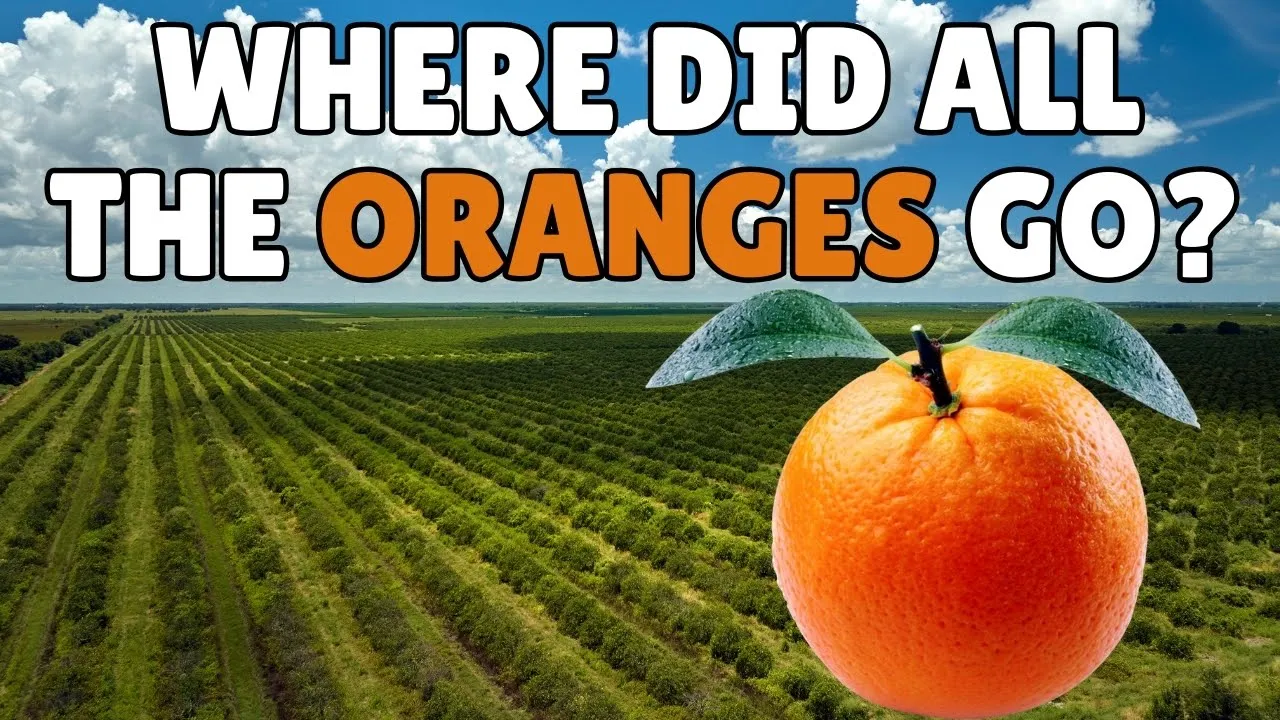
Florida, sunshine, beaches, and once upon a time, oranges. Oranges everywhere you looked. It seemed like groves stretched from the horizon to the horizon. But today, much of Florida's orange empire has vanished. But why? Why did this industry crash? What forces, what weather, disease, people [music] tore apart a 7 billion agricultural titan? This is the story of the boom, bust, and maybe a rebirth of Florida's citrus industry.
The story of Florida citrus starts way back in the mid 1800s, though oranges have been grown locally since the 1500s by Spanish settlers. Commercial citrus production really took off after the Civil War, and by 1865, Florida was producing roughly 1 million boxes of citrus per year, a huge number for a regional crop at the time. Railroads linking the state to northern markets made shipping a lot easier. And the ideal soil, long growing seasons, and warm Florida weather made this look like a paradise for citrus.
And by 1893, production had climbed to about 5 million boxes per year. But the Florida weather wasn't always on the oranges side. In the winter of 1894 1895, a sequence of record freezes known as the Great Freeze devastated citrus in northern and central Florida. Entire groves were wiped out and production fell from millions of boxes to almost zero. This forced growers southward [music] away from the cold and set the pattern of relentless adaptation that would define the industry for more than a century.
Across the early and mid 20th century, Florida citrus went from being a regional crop to a national symbol. Americans developed a taste for orange juice, especially after World War II, when frozen concentrate and refrigeration trucks made year round supply possible. Florida citrus got so big that it even became a plot point in the 1983 Eddie Murphy and Dan Akroyd comedy, Trading Places. Yes, the entire climax of that film revolves around manipulating Florida orange juice futures.
And trust me, if you've never seen it, it's a lot funnier and more entertaining than that sounds. >> The cold winter has apparently not affected the orange harvest. [cheering] >> By the 1990s and early 2000s, Florida was producing nearly 300 million boxes of oranges and citrus annually. It was the undisputed king of orange juice in the US and one of the most iconic agricultural sectors in the country. What's wild is that Florida wasn't just the American citrus powerhouse.
At its peak, it was one of the major citrus producers in the entire world. In the late 20th century and the early 2000s, when Florida was pumping out nearly 300 million boxes of citrus a year, it alone rivaled the production of some leading citrus producing countries. If Florida had been its own country, it would have been ranked among the world's top orange growers. Small town economies revolved around it. Roadside stands and cartoon oranges were everywhere.
A breakfast in America without OJ? Unthinkable. But grapefruit and oranges have an adversary that has nothing to do with nature. Its people. As Florida's population boomed, so did the development. Central Florida's population grew really rapidly, turning groves into subdivisions, shopping centers, and theme parks. Farmland became some of the most expensive real estate in the country. And suddenly, the most profitable crop in Florida wasn't oranges anymore.
It was houses. Whole groves that once produced millions of pounds of citrus quickly disappeared under concrete and turf. This wasn't a single disastrous event, just a slow, steady shrinking of citrus acreage. as Miami, Tampa, and Orlando sprawled outward. [music] If you want a perfect symbol of how big Florida citrus once was and how much it's changed, just take a look at the Citrus Tower in Claremont. When I was a kid in the 1980s, the rolling hills around Claremont were just endless orange groves.
You could see them from the turnpike. Miles and miles of green and gold. And right in the middle of all those groves was this tall, random skyscraper called the Citrus Tower. It was one of those vintage old school tourist attractions where you go to the top and look out at a sea of oranges stretching to the horizon. [music] And today the tower is still there, but the view has changed a lot. Instead of looking out at an ocean of orange groves, it's now a sea of suburban sprawl.
It's like looking back at a postcard from Florida that hardly exists anymore. Weather used to be Florida Orange's oldest and most fearsome foe. We already mentioned the great freeze of the 1890s, but later freezes in the 1980s also pushed citrus growers further and further south, often into marginal lands that were more vulnerable to storms. Then came the hurricanes. In 2017, Hurricane Irma ran right up the entire length of the state, impacting nearly everybody on the peninsula in one way or another.
It smashed through groves just as the fruit was ripening, costing growers hundreds of millions of dollars in lost product. And state leaders are now considering legislation that would help Florida citrus growers replace their trees after a hurricane. This after Irma wiped out 70% of the state's orange crop. >> And more storms followed. Hurricane Ian in 2022 and others in recent seasons dealt fresh blows, pushing production figures down even further.
Now, weather will always be in the mix in Florida, but even more threats were coming from the microscopic world. Nothing, and I mean nothing, has done more damage to Florida citrus in the 21st century than citrus greening disease. Citrus greening, officially known as, this word I'm not even going to attempt to butcher the pronunciation of, so I'm just going to show it right here, was first discovered in Florida groves in 2005.
It spread by a tiny insect called the Asian citrus silid and causes leaves to yellow, fruit to be misshapen and bitter, and trees to weaken and die over a few years. And not all oranges in Florida are delicious to begin with, especially the wild ones. A lot of those that grow in the wild are descendants of old roottocks, and they can be shockingly bitter. I unfortunately learned this firsthand in a county park in Deneden, where I saw a wild orange tree growing near a hiking trail.
I picked one, cut myself a slice. It was just awful. Easily the most bitter thing I have ever put in my mouth and the flavor stuck in there for a long time. I'm going to give it a solid one out of 10. Do not recommend. But citrus greening has no cure. And once it infects a grove, growers have to adopt costly and laborintensive strategies to keep the trees going just long enough to produce anything close to a harvestable fruit.
And the result of all this, Florida's citrus production has absolutely collapsed. from about 300 million boxes in the early 2000s to barely 20 million boxes in the 2023 2024 season. That's a drop off of more than 90% in just two decades. That is staggering. Florida went from being a global heavyweight in citrus to producing less than many mid-tier citrus countries do today. That's how fast and hard the drop has been.
And another disease, citrus canker, was first found in Florida around 1995 and led to the destruction of infected trees statewide. Combined, these two diseases have absolutely devastated harvests. They've driven up production costs and pushed thousands of growers out of business. And it's not just an economic loss, it's a cultural one. Citrus has been woven into Florida's identity and even the state's branding. Back in 1949, Florida started a quirky tradition, giving every traveler a free cup of orange juice at the border at the Florida Welcome Center.
For over 75 years now, that little paper cup has been the unofficial sign that your Florida beach vacation has officially begun. For generations arriving, that first sip meant you're in Florida now. And you can see it in place names all over the map. Citrus [music] County, Citrus Park, Orange Lake, Orange City. And in towns like Winter Garden, Winter Haven, and Frost Proof. Names that were slogans as much as anything else.
Florida didn't just grow oranges. We built entire communities around them. And our standard issue license plate even literally has an orange on it. The one symbol we chose to represent ourselves to the rest of the country is disappearing from the landscape it's been tied to for centuries. Now, let's put some cold hard numbers to the heartbreak. [music] Back in 2003 2004, 300 million boxes of citrus were produced in Florida.
Fast forward just a couple decades later, 2024 25 season, 14.6 million boxes of total citrus were produced with about 12.2 million boxes of those being oranges. That is the lowest output since 1920. And meanwhile, acres under citrus have plunged. In 2004, Florida had roughly 748,000 acres of citrus. But by 2024, it was down to about 275,000 acres. The land dedicated to citrus farming here is now just 37% of what it was only 20 years ago.
Processing facilities and growers have disappeared, tens of thousands of jobs lost, from migrant pickers to packing plant families and whole supply chains dismantled. And the world noticed. Longtime Florida orange juice brands now have to mix in imported juice from Mexico and Brazil because there simply aren't enough Florida oranges anymore to meet the still ever high demand for OJ. That carton of Florida's natural that's in your fridge.
Well, the Florida part is only partially true these days. So, what's even left of this once glorious [music] industry? Well, the citrus sector in Florida today is much smaller, but it's not entirely gone. There are still growers, still groves, still families tending to the trees. But every season now feels like survival. Some boutique growers focus on specialty fruits, things like tangerines and kumquats, farm-to-table markets, or agurism.
Think you pick groves where families come in, pay a small fee, and pick the oranges [music] themselves. And that is actually a brilliant business model when you think about it. The labor isn't an expense anymore. The labor is paying you. But the hard truth, Florida is no longer the orange powerhouse it once was. Many growers have sold land for development. And one major producer, Alico, [music] even announced plans to build a 3,000 acre community in Fort Myers, where its citrus once grew.
And just to put Florida's decline into more perspective, [music] today California has since taken the lead as the number one citrus producing state in America. [music] And it's not even close. California now grows about 79% of all US citrus, while Florida sits at about 17%. Texas and Arizona share the rest of that tiny sliver of the pie. And on [music] the world stage, countries like China, Brazil, India, and Mexico all dwarf [music] US output, each producing more citrus than the entire United States combined, with Egypt not that far behind us.
So, is there any hope? Well, maybe. Researchers are exploring greening resistant roottocks and gene edited trees, some new management practices that boost tree health, and strategies like hydroponic growth or highdensity plantings. And Florida lawmakers and growers recently approved some pretty good research funding to try and revive parts of the industry. But make no mistake, the future won't look anything like the past.
Instead of endless orange groves, Florida will likely shift towards smaller, more resilient operations, niche varieties, high value specialty citrus, and new science driving what gets planted where, and [music] why. I still can remember being that kid in the back seat, staring out the window on the Florida Turnpike as mile after mile of orange groves rolled by like a green ocean under the sun. Back then, nobody could have imagined those groves would be mostly gone in my lifetime.
And [music] now, decades later, the fight to save what's left isn't happening in those endless fields anymore. It's happening in university labs and green houses. Scientists in white coats splicing genes, [music] testing new rootstocks, and trying to engineer trees that can finally beat greening. The rise of Florida citrus was a perfect storm of climate, geography, innovation, and culture. Its decline has been an even bigger perfect storm.
Disease, weather, economics, and the relentless march of development. Florida citrus didn't disappear overnight. It was squeezed from all sides like juice from a juice press. So, what happened? What happened to Florida citrus? In a single word, change. Not just one thing, a cascade of forces that reshaped a 7 billion dollar industry. But as long as oranges are planted, nurtured, and dreamed about in the Sunshine State, the story isn't over just yet.
It's just beginning its next new chapter. Thank you so much for watching. And if you enjoyed this kind of deep dive into Florida's past, please go ahead and subscribe. That means a lot to me. I put out new videos all the time covering Florida's history, hidden stories, tourist attractions, hidden gems, and places that shape the state we know today. If you've got a favorite Florida citrus memory, a roadside stand, a pick and a grove, or even that free cup of OJ at the welcome center, drop it in the comments.
I'd love to read about them. I love this kind of stuff. Anyway, thanks for watching. Thanks for subscribing. Stay safe out there and I will see you around the Sunshine State.
The words are the caption track's own and nothing is reworded or re-transcribed. Paragraph breaks are placed between sentences so the text reads as prose.
Free tools for your own script. No signup, no login.
Paste your draft and see where viewers are likely to drop off, with a rewrite for each weak line.
Paste the first 30 seconds of your own draft for a hook score and rewrites.
Check your draft against YouTube's advertiser-friendly guidelines before you record it.
Read this channel's public videos and transcripts, and download a writing brief for it.
Sentence shape
| Measure | This transcript |
|---|---|
| Sentences | 159 |
| Average words per sentence | 14.3 |
| Longest sentence | 35 words |
| Questions asked | 8 |
| Sentences containing a number | 31 |
Most used terms
Filler phrases
16 in total: like 11 · kind of 2 · I mean 1 · actually 1 · literally 1.
A literal whole-word count of the same phrase list the Prepublish browser extension uses, so a phrase inside another word is not counted and a phrase used in its ordinary sense still is. It is a count and not a judgement.