Getting the transcript
Reading the captions from YouTube. A video nobody has opened here before takes 10 to 30 seconds; this page fills in on its own.
Getting the transcript
Reading the captions from YouTube. A video nobody has opened here before takes 10 to 30 seconds; this page fills in on its own.
Forgotten Fleet · @ForgottenFleet1
Where viewers went back to watch this video again, from YouTube's public Most replayed graph, lined up with what was said at that moment.
Most replayed moment #1
3:445.3x the video's typical replay level
Today, the Nagato lies upside down on the lagoon floor in just 110 ft of water. Yamamoto's flagship, the ship that launched the attack on Pearl Harbor, is lying on its back in a Pacific lagoon. Nobody's allowed to
Said at 3:38
Most replayed moment #2
1:134.1x the video's typical replay level
vessels. American warships >> [music] >> captured German and Japanese ships, submarines, destroyers, and two of the most storied capital ships in the world. >> [music] >> They were crewed by goats, rats, and pigs.
Said at 1:06
Most replayed moment #3
0:583.0x the video's typical replay level
a naval fleet. The people who lived there were told they would be able [music] to come home soon. They are still waiting. The operation was called Crossroads. >> [music] >> The United States Navy assembled a target fleet of nearly a hundred
Said at 0:52
The graph counts replays. It does not show where viewers stopped watching.
Words
1,295
Runtime
8:05
Speaking pace
160wpm
Reading time
5min
160 words per minute, between the 160 25th percentile and the 181 median of 349 measured videos. That distribution comes from the 349-video hook study.
Opening (first 30 seconds)
In 1946, the United States [music] detonated two atomic bombs directly on top of a fleet of warships. The ships are still there. Nobody has touched them since. Most people know nuclear tests happened at Bikini Atoll. What they do not know is what actually went down into that lagoon. [music] What state those wrecks are in right now and why nearly 80 years later the whole world has agreed to leave them exactly where they are. >> [music] >>
80 words, the words spoken in the first 30 seconds at 160 words per minute.
Free, no signup. See how the first 30 seconds hold attention, with rewrites.
Sentence shape
| Measure | This transcript |
|---|---|
| Sentences | 102 |
| Average words per sentence | 12.7 |
| Longest sentence | 33 words |
| Questions asked | 1 |
| Sentences containing a number | 22 |
Most used terms
Filler phrases
3 in total: actually 2 · like 1.
A literal whole-word count of the same phrase list the Prepublish browser extension uses, so a phrase inside another word is not counted and a phrase used in its ordinary sense still is. It is a count and not a judgement.
What this transcript is
Every word below is the caption track YouTube publishes for this video, pulled from the video itself and reproduced unchanged. It is not Prepublish's writing, not a summary, and not a re-transcription: it is the video's own published captions. English captions, generated automatically by YouTube, in the video’s original language. Source: the video on YouTube. A channel that would rather this page did not exist can ask for its removal through the contact page, and it is removed.
In 1946, the United States [music] detonated two atomic bombs directly on top of a fleet of warships. The ships are still there. Nobody has touched them since. Most people know nuclear tests happened at Bikini Atoll. What they do not know is what actually went down into that lagoon. [music] What state those wrecks are in right now and why nearly 80 years later the whole world has agreed to leave them exactly where they are. >> [music] >> Some of what I found when I looked into this, I had to check three times.
Bikini Atoll is a ring of coral islands in the middle of the Pacific Ocean, part of what is now the Marshall Islands. >> [music] >> In 1946, the United States government decided it was the perfect place to find out what an atomic bomb actually does to a naval fleet. The people who lived there were told they would be able [music] to come home soon. They are still waiting. The operation was called Crossroads. >> [music] >> The United States Navy assembled a target fleet of nearly a hundred vessels.
American warships >> [music] >> captured German and Japanese ships, submarines, destroyers, and two of the most storied capital ships in the world. >> [music] >> They were crewed by goats, rats, and pigs. Fully fueled, fully loaded with ammunition, and [music] sailed into the Bikini Lagoon. The plan was to blow them up and watch what happened. The first bomb, dropped from a B-29 on the 1st of July, 1946, missed its target by 700 yards.
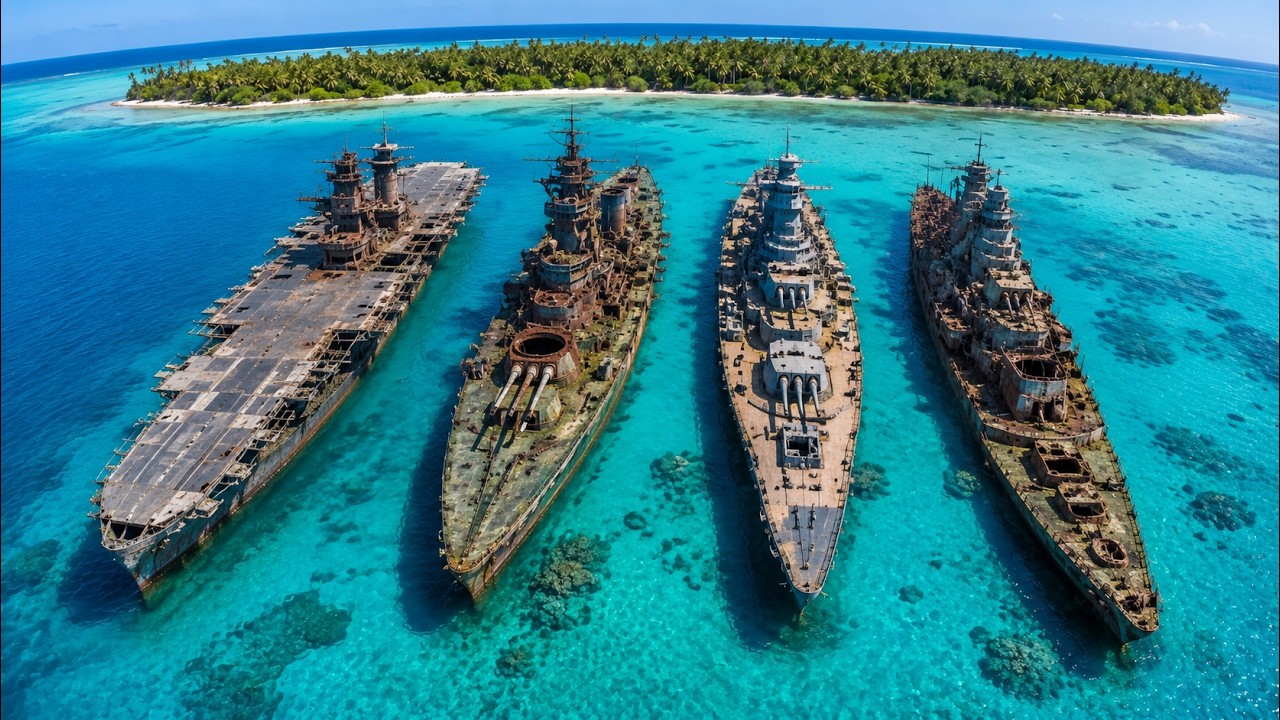
Several ships were damaged. None of the main targets sank. The United States military considered this a disappointing result and scheduled a second test. The second bomb was different. Instead of being dropped from the air, it was detonated underwater, directly beneath the fleet. That changed everything. Here are the four wrecks you need to know about. And this is where it gets strange. The USS Saratoga was one of the first purpose-built aircraft carriers ever commissioned by the US Navy. 885 ft long, 43,000 tons, a veteran of the entire Pacific war with eight battle stars to her name.
The USS Saratoga survived the first atomic blast with minor damage. The second one detonated 500 away underwater, hit the carrier with a force that had nothing to absorb it before it reached the hole. 7 and 1/2 hours after the Baker test, the Saratoga slid stern-first beneath the surface of Bikini Lagoon. [music] Today, the USS Saratoga sits at 160 ft of water. The aircraft in the hangar are still there. The bombs are still loaded.
Divers have found dental chairs, a ship's bell, a Mark V diving helmet sitting exactly where someone left it in 1946. The IJN Nagato was the Japanese battleship from which Admiral Yamamoto personally ordered the attack on Pearl Harbor. The Nagato was the most powerful battleship in the world when it launched in 1920, the first warship ever to mount 16-in guns. By 1945, the entire Japanese Navy had been destroyed around it.
The Nagato was one of only two Japanese battleships still afloat at the end of the war. The Americans brought the battleship to Bikini as a trophy. After the Baker test, the Nagato began listing to [music] starboard slowly over 5 days. Then it capsized and sank. Today, the Nagato lies upside down on the lagoon floor in just 110 ft of water. Yamamoto's flagship, the ship that launched the attack on Pearl Harbor, is lying on its back in a Pacific lagoon.
Nobody's allowed to touch it. The USS Arkansas was one of the oldest battleships in the American fleet. A veteran of both World Wars, present at Omaha Beach on D-Day, part of the bombardment at Iwo Jima, the Arkansas had survived everything. The Baker bomb detonated 250 yd from the Arkansas. Witnesses described the battleship being crushed as if by a hammer blow from below. The force of the underwater explosion appears to have lifted the entire vessel vertically before driving it down into the lagoon floor.
The Arkansas sank in 19 minutes. The wreck now rests nearly upside down at 180 ft. The 12-in guns are still in their turrets. The Prinz Eugen is the one that should not still exist. This was the German heavy cruiser that sailed alongside the Bismarck on its doomed Atlantic mission in 1941. After the Bismarck was sunk, the Prinz Eugen somehow survived the entire war. The British handed the cruiser to the Americans as a war prize, and the Americans sailed it to Bikini.
Here is the part I had to read twice. The Prinz Eugen survived both atomic blasts. The ship that came through the entire Second World War and two nuclear detonations was eventually sunk by a leak, a crack in the hull, a routine structural failure nobody fixed in time. The Prinz Eugen capsized off Kwajalein Atoll in December 1946 and is still there today, propellers out of the water, lying on its side. The wreck is still leaking oil into the Pacific 80 years later.
Fuel is still slowly seeping from that hole. So, why is nobody gone back for any of them? The radiation is the first answer and the most obvious one. The Baker test contaminated everything it touched. Salvage crews were sent in immediately after the blasts try to decontaminate the surviving ships. The crews scrubbed the decks, flushed the hulls, replaced everything they could. It made almost no difference. The ships were still registering dangerous radiation levels weeks later.
The contamination had soaked into the metal itself. Every decontamination attempt failed. The target fleet that survived the blast was eventually scuttled or abandoned because nobody could make the ships safe. The wrecks on the lagoon floor absorbed even more. The sediment around them is still contaminated. The corals growing on the holes are still contaminated. Tests have found radiation in the fish. Divers are permitted to explore the wrecks today, but they are not allowed to touch anything, remove anything, or disturb the sediment.
The rule is simple. What is down there stays down there. But radiation alone does not fully answer the question. There's a second layer. Bikini Atoll was designated a UNESCO World Heritage Site. The lagoon is now formally protected as a site of outstanding universal significance. Raising the wrecks, even if the radiation problem could be solved, would require dismantling a World Heritage Site. The international community has decided that what happened at Bikini Atoll is too important to history to disturb.
And underneath even that is something harder to argue with. These wrecks are graves. Hundreds of test animals died in those blasts. American sailors who boarded the contaminated ships afterward absorbed radiation doses whose [music] long-term effects took years to show up. The Bikini and people were displaced from their home and have never been able to return. The lagoon is a monument to what those weapons did and to what was sacrificed to test them.
The USS Saratoga still has her aircraft in the hangar. The Nagato is still lying upside down 100 ft below the surface. The Arkansas is still sitting where that hammer blow drove it into the lagoon floor. The Prince Eugen is still leaking oil into the Pacific Ocean. Nobody has touched the Bikini Atoll wrecks since 1946. The radiation will outlast everyone alive today. In the end, the atomic bomb did not just sink those [music] ships.
It made sure no one could ever raise them. If you found this video interesting, let me know in the comments where you are watching from. And if you want to see more videos like it, the next one is already waiting.
The words are the caption track's own and nothing is reworded or re-transcribed. Paragraph breaks are placed between sentences so the text reads as prose.
Free tools for your own script. No signup, no login.
Paste your draft and see where viewers are likely to drop off, with a rewrite for each weak line.
Paste the first 30 seconds of your own draft for a hook score and rewrites.
Check your draft against YouTube's advertiser-friendly guidelines before you record it.
Read this channel's public videos and transcripts, and download a writing brief for it.