Getting the transcript
Reading the captions from YouTube. A video nobody has opened here before takes 10 to 30 seconds; this page fills in on its own.
Getting the transcript
Reading the captions from YouTube. A video nobody has opened here before takes 10 to 30 seconds; this page fills in on its own.
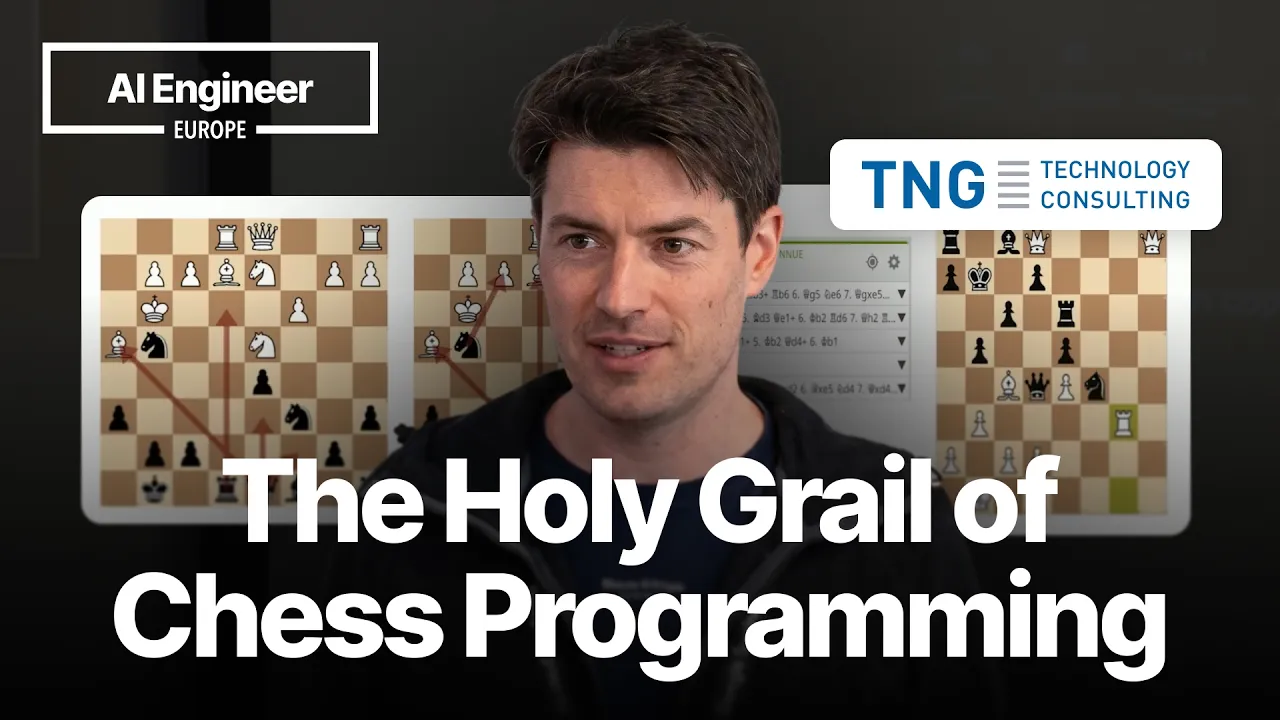
AI Engineer · @aiDotEngineer
This video has no Most replayed graph yet: YouTube shows one only once a video has enough views. These are the moments viewers replayed most in AI Engineer's most watched videos.
Most replayed moment at 18:45
4.8x that video's typical replay level
that they're they're changing they're changing things in the database not yet. You want to run them through the ontology first and make sure that works. Okay. I only got an I've got I've got another I've just a short time. I'm going to try to show you some of the things that um that you can
Said at 18:37
Most replayed moment at 16:13
3.6x that video's typical replay level
method signatures, the program layout and the call stacks. So here's some examples. I don't think you'll be able to read this one, but this is like the level of abstraction we're at. It's how we're actually going to lay this stuff out and how these systems are going to interact. Dylan Mulroy from Cloudflare talks a
Said at 16:06
Most replayed moment at 13:49
2.3x that video's typical replay level
Fable uh and it runs into an unknown, ask it to log it, right? So that um you uh you can see where the deviations happened and then you can sort of figure out why as well, you know? It will usually give you some context about what happened.
Said at 13:43
The graph counts replays. It does not show where viewers stopped watching.
Words
2,713
Runtime
16:31
Speaking pace
164wpm
Reading time
11min
164 words per minute, between the 160 25th percentile and the 181 median of 349 measured videos. That distribution comes from the 349-video hook study.
Opening (first 30 seconds)
Hello everyone. Um yeah, Swyx wrote a blog post and said, "Okay, don't write boring titles." So, I changed my title again actually and said, "Okay, we are working on the holy grail of chess programming." And if you knew me, I mean, I'm usually not the kind of guy who oversells stuff. So, it's actually a quote from someone else about this because like roughly a week ago there was an article on on one of the biggest newspapers in Germany
82 words, the words spoken in the first 30 seconds at 164 words per minute.
Free, no signup. See how the first 30 seconds hold attention, with rewrites.
Sentence shape
| Measure | This transcript |
|---|---|
| Sentences | 171 |
| Average words per sentence | 15.9 |
| Longest sentence | 65 words |
| Questions asked | 18 |
| Sentences containing a number | 25 |
Most used terms
Filler phrases
171 in total: um 48 · like 46 · uh 21 · actually 20 · I mean 16 · basically 6 · kind of 6 · sort of 4 · right? 3 · you know 1.
A literal whole-word count of the same phrase list the Prepublish browser extension uses, so a phrase inside another word is not counted and a phrase used in its ordinary sense still is. It is a count and not a judgement.
What this transcript is
Every word below is the caption track YouTube publishes for this video, pulled from the video itself and reproduced unchanged. It is not Prepublish's writing, not a summary, and not a re-transcription: it is the video's own published captions. English captions, generated automatically by YouTube, in the video’s original language. Source: the video on YouTube. A channel that would rather this page did not exist can ask for its removal through the contact page, and it is removed.
Hello everyone. Um yeah, Swyx wrote a blog post and said, "Okay, don't write boring titles." So, I changed my title again actually and said, "Okay, we are working on the holy grail of chess programming." And if you knew me, I mean, I'm usually not the kind of guy who oversells stuff. So, it's actually a quote from someone else about this because like roughly a week ago there was an article on on one of the biggest newspapers in Germany which was um discussed a couple of approaches to um yeah, new approaches to doing um yeah, combining AI with chess.
And yeah, they had said um it could easily take another 5 years until AI explains chess as well as a human trainer. Wilhelm Weber calls it the holy grail of chess program and work is already underway in Munich and that's basically where we are from, right? And we showed them a couple of videos um that my bosses mentioned and myself. And yeah, they were completely created by our AI engine. I want to quickly tell you a little bit how that's uh working.
So, maybe um don't want to only show it to the newspaper but also show it to you. There's a 2-minute video of what the outcome is. So, I'm going to start it now. Hello chess fans. In this position, black's queen is currently under fire from the white rook on the H file. Trying to find safety, black slides the queen over to G4. This is a crushing blunder. It looks like a completely safe square, but moving off the H file allows white to unleash a spectacular, mind-bending sacrifice.
White plays rook takes H5. White is offering up a full exchange, but this is a masterful trap built on incredible knight geometry. Let's look at what happens if black takes the bait. First, if black simply recaptures with the G pawn taking on H5, white springs the trap. The knight jumps into the action with knight to F6 with check. Look at this beautiful octopus knight on F6. It hits the king on G8 while simultaneously skewering that newly placed queen on G4.
A lethal fork. The king is forced to step aside to F8, and the knight simply scoops up the queen on G4. But wait, let's back up. What if black tries to be clever and avoids the pawn capture? Black could capture the rook with the queen playing queen takes H5. But it is the exact same trap. The queen is attracted right into the danger zone. By pulling the queen to H5, white set up the exact same trick and plays knight to F6 check anyway.
Once again, the king is attacked and the knight reaches across the board to attack the queen on H5. No matter how black captures the sacrificed rook, the queen gets forked because this knight magically controls both G4 and H5. The king must step aside to F8, and the knight captures the queen on H5. This is a gorgeous double-duty fork demonstrating the terrifying hidden power of the knight. Always watch out for these tricky jumping pieces when your king is exposed.
So actually when I prepared the talk yesterday, I um I wanted to show a different video, but um yeah, we are um automatically creating these videos every every night and then uploading them to YouTube. And when I this morning had a quick look if there's anything embarrassing there which I could should hide hide from all of you. I thought, okay, actually there's this video and it's actually even better than the other one.
So, might go for that one. And yeah, as I said, it's automatically created. We basically download chess games from lichess every night and analyze them in the background and then let our agent run and analyze it in more depth. From that analysis we then create some special format with from which we can later on then create a video. And yeah, the video in the end shows variations being explained. It shows brilliant moves, blunders, and yeah, and it's all automated.
And yeah, so how does it work? So, maybe backing up a little bit, what's the general problem? The problem is we've had really good chess engines for multiple yeah, decades actually. And but they can't really explain chess well. On the other hand, we have now LLMs, they can well, say um have words and describe things, but they can't play chess well. So, we have to somehow combine them. That's the main challenge. And yeah, we have now have built an agent which has a lot of tools which is basically the main yeah, important ingredient here.
But what is also important is the LLM which we're using under the hood. So, Gemini 3 but 1 Pro which recently came out is actually like the best model I seen so far on on chess. I'm pretty sure they did some done some yeah, in-depth post training on the model and you can really see in the reasoning traces that it really understands chess a lot better than the previous models. But what we have now put on top of that particular model is a list of tools.
So, what have you got? We've got a tool for legal moves Um, yeah, to just prevent it from ever like thinking about something completely illegal, right, on a chessboard, which might otherwise happen. Then we basically give the agent a complete chessboard and let it play moves and take them back and go to various variations itself. It can then always run a chess engine and yeah, also have get some other kind of chess data, for example, looking at checks, captures and threats.
And yeah, for some kind of videos we also include web search because then might be interesting to also describe the historic context of a game or something like that. So, looking at one particular tool in in detail, there's the checks, captures and threats tool. Um, that's actually quite well known in chess as a like a like a beginner's explanation of what you should be focusing on if you've got a position. So, this is a relatively complicated position in which I'm I'm guessing not that many people in the audience would immediately know which one is the best move.
I mean, does Does anyone want to have a guess at it? Well, I mean, it's it's pretty complicated to be honest. It's a tie game. Um, but what we're giving the the LLM now in this situation is not only the best move, but we're giving it also access to checks, captures and threats because it otherwise might might miss that. And you can see that there are a couple of check moves, um, yeah, on the left board. Um, some of which are obviously wrong.
So, like for example, with the queen taking the bishop on on A4 is obviously a bad move. Um, some other queen moves to give a check, they are quite reasonable, but actually the best move in this whole situation is to sacrifice the rook on E3, which is not completely obvious here, but that's actually the best move. In other situations it might be, however, much better to look at the check of the at the capture moves. And by providing all this via one tool, we give quite some diversity to the agent to um then maybe maybe later on explore other kinds of variations.
So, maybe it wants to check all of these moves and and yeah, describe which ones are actually bad because a human might think about them. And it's so it's not always about the very very best move which we have to describe. Um in general the big question is who should do the thinking. So, when we started this whole project, we initially had a like a some Python scripts which would analyze a chess position and would then assemble information from various positions and would say, "Okay, here are the the check moves and that's the engine evaluation." And then we would then pass it on to the language model to then have a whole description.
But, what um changed last year when reasoning models came out was actually that the the agents could um yeah, rather think themselves about the the positions. And they were already pretty good. So, the best model which we've been using like in in autumn last year was Grok 4. Surprisingly, that was sort of the best one. But, um yeah, also the other models like from OpenAI and so on, they also have quite some decent base chess knowledge to be able to then call the tools at the right position and then like assemble all the knowledge.
And yeah, as I already mentioned, this kind of conflicting information which we provide by the tools is actually very beneficial. So, um we also have other kind of tools which more more geared towards um yeah, having getting out the more human moves and positions. And yeah, that also helps to balance the the description of not being too much focused on the best moves, but also like on the most human moves. Also, in the historical context, there might be like some valuable information which moves have actually been played or someone might have described something in in detail which we might want to analyze.
So, all these kind of things um get into the mix in the context. Yeah, after we did the whole analysis, we would then create it into a special format which we could then easily transfer into a um yeah, into a video. Um we then use 11 Labs V3 for text-to-speech. Yeah, it's actually pretty nice that there are now also these audio tags like I can put this excited in there and it would then sound excited. And yeah, and also the agent also decides by itself which squares it wants to highlight, which arrows want it wants to draw, and if something should be considered a brilliant move or not.
Yeah, and now maybe also some other questions. So, is that all slop which we are which we are creating? I think not, obviously. Um but yeah, I mean we are able to create many many many such videos. So, we have to really balance of how much do we want to put out there on YouTube. So, um what is the input? I mean, the input is actually human games. So, in a in a sense um what we are now positioned at is we could be creating videos of your games and you could send the videos then to your friends and family.
And um we are not trying to um I don't know, put in these artificial things like exploding position um like uh exploding kings or something like that on check checkmate which might might be beneficial for the view count and so on, but we are really trying to yeah, get the most out of the chess quality. Uh in general, why are we doing this? I mean, there are a lot of interesting and great streamers. So, for example, Gotham Chess is one one maybe the the uh the most well-known streamer.
But they he would probably not um describe one of your games or my games uh in his videos. But we now have a a way to also scale for other people who are not like the best players in the world and who might which Yeah, might also like to have a video. And yeah, we've got a YouTube channel and um yeah, currently it's like something like 500k views. And yeah, more than 4,000 subscribers. Most of them actually were um yeah, subscribed within the last month.
So, it's actually going up quite a bit there. Yeah, and that's it. If you've got any more questions, I mean, ask them or send me a message via these platforms here, whatever, and yeah, that's it. Yeah. Uh how how what are the what are the costs? Are you monetizing the YouTube channel to like covering the element of the costs? Yeah. Well, currently we don't make any money yet because we're not haven't reached the monetization stage yet.
And so, it's net minus at the moment. But, okay, might change. We'll see. So, you use self-modifying media with like how many videos you generating and how many like if the quality better Yeah, I mean, so um this whole uh automation we only like enabled like a couple of weeks ago. And so, currently I'm still like a little bit skeptic. Should I really like just leave it uh upload videos? And yeah, I'm mostly still leaning on okay, I still want to watch them first once.
But, um yeah, the error rate is actually pretty low. So, I would say every 20th um video maybe has a a very weird description in which there's I don't know, a checkmate uh and uh that's missed or something like that. But, I mean, that's usually also then of uh valuable information, right? Because maybe some like one tool call was not done at the very end and okay, we can learn something from that. But, I've actually much more now switched to okay, I don't care anymore.
And even if there's a bad a then I'll take it down afterwards, maybe. Yeah. Yeah. Anything else? Yeah. What is the average cost per video? Um it's um something on the order of, yeah, 20-30 cents, something like that. So, I mean, we also have created a couple of other videos which are like uh much much longer, and there it can also get to euros and something like that. Um currently, we are not trying to optimize the costs too much because um uh we rather want to error error on having it too good description, sort of.
And but there are also a couple of optimization possibilities in there. I don't know, redundant tool calls. Sometimes the agent goes through a game like twice or something like that, and yeah, that's obviously stupid in a sense. Yeah. You were talking about human move. Is it like computer master human move or like the human move? You might put in the mix. Yeah, basically all. I mean, so there's this this um uh Maya engine which was also mentioned uh yesterday in the talk, so um by the University of Toronto, which um yeah, they trained a model in which you can basically uh put a yeah, rating of uh of a player, and then it would roughly um give you a move which that player might want to play.
But it's not like it I mean, it's not like perfect sense, right? But it still might be valuable information that maybe some move like this uh deserves a description. So, we don't necessarily need to have what really a human would be playing of that strength, but rather like a mix of different things to consider. So, for example, like a 1,000 rating Yes, exactly. >> 1,600 elo or you know, something. Yeah. You want to explain to you.
Yes, I mean, these these things could also be used then for targeting a little bit more like for the audience rather have like videos for better players or videos for worse players. And um in currently uh we are also not really sure exactly how which videos we should be putting up there or not. I mean, sometimes we also have videos with a checkmate in one, which for like good players is sort of ridiculous. I mean, you see it immediately.
But on the other hand, there there real beginners who really don't see that and need also an explanation uh why that's a checkmate and so on. So, yeah, it's it's all a bit of a balancing question, which we are not really sure yet. Yeah. Have you tried other games? No, not yet. But yeah, I mean, it's sort of uh possible to extend in some, yeah. Okay. Yeah, then that's it. Thanks.
The words are the caption track's own and nothing is reworded or re-transcribed. Paragraph breaks are placed between sentences so the text reads as prose.
Free tools for your own script. No signup, no login.
Paste your draft and see where viewers are likely to drop off, with a rewrite for each weak line.
Paste the first 30 seconds of your own draft for a hook score and rewrites.
Check your draft against YouTube's advertiser-friendly guidelines before you record it.
Read this channel's public videos and transcripts, and download a writing brief for it.