Getting the transcript
Reading the captions from YouTube. A video nobody has opened here before takes 10 to 30 seconds; this page fills in on its own.
Getting the transcript
Reading the captions from YouTube. A video nobody has opened here before takes 10 to 30 seconds; this page fills in on its own.
Rory Anderson · @RorZFilms1
Where viewers went back to watch this video again, from YouTube's public Most replayed graph, lined up with what was said at that moment.
Most replayed moment #1
10:168.5x the video's typical replay level
vest and dropped the camera. It's not uncommon during the shooting of this kind of action to damage a camera. We did destroy one MSM. The problem with working in the IMAX format is there were only four of these cameras in the world. Now there are three, and that that was a little uh little depressing for us all cuz we
Said at 10:09
Most replayed moment #2
8:455.9x the video's typical replay level
were all a bit unknown. >> The IMAX cameras weren't exactly built with this in mind, and so we had to advance a lot of their technology and modify a lot of their stuff. >> $300,000 camera on a motorcycle. >> You know, I went down to IMAX and I spoke to them about using their cameras. And they'd never been used on a on
Said at 8:37
Most replayed moment #3
2:255.3x the video's typical replay level
and his team had to find ways to do that with a camera that's much larger than normal uh film camera [music] and they did an incredible job and I think that when I see the finished film, I don't see any compromises with how we had to make the film. It's really about taking the IMAX canvas and using it um to let
Said at 2:17
The graph counts replays. It does not show where viewers stopped watching.
Words
5,703
Runtime
30:11
Speaking pace
189wpm
Reading time
24min
189 words per minute, between the 181 median and the 201 75th percentile of 349 measured videos. That distribution comes from the 349-video hook study.
Opening (first 30 seconds)
The horizon of cinema is on the precipice of a monumental shift. Nolan shot this globe-trotting epic making history by being filmed entirely using 15 perf IMAX film cameras. As any filmmaker, they know this is a staggering technical feat. For Nolan, this isn't a sudden gimmick. It is the ultimate culmination of a journey that began nearly two decades ago. >> But if there were a film that we wanted to do entirely on IMAX, this is the movie to do it with. I wanted to shoot an entire film on IMAX for a
95 words, the words spoken in the first 30 seconds at 189 words per minute.
Free, no signup. See how the first 30 seconds hold attention, with rewrites.
Sentence shape
| Measure | This transcript |
|---|---|
| Sentences | 309 |
| Average words per sentence | 18.5 |
| Longest sentence | 90 words |
| Questions asked | 9 |
| Sentences containing a number | 24 |
Most used terms
Filler phrases
98 in total: you know 26 · like 19 · uh 18 · actually 8 · kind of 8 · sort of 8 · um 6 · I mean 4 · literally 1.
A literal whole-word count of the same phrase list the Prepublish browser extension uses, so a phrase inside another word is not counted and a phrase used in its ordinary sense still is. It is a count and not a judgement.
What this transcript is
Every word below is the caption track YouTube publishes for this video, pulled from the video itself and reproduced unchanged. It is not Prepublish's writing, not a summary, and not a re-transcription: it is the video's own published captions. English captions, generated automatically by YouTube, in the video’s original language. Source: the video on YouTube. A channel that would rather this page did not exist can ask for its removal through the contact page, and it is removed.
The horizon of cinema is on the precipice of a monumental shift. Nolan shot this globe-trotting epic making history by being filmed entirely using 15 perf IMAX film cameras. As any filmmaker, they know this is a staggering technical feat. For Nolan, this isn't a sudden gimmick. It is the ultimate culmination of a journey that began nearly two decades ago. >> But if there were a film that we wanted to do entirely on IMAX, this is the movie to do it with.
I wanted to shoot an entire film on IMAX for a very long time. I mean, really since I was about 16 and I first started seeing documentaries. And back in 2007 with The Dark Knight, when we were planning that film, I approached IMAX. We talked about using the cameras to shoot the action scenes, the key action scenes of of that movie. And we did that. We did that very successfully. We were thrilled with the way it worked.
Over the years, I've tried to incorporate IMAX technology more and more through the films I've made, from films like Dunkirk and Interstellar and indeed Oppenheimer. But what we've never been able to do before was to shoot the entire film that way because the cameras themselves are very [music] loud. You know, they're taking a very large amount of film, 65 mil film running at 15 perforations per frame. This film has to transport through the camera [music] very very fast.
It creates an enormous amount of noise. We would always [music] use it for action scenes because noise wasn't really a factor with building sound track afterwards. But for dialogue scenes, that made it impossible. And so we challenged them to build [music] new cameras and to build a blimping system uh that we could place an IMAX camera in and mute [music] the sound of the cameras sufficiently that we could shoot an intimate dialogue scene, have the camera very close to the actors, [music] and have them uh not only be able to record the dialogue, but also have them be able to perform uh in the way they needed to perform without the distraction of, you know, [music] a very loud camera.
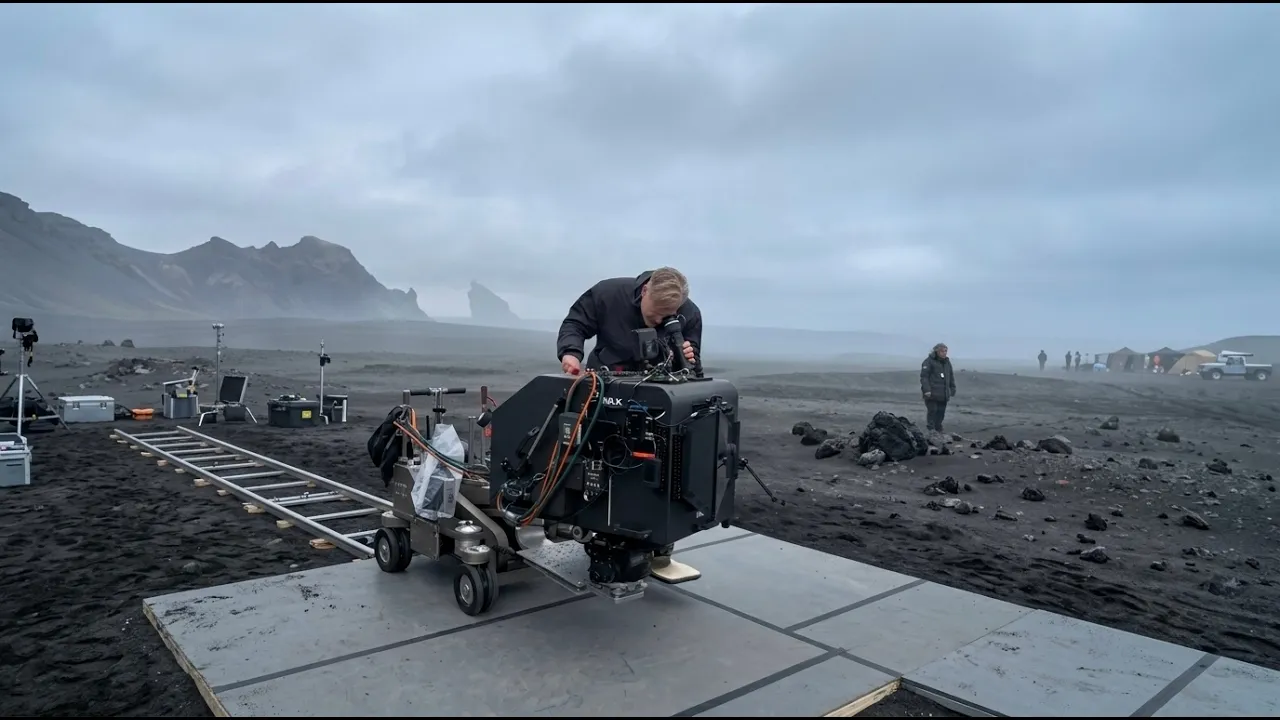
IMAX was able to develop that and step up. We were able to shoot the film that way. My director of photography, [music] Hoyte van Hoytema, and his team had to find all kinds of ways to take this very large camera, over 300 lbs [music] worth of equipment, very large box, in a way it was like going back to an older era of filmmaking where cameras were extremely large and cumbersome, but [music] of course with the requirements of modern filmmaking where the camera is fluid, it moves where [music] it needs to move effortlessly and so forth.
And so Hoyte and his team had to find ways to do that with a camera that's much larger than normal uh film camera [music] and they did an incredible job and I think that when I see the finished film, I don't see any compromises with how we had to make the film. It's really about taking the IMAX canvas and using it um to let the imagery play out on that that larger-than-life screen. >> To understand the genesis of this cinematic obsession, we have to look back to the summer of 2008 when Warner Brothers thought they were simply releasing a standard Batman sequel.
In 2008, the superhero genre was changed forever. But Christopher Nolan wasn't trying to make a comic book movie. He was using the infrastructure of a blockbuster to build something entirely different. A grand city story, a sprawling crime epic. >> How do you move on from what you've done in Batman Begins? How do you make the film bigger and more than Batman Begins? >> Nolan didn't want to repeat the theatrical romantic origin archetype of Batman Begins.
He wanted to change the genre completely, shifting the narrative scale into a hyperrealistic arena heavily inspired by Michael Mann's Heat. >> Heat, absolute classic. >> Yes. >> I kept ripping it off. Best >> Big influence on The Dark Knight. >> Best shootout sequence. >> Incredible shootout. >> Gotham was no longer a stylized comic book backdrop. It became a living, breathing character. >> I wanted to push further and further in the in the direction of shooting on location.
And shooting with a real-world scale because even with some of the interiors, you know, the office spaces or boardrooms and things like that, the biggest set you could possibly build isn't going to be as big as the real world version of it. And so shooting on real locations you're able to get some of that scope and scale very naturally and organically into the film. [music] And it felt to me that Gotham had to become this huge arena in the movie for these characters to to face off in. >> And Chris always came from perspective of, "Yeah, but is it essential?
Let's not make a movie just because, you know, there's an appetite for it. Let's make a movie because we have something to say." If you could seek out the kind of rules hidden in and amongst all of the different versions of the character, the ones that matter, the ones that really matter. >> Coming off the success of the first film, the studio expected a safe bet, a traditional sequel with a larger budget and new toys for merchandising.
But Nolan and his creative team were chasing an artistic truth. They insulated themselves from the expectations of the fan base and anchored the script in a tangible, terrifyingly plausible reality. >> Well, there's always a a risk, you know, with with a property like this that that has so much passion in its fan base. It's a great privilege to work with >> [music] >> characters like that and be entrusted with characters like that, but it comes with a big responsibility, too.
What we did in Batman Begins is we made the best film possible [music] in the way that we thought best and we trusted that the fans would feel the sincerity of the intention there to make a great film. And we did the same thing with this [music] film. It did feel like a risk because to a certain extent with Batman Begins you feel like you got away with it. >> The ultimate risk, however, lay in reinterpreting an icon.
How do you construct an antagonist capable of matching a fully formed Batman without drifting into camp or nostalgia? Nolan's answer was to build a force of pure, unpredictable nature, a psychologically credible anarchist designed to expose the collective neurosis of the post-9/11 society. >> We just had this story we wanted to continue. We just had this idea of who would the Joker be in this world? >> To embody this catalyst of chaos, Nolan famously cast Heath Ledger.
While internet forums at the time melted down over the casting of a romantic lead, Nolan saw an actor of limitless capability. He didn't want a traditional theatrical performance. He wanted an actor who could blend an internal psychological process with the raw external physical presence reminiscent of silent film icons. When Ledger sat down with Nolan, they discovered that they were completely on the same page. >> Tuttle tells me I can do the Joker.
I can make this work. I can create this iconic presence. You trust that. You jump on it. >> The Joker, the character of the Joker was just too good to turn down. I You know, we went through the process of deal making and announcing and everything. And I think the whole whole world turned around and said, "What do you do?" [music] You know, Heath Ledger Joker didn't make any sense to people. They talked about it. >> myself away for 6 weeks in a room and I kind of came up with this creep.
Walk around like a a madman and finding posture, finding stance, finding his voice is very important because when you find the voice, you find the the breath within the voice. >> I think Heath wanted to do was to apply the makeup himself. As an actor saying, "Okay, this character would put his own [music] makeup on you know, in in real life." And so, what would that look like if he just got the makeup. The thing that stuck from that is he always had makeup on his fingers and under his fingernails and everything as he would have from from putting it on just with his hand. >> You know, I just do things. >> Really amazing experience to to be a part of, to see him developing something in that way.
And as we shot with Heath, you could see everybody on the floor just fascinated by it. I mean, it was just such a sort of interesting creation. >> You know, the problem with Batman is is that the villains are always more interesting. Batman actually, he's very close to being a the himself. So, let's never let him become dull by comparison. And unfortunately, I'll sit there going, "I'm feeling a little bit dull by comparison cuz Heath is just like killing this." >> I just did what I do best. >> The result would not just challenge the Batman, it would redefine modern cinematic villainy forever.
Working your way through the evolution of cameras, from early high eight tape and standard digital setups all the way through to heavy duty cinema lines, you quickly realize that every format strictly dictates how a film is physically shot. Nolan's push to use 15 perf IMAX for The Dark Knight wasn't just a simple resolution upgrade. It completely broke the rules of traditional Hollywood cinematography. Suddenly, the crew was wrestling with cameras that were astronomically heavier and louder, completely altering the workflow on set. >> No one's ever done this before, and so the size of the cameras, the size of the film format, the amount of light it would require, all these kind of things were all a bit unknown. >> The IMAX cameras weren't exactly built with this in mind, and so we had to advance a lot of their technology and modify a lot of their stuff. >> $300,000 camera on a motorcycle. >> You know, I went down to IMAX and I spoke to them about using their cameras.
And they'd never been used on a on a Hollywood film before. And what we decided to do was consider certain sections of the film. Now, the camera's very loud, so you don't really want to do dialogue scenes that way. So, we laid out which of the action set pieces we would shoot with the IMAX camera, starting with the opening of the film where we introduce the Joker. >> We really wanted to maximize the use of the IMAX frame, and so this rig where the Joker's been a sliding down the cable from rooftop to rooftop was something I really wanted to get a very dramatic, vertiginous view just [music] to really use the IMAX format for what it's best at, which is really giving people stomach >> [music] >> a lurch as they look down on incredible drop. >> Beefing up the rigs was an understatement.
To capture the visceral heights of Gotham City, the camera department attempted to mount the notoriously heavy equipment on stabilizing gear that simply wasn't designed to take that kind of kinetic punishment. In fact, pushing the limits of large format cinematography resulted in a catastrophic equipment failure right there on set. >> Bob Knorl, our Steadicam operator, tried flying the the lightest IMAX camera, the MSM camera, and found that he could actually use it very effectively, use it very much as he would a 35 mil camera.
It was a 5-day sequence, I think sometime after about the second day of of using Steadicam intensively, the arm actually sheared off, it broke off the vest and dropped the camera. It's not uncommon during the shooting of this kind of action to damage a camera. We did destroy one MSM. The problem with working in the IMAX format is there were only four of these cameras in the world. Now there are three, and that that was a little uh little depressing for us all cuz we we grew to quite like these cameras.
I've always preferred real locations to to sets. There's a feeling of reality, there's a feeling of being somewhere that that matters. You know, I avail myself of all the latest digital effects technology, absolutely. But we try and always achieve what we can in camera. >> But this technical limitation birthed a stunning aesthetic. The unique optics of the format forced Nolan and Pfister to let the world breathe, fundamentally shifting the rhythm of their editing and blocking. >> The uh the way in which you shoot IMAX is a little bit different.
Uh the lenses are very wide, [music] it's a very tall image. Uh so, you do need to adjust your framings somewhat. [music] >> If you look closely at the action sequences in The Dark Knight compared to Batman Begins, the camera holds. It doesn't rely on frenetic, rapid-fire cutting to create kinetic energy. Instead, it captures more information in a single sustained composition, saving the punchy close-up inserts for maximum psychological impact. >> Uh but actually, once you get into the rhythm of shooting it, and very much for the audience watching it, uh you can make it more and more like the way you would shoot a regular 35 mil film.
Because as filmmakers, we got used to the technology, but as audience members you get used to watching it through through the course of the film. And so, with the opening we were very careful to to shoot it in a very precise slightly calmer than usual manner and let the shots play a little longer and let you find things in the in the massive frame. But as the film progresses, we get >> [music] >> sort of more and more frenetic really and I don't think people notice they seem to sort of, you know, go with it. >> Nolan orchestrates these sprawling images not by staring at a video village, but by physically immersing himself in the space alongside the lens. >> I started off on this journey that I've continued of of always trying to think in three dimensions, not look [music] at um the shot as a two-dimensional picture, but look at where everything is in three-dimensional space.
That's why I don't use a monitor on set [music] to this day. I just stay by the camera because I want to see where things [music] are in three-dimensional space. And then place the camera according to my idea of what the point of view is. And I like to try and align the audience quite closely [music] with the point of view of a character in the film. That feels the most natural form of of storytelling [music] to me. Uh and the idea of a narrative [music] that's a maze or labyrinth and the idea that rather than being above that maze and watching the characters make mistakes [music] and wrong turns, you would enter into the maze kind of looking over their shoulder and make wrong turns with them and and find the blind alleys with them.
And that's really an approach that I've in different forms I've I've carried on using through all my films. >> IMAX cameras are notoriously difficult to shoot with. >> You know, the first thing everyone talks about is how heavy the camera is. Probably four to five times heavier than the cameras that we're accustomed to working with. We can't put it on my shoulder and we can't shoot handheld with it. For every rig had to be either reinvented or beefed up a little bit to accommodate that. >> Will you be wanting a back puncher? >> A little of that, Alfred.
Not very subtle. >> The Lamborghini then. >> Much more subtle. >> This meant rethinking the mechanics of entire action sequences. You couldn't just throw the camera on a shoulder rig and sprint down the street. Furthermore, the massive verticality of the 15-perf IMAX frame completely broke traditional night lighting setups, forcing the director of photography to innovate on the fly. >> And the IMAX for Wally particularly shifted the way he had to light things at night, for example.
[music] So, the scenes we just looked at were the Joker standing in the middle of the street, you know, with the truck flipping everything. Um he couldn't backlight those scenes because normally what he would have done is put the light just on top of frame and put a backlight. It's a very >> [music] >> elegant and practical way of lighting night scenes. So, he had to come up with something completely different. He had to front-light the buildings um because the IMAX frame is so tall and no way to get the lights in from behind.
[music] >> By forcing the crew to adapt to the sheer scale of the camera, Nolan captured an unprecedented level of cinematic immersion. It was the crucial testing ground that laid the technical foundation he's now perfecting on his upcoming film, The Odyssey. But a massive canvas is empty without compelling figures to fill [music] it. With the Joker cutting through the narrative as an unstoppable force of chaos, Batman needed a counterbalance, someone to carry the emotional spine of the story.
Batman operates in the shadows, but Gotham needed a hero in the light. This is where Aaron Eckhart's Harvey Dent enters the picture. >> beginning of The Dark Knight, you're looking at a character [music] who has embarked on this this crusade, is looking for an end to it, and sees in the person [music] of Harvey Dent, the new district attorney in Gotham, he he sees the response he's looking for. He sees the legitimate face of his campaign being taken over [music] by Harvey Dent. >> Casting Dent was a massive narrative challenge.
The character had to be unequivocally good and inspiring at the start, yet harbor a believable, simmering capacity for darkness to justify his eventual, tragic fall from grace. >> And when we were casting Harvey Dent, we were looking for somebody who could embody that all-American charm, that that very heroic presence, almost the kind of Robert Redford sort of aura. Uh but would also have [music] this edge, would also have this undercurrent of anger and uh darkness to it.
That that Harvey Dent needs so that where he goes in the story isn't a cheat. >> Aaron Eckhart perfectly walked this tightrope, providing a tragic, emotional core of the film. While the Joker relentlessly tests Batman's rigid rules, it is ultimately Harvey Dent who breaks under the crushing weight of Gotham's corruption. To make the Joker truly terrifying, his visual design had to reflect his fractured psychology. It couldn't just be a clean comic book makeup.
It needed to feel visceral, tactile, and deteriorating. >> I mean, I um showed Heath uh Francis Bacon paintings. Sort of looked at the you know, these great canvases, the way you know, you smear the faces, the the paint of the of the faces, and make these very bizarre blurred sort of distortions, as if you know, the the paint is running on the canvas or smeared across it. And um Heath together with uh John Caglione, his makeup artist, they they really managed to to put together a great texture for that, and it degrades through the film.
Uh it has a very tactile sense. You can really see the the form of the makeup as it as it's caked on the face, and uh I like to say that, you know, what we were after, and I think what what they very much achieved is in the in the big close-ups of of the Joker, particularly in the IMAX format, I think you can really almost smell his breath. >> This degradation didn't just stop at the makeup. The wardrobe itself was constructed to communicate a distinct, almost repulsive anti-vanity.
The character's clothing was tailored to look like an extension of his anarchic lifestyle. >> This this idea that the clothes are grubby and degraded as if he wears the same thing the whole time, you know, as if he's been out all night, never takes his clothes off, never washes, and he just sleeps that way, and probably smells absolutely appalling. >> Heath Ledger matched the physical decay with a vocal performance that kept everyone on edge.
He didn't reveal his choices all at once during pre-production, allowing the unpredictable nature of the character to surprise the director and the crew on set. >> His voice was so unpredictable. [music] He created this bizarre pitch that I've seen a lot of people try to imitate since, uh, >> [music] >> but you never quite knew whether he was going to go high or whether he was going to go low. You never knew what that [music] guy was going to do, and that was what was terrifying about it. >> This commitment to a raw, unpredictable reality wasn't confined to the performances.
Nolan demanded that the film's massive spectacle be captured in camera to maintain the weight of a true crime epic. To match the grounded nature of his universe, even the most outrageous action beats had to be achieved practically, culminating in one of the most astonishing physical stunts in modern cinema. >> Chris Corbould, our fantastic special effects guy, [music] just tried to talk me into a small vehicle all the time, and you know, could it just be a van, and all could it go [music] sideways, and all this.
And I went with that for a while because, you know, if he says he can't do something, he's somebody you believe. But one day I just said to him, you know, I'm sure you can figure out a way to do this. Any kind of rules are sent off and find a way to do it, and he he did it absolutely perfectly. It's It was an incredible and beautiful thing to watch, this thing just just flip straight up and over, hovered for a second, and and down >> [music] >> within, you know, feet of where he said it would land. >> In pre-production, Chris Nolan kept challenging everybody to come up with ideas of how we could beef up these action sequences, and this idea came up to flip this 18-wheeler over without use of CGI. >> It was all right flipping it over in a great big wide open space where it couldn't hit anything, but the road Chris chose to do it was right in the middle of the banking district. >> They had a big chunk of TNT inside there to to blow that air ram too.
The only visual effect involved in that scene was to remove the ram that they had built inside the truck that actually catapulted it. >> They were able to come up with a scenario in which Heath could actually be walking [music] out of the building. If we put in a little beat where the first set of explosions stops as if something's gone wrong and the Joker [music] just takes a second to look around surprised like the audience is surprised.
Then the major demolition comes in and he jumps straight into the school bus. In that way he was able to come up with a practical scenario [music] in which we could actually take a principal actor, walk him out of a building that's about to to be destroyed and literally drop the building [music] to the ground. We rehearsed it I think about 12 times. Videotaped the rehearsal, looked at it from all the different camera angles.
And Heath was such a perfectionist and managed to be so precise in what he was doing which was essential because this was obviously a one take thing and the angle I knew that despite really all the other cameras we set, we really needed that close shot on him walking out to work perfectly. He did it very, very precisely. I don't know how he resisted looking back. I think he wound up with bits of cork in his hair at the end of it so close he was to everything that was going off, but he never looked back.
He never betrayed any sense of worrying about what was behind him. Not through miniature work, not through computer graphics, but to to really destroy a building. We just left the thing alone and allowed it to be this combination of real demolition with wonderful dressing of special effects explosions. >> As any director knows, constructing a massive practical 15 perf IMAX frame is only half the battle. To truly tighten the screws on an audience, the pacing and the soundscape have to perfectly mirror the visual tension.
For The Dark Knight, composer Hans Zimmer completely abandoned the traditional triumphant superhero orchestration to capture the essence of the Joker. He needed an auditory equivalent to Heath Ledger's anarchic performance. A sound that made the audience physically uncomfortable without them understanding why. >> I didn't want to write a summer [music] blockbuster happy indulgence score. I wanted something that was truly provocative and and people could truly hate. >> Talk to me about the nature of the sounds he was playing with.
This this idea of sort of razor blades on strings, this idea of tension and and the idea of the punk influence that I think he could absorb and feel of the character. Getting the feel of that into the music without it ever becoming too punk, too rock and roll, too different [music] from from the rest of the music. >> Zimmer stripped the melody down to its absolute rawest elements, experimenting with the abrasive sounds of razor blades on strings.
The goal was to translate the Joker's unpredictable psychology into a singular antagonizing musical concept. >> What if I can define a character in one note? Actually, it's two notes that clash beautifully with each other. Make it really like a taut string that's that gets tighter and tighter, but never breaks. >> That relentless, unbreaking string drives the momentum of the entire film. It sets the rhythm for editor Lee Smith, who had the monumental task of balancing a sprawling, multi-location narrative without relying on time jumps or flashbacks.
This masterful blend of editing, score, and performance reaches an absolute boiling point exactly halfway through the film, the interrogation scene. This is a master class in blocking and tension. What begins as a physical beatdown quickly shifts into a profound psychological battle. Batman's physical strength, his primary weapon, is rendered completely useless by an adversary who genuinely does not care if he lives or dies. >> I mean, certainly when I look back at Batman Begins, there's a heavy emphasis [music] on on terrorism, on the sort of post 9/11 world, but we it wasn't something we were consciously putting into the film.
We were just trying to be sincere and truthful about what moved us at the time. And certainly the Joker for me and the Dark Knight is all about a fear of anarchy, you know, fear of the rules breaking down and and what that would do to society. >> By trapping Batman in a room and stripping away his physical advantages, the Joker goes to work on the hero's mind. The brilliance of this scene isn't just in the dialogue, it's in how the Joker forces Batman into an impossible scenario.
He attacks the one foundational rule Batman operates on, his refusal to kill, by forcing him to make a choice that will inevitably result in death. The Joker forces Batman to make a choice on who to save. The interrogation scene crystallizes the central conflict of The Dark Knight. It proves that the Joker isn't just a villain with a gimmick. He is the ultimate ideological mirror to the Batman, tearing apart the established order of Gotham and pushing its protector past his breaking point.
As a filmmaker, when you build a world on screen, you're inevitably holding a mirror up to your own. Christopher Nolan didn't just want to elevate the action genre, he wanted to anchor the Batman mythos in the very real, palpable anxieties of post-9/11 society. The Joker isn't just a bank robber, he represents the terrifying concept of modern terrorism, the fear that the rules and institutions that keep us safe can be unraveled in an instant.
To combat this unpredictable threat, Bruce Wayne is pushed into morally gray territory. The film asks difficult questions about what we are willing to sacrifice for security perfectly illustrated when Batman utilizes a massive unethical surveillance system to tap every cell phone in Gotham. He uses it to find the Joker. The film was made in 2007, way before mass surveillance was anything Hollywood movie was expecting to engage with.
The climax of The Dark Knight isn't a traditional CGI heavy fist fight to save the world. It's a psychological and sociological experiment. The Joker asks the citizens of Gotham on two ferries, one filled with citizens, the other with convicts, and gives each the detonator to the other boat. It's a master [music] stroke of tension that forces the audience to ask themselves, "When the chips are down, will civilized people truly eat each other?" Dent is the individual version of the experiment.
The boats are the collective version. They're both asking the same thing. The Joker's goal was never to simply blow up a boat. It was to prove the psychological point. He wanted to break the collective soul of Gotham. But, while the citizens on the ferries ultimately chose to hold onto their humanity, proving the Joker wrong, the villain still manages to claim a devastating victory elsewhere. The true tragedy of the film lies in the destruction of Harvey Dent.
Batman and Gordon put all their chips on Harvey being the incorruptible savior of the city, but the Joker understands that to truly plunge Gotham into despair, he doesn't need to kill their hero. He needs to corrupt him. >> I took Gotham's white knight and I brought him down to our level. It wasn't hard. See, madness, as you know, is like gravity. All it takes is a little push. >> Driven mad by the loss of Rachel and the horrific physical scarring he endured, Harvey Dent becomes Two-Face.
He abandons his rigid idealism and replaces it with the only morality he believes is left in a cruel world, pure, unbiased, chaotic chance. The White Knight falls, and the Joker successfully proves that even the best among us can be broken. Every epic needs a resolution, but Christopher Nolan wasn't interested in tying The Dark Knight up with a neat, happy bow. The climax of the film forces its protagonist into the ultimate corner.
The Joker may not have succeeded in destroying the physical city, but by breaking Harvey Dent, he successfully shattered Gotham's moral compass. To prevent the city from losing all hope, Batman realizes that the only way to save Gotham's soul is to sacrifice his own. >> You either die a hero or you live long enough to see yourself become the villain. >> It is the defining thematic line of the film. Batman chooses to take the fall for Harvey Dent's crimes.
He embraces the hatred of the city he has sworn to protect because his resolve goes beyond mere public approval. He absorbs the sins of the White Knight to preserve the illusion of a righteous system. >> I can do those things because I'm not a hero. I'm whatever Gotham needs me to be. >> In this final, masterful stroke of storytelling, Bruce Wayne transcends the traditional superhero archetype. He becomes an outcast, cementing the unforgettable final words delivered by Commissioner Gordon.
He's a silent guardian, a watchful protector, a dark knight. But the triumph of The Dark Knight is inextricably linked to a profound, real-world tragedy. During the film's post-production in January 2008, Heath Ledger passed away. The cultural shockwave was immense, and the grief surrounding his death naturally overlapped with the dark, heavy atmosphere of the film itself. >> He will be eternally missed, but he will never be forgotten. >> Despite the rumors that the intense psychological toll of playing the Joker contributed to his passing.
Those who worked with him remembered a joyful, dedicated actor who was incredibly proud of the role he had crafted. His loss cast a somber shadow over the release, but it also elevated his performance into something immortal. The Dark Knight was released to an unprecedented acclaim. It was a monumental success that altered the trajectory of blockbuster filmmaking, grossing over a billion dollars worldwide. It demanded that the Academy acknowledge the superhero genre, ultimately earning eight Oscar nominations.
Heath won posthumously. To this day, The Dark Knight remains the gold standard. It showed us that when a visionary director pairs practical, large-format filmmaking with a script that respects the intelligence [music] of its audience, the results are timeless. Which brings us back to where we started. As Christopher Nolan mounts his upcoming film, The Odyssey, utilizing those massive 15 perf IMAX cameras exclusively, he is pushing medium of film to its absolute limits.
If the ambitious evolution of Batman Begins to The Dark Knight taught us anything, it's that Nolan never stops escalating. He broke the mold in 2008, and with The Odyssey, he's undoubtedly prepared to break it all over again. If you liked this video, subscribe, and we'll see you in the next one.
The words are the caption track's own and nothing is reworded or re-transcribed. Paragraph breaks are placed between sentences so the text reads as prose.
Free tools for your own script. No signup, no login.
Paste your draft and see where viewers are likely to drop off, with a rewrite for each weak line.
Paste the first 30 seconds of your own draft for a hook score and rewrites.
Check your draft against YouTube's advertiser-friendly guidelines before you record it.
Read this channel's public videos and transcripts, and download a writing brief for it.