Getting the transcript
Reading the captions from YouTube. A video nobody has opened here before takes 10 to 30 seconds; this page fills in on its own.
Getting the transcript
Reading the captions from YouTube. A video nobody has opened here before takes 10 to 30 seconds; this page fills in on its own.
Digital Foundry · @DigitalFoundry
Words
2,059
Runtime
12:30
Speaking pace
165wpm
Reading time
9min
165 words per minute, between the 160 25th percentile and the 181 median of 349 measured videos. That distribution comes from the 349-video hook study.
Opening (first 30 seconds)
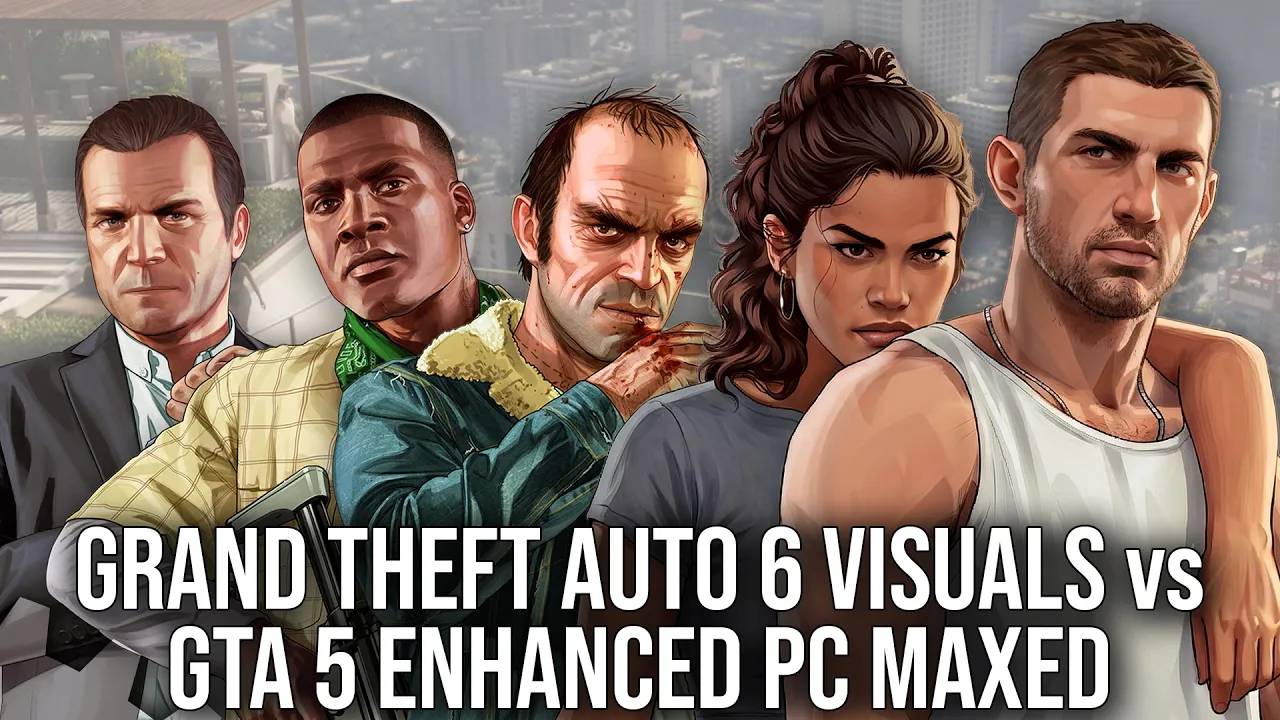
Grand Theft Auto 6 is a visual tour de force packing some of the best graphics we've ever seen despite its open world ambitions. But the game's immediate predecessor, Grand Theft Auto 5, received a PC enhanced edition last year with all kinds of ray tracing tech that some speculate was lifted from GTA 6 itself. So, how does the most advanced version of GTA 5 compare to GTA 6? What kind of general visual advancement can we expect over Rockstar's refurbished 2013
83 words, the words spoken in the first 30 seconds at 165 words per minute.
Free, no signup. See how the first 30 seconds hold attention, with rewrites.
Sentence shape
| Measure | This transcript |
|---|---|
| Sentences | 98 |
| Average words per sentence | 21.0 |
| Longest sentence | 47 words |
| Questions asked | 2 |
| Sentences containing a number |
What this transcript is
Every word below is the caption track YouTube publishes for this video, pulled from the video itself and reproduced unchanged. It is not Prepublish's writing, not a summary, and not a re-transcription: it is the video's own published captions. English captions, generated automatically by YouTube, in the video’s original language. Source: the video on YouTube. A channel that would rather this page did not exist can ask for its removal through the contact page, and it is removed.
No Script X-ray for this video: YouTube shows a Most replayed graph only once a video has enough views.
Grand Theft Auto 6 is a visual tour de force packing some of the best graphics we've ever seen despite its open world ambitions. But the game's immediate predecessor, Grand Theft Auto 5, received a PC enhanced edition last year with all kinds of ray tracing tech that some speculate was lifted from GTA 6 itself. So, how does the most advanced version of GTA 5 compare to GTA 6? What kind of general visual advancement can we expect over Rockstar's refurbished 2013 [music] classic?
GTA 5 was designed around the limitations of the Xbox 360 and PS3. Though the game has been enhanced and upgraded over the years with various asset improvements and lighting changes to suit higher-end platforms. The characters though haven't changed all that much. These are the same waxy, relatively primitive characters we saw back in 2013. They lean heavily on techniques like normal mapping to resolve fine details and expressions are limited.
There's a cheap approximation of subsurface scattering here, but it can give characters a slightly plasticky feel rather than capturing accurate translucency for human skin. By 2013 PS3 and Xbox 360 standards, this was top-of-the-line stuff. But as the rest of the presentation has advanced, it does feel like the character portrayals were left behind. There's good reason for that. Piecemeal asset upgrades and lighting overhauls work well in the systemic open world gameplay and less well in directed sequences with carefully designed skin meshes, agent animation data, and hand-tuned lighting.
You need a comprehensive remaking to meet modern standards here, which is outside the scope of any reasonable remastering effort. I'm capturing GTA 5 on PC here with maximum settings including maxed out ray tracing to show the game in its best possible light. On the GTA 6 side, we're looking at the 14 GB Rockstar extended look PS5 asset, which should minimize compression issues. GTA 6, in contrast, delivers much higher fidelity character rendering with excellent skin as appropriate diffuse and specular response across a range of lighting conditions.
Facial expression is more animated and nuanced. Character clothing is enhanced with high-quality PBR materials and exhibits more obvious movement independent of the character. Hair appears to be strand-based and long hairstyles move much more pleasingly, exhibiting excellent secondary animation. Hair lighting takes another massive step with light realistically diffusing through the edges of matted, kinked hair, exhibiting true lighting depth across a range of hairstyles.
If we go back to GTA 5, the hair was lit more as one undifferentiated mass with little sense of depth or specularity. Plus, pedestrians seem to have high-quality strand-based hair as well. In a variety of shots throughout this showing, we can spot NPCs in gameplay shots that exhibit luscious hair that moves realistically. I'd expect to see some limits on the amount of strand hair fidelity that can exist in any given shot. >> [music] >> Whether that means limits on the amount of NPCs that can use it at any given time, distance-based constraints imposed on the strand hair, or even perhaps transitioning to card-based hair at a distance.
It's a mammoth improvement and it speaks to two generations of graphical advances along with supreme artistic accomplishment. GTA 6 isn't quite aiming for photorealism, but it does achieve very pleasing human portrayals that never feel uncanny. Cutscene sequences do exhibit a characteristic animation stutter, though, which we've observed in prior coverage. This shows up most obviously on camera pans, which often have uneven travel between frames, even in very linear camera movement, but it seems to appear as a general character animation issue as well.
[music] GTA 5 also exhibits this issue, which is especially obvious if I lower the frame rate to 30 FPS. At higher frame rates, the inconsistent travel is less noticeable. GTA 6 also seems to have this problem in some gameplay sequences, which we can easily observe in a few shots. GTA 5, conversely, doesn't seem to exhibit this jitter during gameplay. Moving on to lighting tech, the GTA 5 enhanced edition on PC has very high-quality ray-traced reflections, which show accurate and perspective-correct lighting detail on glossy surfaces.
RT reflections are used for most glossy surfaces in the environment, though mirrors rely on planar reflections, and some bodies of water still use reflection maps, which mostly look good, but can distort inaccurately on especially choppy water. The ray tracing is high resolution, and when maxed out, dynamic objects and shadows still draw pretty far into the distance. It's a simplified ray-traced scene, but not a grossly simplified one.
The biggest limitation of GTA 5's RT reflections is that the assets weren't designed for RT lighting in the first place. The game wasn't originally built with a good PBR asset pipeline. Some materials are generally either very glossy or very diffuse, with little variation between. You don't see the kind of carefully authored roughness variation we expect from modern titles. This gives cars in particular a bit of a simple, uniform look at times, and much of the environmental art tends to have a diffuse material character, but isn't quite correct.
GTA 6 overcomes those issues with modern PBR materials that do exhibit accurate material response. Lucia's car has a slightly dull, semi-gloss finish with realistic imperfections and dust. The floors of this airport terminal have a slightly rougher character as well, as well as the top of this parking garage. This elevator has a pretty diffuse finish, but it still appears to receive accurate reflection details. The quality of GTA 6's reflections is obviously compromised somewhat on PS5 in overall clarity, however, which we can observe in a few shots.
Resolution here is probably cut somewhat, especially compared to our maxed out GTA 5, but relatively distant details still appear in the reflections. Compromise is the name of the game when trying to achieve industry-leading visuals on a PlayStation 5. And the RT reflections seem quite high quality, generally speaking, with just a few shots that show conspicuous quality issues. It's not totally clear the extent to which GTA 6 may use screen space information to inform its reflections.
[music] In this shot of a jewelry store, this falling man doesn't appear to obviously change the character of the reflection behind him outside of causing a slight bit of temporal breakup. In this shot at the airport, though, I am seeing occlusion around the wing that seems to perhaps indicate some SSR maybe going on. Plus, the legs on this glass table seem to show some kind of screen space reflection as the camera reveals new scene detail.
My expectation here is that GTA 6 is relying more fully in its hardware RT reflections than most other AAA games that use this tech, but some screen space information is still used, albeit perhaps selectively. GTA 5 on PC features ray-traced sun shadows, which generally look excellent, but exhibit variable penumbra, softening shadows as they fall away from their occluding object, and essentially have no aliasing. With GTA 5's relatively simple geometry, they don't stand out as much as they do in some other titles, but they still appear refined.
Artificial light sources still seem to rely on shadow maps, however, with acceptable quality, but obvious aliasing and shadow map limitations. GTA 6, intriguingly, seems to go back to shadow maps in most instances, with obvious sawtooth edges visible in some shots and some apparent cascading behavior. But these are very high quality shadow maps with variable penumbra and high resolutions. The shadow solution here looks superficially similar to the solution employed in Red Dead Redemption 2, which exhibited some of the same characteristics.
Cutscenes may be a different story, but it's hard to tell with the available media. I'd expect that screen space shadows may still be in use as well for smaller details, though it's hard to point out specific instances in this trailer. GTA 5's enhanced edition does have RTGI as well, which adds convincing indirect diffuse lighting to the game world. This is best observed in spaces where a brightly lit surface is angled to light up a shadowed area, bouncing its surface color into the darkness.
This applies to the sun as well as artificial light sources in the game. GTA 6 seems to have a superficially similar RTGI solution. The game appears to have very high quality indirect diffuse lighting, which makes the world feel lived in and prevents the glowy appearance that is characteristic of many modern games. We can observe the same bounce lighting flourishes in GTA 6 that we saw in GTA 5. >> [music] >> Like with the other headlining lighting tech, I think the visual progression here comes less from the adoption of new lighting techniques and comes more from their application to a much more sophisticated world that has been created to suit much more powerful hardware.
GTA 5 looks perfectly respectable for a game of its original age, but it tends to look angular and boxy in close ups with most surface detail resolved with simple picture work. RTGI greatly improves the presentation of that world, but plausible lighting doesn't create the density necessary for a believable modern game. And GTA 6 is indeed very dense. I struggled to spot polygonal edges in this preview or really anything that would betray technical limits on model complexity.
I did notice some apparent LOD swaps, however, in this showing, so whether the game has a continuous LOD system of any kind is up in the air at the moment. This particular showing doesn't really show off much of the game's more naturalistic environments, which I expect will represent the majority of the playable area in the game. We do get a peek at some natural environments in an in-game ad, but as other outlets have noted, this appears to be recorded within Red Dead Redemption 2.
So, it isn't indicative of the natural environments we can expect in GTA 6's playable world. GTA 5 has clear model limits in contrast. Rockstar embellished certain discrete objects through the world for the game's 2014 and 2015 re-releases on last-gen consoles and PC, and employed texturing tricks like parallax occlusion maps to enhance depth. But, the world is still fundamentally constructed around the limits of Xbox 360 and PS3.
It's basically a seventh-gen game at its core, running with certain eighth-gen embellishments and ninth-gen lighting technology. That can still look good on modern systems, especially when cruising around Los Santos at speed. But, closer inspection unravels the game's older core tech and artistic constraints. I do think the GTA 5 enhanced edition on PC is a kind of a prelude for GTA 6, just like Alex speculated in his video of the game last year.
Some of the core technology from GTA 6 seems to have been backported to GTA 5, packing sophisticated lighting tech that would be prohibitive to build in isolation for one platform's version of a 13-year-old game. But, that doesn't mean that the two games look similar on the whole, because modern AAA games require excellence on all fronts, not just polishing up old work with advanced lighting technology. And Alex's exploration of the PC enhanced edition has proved prescient in another way, too.
Alex noted that while the enhanced edition's ray tracing was pretty light in modern GPUs, it could hammer CPU performance on lower-end kit, to the point where the broadly console equivalent Ryzen 5 3600 struggled to maintain a stable 60 FPS update. [music] We now know that GTA 6 is targeting 30 FPS as its primary or sole performance configuration on current-gen consoles. And the CPU demands of Rockstar's ray tracing implementation could be a key factor in that decision, in addition to the game's heavy simulation load.
GTA 6 is shaping up to be an absolute visual masterpiece. And Rockstar's accomplished GTA 5 enhanced edition does appear to share some core tech. But there's an enormous difference between a multi-billion dollar game created from the ground up for current-gen rendering paradigms, and a 13-year-old title that has been selectively augmented with current-gen bells and whistles. If you enjoyed this video, please like, subscribe, and press the bell for YouTube notifications.
Check out the Patreon at patreon.com/digitalfoundry for exclusive and early access content and to get in touch use social media.
The words are the caption track's own and nothing is reworded or re-transcribed. Paragraph breaks are placed between sentences so the text reads as prose.
Free tools for your own script. No signup, no login.
Paste your draft and see where viewers are likely to drop off, with a rewrite for each weak line.
Paste the first 30 seconds of your own draft for a hook score and rewrites.
Check your draft against YouTube's advertiser-friendly guidelines before you record it.
Read this channel's public videos and transcripts, and download a writing brief for it.
| 44 |
Most used terms
Filler phrases
11 in total: like 6 · kind of 4 · basically 1.
A literal whole-word count of the same phrase list the Prepublish browser extension uses, so a phrase inside another word is not counted and a phrase used in its ordinary sense still is. It is a count and not a judgement.