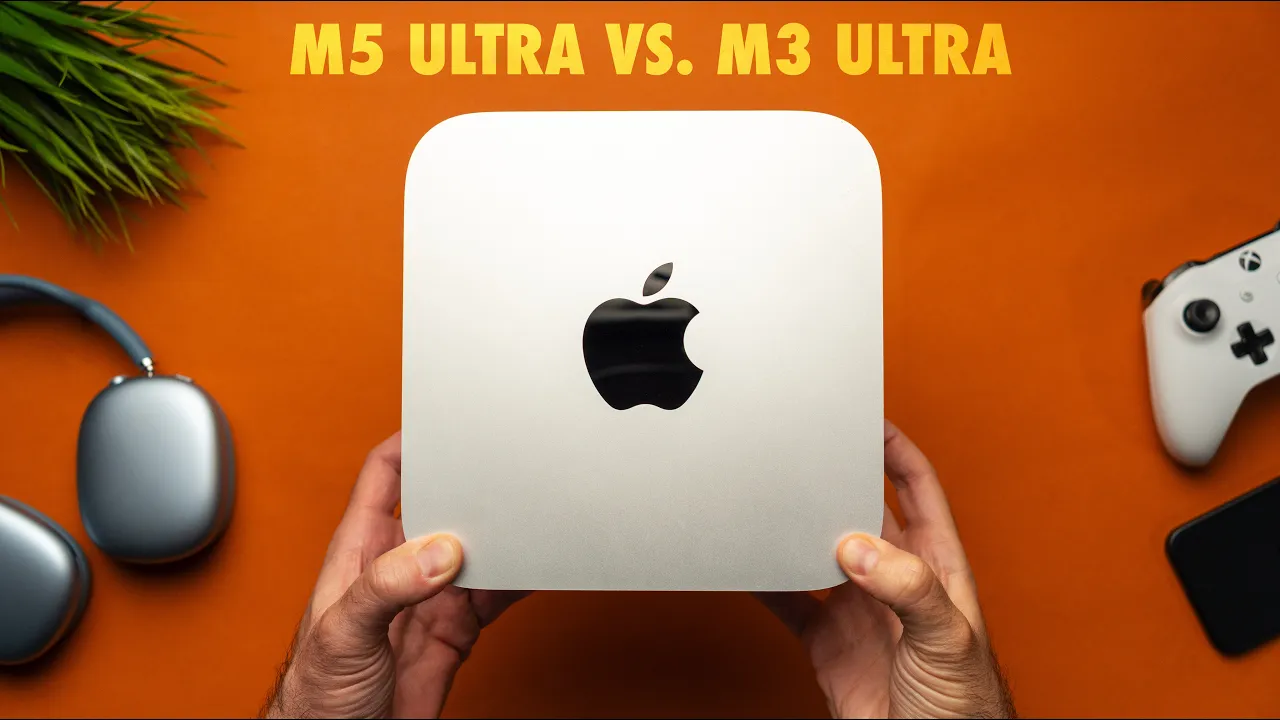
Apple Undersold Their Own Chip: M5 Ultra vs M3 Ultra transcript
Matthew Moniz · @MatthewMoniz
Words
2,064
Runtime
12:03
Speaking pace
171wpm
Reading time
9min
171 words per minute, between the 160 25th percentile and the 181 median of 349 measured videos. That distribution comes from the 349-video hook study.
Opening (first 30 seconds)
This is the new Mac Studio with the M5 Ultra. And the one in front of me is $12,299. Like, this thing is completely stacked with $256 GB of unified memory. And look, they do start at $5,500 US, but if you want maximum performance with the full amount of cores, you have to pay for it. At this price, there's really only one big question that I have. Do Apple's numbers hold up? Because they look super impressive? Because they made three big claims. They
86 words, the words spoken in the first 30 seconds at 171 words per minute.
Sentence shape
| Measure | This transcript |
|---|---|
| Sentences | 178 |
| Average words per sentence | 11.6 |
| Longest sentence | 40 words |
| Questions asked | 7 |
| Sentences containing a number | 92 |
Most used terms
- ultra58
- m527
- m324
- m3 ultra22
- m5 ultra21
- times19
- cores15
- apple14
- performance11
- big10
- generation9
- memory9
Filler phrases
30 in total: like 22 · actually 6 · basically 1 · right? 1.
A literal whole-word count of the same phrase list the Prepublish browser extension uses, so a phrase inside another word is not counted and a phrase used in its ordinary sense still is. It is a count and not a judgement.
What this transcript is
Every word below is the caption track YouTube publishes for this video, pulled from the video itself and reproduced unchanged. It is not Prepublish's writing, not a summary, and not a re-transcription: it is the video's own published captions. English captions, generated automatically by YouTube, in the video’s original language. Source: the video on YouTube. A channel that would rather this page did not exist can ask for its removal through the contact page, and it is removed.
Transcript
This is the new Mac Studio with the M5 Ultra. And the one in front of me is $12,299. Like, this thing is completely stacked with $256 GB of unified memory. And look, they do start at $5,500 US, but if you want maximum performance with the full amount of cores, you have to pay for it. At this price, there's really only one big question that I have. Do Apple's numbers hold up? Because they look super impressive? Because they made three big claims.
They said 1.3 times the multi-core performance of the M3 Ultra, up to 1.8 times the graphics and 4.3 times the AI performance. Now, I checked. I ran 15 benchmarks and a lot of testing with real life world examples. I included six machines, the M1, the M2, the M3 Ultra, and an M5 Max MacBook Pro along with a PC with an RTX 5080. But the big question before I begin is what's actually different compared to the M3 Ultra Max Studio?
Because on paper they look pretty close, right? Like same amount of GPU cores and same 512 GB memory ceiling, but underneath it's a completely different design. Every Ultra chip Apple has ever made was two Max chips fused together. Take a Max, glue two of them with something called Ultra Fusion, and Mac OS sees one big chip. The M5 Ultra is four dyes. The M5 Max itself is two dyes. So the Ultra is two of those fused, four dieseS, one processor as far as the software is concerned.
Now Apple's calling it the first quad M series chip, which is a remarkable achievement because the second you have four diese, you've got four pools of memory, all pretending to be one. Ultra Fusion on the M3 Ultra moved about 2.5 tab a second between diese. On the M5 Ultra, it's 4.4 with six times the connection density. Now, memory bandwidth went from 819 GB per second to 1.2 TB. That's 50%. But we got to start with the CPU.
And I do want to talk about the cores because the M3 Ultra has 32 cores, 24 performance, 8 efficiency. The M5 Ultra increases it to 36 [music] cores, 12 super cores, 24 performance. Now, Apple renamed the tiers. The big ones are super cores now, but look at what happened to the small ones. There are 24 of them now. Apple isn't calling them efficiency cores anymore. 12 1.5% more cores total, but the little cores got a serious buff.
Also, every GPU core now has a neural accelerator inside of it. This is the first time for an Ultra, but look, you're going to have a hard time telling them apart. Like, when you put these things beside each other, they're 3.7 in tall, 7.7 by 7.7 in. So, what actually changed? Well, Wi-Fi 6E became Wi-Fi 7. Bluetooth 5.3 became Bluetooth 6. And the SSD modules are now Gen 6. And honestly, that's the point. Like, if you've got a rack of these, every mount, every dock, every cable [music] you run will already work.
Like, nothing needs to change about your setup. But we got to start with the CPU because this is where single core performance changes [music] every new year. In Cinebench R26, the M3 Ultra scored 577. The M5 Ultra 752. That's 1.3 times. Apple claimed 1.25. So even better. Now when it comes to multicore, M3 Ultra 10,425, M5 Ultra 17,943. This is the fastest multi-core speed I've recorded in my studio so far. That's 1.72 times faster.
Apple said 1.3. And here's my best explanation, and it's the core thing from earlier. Going from 32 cores to 36 is 12 a.5%. That does not get you 72% more performance. What that gets you there is 8 week efficiency cores turning into 12 real ones. Apple didn't add cores, they replaced some of them with better ones. Now, I also ran a Firefox compile M5 Ultra 6 minutes, M3 Ultra 5. These runs are accurate, but the spread across all six machines here is tight enough that I'd call it a margin of error.
Compiling leans on disc speed and single thread and how well the build paralyzes as much as it does on core count. But when it comes to games, performance was super interesting. Like using 3D Mark Steel Nomad, the M3 Ultra scored 5532. The M5 Ultra 8,073 about 1.46 times. Now against the M1 Ultra, and I know a lot of you are still on that one, that's 2 and 1/2 times faster. Now, Blender is where things get silly. Like three scenes, monster, junk shop, and classroom.
The M5 Ultra is 1.67 times, 1.78, and 1.84 faster than the M3 Ultra, depending on the scene. Against the M1 Ultra, it's 8 times faster. Eight. Like, that's incredible. Like, if you render for a living, this is a big jump. Now, specific to gaming, and I want to be careful here because this is where Mac coverage usually doesn't do well as the PC market, but I'm pretty sure most people are not buying a $12,000 computer to strictly game.
But if you're curious, Cyberpunk 2077, M1 Ultra, 74 FPS, M3 Ultra, 108. And again, the M5 Ultra 166 FPS. So 1.54 times the M3 and 2.2 times the M1. This is all using Apple's Metal Effects upscaling with settings set to high and frame generation off. The PC is using DLSS to stay comparable. Then I ran Crimson Desert 2560 by440. Frame generation off. Now I'm not going to say that twice because a lot of the numbers floating around right now have Frame Gen switched on around 60 frames per second and it held it ran smooth and it ran well.
Now we got to talk about more popular apps that most people use and I want to start with Premier Pro. In Pug Bench, the M3 Ultra scored 180,370. The M5 Ultra 234,912. That's 1.3 times exactly what Apple is advertising. Photoshop is a bit different. 14,815 to 18,360 on the M5 Ultra. Only 1.24 times, but Photoshop generally focuses on a lot of RAM, SSD speeds, but either way, it's extremely fast. Then we got to talk about Da Vinci Resolve.
And this one actually surprised me. Now, my render test, the M3 Ultra, 5 minutes 36 seconds. My timeline is composed of 4K Sony footage, ProRes, color correction, HEIC photos, and generators. M5 Ultra did it the fastest in 4 minutes and 54 seconds. That's 14% faster. Now, there's always one section on this timeline that would slow down my M3 Ultra when scrubbing through the HEIC photo section on top of Da Vinci Resolve generators, and that's no longer the case with the M5 Ultra.
It scrubs perfectly now. But now we have to talk about AI or running language models locally. Like this is the section this machine was heavily being advertised for. Apple's headline claim was 4.3 times the AI performance of the M3 Ultra. And that's a big number, like a really big number. And I had to test this in three different ways to see if this was actually correct. Test one was time to first token on a 70 billion parameter model.
I made sure everything was equal across the board. 800 token limit 32,768 context window. Okay, for those of you unfamiliar with time to token, like this is the pause after you hit enter and before it starts writing things on the screen. Okay, this is like important. This is prompt generation. And the M3 Ultra scored 31.6 seconds. The M5 Ultra 7.7 seconds. That's 4.1 times. Apple said 4.3. A little lower, but still within a margin of error.
Now, the PC in this comparison does have an RTX 5080. On that 70 billion model, it took 30 seconds to its first token, slower than a 3-year-old M3 Ultra. Now, this is not because the GPU is slow. It's because the model doesn't fit in 16 GB of VRAM. So, it's crawling across the PCIe bus into system memory. That's the whole unified memory argument. It's not that Apple's faster. is that at this model size, the fast card doesn't have the capacity to compete with all that unified memory.
And with Apple increasing the speeds every generation, these Mac Studios keep becoming more compelling for local AI models. Now, in test 2, actually generating the text on a smaller 8 billion parameter model. The M3 Ultra did it with 129 tokens a second. The M5 Ultra 188. That's 1.45 times. Not 4.3. not even close to 4.3. Now, they're measuring two completely different problems. And this is the bit worth understanding because it decides whether this machine is worth it for you.
Like, when the model reads your prompt, it's processing hundreds or thousands of tokens all at once. Exactly what those new neural accelerators in every GPU core were built for. So, they fire them and you get four times. When it writes the answer back, it's doing one token at a time. And for every single token, it has to read the entire model out of memory. all 40 GB of it. The mass per token is almost nothing. The GPU spends most of its life just waiting for weights [music] to arrive.
So, generation doesn't care how much compute you bolt on. It cares about memory bandwidth. Bandwidth went up 50%. Generation went up 45%. So, here's the thing. Like, if you throw huge prompts at local models, whole documents, entire code bases, rag pipelines, long context, this machine is amazing. 31 seconds down to 7.7 changes the way you work. Now, if you're just chatting back and forth with a small model, it's faster, which is nice, but you have to ask yourself, is it worth upgrading from an M3 or M2 Ultra?
Now, I also wanted to test image generation using SDXL and Draw Things. It went from 21.6 seconds down to 9.45 on the M5 Ultra. That's 2.29 times faster. And finally, I had to test it. The SSD speeds. Okay, this was a big update. The M3 Ultra about 7100 read, 8,000 right. M5 Ultra 14,800 read, nearly 19,000 right. Roughly double the read and write speed compared to the previous generation. That's all the PCIe Gen 6 doing work inside of this machine.
So look, if you're pulling 8K media off internal storage all day long, that double the SSD speeds is pretty nice. And I do want to talk about browser performance, the most boring part of this test that I ran. And look in speedometer, the M2 Ultra 37.4, the M3 Ultra 40, pretty darn close. But the M5 Ultra scored 57, and the M5 Max just a little bit lower, like 4% of the Ultra. The improvement is basically the M5 generation.
So, the big question is who is this actually for? Well, that's hard to answer. It really depends on what you're doing. If you're just doing regular content creation, editing videos, upgrading from an M3 Ultra is definitely not worth it. I feel like if you're coming from an M1 Ultra or an M2 Ultra, you're really focused on AI or anything that requires a lot of GPU cores, this is a massive upgrade. The performance of this M5 Ultra is incredible.
And the thing that I'd even talk about early in the video is that like the power requirements from this thing is so low. Like it just doesn't burn as much power as bigger desktop PCs. That's what always amazes me about this product. It's quiet. It's powerful and it's energy efficient. And if you're coming from an M1 Ultra, M2 Ultra, even M3 Ultra, depending on what you're doing, you're going to absolutely love this thing.
Now, if you're just stepping into the Mac Studio world, I highly suggest the M5 Max. Like, the M5 Max has those Nural Accelerators, plus the GPU cores are really good, and I feel like for most people, that's the skew you should probably buy. Anyways, that wraps up my full video on the Mac Studio with M5 Ultra. If you have any questions, let me know in the comment section down below. Like the video if you liked it. Subscribe if you haven't already.
The words are the caption track's own and nothing is reworded or re-transcribed. Paragraph breaks are placed between sentences so the text reads as prose.
Use this transcript
Three free tools that work on the material around a video like this one. No signup, no login.
Hook Analyzer
Paste the first 30 seconds of your own draft for a hook score and rewrites.
Policy Pre-Flight
Check your draft against YouTube's advertiser-friendly guidelines before you record it.
Channel Skill Generator
Read this channel's public videos and transcripts, and download a writing brief for it.