Getting the transcript
Reading the captions from YouTube. A video nobody has opened here before takes 10 to 30 seconds; this page fills in on its own.
Getting the transcript
Reading the captions from YouTube. A video nobody has opened here before takes 10 to 30 seconds; this page fills in on its own.
UnordinaryMind · @unordinarymind
Where viewers went back to watch this video again, from YouTube's public Most replayed graph, lined up with what was said at that moment.
Most replayed moment #1
6:214.0x the video's typical replay level
It is a simple Mechanical action But over time That weak muscle becomes strong enough to carry you through the long Boring plateaus That is how a Dabbler becomes a Master Now I need to make space for a very important distinction
Said at 6:14
Most replayed moment #2
3:393.5x the video's typical replay level
We often talk about "grit" or "willpower" as if they are magical character traits You either have them or you don't But neuroscience shows that tenacity is physical It lives in a specific brain region called the Anterior Midcingulate Cortex
Said at 3:33
Most replayed moment #3
7:242.7x the video's typical replay level
And you need Gamification Adding artificial rewards to replace the missing dopamine As I mentioned in my previous video on Job Crafting You need to engineer your environment to support your brain
Said at 7:19
The graph counts replays. It does not show where viewers stopped watching.
Words
1,647
Runtime
10:24
Speaking pace
158wpm
Reading time
7min
158 words per minute, below the 160 25th percentile of 349 measured videos. That distribution comes from the 349-video hook study.
Opening (first 30 seconds)
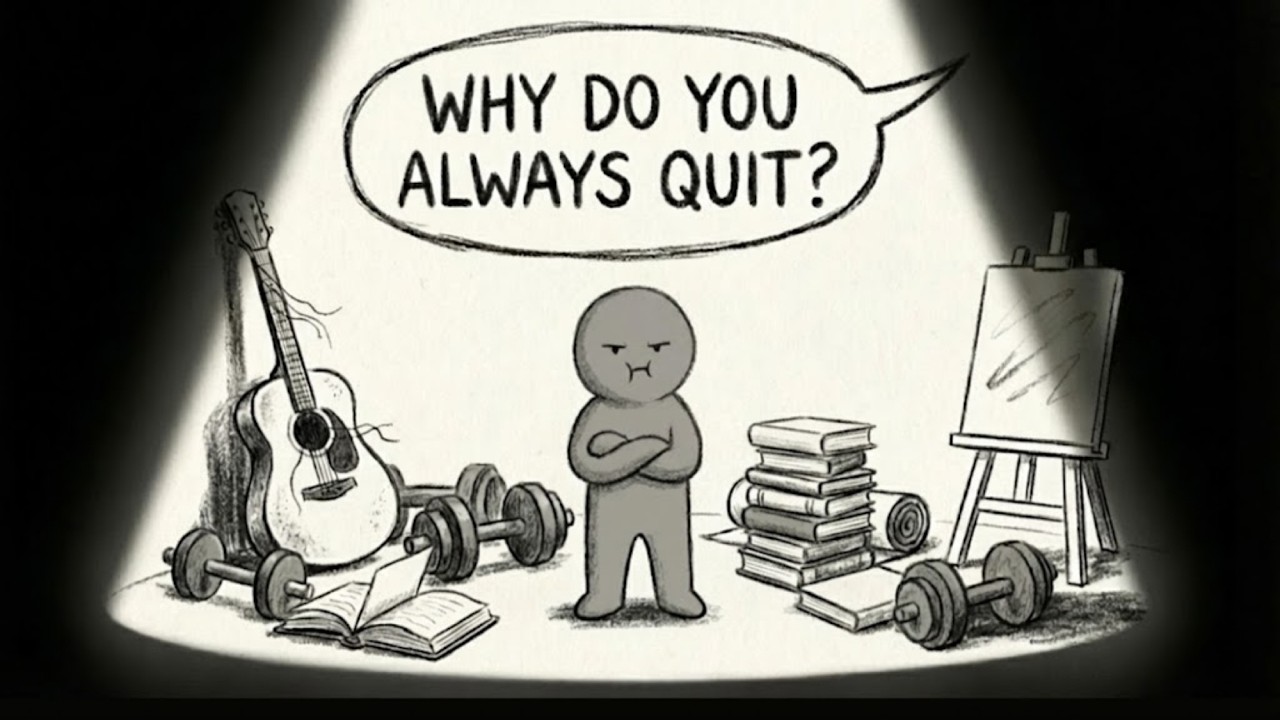
You probably have a graveyard in your house Maybe it is a dusty guitar in the corner that you haven't touched in months A stack of language books you bought with so much hope but barely opened Or a half-finished coding project sitting on your laptop And every time you look at them You feel a little twinge of guilt Society has a lot of names for this They call it "flaky". They call it "lacking grit". Or the
79 words, the words spoken in the first 30 seconds at 158 words per minute.
Free, no signup. See how the first 30 seconds hold attention, with rewrites.
Sentence shape
| Measure | This transcript |
|---|---|
| Sentences | 16 |
| Average words per sentence | 102.9 |
| Longest sentence | 355 words |
| Questions asked | 5 |
| Sentences containing a number | 3 |
Most used terms
Filler phrases
13 in total: like 10 · actually 2 · you know 1.
A literal whole-word count of the same phrase list the Prepublish browser extension uses, so a phrase inside another word is not counted and a phrase used in its ordinary sense still is. It is a count and not a judgement.
What this transcript is
Every word below is the caption track YouTube publishes for this video, pulled from the video itself and reproduced unchanged. It is not Prepublish's writing, not a summary, and not a re-transcription: it is the video's own published captions. English captions, published by the channel, in the video’s original language. Source: the video on YouTube. A channel that would rather this page did not exist can ask for its removal through the contact page, and it is removed.
You probably have a graveyard in your house Maybe it is a dusty guitar in the corner that you haven't touched in months A stack of language books you bought with so much hope but barely opened Or a half-finished coding project sitting on your laptop And every time you look at them You feel a little twinge of guilt Society has a lot of names for this They call it "flaky". They call it "lacking grit". Or the most famous one: "Jack of all trades Master of none".
The narrative is always the same You start with intense passion You consume the information greedily And you feel like this is finally "the one". And then Right when things get serious The feeling evaporates You get bored You quit And you move on to the next shiny thing After a few years of this cycle The self-blame sets in You look at your track record and ask "Why can't I just stick to something? Why do I always give up?".
But today I want to offer you a different perspective One that is a little kinder And a lot more scientific It is easy to feel like being a "Dabbler" is a defect But you actually share the exact same foundation as a genius Polymath You possess the "Knowledge Instinct". You have a high drive for novelty and curiosity The difference between you and a master isn't your personality It is your strategy It comes down to the conditioning of a specific part of your brain But to unlock that potential We need to understand the glitch that makes you quit too early Let’s start by looking at how your brain handles new information Cognitive scientists call this the Knowledge Instinct Which is the drive to reduce uncertainty But your brain is wired differently It cares less about having the knowledge And more about the speed of acquiring it Your brain is highly sensitive to what researchers call Reward Prediction Error Here is what that feels like When you start learning something new Say Photography Everything is novel The learning curve is steep You go from knowing nothing to knowing something very quickly Because the rate of information gain is massive Your brain floods you with dopamine It feels like falling in love The world is full of possibility But this is a trap This is the Novice High Then You reach a point where you understand the core logic You know how the camera works You understand exposure Suddenly The novelty drops The learning curve flattens You enter The Plateau And for your specific brain type That means the dopamine shuts off immediately This is the fork in the road A Master pushes through this plateau because they are looking for a deeper pattern But a Dabbler quits here We often call this laziness But true laziness is a refusal to act You aren't refusing to act You are refusing to act without fuel Your brain is going through dopamine withdrawal Your subconscious realizes the energy required to learn this final twenty percent is no longer worth the reward So you stop But we need to have an honest moment here A brutal reality check Are you quitting because you truly mastered the skill?
Or are you quitting because it got hard? A Dabbler quits because they hit the first obstacle Their ego takes a hit And they run away That is just fear And the reason you give in to that fear is because a specific "muscle" in your brain is weak We often talk about "grit" or "willpower" as if they are magical character traits You either have them or you don't But neuroscience shows that tenacity is physical It lives in a specific brain region called the Anterior Midcingulate Cortex Or aMCC You can simply think of the aMCC as a muscle inside your head Research shows that this area engages when you do something that you do not want to do If you love the task The aMCC sleeps If you hate the task but do it anyway The aMCC fires If you let this muscle bear weight It grows If you don't use it It shrinks For a Dabbler The aMCC is often like a weak muscle that cannot even lift a water bottle Every time you felt a moment of boredom or frustration in the past You quit You put the weight down So now Even a tiny inconvenience Like a difficult chapter in a book or a confusing line of code Is enough to trigger a "give up" decision It’s like asking someone who has never run to suddenly sprint a marathon Of course you collapse This feeling of weakness isn't a moral failing It is muscle atrophy But the good news is that this brain region is plastic It can grow at any age Studies on "Superagers".
Older adults who maintain incredible cognitive function Show that they have aMCCs that are just as thick as young people Why? Because they spent a lifetime overcoming challenges They kept lifting the weight So Even if you are young Your "willpower muscle" might be weaker than a seventy-year-old who has lived a hard life How do we fix this? We need to send your aMCC to the gym But be gentle with yourself Just like a real gym You don't walk in and try to deadlift 500 pounds You will get injured and quit You need progressive overload The rule is the 15% Push When you are practicing your new hobby And you feel that familiar urge to quit That moment when the dopamine fades and the frustration starts Do not quit immediately But also Do not try to force yourself to work for another four hours That is too heavy Just push for 15 percent more If you planned to read 10 pages and you want to stop at page 3 Read to page 4 Then stop That tiny gap That small moment of doing what you did not want to do Is the rep That is how you thicken the aMCC It is a simple Mechanical action But over time That weak muscle becomes strong enough to carry you through the long Boring plateaus That is how a Dabbler becomes a Master Now I need to make space for a very important distinction Some of you watching this might have ADHD And for you The advice is different If you have ADHD Your dopamine system and executive function work differently Trying to simply "willpower" your way through the plateau using the aMCC strategy alone can sometimes be ineffective Or even harmful It can lead to burnout and shame For the ADHD brain You don't just need internal grit You need external scaffolding You need Task Visualization Breaking the project down into tiny Visible steps so you can see the progress You need Time Visualization Using timers so you don't feel trapped in an endless task You need Body Doubling Working alongside someone else to borrow their focus And you need Gamification Adding artificial rewards to replace the missing dopamine As I mentioned in my previous video on Job Crafting You need to engineer your environment to support your brain If you suspect you have ADHD Please use these external tools to assist your aMCC Rather than just blaming yourself for being "weak".
There is one final barrier we need to address Boredom Intolerance The reason the "Plateau" feels so painful is that your baseline for stimulation is too high We live in a world of Supernormal Stimuli TikTok Instagram Sugar Video games These things flood your brain with effortless dopamine Compared to a 15-second video Learning a language or practicing an instrument feels incredibly slow and boring Your brain is calibrated to high-intensity noise So when you try to do the quiet work of mastery You feel like you are suffocating You need to actively treat this Boredom Intolerance You need a Dopamine Reset This doesn't mean living like a monk It means practicing Stimulus Control during your work sessions When you are engaging in your hobby Put the phone in another room Turn off the music Allow yourself to feel the boredom We usually see boredom as a sign to quit But actually Boredom is the "clean slate" required for deep encoding It is the feeling of your brain shifting gears from "consumption" to "creation".
If you can lower the background noise of your life The signal of your new skill will become clear again So here is my proposal for you We are approaching a fresh start I want you to give yourself a 6 Month Challenge Pick one interest Just one It doesn't have to be your career It can be anything And commit to sticking with it for six months Forget about becoming a world expert The aim here is simply to experience the Deliberate Practice phase Your goal is to hit the plateau Feel the drop in dopamine Feel the weakness of your aMCC And then do the work anyway Use the "15% Push".
Train that muscle Find your baseline Once you prove to yourself that you can push through the dip You will unlock a new identity You will realize that the label of "Dabbler" was temporary You are evolving into a Polymath in training And once you have built that muscle You will be ready for the next step But for now Download the free guide in the description It has the "Interest Audit" and the specific protocols to train your aMCC Pick your one thing Lift the weight In the next video We are going to talk about The Polymath Strategy We will discuss how to structure a career that honors all your different interests Instead of forcing you to pick just one I will see you in the next one
The words are the caption track's own and nothing is reworded or re-transcribed. Paragraph breaks are placed between sentences so the text reads as prose.
Free tools for your own script. No signup, no login.
Paste your draft and see where viewers are likely to drop off, with a rewrite for each weak line.
Paste the first 30 seconds of your own draft for a hook score and rewrites.
Check your draft against YouTube's advertiser-friendly guidelines before you record it.
Read this channel's public videos and transcripts, and download a writing brief for it.