Getting the transcript
Reading the captions from YouTube. A video nobody has opened here before takes 10 to 30 seconds; this page fills in on its own.
Getting the transcript
Reading the captions from YouTube. A video nobody has opened here before takes 10 to 30 seconds; this page fills in on its own.
HazeInk · @Haze-ink
Words
833
Runtime
9:17
Speaking pace
90wpm
Reading time
3min
90 words per minute, below the 160 25th percentile of 349 measured videos. That distribution comes from the 349-video hook study.
Opening (first 30 seconds)
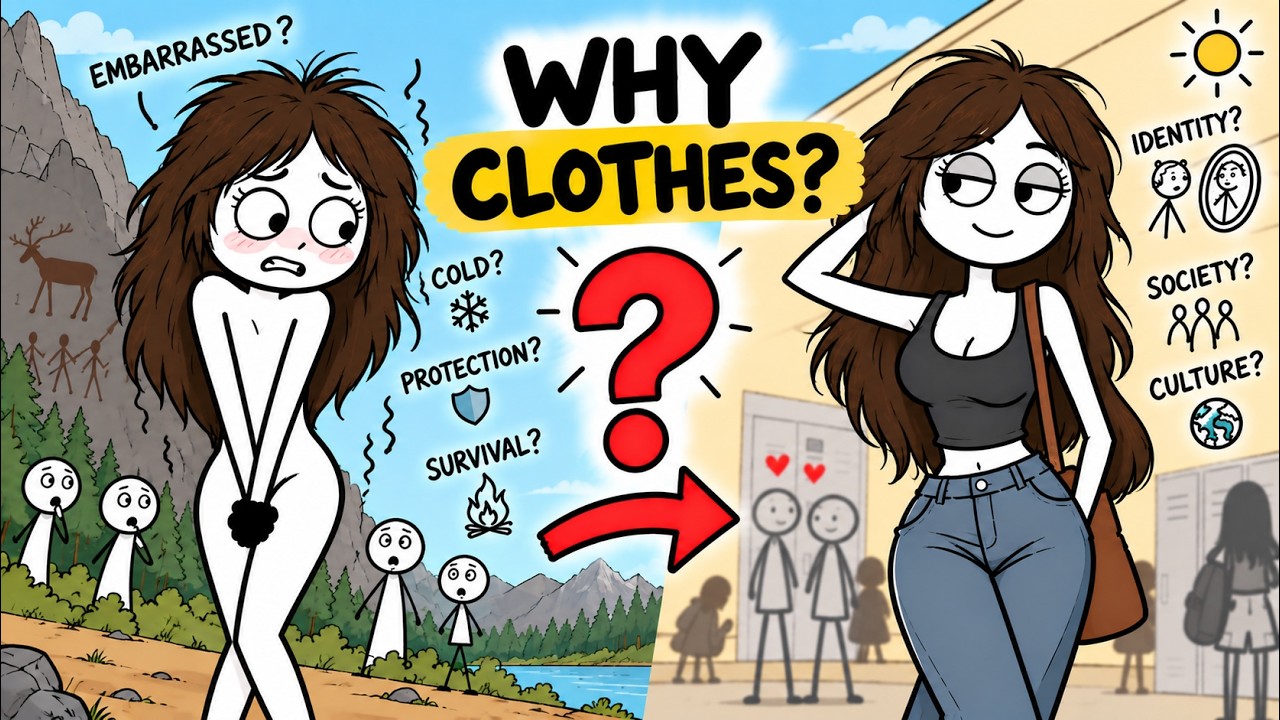
Have you ever wondered why only humans wear clothes? Every other animal seems to come with its own protection. Fur. Feathers. Scales. Shells. But humans? We make ours. We create layers of protection and put them on our bodies. So when did humans start doing
45 words, the words spoken in the first 30 seconds at 90 words per minute.
Free, no signup. See how the first 30 seconds hold attention, with rewrites.
Sentence shape
| Measure | This transcript |
|---|---|
| Sentences | 106 |
| Average words per sentence | 7.9 |
| Longest sentence | 24 words |
| Questions asked | 9 |
| Sentences containing a number | 2 |
Most used terms
What this transcript is
Every word below is the caption track YouTube publishes for this video, pulled from the video itself and reproduced unchanged. It is not Prepublish's writing, not a summary, and not a re-transcription: it is the video's own published captions. English captions, published by the channel, in the video’s original language. Source: the video on YouTube. A channel that would rather this page did not exist can ask for its removal through the contact page, and it is removed.
No Script X-ray for this video: YouTube shows a Most replayed graph only once a video has enough views.
Have you ever wondered why only humans wear clothes? Every other animal seems to come with its own protection. Fur. Feathers. Scales. Shells. But humans? We make ours. We create layers of protection and put them on our bodies. So when did humans start doing this? And more importantly, why did we need clothes in the first place? The strange thing is that the first clothes are almost impossible to find. Stone tools can survive for tens of thousands of years.
Clothing usually can't. Animal skins decay. Plant fibers break down. Wood disappears. So the first garments humans ever made may have left almost no trace. Instead, scientists have to follow the clues that survived. And one of the strangest comes from a tiny parasite. Lice. Head lice live mainly in human hair. Body lice are different. They are closely associated with clothing. That gives scientists an unusual clue. By comparing the genetics of head and body lice, researchers have tried to estimate when body lice first became distinct.
The dates are uncertain, but some studies place the split surprisingly far back in human history. So clothing may have appeared long before agriculture, cities, or writing. But why? The obvious answer is cold. And cold was certainly important. As humans moved into colder environments, an extra layer around the body would have been extremely useful. But clothing probably solved more than one problem. Think about the world our ancestors lived in.
There were no houses with sealed windows. No modern shoes. No sunscreen. No insect repellent. A person moving through grasslands or forests was exposed to almost everything around them. A covering could reduce heat loss at night. It could protect skin from sunlight. It could limit some insect exposure. And it could offer protection from rough vegetation and the environment. Animal skins could also be used for bedding, coverings, bags, and parts of shelters.
So clothing probably wasn't one invention designed to solve one specific problem. It was part of a much larger technological toolkit. And that's where the story gets interesting. Because humans have a very unusual way of adapting to the world. Most animals adapt mainly through their bodies. Over many generations, natural selection can favor physical traits that help a species survive a particular environment. Humans found another option.
We could change what existed outside our bodies. Instead of growing thicker insulation, we could make it. Instead of relying only on our feet, we could protect them. Instead of finding natural shelter, we could build it. Clothing is one example of this larger pattern. But then another mystery appears. Why did humans become so dependent on external protection in the first place? Part of the answer may be written on our own bodies.
Humans have much less dense body hair than many other mammals. Exactly why we lost so much of it is still debated. One possibility is that reduced body hair helped our ancestors lose heat more efficiently, especially alongside our ability to sweat. That could have been useful in hot environments and during prolonged activity. But there was a trade-off. A body that can lose heat efficiently can also lose heat quickly when temperatures fall.
Clothing offered a simple solution. Instead of evolving a completely new layer of fur, humans could make one. And unlike fur, clothing had a major advantage. It could be changed. Too warm? Remove a layer. Too cold? Add one. Different environment? Use different materials. That flexibility was incredibly useful. Our bodies didn't have to be perfectly suited to every place we entered. We could carry part of the solution with us.
And that mattered as humans spread across the planet. Hot regions presented one set of challenges. Cold regions presented another. Wet environments created different problems again. Humans could respond with technology. And some of the oldest evidence suggests this was happening surprisingly early. At Contrebandiers Cave in Morocco, researchers found specialized bone tools dating to roughly 90,000 to 120,000 years ago.
Their wear patterns suggest they were used to process animal hides. Researchers also found carnivore bones with marks consistent with skin removal. Together, these findings provide some of the oldest evidence that humans were systematically processing hides and fur, probably for clothing, around 120,000 years ago. But notice what we don't have. We don't have a preserved prehistoric jacket. We have the tools used to make one.
We have marks left on bones. We have genetic clues from parasites. And we have evidence from the environments humans managed to live in. Piece by piece, the picture begins to emerge. But clothing didn't remain only a survival tool. Eventually, it became part of human culture. Humans have long used objects to communicate. We decorate our bodies. We use colors and patterns. We wear objects that tell others something about us.
As clothing became more complex, it could carry meaning too. It could show where someone came from. Which group they belonged to. What traditions they followed. And, eventually, their social position.
The words are the caption track's own and nothing is reworded or re-transcribed. Paragraph breaks are placed between sentences so the text reads as prose.
Free tools for your own script. No signup, no login.
Paste your draft and see where viewers are likely to drop off, with a rewrite for each weak line.
Paste the first 30 seconds of your own draft for a hook score and rewrites.
Check your draft against YouTube's advertiser-friendly guidelines before you record it.
Read this channel's public videos and transcripts, and download a writing brief for it.