Targeting the Vim by Jeff Elias transcript
Stereotactic Academy · @StereotacticAcademy
Words
1,608
Runtime
15:30
Speaking pace
104wpm
Reading time
7min
104 words per minute, below the 160 25th percentile of 349 measured videos. That distribution comes from the 349-video hook study.
Opening (first 30 seconds)
hello I'm Jeff Elias from the University of Virginia and I would like to welcome you to this video course dedicated to targeting the VI M nucleus of the thalamus the VI M may be one of the most targeted regions of the brain for stereotactic surgery and it's been used with
52 words, the words spoken in the first 30 seconds at 104 words per minute.
Sentence shape
| Measure | This transcript |
|---|---|
| Sentences | 1 |
| Average words per sentence | 1608.0 |
| Longest sentence | 1,608 words |
| Questions asked | 0 |
| Sentences containing a number | 1 |
Most used terms
- vi24
- region18
- targeting17
- ventral12
- different11
- regions10
- based9
- tremor9
- anterior8
- lateral8
- stereotactic8
- thalamic8
Filler phrases
3 in total: like 3.
A literal whole-word count of the same phrase list the Prepublish browser extension uses, so a phrase inside another word is not counted and a phrase used in its ordinary sense still is. It is a count and not a judgement.
What this transcript is
Every word below is the caption track YouTube publishes for this video, pulled from the video itself and reproduced unchanged. It is not Prepublish's writing, not a summary, and not a re-transcription: it is the video's own published captions. English captions, generated automatically by YouTube, in the video’s original language. Source: the video on YouTube. A channel that would rather this page did not exist can ask for its removal through the contact page, and it is removed.
Transcript
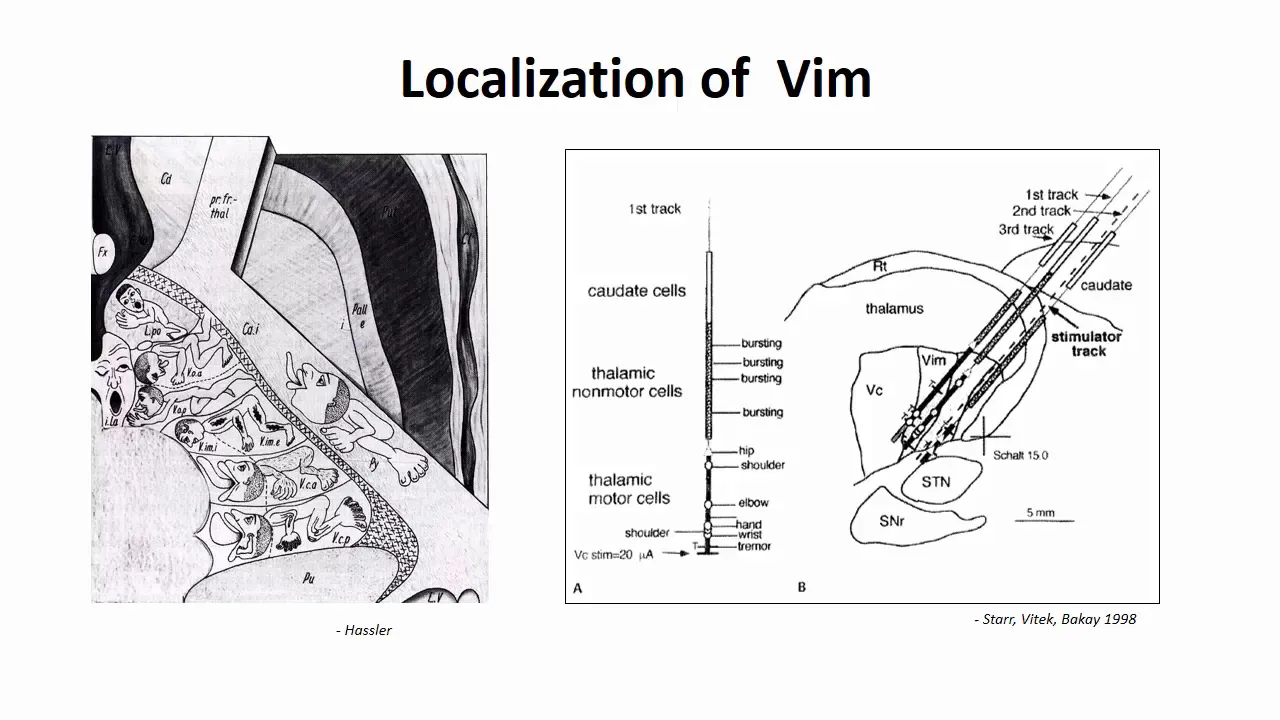
hello I'm Jeff Elias from the University of Virginia and I would like to welcome you to this video course dedicated to targeting the VI M nucleus of the thalamus the VI M may be one of the most targeted regions of the brain for stereotactic surgery and it's been used with a variety of different techniques including deep brain stimulation and lesioning techniques the focuses of this course however will be aimed toward the understanding of the targeting process and not for the different procedures used to manage tremor why would we target the VI M first and most importantly the VI M is a very powerful region of brain to control and manage tremor there's now long history and experience of over 50 years targeting this region and it's proven relatively safe with a variety of different procedures including stimulations infusions and lesioning x' more recently there's a lot of work and research unders undergoing the connectivity of the region which could be used to improve the targeting process and maybe even in a patient specific manner historically there were really two key issues in the 1950s that paved the way for our understanding of the ventral lateral thalamus as a region to manage and treat tremor problems firstly Rolf Hassler and Germany provided seminal work an understanding of the palatal amic tract and a connectivity to the motor thalamus secondly Cooper who pioneered the pallidotomy procedure reviewed 3,300 of his cases in 1959 and found that the ventral lateral thalamic lesions were much more effective in managing tremor than the medial paladin's this paved the way over the next few decades for stare tactic surgery of the ventral lateral thalamus to treat tremor there was a survey in 1985 of some of the international expert functional neurosurgeons around the world to look at the ways that they targeted this region and as you can see from this diagram there was a variety of different regions used to manage trimmer with lesioning but overall many of the leaves many of the lesions were made at roughly three-quarters of length of anterior posterior commissure and between 10 to 15 millimeters lateral of the midline and this helped our understanding of the VI M region for targeting and especially as we entered an era of deep brain stimulation shortly thereafter the focus of the course today is really threefold firstly we'll review the VI M nucleus with it's a anatomical and connectivity issues secondly we'll talk about the different methods for targeting the region and lastly I'll review our technique for targeting VI M with indirect methods the ventral is intermedius or ventral intermediate nucleus of the thalamus is named because of its location intermediately between the motor and sensory regions of the thalamus in the ventral lateral thalamic tier this nucleus is an hourglass shaped nucleus as you can see in the sagittal section on the right it's roughly eight to nine millimeters in height and eight to nine millimeters in width as seen on the axial section these three ventrolateral thalamic regions receive different types of afferent information and project to different F efferent regions there's the motor region receiving basal ganglia inputs and projecting to motor regions of the cortex the somatosensory region depicted in blue receives sensory region sensory information from the spinal cord and projects the primary sensory areas and our VI M nucleus receives primarily kinesthetic information from the cerebellum and spinal cord and then projects to primary motor regions the trimmer circuit is classically recognized as the dentate o rubra thalamic tract localization of the VI M is based on clinical and electrophysiological observations first on the left just as Hassler proposed in the 1950s there's a semana toppy of the VI M region much like the somatosensory region posterior Li located to it with the mouth being located medially the hand intermediately and a leg laterally toward the internal capsule on the right we can see a sagittal section where microelectrode recordings are used to map the region bursting neurons in the VI M can be recorded and sometimes they're synchronously firing with the tremor and term tremor cells their kinesthetic neurons recorded here that may respond to passive joint movements micro stimulation can be used to identify the ventral is called Alice nucleus bounding the V impost ear Lee in stereotactic surgery we think of targeting based on indirect or direct methods the indirect method is primarily used based on the internal landmark of the anterior and posterior Mercer or the commercial line this line was proposed by Tala tract in 1957 and really represented an internal reference point that is relatively standard across humans prior to Tala acts proposal of the a CPC line most stereotactic procedures were based on external landmarks on the scalp and skull direct stereotactic targeting involves visualization of the stereotactic region or target with mr imaging the VI M has been proposed for direct stare tactic visualization or targeting as MRI continues to improve and we're obtaining high-resolution images here's a seven Tesla susceptibility weighted image which shows some of the different cellular density of the ventral lateral thalamus and this has been proposed as a method for direct targeting of the VI M but I think we should be cautious about direct targeting or visualization the VI m as histological studies have shown that there really no discrete or specific nuclear boundaries of the ventral lateral region there certainly is of differences in cellular size and density but no specific nuclear boundaries and that is why people have proposed connectivity as an ideal way to target the VI M with diffusion tensor imaging seed regions can be designated and we can identify areas that are strongly or weakly connected to these regions and this has been used extensively to segment the Salamis and especially the ventral ventral lateral thalamic region and there'll be more and more investigation in this area as to the real ideal connectivity patterns that match the VI M others have proposed using tractography from diffusion tensor imaging to identify the dentate rubra thalamic tract or the medial lemniscus or internal capsule that bounds the VI m the VI M is really one of the primary stereotactic targets for indirect stereotactic planning and targeting because as you can see this t1-weighted image in the center section shows that the thalamic architecture and nuclear boundaries are really not evident thus making it amenable to a measurement in relation to the anterior and posterior commissure I've listed our stereotype to coordinate for VI M and I'll discuss it in more detail in the next few slides firstly we'll identify on the sagittal section the anterior post your commissary there's the anterior commissure and the poster commish or at the top of the tag tectum in order to prescribe the rest of the imaging reference imaging in orthogonal planes to the a CPC line next we identify the anterior and push your Comus yours on a single axial slice has been obtained from the sagittal reference and once we've identified that anterior and push your commish ours we draw a line the Commish align and measure it so that we can determine the coordinates for the VI M all right anterior posterior dimension is 3/4 of the commercial line seen in yellow our laterality is 14 point five millimeters from the midline but we sometimes adjust this based on different read different for different reasons in cases of ventricular megali or a large third ventricle we'll plan the laterality ten to eleven millimeters from the large third ventricular wall our dorsal ventral plane or the z axis is really based on the thalamic base and equates to the level of the a CPC plane for planning then there are other considerations that we take into account when doing a procedure based on the type of procedure we're doing and the type of clinical testing that we obtain from the patient sometimes minor adjustments in the V I am targeting are made based on clinical optimization or testing of the original VI M target and they're really two scenarios where we make adjustments one is we want to see optimal trimmer rest at low clinical thresholds of testing and secondly we want to see transient paresthesias that are ideally located in assam and topic region of the hand or more precisely the index finger thumb and corner of the mouth we believe these are really ideal regions of the VI M for tremor rest there are some technical adjustments that will make in the in the VI M targeting based on the modality that we're using for DBS or radiofrequency lesion when we're inserting a probe into the brain will sometimes adjusts are targeting slightly laterally as the probes tend to deviate medially with our system as the tissue is displaced for focused ultrasound lesioning depicted on the far right will sometimes target more medially so that as we enlarge the lesion we have the ability to make a lesion toward the internal capsule and towards the base of the thalamus and then we always obtain post-operative imaging for quality control and to compare our stereotactic precision and process and so I'd like to thank you for joining me for this session on targeting the VM the VI M has been targeted perhaps more than any other region the brain was stared tactic surgery it will probably continue to be targeted and refined over the next several decades and more and more modalities being developed to manage tremor and other disorders thank you
The words are the caption track's own and nothing is reworded or re-transcribed. Paragraph breaks are placed between sentences so the text reads as prose.
Use this transcript
Three free tools that work on the material around a video like this one. No signup, no login.
Hook Analyzer
Paste the first 30 seconds of your own draft for a hook score and rewrites.
Policy Pre-Flight
Check your draft against YouTube's advertiser-friendly guidelines before you record it.
Channel Skill Generator
Read this channel's public videos and transcripts, and download a writing brief for it.