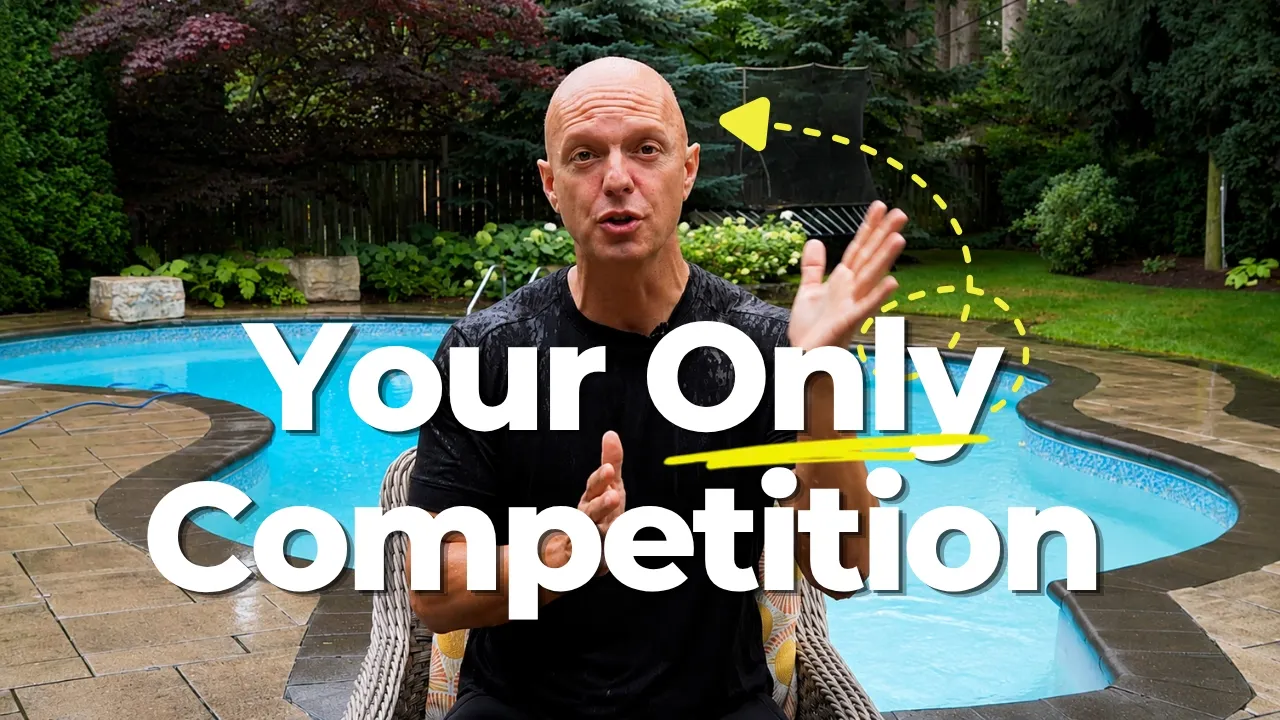
How to Get Ahead of 99% of People in Business transcript
Yuri Elkaim | Healthpreneur · @Healthpreneur
Words
6,734
Runtime
29:49
Speaking pace
226wpm
Reading time
28min
226 words per minute, above the 201 75th percentile of 349 measured videos. That distribution comes from the 349-video hook study.
Opening (first 30 seconds)
I've built two multiple trigger businesses. I've helped thousands of health professionals generate more than $300 million in collective revenue. I'm a New York Times bestselling author and former professional athlete. I don't share any of that to brag with you, but to impress upon you the 10 mindset lessons I'm going to share with you today that will help you succeed in business [music] and quite honestly in every aspect of your life. My name is Jeriel Kim. I'm the CEO and founder of Health Prer. Stick with me and I promise this video will be well worth your time. Let's dive into this. The first mindset that's allowed me to achieve
113 words, the words spoken in the first 30 seconds at 226 words per minute.
Sentence shape
| Measure | This transcript |
|---|---|
| Sentences | 499 |
| Average words per sentence | 13.5 |
| Longest sentence | 125 words |
| Questions asked | 78 |
| Sentences containing a number | 48 |
Most used terms
- people45
- business34
- life26
- okay20
- better14
- number13
- years13
- big11
- focus11
- hours10
- lot10
- school10
Filler phrases
183 in total: like 114 · right? 27 · you know 18 · kind of 11 · actually 4 · I mean 3 · uh 3 · basically 1 · literally 1 · um 1.
A literal whole-word count of the same phrase list the Prepublish browser extension uses, so a phrase inside another word is not counted and a phrase used in its ordinary sense still is. It is a count and not a judgement.
What this transcript is
Every word below is the caption track YouTube publishes for this video, pulled from the video itself and reproduced unchanged. It is not Prepublish's writing, not a summary, and not a re-transcription: it is the video's own published captions. English captions, generated automatically by YouTube, in the video’s original language. Source: the video on YouTube. A channel that would rather this page did not exist can ask for its removal through the contact page, and it is removed.
Transcript
I've built two multiple trigger businesses. I've helped thousands of health professionals generate more than $300 million in collective revenue. I'm a New York Times bestselling author and former professional athlete. I don't share any of that to brag with you, but to impress upon you the 10 mindset lessons I'm going to share with you today that will help you succeed in business [music] and quite honestly in every aspect of your life.
My name is Jeriel Kim. I'm the CEO and founder of Health Prer. Stick with me and I promise this video will be well worth your time. Let's dive into this. The first mindset that's allowed me to achieve a lot of success in life is number one, and I'm just looking at a couple of my notes here. I embrace failure as a stepping stone, not a dead end. [music] I don't look at failure as the end of the world. I look at it as learning.
You're going to fail more in life and in business than you'll succeed. And that's just the reality of it, right? Like most things are not going to work out. Even the best baseball player of all time has a batting average of 386, which means he strikes out six out of 10 [music] times. most best of anything strike out more than they win. And so if you embrace failure as part of the learning process, it's simply a way of getting feedback.
And the faster you fail, quote unquote, the faster you learn. And the faster you learn, the faster you'll earn. The more you learn, the more you'll earn. So don't worry about failure. Like if my kids, you know, they play soccer and I'm like, "Go out there, play free, make mistakes. Who cares? You're going to learn from that. You're going to get better. You're going to build confidence, okay? And it's okay in business if not everything works out.
It's not supposed to. You're going to launch ads that don't work. You're going to write emails that no one responds to. You're going to have sales calls that people say no. It's all good. Just keep moving forward and learn from each of those lessons. Number two is I invest in myself because me, myself, you are your greatest asset. [music] There is no way on this planet that you lose by investing in yourself. [music] And I think there's a lot of people who struggle in business because they're too smart for their own good and they're always thinking about ROI, ROI, ROI.
How's this going to ROI for my business? I'm like, dude, no, no, no, no. The ROI is you you developing yourself and getting better, building your skills, building your capabilities, and building that confidence that comes that like [music] just from being in the field, being in the trenches and and succeeding, right? And that's the ultimate investment. like you went to school maybe maybe you invested like a lot of the practitioners we work with half a million dollars in your education which sounds crazy and then you get into a profession that essentially ends up making you a slave that you can't even get away from that type of job to live a life it's it's kind of crazy but nonetheless outside of school like I went to school for many many years my best investment has always been in myself I've learned more outside of school than I did in school and we're going to continue shooting even as this rain's falling down I don't know if I'm going to get caught in a torrential downpour in my backyard here.
But you know what? I've committed to this video. We're going to see it through. So, when you invest in yourself, no matter if it's a course, a book, a coaching program, anything, just make the most of it because you will become better on the outside of it. Number three, I don't wait for opportunities. I create them. Okay, this is a big one. Don't sit around waiting for things to fall in your lap. Go out there and make them happen. and at the same time give the universe or God or the bigger power whatever you believe in the space to create what it is you know is coming into your world.
The thing here is like most of us if you're like myself we're very type A control freak. We're going to go and create stuff. The problem though is you have to be able to relinquish control of the outcome because you can only force grass to grow so fast, right? I can I can water my grass 24 hours a day and the only thing that's going to happen is I'm going to kill it. So, you have to find that balance of going out and creating opportunities and taking action and knowing what you have control over and also being able to disconnect from whatever the outcome is.
Because here's the thing, the more you force something to happen, the more you are telling energetically the universe that you don't believe it's coming into your world. If you went to a restaurant and you ordered a steak, it takes maybe what 15 20 minutes for the steak to come out. Do you get out of your chair and go to the kitchen every 5 minutes? Hey, where's the steak? Is the steak coming in? Did you get my order?
Where's the steak? No. But if we do that in life, we're essentially saying, "Chef, I don't believe the steak is coming into my into my table." And this is where there's an energetic disconnect between going out and creating opportunities and allowing them to come into your world. But in this whole kind of like spiritual woowoo world, which by the way, I'm a very big a part of in terms of my own belief, a huge pragmatic actionoriented type ae maniac.
And at the same time, the other side. But you can't be just the other side and just like kumbaya allow things to fall into your lap. It's not going to happen. And at the same time, if you only force and force and force and force, you're going to lead to burnout. I think one big distinction that I've learned over my 20 years in business is that right there is that early on I thought I was the creator of everything. I'm like, dude, you're a tiny little fish in this massive sea.
And yes, we all have creative power, but we also have to recognize the very fact that we can intend and visualize something means that it already exists in a different dimension, in a different plane, and it's simply a matter of aligning with that version of ourselves to allow it to show up. Now, I know if I just lost you, just like like what the hell are you talking about? Just like rewind that and maybe at some point it will land with you because I'm telling you it will and this is how things work.
So, for me at least, that's been a big lesson is like you create opportunities. Don't just let them fall in your lap, but it's that tension, that balance between that and allowing. Okay. Number four is I set audacious goals and then I reverse engineer how to make them a reality. Now, as I just said, there are things that you have control over. So, in business, let's say you have a goal for making $10 million and you know that the unit of whatever you're selling, whether that's a product or service cost or provides you x number of dollars in terms of lifetime value or whatever it is, then you just look at how do we make that happen, right?
So, if you know how much it costs to acquire a client or a patient or a unit sold and you know how much it generates and you have this ambition of like whatever the goal is, then you simply reverse engineer how to make that a reality. But if your business is largely built on word of mouth, then you're screwed because you don't have a business. You have no control. You have no predictability. You have no scalability. You can't forecast.
And so word of mouth is awesome, right? It's the cherry on top. But you can't that's not a business. And I'm all for referrals and word of mouth. You need some type of system that you can predictably put a dollar into and it will spit out 10 or five or whatever it is. And I encourage you to think about what that could be for your business. Right? Content is amazing. It's very hard to maybe track in the same way like advertising might.
But ultimately, you want to build a business where you can reverse engineer how you can make your dream a reality. And so what I like about this is that whether you're selling a $30 book or a $3,000 coaching program, if you know what your goal is, then you simply know how many of those units you need to sell. As an example, I was talking to a client of ours today who works in the IBS space. She does extremely well, and she was thinking about opening up a slightly different division to her business to support kind of a tangential type of uh avatar. and she actually wanted not to go to her highle $7,000 offer, but into a school group for like a h 100 bucks.
And I said, "Okay, let's just reverse engineer the math here." So, one $7,000 client, how many people at $100 a month would you need to make $7,000 a month? And the answer is 70. I'm like, that's a lot of people if you think about how they're coming in. They're not going onto a discovery call and you're not going to sell them a $100 thing. They're going to go to some type of landing page and they're going to hit buy now.
Statistically, 1% of people who land on a page who somewhat buy into what you're selling and there's risk reduction, 1% of those people statistically might hit buy. Now, that's 7,000 people to get 70 people to say yes. Where are you getting 7,000 people from on a consistent basis? Referrals, never. Your email list, unless it's 70 million people, probably not. Social media, it's not going to happen. So, it's going to come from ads, right?
Okay, cool. You can drive 7,000 clicks, no problem. But at a $100 acquisition value, it's not it doesn't make sense. So, I'm working through the reverse engineering of her achieving this goal with a $100 price point, and it just makes no logical sense. And it's like, just double down on what's already crushing for your business. Our vision, our mission with healthreneurs to help a billion people to improve their lives, to improve their health.
Now, I have no idea how I'm going to get there. I really don't. And I don't care about that. All I know is that that's the vision. that's the north star and we're going to get there because fundamentally we want to empower people to transform their lives. All that good stuff. But I don't I don't obsess about like if I just focus on how am I going to reach a billion people. I I don't even know. But all I can focus on is that's northstar.
Here's why this is important to us. What can we do this month to move us in that direction? I don't worry about six months from now. I don't worry about a year from now. I'm like 30 days, 30 years. And I chunk everything down to the micro because these are the things that I can control and I can tangibly execute on. And with that said, number five is I don't let fear dictate my decisions. I am guided by my vision at all times.
Now listen, as an entrepreneur, I mean, listen, like if you're going to achieve anything is substantial in life. You have to be delusional in your pursuit of your vision. When I was 10 years old, I made the decision, the commitment that I was going to become a pro soccer player. That was it. I'm like, I'm going to go pro. That was my whole life from that point until I retired at 25 years old, which I know it sounds early to retire.
I'll save that story for a different day. But from 10 years old all the way to 19. All I did was my vision was pro soccer. Broke my leg, lost out on opportunities to go to a youth academy in France. I didn't let that deter me from continuing to push and continuing to train and continuing to get better. And there were moments where, you know, like how are things going to work out? You're up against insurmountable odds.
You got to keep focused on the vision because you're going to get into situations where they feel paralyzing. And there are situations where you're going to have to take big risks that feel very scary. And I'll tell you that everything is everything you want is on the other side of that fear. Everything you want is on the other side of uncertainty. And everyone's going through this world. And the reason they're not entrepreneurs is because they're not willing to take on that risk.
They're not willing to say, "I don't know what's on the other side of this bridge. Therefore, I'm not even going to start." But you and I were different. Right? Here's the analogy. Let's say we're at the Grand Canyon or a canyon and on this side is where we are and on on the other side is everything we want in life and there's this bridge between the two. And sometimes you can see the other side very clearly and you're like, "Okay, I'm going to walk across this bridge, but man, that I I really," and I'm not talking about like a Golden Gate Bridge.
I'm talking about like those like raggedy rope Indiana Jones type of bridges and it's over this canyon that's like a thousand feet and I don't like heights. and you're like walking across this bridge and you're like, "Holy [ __ ] is this thing going to hold?" And most people, they'll take the first two steps and then they just like they reverse back. They're like, "No, no, no, no. It's too scary. I don't I don't want to do that cuz I don't know for sure that I'm going to be okay." Sometimes you're on your side of the canyon and you can't see what's even halfway across the bridge, but you know, you have faith that everything you want is on the other side because you've had glimpses of it.
But today, it's foggy as [ __ ] and you can't see anything. Most people, they're like, "I'm not leaving. I'm not even going to leave home. I'm going to stay in my comfy blanket. So comfortable. And that's where dreams go to die. But you and I, we understand that. How do you get clarity through fog? You take a couple steps forward. And as you step across that bridge, you start to see 10 more steps in front of you, but you can't see the whole thing yet, but you keep moving forward.
And you get more clarity as you move forward. So for me, a big thing that has allowed me to achieve a lot of the success that I've had in life is I've just recognized the fear and I just kept moving through it. There's no helicopter coming to save you. Like you just move to get to it. You have to go through it. And a great example is when we built our house in Mexico. If you haven't seen it, it's pretty cool. I'm sure we'll throw some B-roll in or something.
We bought it sight on scene on a sheet of paper over Zoom during COVID. Now, most people are like, "Oh my god, Jerry, you like Mexico? Are you like, "Are you sure?" Now, we've been to this location many times before, but not this specific lot of land. So, there's naturally uncertainty. Is this going to work out? Etc., etc., etc. And we pulled the trigger and did it anyways. And when we were able to travel, finally, we got down there and we knew everything was going to work out beautifully.
And so, in that process, like that's one example of like moving through uncertainty. But even when we were down there, I'm not a huge fan of spiders. I don't like spiders. But one thing I realized is I remember the first night we were staying in our house and I remember seeing this spider on the wall. I'm like this is the biggest spider I've seen in my [ __ ] life. And I couldn't sleep because it was just like on the wall.
And then the next day I remember we were talking to one of the house staff supporting us there and she just took a broom and just took care of it. I was like, "Huh?" And they're not poisonous. They're not dangerous. They just move quickly and it freaked me out. And I realized the more time I spent down there, like I would just move closer and closer to the spider. Like that wasn't the only spider obviously. There may have been a couple others that I'd seen and I just moved closer and closer.
Successive approximation as it's known in psychology. And now like I'll be brushing my teeth and I might see you know one of them in the corner. I'm like, "Hey, what's going on, man? No big deal." Right? So I share this not because I'm like, you know, some special person. It's just like you get used to things that make you slightly afraid by going into those situations and realizing that you're okay. You're going to survive.
Okay. Number six is that I constantly challenge status quo and kind of accepted wisdom or conventional wisdom if you will. If you want conventional results, you can follow conventional wisdom. By all means, go for it. But for me, I've always been a little bit of a maverick, a bit of a rule breaker. I'm not saying you have to, but I don't like doing what most people do. When people leave the city for a long weekend, I stay put.
When everyone comes back into the city, I leave. When people travel for March break, I stay put. when they come back, I leave. I don't like doing what most people do. And if you think of entrepreneurs in general, it's what 5% of the population maybe, right? And so, if you just naturally think of like what do most people do and how do most people think and if you do the complete opposite, you're probably going to be okay.
Now, you have to take that with a grain of salt because there are a lot of people that do okay in this world and they live a very safe, calculated life. I don't I don't have I don't care about that, right? I'm willing to take on big bets and big risks. And I don't need everything to be 100% certain before I start because I know the only certainty in life is myself, right? Water is wet, fire is hot, life is uncertain.
Welcome to planet Earth. If you don't like it, you can check out. But ever an entrepreneur, you have to be willing to deal with that uncertainty and challenge conventional wisdom. If you've gone through the school system, you are brainwashed into this whole story of get a good degree. Why? So you can get a good job? Why? So you can make a difference in the world? No. So you can have a good paycheck? Why? So you can buy a nice house?
Why? It's all this this stupid [ __ ] story that we've all been like we've all bought into, right? And like to a certain extent, I've bought into that. I have a house. I have some stuff. I went to school. But I also I'm the only person in my graduating class from the faculty University of Toronto in kinesiology. the only person that went into business for myself. Everyone else went into PT, Cairo, teaching, etc. And we we actually had our 20-y year reunion a few years ago, and it was like 20 years crazy.
But as much as I enjoyed my time with so many of these amazing friends at the time, I don't talk with any of them. I haven't talked to any of them except for one good friend of mine, uh, who I actually went to school with. Everyone else, I'm like, "Cool, good to see you. It's been 20 years. Hope all is well. I'll never talk to you again." And there's it's not that I don't like them. And it's not that I'm like too cool for school.
It's just that we live in different worlds, right? They're okay getting the 9 to5 paycheck and saving up for retirement and their pension and all this stuff. And I'm like, dude, RRSPs or like your 401k, I'm like, I don't have that [ __ ] You know why? Because I don't see a world in which I'm going to earn less in the future than I am now. So why would I ever put my money into that type of vehicle that by the way would be taxed at that level anyways?
I'm gonna be taxed higher when I'm 75 than I am now because I'm gonna make a [ __ ] ton more money then. Why would I put my money into that type of vehicle that is meant for the everyday nineto-fer? Nothing wrong, just not me, just not us entrepreneurs. So, I think it's like if you want to achieve something great, you got to be very careful of where you're getting your advice from. I would never personally take advice from someone I don't want to trade places with.
So, if I go into like my local Royal Bank, right, which is where I do my banking in Canada, you think I'm going to sit down to the office manager's cubicle and get financial advice from her? No. No. No way. How much are you making? 120 year, 150, 160? I'm like, dude, like, no way. Maybe if you're making 10 million, 50 million, 100 million, please. I'll like we'll have a conversation. Since I've been in business now 21 years, an important priority of mine to invest in my own growth, right?
And and I've talked a little bit about this already in this video. And what's cool about, you know, the coaching programs and the masterminds and mentorships that I've invested in, which is now more than $1.6 million in my own self-education post formal education, all of my best friends came from those groups. My best friends, I'm talking about like we've traveled together, we've been at each other's wedding parties, our kids know each other, obviously we've done business deals in some cases.
And the reason that these individuals are my friends is because they're number one great people. And what's cool about entrepreneurs is that it's a lot of fun to hang out with other people who are not just like financially like successful, but they're growth oriented, right? They they they see the value. They see the world in the same way that you do. And so they value growth and contribution and and just becoming a better version of themselves as opposed to other people who are just, you know, maybe sometimes victims or they don't really share the same values as you.
So, I encourage you, and I know this is a little bit of a departure from this lesson of like the status quo and challenging it. But if you want an ordinary life, just follow what everyone else is doing. But if you want to live an extraordinary life, and if you want an extraordinary business, I would also recommend that you don't even take advice from other people in business in general, because most people's businesses suck ass, right?
Like, why would you worry about what else what someone else is doing unless you know exactly how well their business is? I don't give a [ __ ] what someone else does in their business unless they're way further along than I am because most businesses are mediocre at best. Right? Get on any airlines, go to most hotels, go to any restaurant and you will be underwhelmed most of the time. And the rare occasion when you're blown away, take note of that.
What was it about that experience that was special? And that's when you start taking note of like, huh, interesting, noted. I like that. I can apply that in my own business, in my own life. Okay. Okay, with that said, number seven here is, and I and I write these notes down, so I'm just kind of remembering, I'm just reading my phone notes here. I surround myself with people who elevate me, not those who bring me down.
So, this kind of ties into what I just mentioned. I would never associate with someone who imposes their limitations on my dream, right? And this is this kind of goes to what I was saying is like never take advice from someone you wouldn't trade places with. If someone doesn't have the results you want, their opinion has zero zero zero weight for me personally. Now, I have this kind of like circle of influence, right?
So obviously my immediate family. So the people who know me the closest. I will value their opinion a little bit more. Outside of that are going to be kind of close acquaintances, business, etc. who understand more of the context. Okay, I'll listen to them a little bit more. But as this concentric circles go out from the center, I'm talking about people on the outside of the fringe here. And this could be people I don't even know.
So this could be like watching someone on the news, which I never watch, or seeing someone's comment on one of my ads, right? who has no contacts, like they see one of our ads and they're like, "Ah, you're a baldy. I would never take business advice from you." I'm like, "Am I going to let that bother me really?" Like, "No, I'm going to block that person, delete the comment, and I move on with my life." Okay? And just like flick, you have to be able to set up very strong boundaries that protect your space, your mental space, because a lot of people will support you until you achieve a certain level of success, and then they want to tear you down like crabs in a bucket.
Very seldomly will people further ahead of you push you down. It's usually the people beneath you who pull you back. I'll give you a great example. So, my oldest son is on a soccer team, which is [ __ ] horrible in terms of the coaching and the standards, just awful. And I was at his game the other night, and I was literally about to throw my chair across the field. And I there just for so many reasons. And it all comes from the coaching and the standard of a like this [ __ ] that's not being I could shoot a whole another video on this.
Anyways, he's trying out another team, one of the best teams in our area. and he had a try out the other week and the first thing he mentioned as he came off the field two things. One, oh my god, the coaching here is so much better. Two, all the guys in the fields like the on the existing team were so nice. And I was like, huh, why do you think that is? Because it's a top- down approach. The leadership, the coaching, who's the coach actually, ironically is a former professional goalkeeper just like I am or I was, the standards and the character traits and those things trickle down into the team and into the players.
And when he said that, I said, 'Well, that's not surprising. And there's a reason why they're so successful. And so, it would have been very easy for them to be, you know, arrogant and like, who are you? We're way better. But they weren't. And usually, it's on like these shittier teams of players that are less than who feel threatened by others that are better than them. They're the ones who talk all the smack and all the trash.
So, here's a really simple rule of thumb. If someone tries to put you down, then you automatically know they're loving on the totem pole. It's really simple, right? And I talked to this about my with my kids. I'm like, "Guys, if you ever get into a situation where someone's bullying you, which thank God doesn't h hasn't happened to our kids, but I'm like, if you're in a situation, even your brothers, I've got four boys.
Even if your brothers are trying to smack talk you, what does that tell you? Are they above you and trying to pull you up or are they below you?" Obviously, like in this case, maybe they feel shitty about themselves and they're trying to make you feel worse. Use that as positive reassurance that you're moving in the right direction. It's not about you, it's about them. So continually surround yourself with people who lift you up, who inspire you, who make you feel good.
And quite honestly, if you don't have those people, then that's okay. You might have to just plug into other types of inputs like videos like this or inspiring audios or anything that's going to brainwash you. That's all this is. You have to brainwash yourself because either you're getting inputs from people who are just [ __ ] or you're getting inputs from people who are going to propel you. Right? If you think of the word that I just mentioned in French means to slow down.
When a plane is landing in the cockpit, there's a sound that says [ __ ] [ __ ] which essentially means slow down. Don't associate with people like that. They're going to slow you down. The opposite of that is propel. To push you forward, to propel you forward, to inspire you. Be around other people like that. Be around other inputs. There's so much amazing stuff on the internet, on YouTube, but find the right inputs because for every good input, there's also a not so good input, right?
What you choose to put in your ears and your eyes is who you become. You become your environment. You become your inputs. All right? So, as I continue to get almost drenched here, um, as the rain is coming down, we continue on here. So, I believe we're number eight. I focus on impact more than revenue because the former drives the ladder. And I know that sounds like really like kumbaya, but here's the reality. If when I what when I mean by focus on impact, I mean focus on the quality of your service or product, if your service or product is [ __ ] you're not going to make a lot of money.
But if you relentlessly focus on how do I help my clients what they paid me for? How do I help them win? How do I make this amazing? That by and of itself will create a much better service, a much better experience, much better product. And because of that, it will drive more revenue because people have a great experience, they have great results, and there's more word of mouth, there's better social proof, reviews, all that stuff.
But if you only focus on the money at the expense of the service or product, that's going to catch up with you. So, relentlessly focus like maniacally to make something incredible. If you go to a hotel, if you own a hotel, you got to focus on what is the experience that these people are going to have. When they walk into the room, the smell, when they go into the bathroom, what does it all look like? When they open the sheets to their bed, all of these little touch points make a huge difference.
All right, let's keep going before I get absolutely trampled on here. I prioritize my time ruthlessly, understanding that it's the most valuable resource I have. I've got four boys. I spend 15 to 20 hours a week later in the day driving them to soccer, right? So, I have to work my day and prioritize my time really, really diligently. I only have so many hours in a day. My team has demands of me, my clients do, and so forth.
I need to make time for myself first and foremost in the morning. My first couple hours, as soon as I get up, my first three to four hours are all yuri time. It's creative. It's focusing on the important things, uh, the things that only I can do that drive the business forward before I get into meetings, calls, etc. because if I don't focus on the most important things that drive my business, by the time I get halfway into the day, I'm just, you know, swept up by the tide, if you will.
So, in your business, in your life, identify the one, two, or three things that are the most important thing for you to do. From a business perspective, identify what those are. Outside of that, I would recommend identifying one thing every morning that you can do first thing to energize yourself. Maybe it's rebounding on a trampoline. Maybe it's going for a swim like I do. Or maybe you want to go for a run or a workout first thing. whatever that is, energize yourself, prioritize your health, and then get right into the most important stuff in your business every single day.
If you do that, you will move further ahead. 10 years ago, maybe 12 years ago, and I wrote three published books. And the way I did it, I was running a very successful health business. I didn't have time to write a published book. So, I woke up from 5 till 7 a.m. And every morning, seven days a week from those times, I wrote two hours every morning. And if you think about this, if you add two hours, right, or even just one hour, one hour every morning, that's 30 extra hours in a month.
Multiply that by 12, that's 360 hours. That's nine full-time working weeks. Thunder coming down. I hope I don't get struck by lightning. Stick with me. We'll see what happens. That's nine full-time working weeks by working or waking up and working one extra hour in the morning. So, if you want to move your business and your career further ahead, that is a massive unfair advantage. Whether or not you want to do it is up to you.
But prioritize your time and allocate it on the most important things because the only difference between you and Bezos is that what he's done with his time simply has more value than what you and I have done. Okay? They don't have 28 hours. They have 24. Use every moment accordingly. I'm going to finish on this last one. Number 10. The big shift. The big mindset idea here is that I take full responsibility for everything in my life.
No matter what. no matter what. Years ago, I was driving home and I'm in my M5. I'm coming down the road and I get sideswiped by this lady who's all frantic and I'm a good driver, so I more or less kind of get out of the way. And she just gets the rear right corner of my car. We stop, exchange insurance, and I'm like, "Hey, what's like what's going on here? Like, what was the rush?" And she's like, "I'm trying to find parking on my way to yoga." How ironic.
Now, I could have blamed her, and yes, she was a bad driver and she made a bad decision, but honestly, it was my fault. I could have left earlier. I could have driven slower. I could have driven faster. I could have left later. All of those are my choice. And you can say, Yuri, that's a bit extreme. I get it. But that's how I choose to live my life. Because if I have control over my decisions and their outcomes to a large extent, then I can change the input to get a better output.
So, you know, whether my business goes up or down, it's my fault. I take responsibility all the time because at some level, I made decisions to hire someone, fire someone, invest in something, not do something, and it's top down. Okay? If my kids hopefully, knock on wood, they have a great life. But if they don't, obviously it's on them, but I'll take some ownership. Maybe there's some things I did as they're growing up that kind of [ __ ] them up.
Maybe, right? As as parents, we all do in some way, shape, or form. And also, if they have a great life, well, I want to take a little bit of credit for that as well, even though it's mostly on them. I think there's too many adult babies walking around this earth, so they're grown-ups. They're basically babies in adult clothing, and they're always pointing their finger at other people. They're blaming everyone else for their lack of whatever.
And you can never get ahead in life when you're blaming other people for your outcomes. And so, rule 101, this is the number one lesson outside of your environment that I teach my kids. I'm like, if there is anything you get from me as your dad, it's this. Take 100% responsibility for everything. So, when a conversation starts with someone else's name, it better follow with praise, not so- and so did this to me. because you're either complaining or you're blaming someone else.
And as soon as you do that, your locus of focus is external to you and you have no control. You have no power in your life. You're pointing one finger that way, three fingers are pointing back at you. So, if you want to take your business and your life and your success and whatever is important to you to the next level, rule number one is take ownership. And I know that might be hard to to hear sometimes because it's like, well, you don't understand my situation.
D, I understand it. Listen, like we all have a story. We all have a backstory. We all have baggage. It's fine. But you can keep living that story over and over again. Or you can turn the page and write a new one. It's your choice every single day. So [music] now that I'm completely drenched, I appreciate you hanging out with me. And the good news is hopefully drier than I am. But this was the commitment I made when I started shooting this video.
I had no idea this was going to happen. I appreciate you hanging out with me. If you enjoy this, subscribe. I've got lots more to help you live a awesome life, crush it in business. And with that said, I'm out.
The words are the caption track's own and nothing is reworded or re-transcribed. Paragraph breaks are placed between sentences so the text reads as prose.
Use this transcript
Three free tools that work on the material around a video like this one. No signup, no login.
Hook Analyzer
Paste the first 30 seconds of your own draft for a hook score and rewrites.
Policy Pre-Flight
Check your draft against YouTube's advertiser-friendly guidelines before you record it.
Channel Skill Generator
Read this channel's public videos and transcripts, and download a writing brief for it.