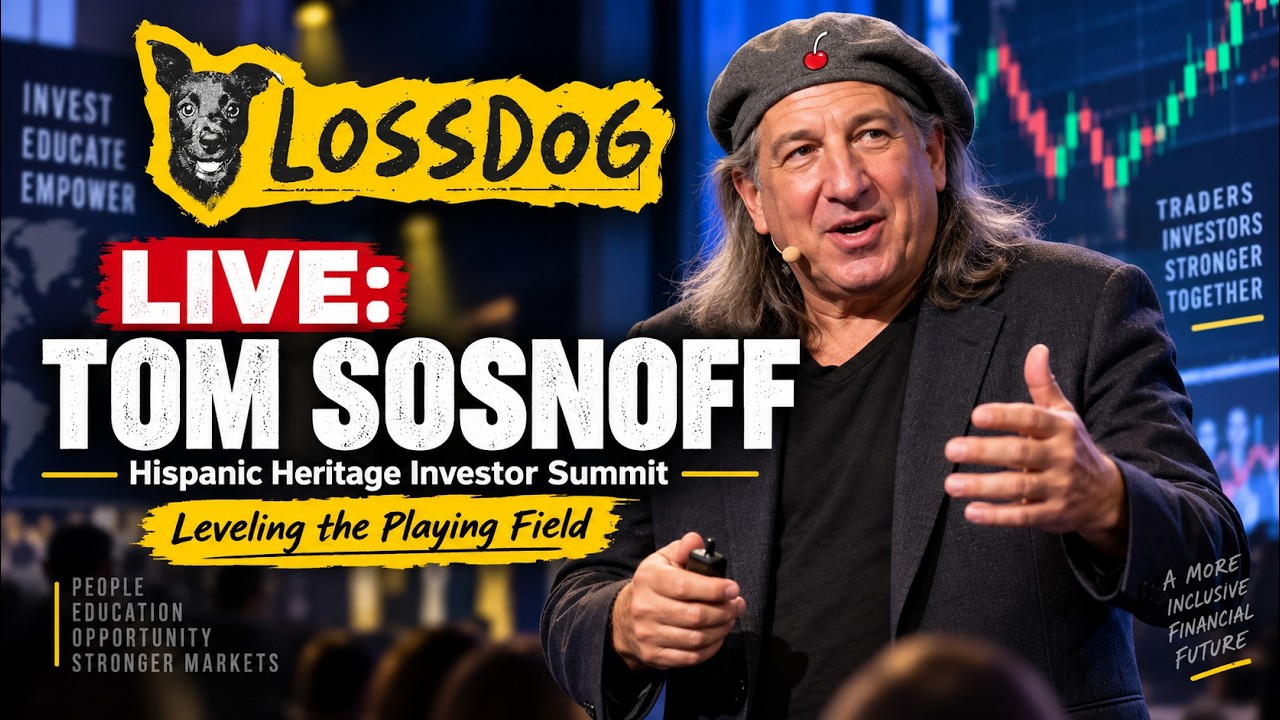
Tom Sosnoff: Guest of Honor at the Heritage Investor Summit in Miami transcript
Lossdog · @lossdog
Words
10,774
Runtime
57:55
Speaking pace
186wpm
Reading time
45min
186 words per minute, between the 181 median and the 201 75th percentile of 349 measured videos. That distribution comes from the 349-video hook study.
Opening (first 30 seconds)
In July, we had one of those moments where it was a move all the way into negative gamma and then a slingshot springboard. This should be familiar to you guys. 6%. When I was thinking about this in July, I thought the average move or the median move a full month later is 6% for the range. Well, here it happened in 4 days. September. These levels are obviously behind us, but this was created before the move. And note how close that level, again, I promise you these were made before
93 words, the words spoken in the first 30 seconds at 186 words per minute.
Sentence shape
| Measure | This transcript |
|---|---|
| Sentences | 744 |
| Average words per sentence | 14.5 |
| Longest sentence | 143 words |
| Questions asked | 62 |
| Sentences containing a number | 79 |
Most used terms
- people58
- um41
- trade38
- risk33
- everybody30
- trading27
- thank24
- room23
- lot22
- years22
- financial21
- life20
Filler phrases
261 in total: like 102 · you know 46 · um 41 · kind of 19 · I mean 16 · right? 15 · actually 11 · uh 7 · basically 4.
A literal whole-word count of the same phrase list the Prepublish browser extension uses, so a phrase inside another word is not counted and a phrase used in its ordinary sense still is. It is a count and not a judgement.
What this transcript is
Every word below is the caption track YouTube publishes for this video, pulled from the video itself and reproduced unchanged. It is not Prepublish's writing, not a summary, and not a re-transcription: it is the video's own published captions. English captions, generated automatically by YouTube, in the video’s original language. Source: the video on YouTube. A channel that would rather this page did not exist can ask for its removal through the contact page, and it is removed.
Transcript
In July, we had one of those moments where it was a move all the way into negative gamma and then a slingshot springboard. This should be familiar to you guys. 6%. When I was thinking about this in July, I thought the average move or the median move a full month later is 6% for the range. Well, here it happened in 4 days. September. These levels are obviously behind us, but this was created before the move. And note how close that level, again, I promise you these were made before FOMC.
That level is to where we actually sold off to. We bottomed just above 7500. That's where the market maker book changed. So where suddenly if you keep buying volatility, if you keep making V go higher and higher and higher, there's this odd feature in these near dated expirations where that would make people have to buy futures instead of sell them. And it might not be the one thing that makes this happen, but it sure is helpful when suddenly the market no longer keeps spiraling and takes a breath.
All of a sudden everyone else follows in behind. That's exactly what happened. and we had a V rebound. Now, if you don't know this, it's very difficult to trade it because they hiked rates and maybe there was hold out and they wouldn't hike rates. We don't know why the market didn't do anything or seem worried about it ahead of it, but certainly it seemed panicked when Wars was talking the Let's see here. What happened?
And there we go. Not the same as July, but very close. Market sold all the way back off into that part of the position where things change. And suddenly selling flips to require buying, and that's where it bottoms. This happens all the time. I saw this in my career firsthand, probably 10 or 20 times before it clicked that there's a big system behind all this that I was a big part of, and now it's the first thing I think about when I'm shaping my trades.
So again, the main thing here, what I hope you guys take away from this speech, and of course, these slides will be shared with you guys for the details, it's it's not about predicting where the market might go. It's about responsible trading and avoiding the traps that are set by these mechanical positions. In the first slide, we talked about maybe four, but you can see the last one. This option hedging is active every single day and requires a dynamic understanding of it.
So again, the more you do this, the more you realize it comes down to having a responsible framework. It's not will it go up or down today. You guys might have much more intelligent views than I do about that look ahead, but it's about understanding whether you're bullish or bearish, whether your time frame is now or later. You need to merge the two because if you flip bullish and overcommit before that sell-off, you don't know what to do when it sells off hard if you don't know that it's just mechanical.
And often times those are the most opportunistic moments to wait for your entry. Then of course making sure you have a strategy that fits your view and the actual market layout itself. I think my time is up, but thank you guys so much. And hopefully this is helpful and not too confusing. Thank you so much, Daniel. and Mahot. I also want to mention Daniel's beautiful family that has been waiting in the wings and watching.
Let's give them a big round of applause as well. Yay. One of the things that I love about Latino Wall Street is also our family values. So, thank you so much for embodying that. Okay. of honor. Guest of honor. Okay. Okay. The person that I'm about to interview did what so many investors dream of doing. And he did it twice. HE DID NOT ONLY EXIT ONE COMPANY, he exited two companies. He basically changed the way everybody trades.
Okay. Okay. So, let's watch the video. Everybody, welcome in Tasty Co Sausnoff, also founded Thinker Swim. Some call him the godfather of retail options trading. Tom, it's good to it's good to have you on. How would you be reacting as a startup founder to this news? >> I'd be really pissed. Yeah, >> as as you should be. I'm glad you said it cuz I can't. >> And this is how we think as traders. You're much better off instead of trying to follow the trend or follow the fundamentals, you're much better off playing the role of a contrarian.
And what I really want to do today is kind of break it out of that box and make it what it really should be, which is about understanding and thinking about probabilistic predictable outcomes, about quantitative strategies. True financial literacy is about taking risk. >> There's a very thin line between opportunity and risk, but where there's the most noise, there's the most opportunity. >> Now, you're launching a lost dog. >> Most executives in this world now are overpaid and most workers are underpaid. >> If you're a fighter and you don't think the other side can hurt you, you just say, "Give me your best shot." Without taking risk, it's almost impossible to have reward.
Traded daily for nearly 45 years. I'm a risk taker. Why would I care what a passive positive drift return looks like? I don't want to be average or just slightly above average. Everybody, let's greet Tommo. Are you happy to be here, Tom? H >> how could you not be? This is amazing. >> Everybody, >> I'm actually I'm actually a little embarrassed. This see it feels, you know, it's a little overwhelming. Thank you guys so much. >> No, you deserve it.
You deserve it. Okay, everyone. This is this is actually a moment that we've all been waiting for because before we give you the floor, we actually want to bring two special people up on stage to honor you with a recognition that you deserve. the founder of Tasty Trade, the founder of Think or Swim. Let's welcome to the stage OUR TWO FOUNDERS, GABBY VERROSI AND TONY VALO. Thank you for being here, Tom. It's an honor to present you with a Pioneer of Financial Innovation Award. >> Yeah, Tom.
Um, I mean, you've inspired uh investors all around the world, right? The godfather of day trading, the creator of Thinker Swim, uh, and not only in English here in the United States, right? But all across Latin America and all across the world in languages people have never even heard of. So, I'm so gracious for you uh, for being here. And let's give it up again. >> Thank you. Thank you guys so much. Perhaps the the the greatest measure of your legacy is how many lives you have changed, many of which you will never know.
So, thank you for transforming this industry and making it accessible to all of us. >> Thank you. Thanks. >> So, now Tom is going to be in conversation right here with with Gabby. >> Yes. Keynote. >> We're going to start off you and me. >> Yeah. So, you start alone and then I'll wait for you. >> What? >> No, you go ahead. >> Oh, okay. Yeah, >> I was thinking I messed up the order. Anyway, thank you guys so much for having me.
It's um it's incredible. And yeah, okay, now now you're embarrassing me. And just to give you a little background, has anybody ever been to any one of my events before? A bunch of you. >> No. Oh my god. All right, get out of here. This is >> But some of you have used the software, right? >> A lot of you. Okay, I'll take that. I'll take that. Um, my Spanish is no good, so we're going to speak do this in English. Sorry.
Um, I got a fun presentation. It's I have 20 25 minutes to engage you to kind of excite you a little bit about trading and about finance. So, I'm not going to get into too much crazy detail. I'm just going to give you a little bit of a little background of my own story and maybe some encouragement, maybe some just some big picture takeaways, that kind of stuff. And and then Gabby and I are going to have a fun little uh fireside chat.
And after it's all said and done, if you ever want to email me anything, just email me tom@losdog.com and I'll answer your questions, anything you want. I I'm I am truly a junkie. That's why I'm still doing this. And I think I've been on the road. I was just telling Gabby, I'm on the road now for the next until the end of October. And I've been on the road for about 25 straight years. This is probably my 500th or 600th show.
So, um, I just you guys keep coming out. We'll keep doing this until we can't walk up the steps anymore. So, I really appreciate it. Um, again, my objective here today is is just to get you excited. I don't want to be like tonedeaf or anything like that making people think you can do things that you can't, but there's there's so much the foundation of trading and financial markets and just being able to talk about markets, articulate strategies, talk about finance.
It's just so important to building a personal foundation from which you grow wealth or you just grow maybe it's you grow confidence, wealth, happiness, whatever it is. I really don't care. My objective when I talk to people, whether it's doing a daily show, whether it's doing whether it's building technology or whatever it is, is just to push people to push people to to push people into opportunities that they maybe didn't realize were out there.
My it's really easy for me to say to bet on yourself because everybody talks about betting on yourself, but I'm actually one of those people that promotes it every single day about betting on yourself. And the easiest way to start betting on yourself is through financial markets. than starting to trade. I know every person in this room is not going to be a crazy successful trader, but I also know that every person in this room has an opportunity to be way ahead of average or way better than average.
And so the way the numbers play out, and I'm kind of a freak about law of large numbers, and you'll hear it in a little bit. The way the numbers play out, the people that come to these events, the people that commit the time and the resources, the energy, usually walk away with either takeaways or some ideas or some thoughts that they didn't have before that lead to things that are essentially life-changing. Okay? Not everybody's going to be the greatest trader in the world, but it may turn out that from trading, you learn basic strategies, you learn basic probabilities, and it turns out you become an amazing entrepreneur, an amazing business person.
So, there's so much stuff out there. So, I'm just going to encourage you over the next 20 minutes to kind of take that step, giving you a little bit of a tour of my life, and then also um just some highlights and things that we talk about. I believe and and again um I made this super simple learning how money works I it's not easy but the other side of it is it's a very level playing field. There's no negative edge anymore.
And so we encourage people to just challenge themselves. There's very few things in life there's very few ways in life that you can go out and challenge yourself in a on a on a level playing field. Like just as an example, if you're if you're investing in real estate, just to use just one crazy example, the markets are wide. There's no not only is there no theoretical edge, there's wide markets that you have to deal with over time to make back that bid ass differential.
When you're dealing in most things that aren't financial market related, it is very difficult to get a fair theoretical playing field so that you can create lots of opportunities, lots of occurrences. But the financial markets and active trading, that's one of them. So, the real risk of not doing something, and you guys obviously are the people that do something because you're here. The real risk is not trying. The real risk is not putting yourself out there and and seeing, you know, really what resonates with you.
Are you a good Are you a good statistics person? Can you can your mind think probabilistically? Is the math fun for you? You know, most people that come to our events are kind of like me. They're a little bit math geeks, a little bit gamblers, a little bit probabilistic in nature. Definitely risktakers and and and and people that that like to essentially put themselves out there in a situation where you know what they like the risk return or they like the riskreward.
Um they they're essentially bottom line is they love the idea of speculation. So, I call this one of the biggest risks in life is what I call the 40-year nap. And the 40-year nap is is kind of um what I say it's it's it's it's a way most people surrender. You're 25 years old and you're and you're just starting out. You're out of college. You're getting your first job. You're entry level. You're building your way up. You're you're starting to network.
And all you hear from large financial institutions or large financial service firms is let us take care of your money. And you're all here for different reasons, but what you hear from everybody is let us take care of your money. So you're 25 years old. You're letting people other people that are conflicted tell you let us take care of your money. And essentially at that point you're surrendering because you close your eyes, you take a short nap, and 40 years later you wake up and you're 65 years old and you're like where the hell did my life go? like I just missed something.
I'm 40 year I'm 65 now and I'm not sure. I don't know what's going on. I don't understand financial markets. I don't understand strategy. I don't understand taking risk. I haven't had a lot of opportunities. You know, I haven't been able to make a lot of decisions and with respect to finance. So, kind of that 40-year nap thing comes into play. So, I always encourage people, you know what, if you're 22, 25, 30, or you have a 25year-old kid, encourage them.
Just take as much risk as you can. I don't like to hear anybody that's young say, you know what, I can't afford to take the risk. Yes, you can. You got the whole rest of your life to figure out how to build wealth. Take as much risk as you can when you're young. Take as much risk as you can when you're older. I mean, I'm all about every time you come to that kind of that fork or that decision-making opportunity, you go for it.
Every time you have an opportunity, go for it. You know, and I wrote up here, success isn't about marginally marginally beating a benchmark. Who cares if the S&Ps are up 10% and you're up 11? Who cares if the S&Ps are up 16% and you're up 14 or you're up 18? Really, does that make a difference? Okay. As soon as you outsource the decisionmaking of what you're going to do with your money to somebody else, you've already lost.
You've conceded. You've conceded to an industry that's conflicted that really wants to manage your money because they make a lot of money managing your money. We want you to be self-directed at least to a certain point. We want you to take care of your own finances. We want you to manage your own future or manage the opportunity in your own future. So I believe that beating a benchmark is irrelevant. What's important is that you look at what risk-free rates are right now.
Let's say risk-free rates are 5%. And you say to yourself, you know what, if I'm going to commit to this, if I'm going to spend time watching markets, if I'm going to spend time trading, if I'm going to spend time investing, I have to beat risk-free rates by some multiple. So, if I'm going to commit my time, I need to beat risk-free rates by, let's say, 3x, so I need to make 15%. Or I need to beat risk-free rates by 5x, so I need to make 25%.
What the what the S&Ps do is irrelevant because one year the S&Ps will be down and they'll be like, well, I didn't lose any money because I didn't trade. But that's not the way you have to look at this. The way we look at risk- takingaking, the way we look at at decisionmaking and investing and being self-directed or a do-it-yourself investor is what is my return relative to risk-free rates. And don't worry about what the S&Ps are doing or any of that stuff.
So, I'll give you a little bit about my background. I started just like the last speaker, Daniel. I started um when I was 23 years old. I lived in New York and I I grew up in an era when interest rates were 20%. And there were no jobs when I was getting out of school in the late 70s, early 80s. And in 1980, I got a job on Wall Street. And the only reason I got a job on Wall Street was because they were the only ones who gave me an interview.
So I I was a political science major. I got an interview on Wall Street. They offered me a job. I took the job and I went to Wall Street. Within a few months, I met a bunch of people that said, "If you move to Chicago and trade, you know, we'll put up the money." And I didn't have any money. So, I'm like, "Okay, it sounds like a plan to me." I went to Chicago. I walked on the floor of the CBOE, Chicago Board Options Exchange, and was about the size of this room, kind of the original floor.
And everybody was yelling and screaming. I had no idea what was going on. And I'm like, the energy in this room is so incredible. I felt like it was it was not only capitalism in its rawest form, it was also to me like a frontier of capitalism that I didn't even know existed. I had no idea. Well, I walked on the floor of the Seabbo on day one and I never left. I mean, I never left this industry. It's been it's been 45 years.
So, I've been doing this since 1981 and uh four and a half decades. And my start was on the floor of the SIBO as a market maker in the S&P 100. Just like the last speaker, he was in the S&P 500. I was in the 100. Kind of very similar products. We had very similar careers. But I left that in 2000 to build Thinker Swim. Now that was just taking a shot. I had made money. I decided to roll the dice. We knew Thinkerson was going to be successful when a writer for Crane Chicago, which is a business newspaper, said wrote a story saying a bunch of traders from the floor of the SIBO started a new brokerage firm called Thinkorswim.
With that name, they have no chance of success. We loved that cuz that motivated us. How many people have used Thinkorswim here? Wow. Wow. Congratulations. We had Thinkerson was an idea I had walking through my living room one night and I remember turning to my wife and saying, "You know, I think I'm going to start this firm called Thinkersome." She goes, "I don't even want to know. I don't even care." Um, but we um but we we built it up with some incredible developers and some really smart designers.
We didn't we we knew the we knew the we knew trading and we felt like that was our domain expertise and the important thing about that is that was our domain expertise so we could talk the talk but we weren't sure about retail platforms. One of my favorite stories about Thinkersum was that when we built it cuz we were ex floor traders as we're building Thinkersum we didn't even build a charting package. So the first version of Thinkersum had no charts and then customers started to log on to it and they go where's the charting package and we go who uses charts.
We had no clue that retail investors use charts. So we went out and now today they built one of the best charting platforms. But the point here is that like we didn't actually even know what retail investors wanted back then. We just thought we knew what we wanted. So one of my first takeaways from today's talk is I don't I'm an entrepreneur but I'm not a problem solver. I don't really care about other people's problems.
I care about and I think really good entrepreneurs should do this. You should focus on your own vision. Like whatever your vision is, like what Gabby's vision is for for her company, that should be what's out there. Not trying to solve a problem, but trying to basically here's my vision. This is what I wanted to be. That's what Thinkerson was. This was our vision, and we wanted to be something special. It turned out to be a cult-like firm.
We built it up. A lot of you guys are still on it. Do you know that platform hasn't changed in 26 years? It's incredible. Um, but the lead designer of Thinkorswim is also the lead designer of Tasty Trade and is also still very close with us and works in the same building as us today when we're building Lost Dog, but he's not part of Lost Dog. But, but that platform held up 26 years. Amazing. It became TD Maritrade's main platform and now it's Schwab's main platform.
And to tell you a little funny story, when we sold Thinkorswim, we sold it for $750 million to TD Merit Trade at the time. And when we sold it, we were public company. And the CEO of TD Merit Trade goes, "I love this platform." Even though we never even logged on, he goes, "I love this platform, but I hate the name." And I'm like, "You can't hate the name. The name is great. Everybody loves the name. All the customers love the name.
You can't change the name." And he's like, "Well, we're going to change the name. We're going to call it the ultimate trading platform." And I go, "You can't do that. You're going to ruin it. Everybody loves the name Thinkersome." He goes, "Well, we'll do a study." So they paid half a million dollars in 2009 to do a study to see if the name Thinkers Swim was more popular than than the ultimate trading platform. It came back 95 pe 90 the the ratio was 95 to5 keep the name Thinkers Swim.
So the CEO didn't believe those numbers were right. So they paid another $500,000 did another study on a different part of the US and it came back 98 and two. So they kept the name Thinkers all through TD Meritra's time and then they kept the name Thinkers actually now that Schwab owns it which to me is kind of a testament to that fun name and logo and everything else but um when we built Tasty Trade which happened after we sold Thinkers.
The first investor was that same CEO from TD Merit Trade, who's still my friend, who said, "I hate the name Tasty Trade more than Thinker Swim, but I believe in you. So, we're going to be your first and largest investor." Which was really nice. So, that takes me to the next stage of my life, which was we built Tasty Trade to be um initially it wasn't a brokerage firm. I wanted to be a digital financial network because I didn't like I didn't like what was happening in financial news.
I don't think financial news should be about interviewing people and asking what they think. Like it drove me crazy that people be on on different networks all day, whether it's CBC, Bloomberg. It's still the same today. Every single network, every single interview in finance is always about what do you think? I don't care what other people think. I want people to understand the mechanics and to recognize opportunity. not what somebody else thinks, what you think.
So, right now, I mean, and then I I'll I'll actually tell you what we're doing in a couple seconds, but we built Tasty, became the largest digital financial network after a couple of years, and then we built and then we changed the name and became Tasty Trade, the brokerage. And today, um, it's it's a monster brokerage firm. And a lot of you, anybody here use Tasty Trade? I know a bunch of you do. Yes. Thank you. >> And I know some of your instructors do, which I love.
And the amazing thing about Tasty is it's kind of the same it's just a next generation of what we built at Thinkerstone, but it's just it's a it's a really slick platform and it's um uh and it was just a fun experience building up content along with technology. And then today I'm building Lost Dog and I'm also building a brand new platform called One Lucky Dog, which we're going to release in a couple of weeks, which all it is is endless ideas about trading.
Not who's good or who's bad or who's the best adviser or who's the best trader. It's just ideas because I believe ideas are what generates opportunity. It's what generates wealth. It has nothing to do with whether somebody's been is good or bad or knows what's going to happen next because nobody knows. It's all about just recognizing opportunity and that's coming out. So in life, what you own in life, and the reason that you're all here is you own your opening trade.
You can't control what happens after you make a trade. Like you can't control what the market's going to do after you've done something, but you can control all the mechanics around what you're about to trade. So when everybody thinks of like what is AI going to do for me when it comes to trading? Well, the next agentic tools that you're going to see on every single platform is going to be like this little angel on your shoulder.
One good angel, one bad angel. And they're going to say things like your mechanics are in line or your mechanics are not in line because you own that opening moment making that trade. After you make the trade, like whatever the probability of success is when you make the trade, that's your probability of success. Whatever the expected move is, that's the expected move. You can't control what happens after that. But you can control what happens when you make the trade.
So, you're not going to trade something that's illquid. You're not going to trade something where maybe the volatility is too low or it's too high or you're not going to trade something that has certain binary risk, but you control all that. And just making sure that you have all that in place is one of the really it's going to be one of the huge advantages of AI when it comes to self-directed trading. the root cause in my opinion of the root cause of wealth inequity and and and or wealth inequality, whatever you want to say, and this is a lot of what Lost Dog is about, is the lack of financial knowhow.
It's not that person A in this room is smarter than person B that's not in this room. It's just that person A in this room has financial knowhow. It has the ability to articulate things financially and strategies that other people don't have. So what makes what makes I mean some people call it financial literacy. I call it financial knowhow. It's it's close to the same thing. But the reason that being here is so important is because the stuff that you pick up, however it applies, will apply to every aspect of your business because you can test it over and over again.
Life is based on number of occurrences, nothing else. So if you're worried about hey there's a huge concentration of wealth there's a huge wealth inequity in this country right now and there is all over the world which is all true but the way to deal with it is on your own through financial knowhow is through understanding is through is through just the amount of times you do something. So it brings me to the next slide which is speed over everything else.
Don't let anybody tell you to take a step back. What used to drive me crazy especially even with my own kids. One time my son after he he got he went to grad school for his NBA and he got grad school he got offered a job and he called me up and he said and he lives in LA and he said, "Dad, I got um a really good job offer from some big tech company." And I go, "Did you take it?" And he goes, "No, I told him I'm going to think about it over the weekend." I'm like I'm like, "Dude, I've been talking to you about this for since you were two.
Make a damn decision. Don't nobody I try when I offer somebody a job and they don't take it on the spot, they don't get the job. Like I want people that make an instantaneous decision. You tell me you're going to go think about it, you're out. I don't care. I don't want you. I want people that make decisions on the spot. I don't care if you're wrong. I don't care if anybody's wrong. When you make If you make a lot of decisions, you're going to be wrong a lot.
But that's really good because you're making lots of decisions. It is way more valuable in life to be fast than it is to be right because otherwise you leave too many opportunities on the table. Most Yeah, you like that, right? Everybody else, everybody in the world will tell you, take a step back and think about it for a while. Don't do that. If you ever run into really successful people, like you find some crazy eccentric billionaire or you find somebody that's sold a million businesses or you find somebody that's incredibly successful, however you want to measure success, I promise you the one trait they all have in common is they make lightning fast decisions.
When we put our boards together for our companies, I I will only take successful entrepreneurs on our board. You know why? Not because they're successful entrepreneurs, but because they make fast decisions and because they won't sit at a three-hour board meeting. They want to be out of there in 15 minutes. That's what I want. People who make decisions in 15 minutes. People make decisions instantaneously. I'll tell you a quick story.
I don't want to go too long. I'm sorry. There there is we built an exchange once. It was called the small exchange. And I wanted to build a futures exchange because I wanted to create a small micro futures product which the CME eventually did. We built this exchange called a small exchange and we built this micro futures product. Well, the CME copied us right away and they and it made it impossible for us to get product out because they were too big.
So, we turned around and we put the exchange technically not on the market, but a big crypto company needed an exchange. So, the CEO of this crypto company called me up one night and he said, "Can you make a decision?" And I'm like, I this guy's asking me, "This is my game. Can I make a decision?" I go he goes cuz I'm interested in buying your exchange but he goes I don't want this to be a long drawn out process. I and he was in Hong Kong that night and I said well it's 9:00 in Chicago.
If we don't have this deal done by 9:05 I didn't do my job. At 9:03 we had a $250 million deal done and that deal was done in the clearing firm at 9:03. It took 3 minutes to make the deal. But here's the best part of that deal because I didn't even tell Gabby about this or anybody here. They didn't turned out they didn't need the exchange so they sold it back to us for 10 million. So we sold to them for a quarter billion bought it back for 10 million and then we sold it to the next person for 100 million.
That's just exchange that's scalping an exchange. But but the fun thing about that is I never could have done that if I didn't learn how to trade doing other things. So it's all part it comes back to this whole foundation of trading. years ago when they went to commission-free trading, everybody said it's going to end horribly. Well, it didn't end horribly because zero commission trading actually opened up the business to everybody.
That's stock trading. But options are next to free. Everything's like basically nothing. And so the whole concept of zero commissions made everything commoditized everything, standardized everything, but it also made all the markets accessible. And now there's no like negative drag or negative edge in that way. So what I encourage everybody here to do and your takeaway is just remember like a lot of sometimes people are nervous about making the first trade, sticking your toe in the water, whatever it is, but real time experience there is no substitute for getting involved in the markets and you can do it with very little money and you can do it in a way that creates as many occurrences as possible.
Um, the value I wrote up here just a little saying, the value isn't the return. I it's it's the calibrated judgment under uncertainty. That's where you learn how to defend things, how to tweak things, how to strategize. That's what life's all about. It applies to everything. most people in their lifetime and this includes every, you know, just about everybody. You rarely get a chance to sit on the cap table of a big company because it's just not how life works.
You just got to get lucky in a couple of regards. But trading is the next closest thing to doing that. I mean, when I started this business, I told you I had no money. I I got lucky because I met some guys in New York City when I was just out of college and they they put up 50 grand for me to go to Chicago. They lost all their money within two weeks and I was just stuck there. But I was able to raise $100,000. Where is it on here?
I think it's up here somewhere. Oh, I was able to raise $100,000 when I was 23 from just some guy because for only one reason. I could talk circles or he he wanted to get involved in trading, but he didn't understand the business and I understood the business so I could talk about it and he wrote me a check for 100 grand. This is 1981. I mean, we were partners and I was able to buy him out in a couple years. A couple years after that, we raised $10 million to manage a hedge fund when I was 31.
That was fun, but I didn't like managing hedge funds. So, we raised a half a billion dollars in the '90s to manage some index funds. I didn't love that either. So, that's when we started thinkers after that and we raised money obviously to build that firm, but we bootstrapped it ourselves. The important thing about is that trading and all of you are here as self-directed traders or working with somebody or whatever it is.
Trading provided that foundation. It made it all possible because you learn so much stuff and you understand kind of taking risk, eating what you kill essentially as as you know, I've never really worked for anybody. So, I've never had the experience of like understanding what a day off is or a sick day or any of that stuff, which is I think it's good. The other thing about the other thing about being here and this is really what's important.
This is what makes everybody that puts on these events and that talks to you. What makes them so valuable to you is they can articulate mechanics. Nobody wants to hear necessarily what you think. Like like if you put somebody up on stage that says, "I think Nvidia is going to 400 or I think Tesla's going to 100." I couldn't care less. But if you put somebody up here that talks about and can articulate like the last speaker, articulate the mechanics of trading, that's real value.
That's where you learn stuff. And once you can articulate the mechanics of trading, you can articulate everything. I've had kids that have reached out to me years after they met me at some crazy event I did and whatever at some university or some some online some online webinar I did that said I'm managing a hund you know a hundred million dollar or a $2 billion hedge fund now all because you taught me how to explain volatility and nobody else in my graduating class could explain volatility the way I could in a trading sense articulating the mechanics is super critical so there's which goes back to the fallacy of the crystal ball.
The crystal ball thing where essentially, you know, where you know what's going to happen next in the markets, nobody knows. So reject that right away and talk about the edge is in optimizing your mechanics. The edge is in understanding that, hey, listen, I don't really have a theoretical edge, but I have a mechanical edge. I'm not going to throw good money after bad. I'm not going to trade too big. I'm not going to I'm going to take my profits early.
I'm going to trade when volatility is high. I'm going to trade when opportunity is best. That's the f understanding the fallacy of the crystal ball is what separates a lot of people. So control your trade size and you essentially control your risk. The only time in this business when genius fails and everybody's a genius. Just so you know, genius fails when you get too big size-wise. If you keep your size in check, you will never fail.
You can lose. And I lose as much as anybody else in the world on investments on on you make bad investments, you make bad trades. I mean, it happens, I don't know, countless times a day. But the way you always show up to play the next day and wait for more opportunity, everything else is you keep your trade size in check. You know the book, I don't know how many of you have read the book When Genius Fails, but it's a great book and you should get it.
It's about long-term capital management. It talks about when four Nobel laureates started a hedge fund and they were all geniuses and they wrote the black shells model but they blew up a hedge fund which almost took down the market because their size was too big. It's the same thing for retail investors. You keep your trade size in check. You can do whatever you want. You keep your investment size in check throughout life.
You can do whatever you want. You can make as many bad trades as as you can imagine. You can make you'll make as many good trades but you keep your size in check. That's the key. law of large numbers. The way to get from point A to point B to some kind of wealth creation is by doing something a lot of times. And it's frequency, not conviction. Everybody thinks it's about conviction. It's not. It's about frequency. You have to create enough occurrences to have the mechanics or the probabilities or the statistics in your favor.
If you are somebody that believes that you can figure out things probabilistically, which I think everybody in this room can because especially in the option market, but most financial markets, everything is math. The underlying theme for everything, the foundation is all math. So everything has a probabilistic outcome. Everything has an expected move. Volatility is just expected move. So when you talk about law of large numbers, it's how many occurrences did you create?
I think there's a reason why I make 15 or 17,000 trades a year. There's a reason why most successful customers that use platforms like Think or Swim and like Tasty Trade and platforms like that that are very aggressive are more successful than than customers of that try to trade every so often on other platforms. It's because they make more trades. And the more trades you make, if you keep your size in check, the better you're going to do over time. doesn't mean the better you're going to do tomorrow or next week or next month, but the better you're going to do over time because everything is about um everything is really about just the number of occurrences you create.
I skipped one here. Sorry, one second. Oops. All right. Sorry, one sec. Oh, going the wrong way on this. >> Yeah, I figured that. Uh, hold on one second. Oh, got it. My my bad. Give me one sec. I just missed one slide. Yeah. And so my last my second to last slide is just decision-making speed over deliberation because I want to take you home with this. There is very little that separates us all in this room. Very little that separates everybody because I have a couple of underlying themes I work on in life.
First of all, everybody's smart. Everybody is smart and in their own way everybody's smart. The only difference that AI gives us now is that all of us are smart, but we just got we just got a really smart friend with 165 IQ that we can sit by because most of us are some average of our our friend group and our intellectual group, but now we have somebody with 165 IQ that sits next to us that really gives us this additional edge.
That's the coolest part about AI. But decision-making speed over deliberation is really one of the takeaways I want you to have here today is that you feel really good about this. Next time you say, "Should I make this trade or should I not? Do I need to think about it?" You're going to be like, "You know what? Screw it. Let's just do it and see what happens. Just keep your trade size small." So I I just engage you. I implore you.
You guys here, you carry the torch now and then you pass the torch to the next person like we're all doing. That's what I'm here for. That's why I still talk at universities and events like this because you know we've carried the torch for a long time for the last 26 years on the retail side for 45 years total. It's time to pass it on to you guys. And now you take the torch now and then you pass it on to the next generation.
You have better technology. You have better markets. You have more capital. You're smarter. You have way better content. You take that. Hand down fluency not fear. And always be an opportunist. So look at the tomorrow, next week, next, you know, next day, next month, whatever it is, and just think about everything in life is about knowing what to do when the opportunity is there. It's never about fear because you can't control that.
That's why, you know, that's why fear is mean reverting because you can't control it. So the best thing you can do is pass down fluency, but always think of yourself as an opportunist. when the opportunity comes up, you have to have the dry powder and also the understanding and the speculative nature to take advantage of it. Thanks so much. >> Thank you so much, Tom. >> Thank you. That was amazing. >> No, it's perfect.
Thank you. I would really like to acknowledge you for being here, for taking the time to share your wisdom. It really means a lot to us. We look up to you to the legacy you've left and you've empowered millions of people who some don't even speak English and you've made a huge difference because of your creation and like you said, taking action and being fast and putting yourself out there. And I love when you spoke about the connections in New York and I always tell them one connection can change your life, right?
One idea, one mentor. So, thank you so much for being here. Um, yet we have a very interesting market and economy right now. Obviously, a lot of of our members are worried about the change in monetary policy. I know you talked about interest rates being 20%, and some of us can wrap our heads around that, but the Fed just raised rates and I think we've gotten spoiled, a little bit used to lower rates. So, what should matter for investors right now?
Where do you see the biggest risks, the biggest opportunities in the next 12 months? >> Well, it's funny. you know th this would have been a really if if I was answering this question 10 years ago or you know maybe 15 years ago, 10 years ago or even five years ago I think my answer would have been structured more around um a macro answer and more around maybe you know geopolitical risk and things like that just things I think now what's so interesting about markets today is that the stock market not just in the US but kind of all over the world but US more so than anywhere else because we just have such a huge um you know the size of the US markets not including the derivatives markets the bond market and the um and the stock market are you know like a hundred close to 150 trillion not including like $150 trillion derives market.
So what's happened is that and this is a weird way to say it but capitalism just because it's gotten so massive in this in specifically in this country but all over um has almost outgrown geopolitical risk. That's why when you look at markets right now you kind of think like we have companies we have like seven companies that are bigger than the GDP of the rest of the world combined. So what happens now is interest rates go up a quarter of a point, but like you saw on on Friday, you know, markets have a huge rally. >> Yeah. >> Because because people recognize, you know what, that quarter point jump is not going to change what happens in how many chips Nvidia sells in 2027. >> Is it just symbolic?
Do you think they're just doing it because they want to look a certain way? >> Well, I think that they're the Fed has an obligation. I mean, I know most of you follow like a lot of financial news and stuff like that. I don't follow as much of it. Of course, I'm involved, but but the Fed has an obligation to be to kind of provide both disaster insurance and to and to be there in case there's an an issue with the economy to to tame inflation.
That's their role. So, they're doing what their role is. That that's what they're supposed to do. But I think that when you look at how the that impacts companies, I don't think I don't think if you knew the Fed was going to raise, which most people did, knew the Fed was going to raise a quarter of a point. I don't think that that's a tradable event. >> Meaning that I don't think you go out and say, "Oh, because I'm going to because the Fed's raising rates, I'm going to do something about it." You know, like like I was buying bonds all week because I thought they were too cheap and I thought if the Fed raised rates, they might rally.
But that's not really a way. Like I consider bonds to be cheap, so I consider that to be an opportunity, but I don't know that I would look at this thing and think about it geopolitically. >> Got it. Yeah. Well, they obviously want the bonds to go up because they're doing buybacks, right? So, we know that's their plan at least. >> So, what about um what retail traders have taught you? You have obviously a lot to teach us, but as with any project, also your customers teach you, right?
You've spent decades building platforms for retail investors and watching millions of people trade. So, you've seen what works and what doesn't. You spoke about the mechanics of it. What do you think separates the successful ones, the ones who make it versus the ones who don't? >> It I I I'm going to go back to some of the things I said just before. I I do believe there's first thing is obviously number of occurrences.
So I think that there's a set of mechan I think the most successful traders are the ones that are able to say um to optimize what they're doing through mechanics you know like like for example take winners when you can you know not necessarily don't try to squeeze the last penny out of things be be aware of certain things like things like liquidity things like volatility I think traders I think the most successful traders are the ones that are not necessarily the most disciplined but they're the most consistent with respect to mechanics And the thing that I think that people don't understand that I don't think they fully grasp about trading, especially the active ones like everybody in this room.
There is a huge percentage of people that are successful as self-directed traders. Like when you look at the breakdown, and this is I'll throw some numbers out there that are just really interesting. Let's say let's say there's there's I don't know how many people in the room. Let's say there's 400 people in the room just to make it simple. If there's 400 people in the room, there's going to be 16% of you of 400. 16 people out of every 100 are going to be very very successful.
Now, when you start to think of be like, "Wow, that doesn't seem like it's good odds." That's only the part that are really successful. 50% of this room, 200 people in this room are going to do way outperform any of the benchmarks over time and they're going to create a lot of wealth. And when you think about that and you put that in the perspective of like all the people that are out there, most people un most people in the world underperform.
They don't understand this stuff. But of this room, 200 of 400 are going to be crazy successful. Those are odds you should love. Like I would I wish I had walked into a trading pit one day and said there's 400 there's 400 guys standing here. I I want to be one of the top 200 because that would take a lot of pressure off. I mean, it's just there there there is I've learned that that customers and first of all, I've learned everybody's smart and I've learned that this everybody can do this.
Like the technology has really leveled the playing field. So there's no advantage to somebody else now. You're never disadvantaged to the counterparty. Um in the years past you were disadvantaged to the counterparty. That means whoever was making the market, stuff like that. Today it's not the case. It's truly level. >> No, I love that. I never like when people are negative about this industry and say, "Oh, the odds are stuck against you." Because I'm like, "The stocks are stuck against you in whatever you do, right?
Whether you want to be an actor, open a business, be a dancer, it's right. So, if we think about it that way, we're never going to give it a shot." So, I I like that context like looking at it in the perspective of hold on, I can actually if I stay consistent, I can have the results. But I like with anything, right? You have to keep going. So let's pretend for a second that you lost almost everything. >> Uhhuh. >> And you only have 10,000 left to your name, but you have all the experience, all the knowledge, where would you go?
What would you do? What would you avoid? Who would you surround yourself with to start over? Can we change the question to rather than I lost everything, can we change the question to what if I had $10,000? >> Well, unfortunately, those things happen, right? And that's people's biggest fears. So, >> I know. I mean, for whether you're starting out with 10,000 or you, you know, you started with a million and you have $10,000 left.
Um, I I mean obviously something if you started with a million, you have $10,000 left. Something's broken. And and you have to figure out what's broken before you do another thing. And and by that I mean you have to get like significantly smaller. You have to get more diversified. You have to think about the strategy you're using. You really have to dig deep and thinking, you know, hey, I I have to whatever I was doing before, I have to do something different.
But if I was just starting out with $10,000 and I wanted to get involved in the markets, I would be super aggressive but small. So what I mean by super aggressive is I would I would use a couple thousand dollars of that money to try a variety of different strategies. And like I would do everything from covered calls, short puts, you know, some some short credit spreads. Um I know you've got a bunch of butterfly sellers here. >> No, we like that, right?
By the way, that was one of my um that was one of my favorite stories to hear. I I was sitting out in the um sitting in the room waiting for the show to start was um was listening to all the butterfly traders in this room that were all doing broking butterflies for credits. I I almost got teeyed. It was great. So, I love that story. >> Amazing. So, let's talk about AI for a second. I know you discussed it, but I want to talk about something that came up recently with the anthropic CEO that he's all of a sudden, right, he's an industry leader and now he's warning us, saying that we need to calm down, we need to slow down, that it can destroy humanity if we don't take it easy.
What do you make of that? Is it the best thing that is happening to us where we can optimize our time and you know get faster results and be more productive or is it the are we up against the biggest danger? >> Well, first of all, I don't think we're up against the biggest danger at all. That that's for sure. Um but I also I think you have to take a step back and remember it's the anthropic CEO who's also about to go public at $2 trillion.
So, I think that he's trying to temper expectations a little bit. And I'm not sure I don't >> I don't hate all CEOs, of course, and stuff like that, but if you ask me, do I trust the Anthropic or the OpenAI CEO or or some of those or CEOs that manage multi-trillion dollar companies? And I'm going to take that with a grain of salt and just say I think they're talking their own position and just trying to temper expectations from the street.
M >> I think I think as traders though and I think as people in the world of finance we have to look at the um at the positive side to what AI brings to us as to help us. I think the agentic tools that are out there the I don't think AI is ever going to sit down like I don't think it's going to there's going to be a Gabby bot or a Tom bot and that bot's going to go out there and make all the trades I would make or make all the trades you would make or or you know basically trade for you.
But I do think there are these the there going to be these incredible agentic tools that help you not to make mistakes. There's going to be monitoring tools. There's going to be all these different things. I do this like this one almost a 90minute seminar on just like 35 different things that that I think AI is going to benefit from around the clock monitoring to tail risk. I mean imagine what's the biggest thing that scares most people.
It's tail risk, right? stuff that happens outside your control up to two standard deviations which is 95% probability it stays within a certain range we can control that but outside of two standard deviations which is that you know we get to three standard deviations which is still barely quantifiable but then four five and seven standard deviations which is not quantifiable how how do we even monitor that or control that like that's the kind of stuff that I think you're going to see AI play a really nice role with retail investors so I see it on for the from from in our business as a very complimentary tool and as something that's going to help everybody in this room.
Um, and the stuff like we're building a ton of stuff right now that are all tools that help investors to optimize their portfolios and help investors to make less mistakes. >> Amazing. And we're going to do um a followup with to learn more about Lost Dog and all these things. So, that's going to be fun. >> Yeah. So, thank you so much for that. Um, yeah, I do agree. I'm also optimistic about AI. I don't buy into all this fear, but as you said, these people have an agenda.
It is odd when a lot of them start saying the same thing, right? Then comes Elon Musk says the same thing. Oh, yes, you're right. And then all of us are like, what is going on? >> If you put Sam Alman, Elon, and Dario in a room together, I mean, watch your wallet. >> Yeah. >> Awesome. Okay, so we're going to finish with this question that for me is the most powerful one. It's about the power of making big decisions. Um, you've built extraordinary companies, created enormous value, and helped change how retail investors participate in the markets.
Now, looking back, and you shared about your story, right? But if you had to choose one decision or one person, one relationship, one opportunity that was the breakthrough, right, that changed the trajectory of your life. What would that be? And what would you tell someone in this room who knows their next level would require them to take action to be faster as you said, right? Is the fastest one, the one who wins, but they're up against the fence.
Well, I think that I so I would I would say the same thing to you now that I would say to a lot of young entrepreneurs that we and when I say young, you know, not talking about like 22 year old entrepreneurs or something like that because now every kid is a 22-y old entrepreneur and then until they need a job, but but I'm talking about like 30, 35, 40 year olds who are building businesses and doing things like that. I think the the real challenge at that point and and for a lot of people in this room is the decision you reach this point where you say should I go for it and I think everybody reaches a point I'm sure you did with building this company and you had to make a decision. >> I I have I'm comfortable but part of me knows there's more to life than just being okay and I I have to go go for it.
And I think that that challenge that the willingness to accept like this this this this ner this willing to get over your nerves about the risk that you're about to take like that next move when you know when you don't know what the outcome's going to be, but you know that you're smart enough and you're risk and you're and you're risky. You you feel like you can handle the risk part of it, but you want to take that next step.
A lot of people don't take that step. And I think that for whatever that is that holds people back, maybe it's the fact they're starting out building a family, maybe it's they don't want to risk what they've already have. And you know, we we're trained all through, you know, through academia and then our first jobs and everything else and then through a conflicted financial service market not to roll the dice, you know, not to take all that risk.
And I think in a calculated way, um, I think you have to do it. >> You have to take a risk. That's true. If you stay in your comfort zone, you'll never know what's possible outside of it. Absolutely. I want to thank you so much for your time. It was wonderful to have you share your wisdom. Thank you so much, Tom. And don't forget your award. >> Thank you. >> Thank you so much, Tom. Thank you. Thank you. I want to thank you Tom for taking the risks.
Thank you so much Gabby. Spectacular. One big more round of applause for Tom Sav. Wow. That's one message that I'm taking away is to not be okay just being fine. How can we aspire to more? How can we dream bigger? And as I mentioned in
The words are the caption track's own and nothing is reworded or re-transcribed. Paragraph breaks are placed between sentences so the text reads as prose.
Use this transcript
Three free tools that work on the material around a video like this one. No signup, no login.
Hook Analyzer
Paste the first 30 seconds of your own draft for a hook score and rewrites.
Policy Pre-Flight
Check your draft against YouTube's advertiser-friendly guidelines before you record it.
Channel Skill Generator
Read this channel's public videos and transcripts, and download a writing brief for it.