Getting the transcript
Reading the captions from YouTube. A video nobody has opened here before takes 10 to 30 seconds; this page fills in on its own.
Getting the transcript
Reading the captions from YouTube. A video nobody has opened here before takes 10 to 30 seconds; this page fills in on its own.
Benjamin Cowen · @benjaminjcowen
Where viewers went back to watch this video again, from YouTube's public Most replayed graph, lined up with what was said at that moment.
Words
4,697
Runtime
22:00
Speaking pace
214wpm
Reading time
20min
214 words per minute, above the 201 75th percentile of 349 measured videos. That distribution comes from the 349-video hook study.
Opening (first 30 seconds)
Hey everyone, and thanks for jumping back into the cryptoverse. Today, we're going to talk about the total cryptocurrency asset classes risk metric, and how I use it to navigate crypto. If you guys like the content, make sure you subscribe to the channel, give the video a thumbs up, and also check out the Telegram channel, which you can find a link to in the description below. Let's go ahead and jump in. So, as many of you guys know, I do not monetize my YouTube channel. I do not have affiliate links, I do not have uh or you know, any type of paid promotions.
107 words, the words spoken in the first 30 seconds at 214 words per minute.
Free, no signup. See how the first 30 seconds hold attention, with rewrites.
What this transcript is
Every word below is the caption track YouTube publishes for this video, pulled from the video itself and reproduced unchanged. It is not Prepublish's writing, not a summary, and not a re-transcription: it is the video's own published captions. English captions, generated automatically by YouTube, in the video’s original language. Source: the video on YouTube. A channel that would rather this page did not exist can ask for its removal through the contact page, and it is removed.
Hey everyone, and thanks for jumping back into the cryptoverse. Today, we're going to talk about the total cryptocurrency asset classes risk metric, and how I use it to navigate crypto. If you guys like the content, make sure you subscribe to the channel, give the video a thumbs up, and also check out the Telegram channel, which you can find a link to in the description below. Let's go ahead and jump in. So, as many of you guys know, I do not monetize my YouTube channel.
I do not have affiliate links, I do not have uh or you know, any type of paid promotions. I don't even have AdSense turned on. The only thing that I do is I have a premium list where I post additional information beyond what I post on the public YouTube channel. And occasionally, I find it worthwhile to show you guys what I'm doing on the public channel so you get an idea of what's behind the curtain. So, this is the total cryptocurrency risk metric.
And I'm showing you because the prices of the premium list are going to go up soon. So, if you want to lock in the lower rate, make sure you do so. You can find that at intothecryptoverse.com. The prices will go up in about nine days or so. Okay. So, this is the cryptocurrency risk metric, and the whole idea is that, you know, what if we used a metric that accounts for diminishing returns, which this does, to identify local tops or and/or market cycle tops.
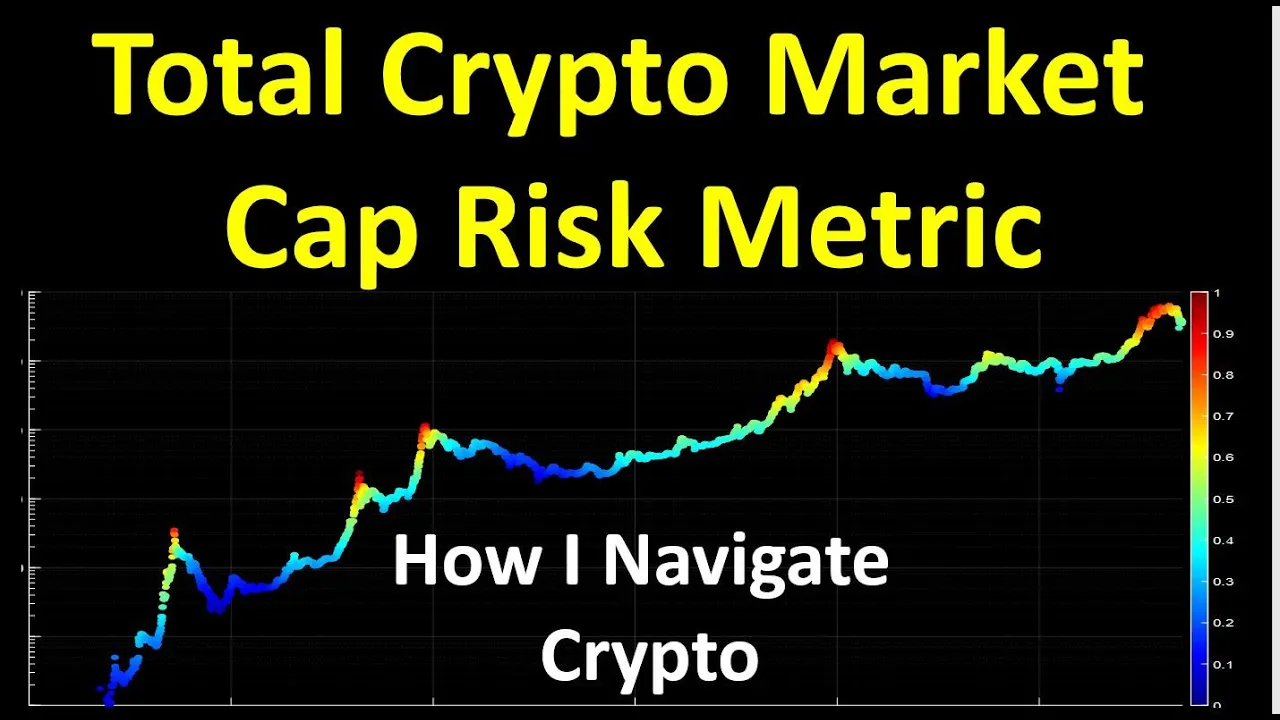
Now, at any given time, when you're at a local high, if it's in the 0.9 to 1 in the span, you really never know for sure if it's a local top or a market cycle top. Now, we speculate on it all we can, but you really never know until the cycle fully plays out. This chart is a chart showing the total cryptocurrency market capitalization on the primary Y axis on a logarithmic scale versus time, color-coded by the risk metric, which goes from zero to one.
When it's zero or close to zero or in the blue, it means it's historically low risk. If it's in the red, it means it's historically high risk. So, the whole idea is that when you're when you're living through the cryptocurrency cycles, you might be the most fearful when we're in these blue regions. However, if history is any indication, that's the best time to buy. It's just that most people run for the hills at that point.
Really, the time you should be running for the hills is when this risk metric starts to get into the point nine to one risk band. That's to say you shouldn't necessarily sell everything, but if history is any indication, taking profits is not a bad idea. Now, the idea of a market cycle peak is a little bit fluid in and of itself because it depends on what you mean. For some people, the market cycle peak is when Bitcoin hits a high that it will not overcome for years to come.
But remember, the same day that Bitcoin hits its all-time high is very unlikely to be the same day that a lot of other cryptocurrencies hit their all-time highs. If you think back to April and May, Bitcoin hit its all-time high in April at around $64,000, and then Ethereum didn't go to 4400 until the following month. So, there is somewhat, you know, some some degree of of of things being a little bit fluid when talking about market cycle peaks because you do need to specify what are you talking about?
Are you talking about Bitcoin? Are you talking about the entire asset class? Are you talking about Ethereum? Obviously, we primarily talk about it with regards to Bitcoin, but if you sell every part of your cryptocurrency portfolio just because Bitcoin's at a market cycle peak, you could miss you could miss an alt season that follows that market cycle peak and a potential bounce that doesn't quite get you back to the market cycle peak, okay?
So, the way I navigate crypto, we do have the Bitcoin risk metric. Again, I showed that a few weeks ago. I'll probably show it again relatively soon. Um but this is the total cryptocurrency risk metric, okay? The total cryptocurrency asset classes market capitalization. And you can generally see that there was times when it makes sense to maybe take profits off the table. And and then in the blue regions, and the light blue, and even in the green, it means historically DCA, right?
And in this situation, if you had been DCAing over here, you would have had to have lived through some short-term moves to the downside. But this is sort of where you just have to you have to distract yourself with something else, right? You just DCA into the market, you recognize there's more downside risk, but you don't care. You just keep on buying. And then eventually it goes parabolic, right? And then when it comes back down into these regions, when it pulls back, you can DCA again with the expectation that it could go up or down, right?
Because if you're deterministic about anything, it it will it is somewhat dangerous, right? This is the same type of thinking that I think got a lot of people in trouble back when Bitcoin was at 64k. You know, so many people thought that we had to have a September market cycle peak or even a summer market cycle peak. So many people thought this that they were unable to see at the time that Bitcoin was so far extended, right?
They they were blind to that because in their minds Bitcoin had to peak in a certain month at a certain price. You know, you have to be flexible on on what Bitcoin is what you're allowing Bitcoin to do. I mean, remember, at the end of the day, Bitcoin's going to do whatever the hell you whatever the hell it wants, not necessarily what your model says. Okay? So it's more important, in my opinion, to react to moves like this than to necessarily predict exactly when it will happen.
I didn't need to know that Bitcoin I didn't need to know in, say, you know, April of 2020 that Bitcoin was going to go to 64k by by April of of 2021. I didn't need to know that ahead of time because I was DCA-ing regardless. But whenever 64K Whenever 64K ended up coming, whenever we we we hit those higher risk bands, that's when I knew, okay, it was time to take some off the table. Again, if you followed the premium list, I sold 87% of my Bitcoin that was in long-term capital gains territory before the May before the drop in May.
And actually on the way up on the way that Bitcoin was going up, I took a lot of profits out of Bitcoin and then put them into altcoins. And now I started skimming some of those profits out of Bitcoin, uh you know, well before it got to those final stages, but it doesn't matter because I put all of those profits from Bitcoin and I kept skimming more profits off the top of Bitcoin and then putting them into altcoins and was letting the altcoins ride, okay?
And I still had more more Bitcoin, but then I slowly sold off a lot of my Bitcoin into altcoins. Then I rode those altcoins up and then I took profits on them and then we had the May drop and then the risk levels on everything just crashed back down. And so I started accumulating again when Bitcoin dropped to $30,000 back in back during the flash crash of May. Okay? So, you know, there's no these models that we talk about, right?
These these theories that we talk about and and cycle theories and whatnot. And you guys know my opinions on on cycle theories. I told you guys a long time ago I don't I don't think the peak is going to be in September. Um at least not the market cycle peak. But when we were in April and May, I said we were ahead of schedule. Now a lot of people thought that I was just saying we're ahead of schedule because if you measure the market cycle ROI as measured from the bottom or as measured from the having, it showed we were ahead of the prior cycles.
But in reality, the main thing that was you know, that was alerting me to the fact that we were ahead of schedule is the fact that the total cryptocurrency asset class was in the upper risk bands. It was in the 0.8 to 0.9 risk band and the 0.9 to 1 risk band. Okay? That's what alerted me to it. So again, I say, does it matter exactly when it happens? No. What's more important is when it happens, do you take advantage of it, right?
That's the more important aspect, in my opinion, right? Um so, if you take the color out of it and look at it like like this, you can see that, you know, the total cryptocurrency asset class, when it goes to these high-risk bands and gets in these upper levels, it it definitely makes some sense to to to skim some profits off the top. Now, this is not you know, this is not to say that you can't just ride the market through.
It's not to say that you have to take profits. It's just to say, you know what? When the market is overheated and it's in these higher risk bands, historically speaking, if you did take some profits, you would have been fairly happy. And And again, it it strikes again, and you can see that once again, you know, we saw we saw this this sort of thing play out. Like, imagine imagine you were, you know, you you did something like this, where you buy you buy up to say the 0.7 risk band or something.
Um and which is what I do, by the way, for for the total asset class, buy up to 0.7 risk. Um you know, when when it made this move, you could just say let it ride. Maybe you take some profits on it, maybe you don't, maybe you just wait for the 0.9 to 1 risk band, if you want to be incredibly risky. And you just you don't buy beyond this point. And then if the risk levels ever come back down, then you continue to DCA, right?
So, you you DCA you you you DCA for years and years and years and years. You let it ride, maybe you take some profits, and then if it pulls back, okay, you go back in. Um and then ultimately, when it makes these, you know, these crazy market cycle peaks, ideally speaking, anyways, you know, you would take profits and and then hopefully rinse and repeat the process. The hard part, of course, is knowing what comes after these pullbacks, right?
Is it Is it just something like this, where we sort of come back down, spend a little bit of time down in this this area, and then go back up? Or does it look something like this, where we come down and instead of spending a little bit of time in this area and going back up, we then go even further down? But the whole point is to say, as long as you follow a strategy and just DCA whatever cryptocurrencies you want below a certain risk level, as long as they're, you know, useful cryptocurrencies, and hopefully Bitcoin, Ethereum, and then a few others, then you should be doing relatively well, even if you have to live through occasional 50% drops or more, right?
Even if you have to live through them. You know, one of the things I I I I tell myself, anytime the risk levels are are low, is I never really fully know, 100% sure, that we'll ever go back to these higher risk levels. Like, I think we are, right? I always think we are, but I'm not going to say deterministically we have to go back to these higher risk levels. What I always say to myself is I don't know if we'll go back, but if we do go back, you sure as hell can bet that I'm going to have a ticket to that show, right?
I I'm not I would not miss one of those shows. So, I I don't really know exactly what we have to live through to get to those shows again. Um the the point to say is when we're at lower risk levels, anything that happens in in the short term, in my opinion, is just noise. It's just DCA time. Forget about, you know, forget about if it if it drops, if it drops, you just DCA more. This goes back to the whole dynamic DCA strategy, where, you know, you you might DCA less up in these levels than you do over here, and then then you do over here, and then if it's all the way down here in these lower risk levels, then you DCA more, right?
And then that's just the way, you know, that that's sort of one way to think about it. You know, one interesting thing is to look at this risk metric and to see that we're putting in um higher lows, right? We're we're putting in Here is a low, and then we put in a higher low, and then we put in a higher low, and then again a higher low as well. So, we've done it four times now. And, you know, I mean, it'll be interesting if we continue climbing this and and and continue just going up.
Um and this has lasted since the end of 2018. I mean, we're we're talking about going on 3 years now where where the the total cryptocurrency asset class market capitalization risk metric has been putting in higher lows. Okay? Um I mean, it's possible that the next higher low could be at 0.7 risk. I mean, you know, these things are certainly possible. So, we'll just have to keep that in mind. Obviously, when when you get to these these phases, it's more so just all right, you you know, you you you recognize the risks involved and and you just sort of have to you you just live with it, right?
You you just figure out if it's worth your your your risk um or if it's in your risk tolerance or not. And if it is, you do it. And if you don't if it's not, then you just don't do it. Um and then I I do know a lot of people prefer doing something like this where, you know, you only buy when it goes into these lower risk bands, you don't do anything in this region, and then you only sell when it goes up here. Some people do something like this.
I actually know a lot of people a lot of uh you know, a lot of people that do stuff like this. And I think the people that follow this strategy are the ones that you know, they they don't really want to follow crypto on a day-to-day basis. What they want to do is every few years they just want to put a lot of money into crypto and then wait for it to go to these higher risk bands, and they just take profits. And then just wait again, right?
They just wait until it goes back down. And eventually it will go back down, but they don't really know when it'll happen. But there again, it's sort of a mentality, right? You don't have to time every single move. You just have to you just have to have a strategy and stick to it. And I think that's the most impressive way um to navigate crypto to anyone is just to have a strategy and and stick with it rather than chasing what was shilled on Reddit that day, okay?
So, just keep these things, you know, keep these things in mind. So, when we're at these higher risk bands, like I would say above eight above 0.8 especially above 0.8 is historically it's the you know, the best time to be skimming profits off the top. No one's going to be able to tell you the exact day that every every altcoin peaks or or say every single day that Bitcoin's going to peak cuz a lot of the altcoins peak on on different days, but again, no one can tell you that.
But, if you take profits just when we're in those levels over the course of a few weeks, then whatever the pullback does happen, you'll look back and you'll be happy that you took profits, right? So, that's that's more or less how it works. I should say that, you know, tax implications are a thing in terms of in terms of how people use this risk metric. For people that for for people that incur, you know, short-term capital gains if they bought something and they don't want to sell it a few months later, they might develop the strategy where they have a gray region in between somewhere where they don't buy or sell.
They just buy down here maybe and then they sell when it goes up, um but they don't buy it and sell it, you know, just right above each other. Like they don't buy it below 0.7 and start selling it immediately above 0.7 or they they have like a a gray region in between. So, I thought this chart was interesting. This shows the number of days spent in each risk band. Um and it's interesting because it shows that we spend the most number of days in the 0.3 to 0.4 risk band.
For the 0.4 to 0.5 risk band, we spend the second number of most days. And you can see that on either end, we spend the least amount of time. So, we spend the least amount of time in the 0.9 to 1 risk band and then the 0 to 0.1. So, the extremes we spend the least amount of time in and generally that's the best time to be either buying or selling depending on in buying over here, selling over here. Arguably though, above 0.8, uh you know, you have a few weeks, maybe even a couple months to be, you know, skimming profits here and there if you if you want to to uh to secure some of those gains um before we get a a a fairly significant drop.
I mean, that's what we had over here, right? We were above 0.8. Uh we actually came back down and that moved to 29K, so it would have allowed people to buy the dip if they were going 0.7 and then all the way back up. And then we stayed up in this region where we sort of just hung around up here. And it it sort of just gave people time to take profits. And again, my strategy back then was I I'd bought Bitcoin and a lot of altcoins over here.
As Bitcoin started to climb this thing, I started taking Bitcoin out and and DCA'ing Bitcoin for altcoins, then letting the altcoins run, and then taking profits out of altcoins back to US dollars and or back to Bitcoin. And then when it drops, you just rinse and repeat the same strategy. And then here it says the same thing but as a percentage of time, so you can see we spend a relatively small amount of time in these upper risk bubbles, but those are of course the most exciting times and the times that everyone seems to live for uh in crypto.
Another thing is is this was this and I showed this in the last video. This was just a snapshot of of some of the risk levels back in back in um March. Obviously, they look a lot different today. Uh clearly they look a lot different today. Um but back in March, remember the risk levels are dynamic. Back in March, one of the reasons why again why I was saying Bitcoin is so far ahead of schedule is because we saw I saw this.
You know, I'm like, all right, we're at 60k, the risk level is 0.875. And and then as as I as I reminded you, this was also the same time that a lot of people said, you know, sell your Ethereum. It's not doing anything, you know, it's not going anywhere. You should everyone should just sell their Ethereum. And I kept telling you, right? I was like, no. And I was adamant at the time that the Ethereum tsunami was coming.
Why? Because I saw this discrepancy. I mean, Bitcoin was three risk bands ahead of Ethereum. And it seemed like only a matter of time before Ethereum played a little bit of catch-up. Right? And I mean, that's what transpired. I mean, yeah, Bitcoin had a had a drop, fairly nice drop, back down to like, you know, 50k or something. Um but then it had sort of that bounce back up and during that bounce, Ethereum doubled up.
It it went 2x in 2 weeks. Right? So, the Ethereum tsunami comes, it's just a delayed beyond what a lot of people think. So again, you know, the point of all this is to show you, you know, to give you a glimpse into the premium list if you if you have ever wondered what's there. This is not the only stuff. We also have a lot more things. We have the Telegram alerts channel. In the Telegram alerts channel, I I post a lot of daily messages, audio updates, my thoughts on the markets, not just crypto.
I also sometimes talk about stocks and precious metals, real estate, and and you know, just the other day we were talking about dividend stocks. So, it's sort of just my candid thoughts in a lot of different markets with a primary focus on crypto. We also have the Telegram chat room. We have the the risk dashboard, of course, that looks a lot different than this one today because again this one was from half a year ago or more or maybe around half a year ago now.
And you know, it also we also have an Into the Cryptoverse app which has the risk levels. We we have two weekly videos where we one is sort of we put out on Wednesdays and then another one we put out on on the weekend and it's sort of like a special topics type thing. So, sometimes you know, we talk about you know, what's the best day to buy a certain crypto. What's the best time based on historical data. What you know, what is modern portfolio tell it modern portfolio theory tell us about certain cryptocurrencies.
How how do various strategies pan out if you followed, you know, waiting your assets by market cap, by the square root of market cap, by the natural log of market cap and and then different strategies there. So, we do these special weekly reports, a newsletter called the quantitative investor that goes out every weekend and and then we have a video to go along with it. So, you know, there's a lot of things involved and then again the reason I'm saying this is the prices on the premium list are going to be going up in about nine days.
So, if you want to lock in the lower rate before they go up, make sure you do so and then you'll know at least how I'm navigating crypto. And if you don't want to do so, that's completely fine, right? What I would say is if if you're following crypto and you know, you don't want to follow this plan, which is completely fine, right? It's completely fine. Uh What I would say though is come up with a plan. Even if it's not mine, like you really should come up with a plan to navigate crypto.
Whether it be, you know, you say, "Okay, if it if it appreciates a certain amount, you know, you're going to take some profits off the table." The hard part is don't move the goalpost, okay? If if you set out sort of these milestones for yourself and say, "All right, well, if I hit these milestones, I'm going to be able to make it, right? I'm going to be able to provide, you know, certain things that I would have never been able to provide before, and I can, you know, you can pay off loans, whatever, right?" A lot of people have a habit of moving the goalpost.
So, once they hit that milestone, they just say, "Oh, well, you know, I'd rather go I'd rather watch it go up another 2x, and then I'll take profits." And then maybe even it hits that milestone, they just keep moving the goalpost. So, I imagine a lot of people did this back over here. And theoretically, if you're doing it for Bitcoin, it it's okay because if any if history is any indication, Bitcoin will eventually bail you out.
But the problem is a lot of people, you know, bet the family farm on a lot of altcoins, and a lot of these altcoins, you know, especially if you're going after microcaps, some of them will do well, but a lot of them just trend to towards zero over the long haul. I would encourage you to go look at the top 10 cryptocurrencies by market cap back in 2013, and I would I would guess that you probably don't even recognize five or six of them.
You've never even heard of them before because back then, you know, I mean, the asset class was a lot different. I would also speculate that five years from now, there's a high probability that we have several coins in the top 10 that don't even exist today. They just simply don't even exist today. So, you know, you have to you have to take one cycle at a time, and and also remember that if you bet everything on a microcap when the total cryptocurrency asset class risk metric is in these like high risk bands, then you are playing with fire, and those are the ones that can get wrecked the easiest when Bitcoin when Bitcoin drops back down.
So, again, I I wanted to show you guys the total cryptocurrency risk metric again. Um this is slightly different than Bitcoin's. Bitcoin does account for diminishing returns, so does this one. Okay? And I I use these sort of in tandem to try to figure out how I'm going to navigate crypto. So, again, intothecryptoverse.com if you want to follow this, but again, even if you don't, that's fine. Just come up with a strategy, stick to it, don't deviate from it, and I mean, you know, the rest is noise, right?
Like the rest is noise. Cycle theory is somewhat noise. I I think a lot of it is is is complete noise. And I I I I tell you guys what I think's going to happen, but at the end of the day, um you just have to come up with a plan and stick to it. Thank you guys for tuning in. If you guys like the content, make sure you subscribe to the channel at the very least. Check out the premium list at intothecryptoverse.com, and I will see you next time.
Bye.
The words are the caption track's own and nothing is reworded or re-transcribed. Paragraph breaks are placed between sentences so the text reads as prose.
Free tools for your own script. No signup, no login.
Paste your draft and see where viewers are likely to drop off, with a rewrite for each weak line.
Paste the first 30 seconds of your own draft for a hook score and rewrites.
Check your draft against YouTube's advertiser-friendly guidelines before you record it.
Read this channel's public videos and transcripts, and download a writing brief for it.
Most replayed moment #1
15:253.2x the video's typical replay level
take profits. And again, my strategy back then was I I'd bought Bitcoin and a lot of altcoins over here. As Bitcoin started to climb this thing, I started taking Bitcoin out and and DCA'ing Bitcoin for altcoins, then letting the altcoins run, and then taking profits
Said at 15:18
Most replayed moment #2
5:573.1x the video's typical replay level
regardless. But whenever 64K Whenever 64K ended up coming, whenever we we we hit those higher risk bands, that's when I knew, okay, it was time to take some off the table. Again, if you followed the premium list, I sold 87% of my Bitcoin that was in long-term capital
Said at 5:49
Most replayed moment #3
8:352.5x the video's typical replay level
you know, we saw we saw this this sort of thing play out. Like, imagine imagine you were, you know, you you did something like this, where you buy you buy up to say the 0.7 risk band or something. Um and which is what I do, by the way, for for the total asset class, buy up to
Said at 8:27
The graph counts replays. It does not show where viewers stopped watching.
Sentence shape
| Measure | This transcript |
|---|---|
| Sentences | 242 |
| Average words per sentence | 19.4 |
| Longest sentence | 66 words |
| Questions asked | 48 |
| Sentences containing a number | 30 |
Most used terms
Filler phrases
171 in total: you know 60 · right? 29 · like 24 · um 21 · sort of 14 · I mean 11 · uh 9 · actually 3.
A literal whole-word count of the same phrase list the Prepublish browser extension uses, so a phrase inside another word is not counted and a phrase used in its ordinary sense still is. It is a count and not a judgement.