Getting the transcript
Reading the captions from YouTube. A video nobody has opened here before takes 10 to 30 seconds; this page fills in on its own.
Getting the transcript
Reading the captions from YouTube. A video nobody has opened here before takes 10 to 30 seconds; this page fills in on its own.
Sandeep Swadia · @SandeepSwadia
This video has no Most replayed graph yet: YouTube shows one only once a video has enough views. These are the moments viewers replayed most in Sandeep Swadia's most watched videos.
Most replayed moment at 1:38
4.9x that video's typical replay level
extract. Open the voice mode in Chat GPT and say, "Listen, you're my chief of staff. Interview me for 20 minutes, 30 minutes, my background, my tone, my strategy, my blind spots."
Said at 1:33
Most replayed moment at 0:55
3.8x that video's typical replay level
call it ARR. If a task is autonomous, recurring, and reviewable, it's a strong candidate for an agent. If it needs live judgment, or it only happens once, or can't be reviewed clearly, then use a prompt. That one distinction alone will
Said at 0:48
Most replayed moment at 14:58
3.9x that video's typical replay level
because you're going to ask, "What's the connection between cause and effect?" Is it obvious? Then you're in a clear system. Is it discoverable through analysis? Then it would be a complicated system. Is it emergent and constantly changing and you can get to it only in hindsight? That could be a complex
Said at 14:51
The graph counts replays. It does not show where viewers stopped watching.
Words
3,190
Runtime
21:45
Speaking pace
147wpm
Reading time
13min
147 words per minute, below the 160 25th percentile of 349 measured videos. That distribution comes from the 349-video hook study.
Opening (first 30 seconds)
This is how you use AI to change your life. Most of us use ChatGPT or Claude for productivity hacks or [music] to do work that we don't want to do. But can AI actually make a difference? Can it help you build a life worth waking up for? I think any thinking partner can. If you use it the right way, so we're going to look at the five blind spots that keep
74 words, the words spoken in the first 30 seconds at 147 words per minute.
Free, no signup. See how the first 30 seconds hold attention, with rewrites.
Sentence shape
| Measure | This transcript |
|---|---|
| Sentences | 318 |
| Average words per sentence | 10.0 |
| Longest sentence | 43 words |
| Questions asked | 27 |
| Sentences containing a number | 12 |
Most used terms
Filler phrases
18 in total: you know 7 · actually 4 · like 4 · I mean 1 · right? 1 · um 1.
A literal whole-word count of the same phrase list the Prepublish browser extension uses, so a phrase inside another word is not counted and a phrase used in its ordinary sense still is. It is a count and not a judgement.
Run the check on the words above: where attention is likely to drop, with a rewrite for each weak line. The free check shows the scores and the one issue costing the most.
What this transcript is
Every word below is the caption track YouTube publishes for this video, pulled from the video itself and reproduced unchanged. It is not Prepublish's writing, not a summary, and not a re-transcription: it is the video's own published captions. English captions, generated automatically by YouTube, in the video’s original language. Source: the video on YouTube. A channel that would rather this page did not exist can ask for its removal through the contact page, and it is removed.
This is how you use AI to change your life. Most of us use ChatGPT or Claude for productivity hacks or [music] to do work that we don't want to do. But can AI actually make a difference? Can it help you build a life worth waking up for? I think any thinking partner can. If you use it the right way, so we're going to look at the five blind spots that keep you stuck in survival mode. For each blind spot, we're going to do three things.
First, unpack why it happens. Second, show how AI can help. And third, what you can actually do about each blind spot. And for each one, I'll share a specific approach and a specific prompt that turns AI into your partner as you reinvent yourself. I'll also show you where AI is limited and why your judgment still has to stay in charge. Do this seriously for just 30 days and you may become unrecognizable in the only way that matters.
The most dangerous thing on the road is not always the thing you can see in front of you. On US highways, you see these 18-wheelers, these massive trucks that weigh around 80,000 lb. They're very hard to turn. Some personal injury law firms estimate that 840,000 crashes a year in the US alone involve lane changes and blind spots. And you know, our lives feel like those giant trucks sometimes. The freight you carry is heavy, building your career, your family, a company, a future.
The road is full of lane changes. The first blind spot is [music] deception. Why do I keep doing the thing that I know is hurting me? Every plane carries a device called the black box. When something goes wrong, investigators don't start with the pilot's memory or his or her story because under pressure memory gets distorted. They start with the data recorded in the black box. Self-improvement ought to start in the same place.
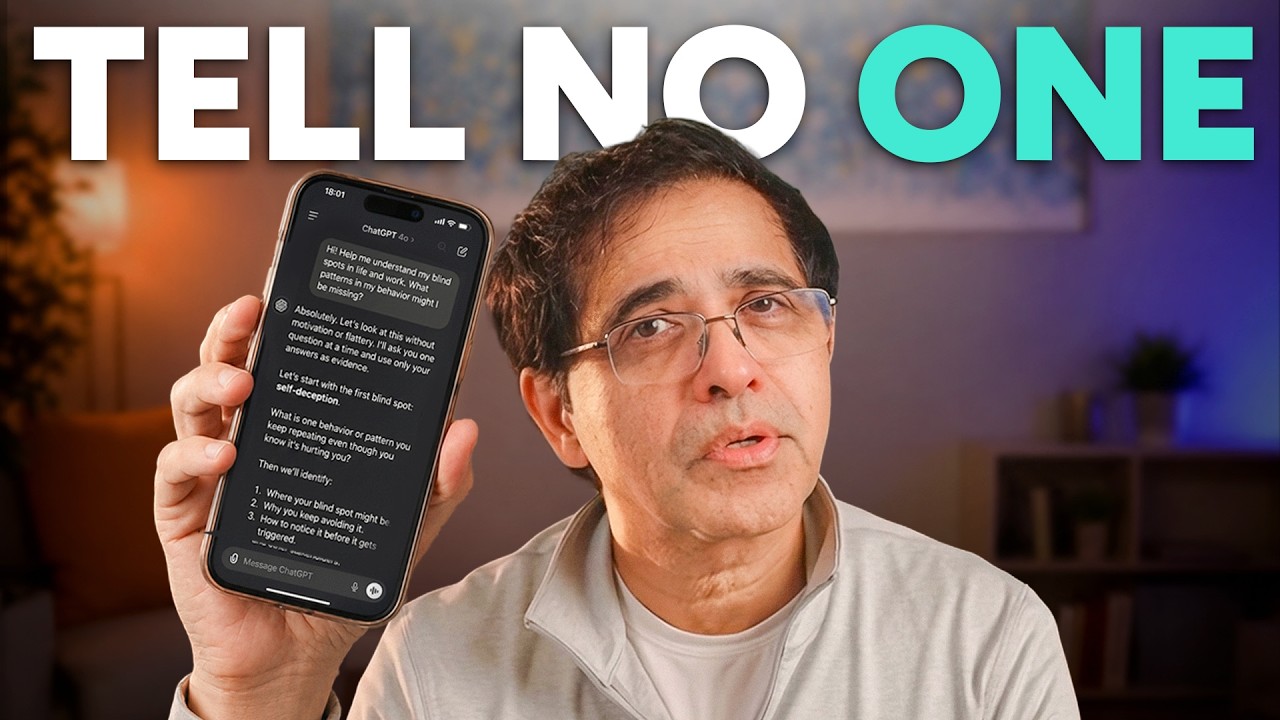
Your life is the black box. It has all the data. It has all the information, but you can make AI to act like the investigator. It can help you examine the evidence you can provide from a third party's perspective. The pattern that you may not have seen before become more obvious. Here's our first prompt. Act as an investigator for my behavior. This is the pattern I keep repeating. I don't give candid feedback to my team members, even when I know it would help them.
I focus on positives and avoid the uncomfortable conversations that could help them improve dramatically. Now, this is a real pattern for me, but you could insert any pattern of your choice. For you, the pattern might be that you can't work out consistently, which is my problem, too. Or that um work keeps getting your best attention while your partner or family gets the leftovers. Whatever it is, share here. Next part of the prompt.
I want to understand three things. One, where my blind spots may be. Two, why I keep avoiding them. Three, how do I catch them before they're triggered? Interview me one question at a time. Unpack my answer and based on it, ask me the next better question. Use only my answer as evidence. When you're ready, give me your best hypotheses, the evidence behind it, and the evidence that's still missing. Be respectful, candid, and direct.
Do not motivate me or flatter me. Do not suck up to me. That's the whole move. That's the prompt. One very important caveat here, AI doesn't have any divine insights. It can distort facts, it can overstate patterns, and it sounds more certain than it should. So, treat the answer as a hypothesis, not a diagnosis. AI is not a trained psychologist. So, why use it at all? Because your own mind is not neutral, either. The problem is that we rarely recognize our own self-deception.
Once we've found a story that protects us, we stick to it. We stop asking a harder question. Now, what do you actually do in real life when you see it spots such a deception? A study from Frontiers in Psychology found something very interesting. They found that real, concrete, negative feedback can reduce self-deception. I was surprised to find that, too. And I don't mean feedback from social media trolls. Ignore all of that.
I mean feedback from someone who has worked with you, who knows you well. That person has already told you the truth at least once in the past. Here's one thing that I do. I keep a list of every hard piece of feedback I've gotten over the years. And I read it sometimes. I go back to it. I don't kick myself for it, but again, it's a good mirror. Also, if you want a more in-depth look at topics like this one, please join our newsletter.
Every Tuesday, [music] one insight, one tool, and one practice. I love writing it. Link is below, and it's totally free. Now, let's go to the second blind spot, relationship. The stories we tell ourselves about others. There is a psychologist named Eli Finkel who ran a study at Northwestern University with 120 married couples. And all of those couples had their relationships slowly getting worse. Now, some of these couples were asked to write about their worst fights from a view of a neutral outsider who wanted the best for both of them.
And you just had to do it for 20-odd minutes. And the surprising fact was [music] the decline for those couples stopped. The rest who didn't go through that writing exercise kept sliding further. And I think that happened because writing brought them some clarity that every communication has four parts. What you meant to say, what came out of your mouth, what the other person heard, and what they interpreted. And all four of these can be very different.
Because in every conversation, we bring a story. She ignored me. He disrespected me. My partner doesn't love me. My employees are lazy. On and on. And too often, the goal of that conversation is to reaffirm that story that's playing in our head. Every new detail is recruited to reinforce that old story. And that's why relationships are such powerful blind spots. Because the distance between a conversation and a prosecution is so tiny.
This is where AI can help. In the previous blind spot, we used AI to act as an investigator. For this one, we use AI as the counterparty. Use it to build the stronger version of the other person's case. Here's the prompt. Act as the person I am in conflict with, or the person and trying to communicate with. Do not pretend that you know their inner life. Here's the situation in my own words. You can now describe the conflict or a conversation that you want to have.
Be as honest as you can. Here's what I plan to say. Tell AI what you're trying to say, your side of the equation. Do not take my side. Argue their case as they might, assuming they're smart and fair and have reasons that make sense to them. Then, tell me the following. One, what they most likely feel that I'm not seeing. Two, the weakest part of my argument. And three, what they may need to hear from me. Do not flatter me.
Do not turn this into a therapy session. Help me rehearse the actual conversation. That's the prompt. And by the way, for this one, turn the sound mode on and have an actual spoken conversation with AI. Now, what do we do about this in real life? Well, the study that I talked about gave us a clue. That small habit of taking a neutral, third-party perspective >> [music] >> helped stop the decline in those couples. So, that's definitely a good move.
One other thing I learned, a little late in my life, unfortunately, [music] was to replace accusation with observation. You know, we sometimes don't know the difference between attacking the pattern versus attacking the person. The useful move is much simpler. Name the behavior, name the impact, and then ask the question. Be curious. So, instead of saying, "You don't care about me." try this. You know, when I don't hear back from you for 2 days, I start wondering if this is important to you.
Is that fair? Am I being [music] fair? What do you think? That's the human work that we have to do. AI can help you unpack the story, but you still have to face that person yourself in that room. Now, the third blind spot is the relationship you have with your own identity. We're entering an era where you may have to reinvent yourself again and again, and that's one of the trickiest transformations. That's where we go next.
There is a strange illusion in [clears throat] psychology called the end of history illusion. Researchers studied more than 19,000 people between the ages of 18 and 68, and they found that people can look backward and see how much they have changed, but when they start looking forward, they assume they're not going to change that much. We know how much we changed in the last 5 years, but we feel certain we'll be the same for the next 5 years.
As if we have arrived at some final version of who we are. That's never the case. That is the identity blind spot, and it gets worse. Sports researchers have found that athletes who have their sense of self fused too tightly with the sport they play often have the hardest time when they retire. And you know, I have had a lot of personal experience with this idea of ever-changing identity. I have pivoted so many times in my life.
When I was young, I wanted to be a monk. That's all I wanted to be. I trained for it in an ashram. Well, that didn't work out. Then I tried to be a full-time musician, then a mathematician, an equity analyst on Wall Street, a CEO of an AI company, a board member, then an investor, and now this YouTube channel. So, technically I am a creator, but now when I look back and think about it, none of those roles were fused with my identity.
They didn't form my identity. They were just clothes that I was wearing, not my skin. I wore them when it was time, I took them off. So, that's one good way to look at life. The confusion feels existential, but it's just navigational. This is where AI can help. For this blind spot, AI is your mapmaker. It can give you a map from the old territory to the new landscape. Here's the prompt. Act as my transformation partner.
You are my mapmaker. Map out my next move. Here's where I am right now. So, here you can put your current role, your strengths, your habits, your fears, what people reward you for, and so on and so forth. Give it more details. Here's where I'm trying to go. Here you'll describe your new chapter. Be honest, you know, your new job, your new company, new career, new relationship, new phase of life, health reset, whatever lies ahead.
Now, interview me one question at a time to find the gap. Then, give me an action plan and a map that bridges that gap. Respond to these five questions. Number one, which of my strengths still will carry over? Number two, which strengths will become liabilities in this new chapter? Number three, what I need to leave behind even though it's worked before? Number four, what I've never built but is now needed? And number five, what I should test for at least 30 days before I make a bigger commitment.
Do not give me abstract purpose advice. Do not flatter me. Do not give me a 10-year life plan. Give me a practical transformation map. And do not suck up to me. You have to keep saying that. All right, so that was our prompt. Again, one caveat, AI won't know the emotional cost of whatever you're leaving behind to become someone new. It will make this reinvention of your identity sound crisp and clean. But, life is usually pretty messy.
I've gone through such transformations many times, and I know there is grief, there is fear, there is anxiety. But, there's also growth. Now, what do you actually do once you see the gap? You should run the smallest real test that you can. For instance, don't quit your day job until your new adventure shows some promising signs of working. The fourth blind spot is forks, the decision you keep staring at because it's hard to make.
There is a movie called Cast Away. And at the end of the movie, the main character, played by Tom Hanks, is standing in the middle of a crossroad, a map in hand, weighing his options. We've seen everything that he's gone through and what brought him here. And for a moment, the whole movie boils down to one question, which road will he take? We all know that feeling, standing at a fork, staring at a decision we don't know how to make.
Do I go left or right? Do I quit or stay? Propose or wait? Forks are hard because both roads have a cost. Both roads have a risk, and you don't get to live both of them simultaneously. So, how do you forecast these risks? Gary Klein created a decision tool called pre-mortem. Before you make the decision, you should imagine the absolute worst scenario. Describe it in detail. Write it down. Then ask, "What went wrong? What did I ignore?
What was I too excited to miss? What was I too afraid to admit?" This is all hypothetical, so create the most realistic scenario you can. And this is where AI can help you tremendously. In this blind spot, AI becomes your simulator. It runs that pre-mortem with you. And here's the prompt. "Act as my decision simulator. I am facing a fork ahead." Here you can describe the decision you have to take, the options you have, etc.
Option A is describe option A. Option B is describe option B. Here's what I know. Now you can add all the constraints, money, time, people, organization, timeline, whatever. The rest is the same. Interview me one question at a time to understand the decision, and then run a separate pre-mortem on each option. For each one, imagine that it's 2 years later and that choice failed badly, and work backward from there, and tell me why.
Treat them independently, so I can compare how each road fails differently. And then for each road, tell me these three things. Number one, the most likely way it will fail. Number two, the warning signs I should see first. And number three, the cost I cannot reverse. Do not tell me what to choose. Be very rigorous and systematic about your analysis. All right. So, that was the prompt. Again, you can add anything you want on top of it.
You're not asking AI to choose the road for you. It cannot. No one can. But AI can pressure test your assumptions. It can surface risks that you haven't thought about yet, and help you understand the trade-offs. That's what that exercise is for. Now, what do you do in real life after AI has analyzed it? I like Jeff Bezos' rule. He talks about two types of decisions, one-way doors and two-way doors. A two-way door is when you can walk through a door and if it doesn't work out, you walk back.
The cost is bearable. In those cases, you should move fast. And a one-way door is the one you can't reverse. Those are rare, but they do happen. When you're facing one of those, slow down. Now comes the fifth blind spot, trials. What do you do with the trauma and pain after you have failed? Our trials and traumas don't ask for our permission. They arrive unannounced. They don't care for our opinions. Long-term viewers know this story that I've shared before.
At one of my jobs, my boss invited me to a very fancy restaurant for drinks and dinner. And I was thinking that I was getting promoted. And in the middle of the dinner, he handed me a brown envelope and said, "We've decided to let you go." When failure comes this suddenly, your entire body just shuts down. But the blind spot isn't the event. It's the story that stays behind. Why do I keep screwing up? I shouldn't trust people.
I should have never tried that. On and on and on. A researcher at UT Austin found something strange. People who wrote about a painful experience for even 15 minutes four days running were way healthier months later. And that has been my experience, too. When [music] we fall, writing about it helps a lot. And this is why AI can help. For this blind spot, AI becomes your debrief partner, a companion. Here's the prompt.
Act as a debrief partner for something difficult that I have gone through. Here's what happened. Now you can describe the failure, loss, your setback, betrayal, rejection, grief in plain language. The story I've been telling myself about this is this. Share what you've been thinking about, about yourself, about other people, trust, risk, love, work, future, all of it. The rest, of course, is the same. Interview me one question at a time.
Do not comfort me or try to find a solution. I just [music] want to talk. And then help me understand the following four things. Number one, the facts of what happened. Number two, the meaning I keep attributing that isn't about the facts. [clears throat] Number three, what was mine to control and what wasn't. And number four, one thing to carry forward, one thing to leave behind. That's the prompt. And again, remember, AI is not a therapist.
And for some traumas and some trials, you're going to need one. If this is a grief, pain, or a weight you can't lift alone, a language model is not the way to go. Talk to a close friend or an expert. Take care of yourself. Loss and grief change you. They rearrange you forever. You don't get to go back to who you were before. But you don't have to let your wound become your way of life. There is an old Buddhist teaching that [music] pain and suffering are not the same things.
Pain is what happened. Suffering is the story we keep telling ourselves after. You know, when I first learned guitar, the skin on my fingertips would split. It would bleed. It hurt. But then the skin hardened. First, there's pain. Then there's music. Thank you. And I love you.
The words are the caption track's own and nothing is reworded or re-transcribed. Paragraph breaks are placed between sentences so the text reads as prose.
Free tools for your own script: paste a draft and see where it stands before you record it.
Paste your draft and see where viewers are likely to drop off, with a rewrite for each weak line.
Paste the first 30 seconds of your own draft for a hook score and rewrites.
Check your draft against YouTube's advertiser-friendly guidelines before you record it.
Read this channel's public videos and transcripts, and download a writing brief for it.