Getting the transcript
Reading the captions from YouTube. A video nobody has opened here before takes 10 to 30 seconds; this page fills in on its own.
Getting the transcript
Reading the captions from YouTube. A video nobody has opened here before takes 10 to 30 seconds; this page fills in on its own.
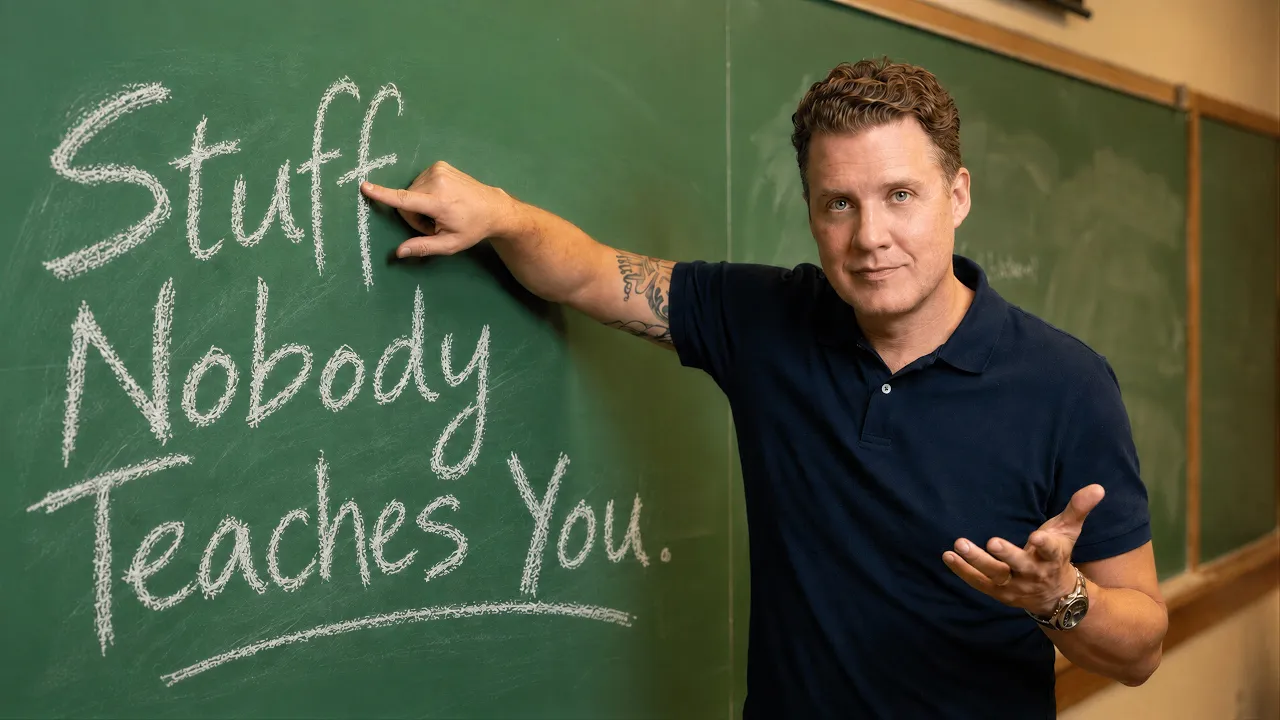
Mark Manson · @IAmMarkManson
Words
3,015
Runtime
15:29
Speaking pace
195wpm
Reading time
13min
195 words per minute, between the 181 median and the 201 75th percentile of 349 measured videos. That distribution comes from the 349-video hook study.
Opening (first 30 seconds)
Nobody hands you a manual called how to be a functioning adult. You're just supposed to know things. You're supposed to figure out how to like manage your money, your emotions, the people around you through some kind of trial and error process. So, consider this your [ __ ] manual. This is 33 things every adult should know how to do. Beginning with number one, learn how to tolerate being disliked. Look, some people they're going to hate the honest version of you. You can't help it, but that's so much better than spending your life putting
98 words, the words spoken in the first 30 seconds at 195 words per minute.
Free, no signup. See how the first 30 seconds hold attention, with rewrites.
Sentence shape
| Measure | This transcript |
|---|---|
| Sentences | 198 |
| Average words per sentence | 15.2 |
| Longest sentence | 57 words |
| Questions asked | 15 |
| Sentences containing a number | 31 |
Most used terms
Filler phrases
36 in total: like 14 · actually 10 · you know 5 · kind of 3 · sort of 2 · I mean 1 · uh 1.
A literal whole-word count of the same phrase list the Prepublish browser extension uses, so a phrase inside another word is not counted and a phrase used in its ordinary sense still is. It is a count and not a judgement.
Run the check on the words above: where attention is likely to drop, with a rewrite for each weak line. The free check shows the scores and the one issue costing the most.
What this transcript is
Every word below is the caption track YouTube publishes for this video, pulled from the video itself and reproduced unchanged. It is not Prepublish's writing, not a summary, and not a re-transcription: it is the video's own published captions. English captions, generated automatically by YouTube, in the video’s original language. Source: the video on YouTube. A channel that would rather this page did not exist can ask for its removal through the contact page, and it is removed.
No Script X-ray for this video: YouTube shows a Most replayed graph only once a video has enough views.
Nobody hands you a manual called how to be a functioning adult. You're just supposed to know things. You're supposed to figure out how to like manage your money, your emotions, the people around you through some kind of trial and error process. So, consider this your [ __ ] manual. This is 33 things every adult should know how to do. Beginning with number one, learn how to tolerate being disliked. Look, some people they're going to hate the honest version of you.
You can't help it, but that's so much better than spending your life putting on a performance for people who aren't even really paying attention. It's better to be disliked for who you are than to be loved for someone you're not. Number two, learn how to listen actively without interrupting. There is nothing more annoying than dealing with somebody who can't wait their [ __ ] turn to open their mouth and just has to interject every tiny idea they have into every conversation.
Maybe take a step back, pay attention to what people are saying to you, really try to empathize with their feelings, their motivations, their emotions because real connection requires listening to understand rather than just listening to respond. Number three, learn how to talk to strangers. I know your parents [music] were all paranoid and your teachers told you never to [ __ ] talk to a stranger, but it turns out talking to strangers is a really important life skill.
It just helps you move throughout the world. It helps you get the things that you need. It helps you speak up when something's wrong. Social confidence is not just handed to you. It's built through thousands of tiny mildly awkward situations. So, say hello to the cashier. Ask a question to a random guy on the street. Speak up in a crowded room and voice your opinion. Just see what happens. It could be worse. Number four, disagree with people civilly.
It's inevitable throughout life that you're going to run into people that have ideas that you think are just completely [ __ ] up and completely opposite of your own, but that's a normal, natural state of the world. In fact, I I argue a healthy version of the world is when you have lots of people of completely divergent viewpoints who interact regularly with each other and keep each other accountable. It's when you only have a world where everybody agrees all the [ __ ] time where [ __ ] starts to go wrong.
The important principle here is to not take these disagreements personally, to not turn everything into a moral judgment. That's what children do. An adult is able to understand that people come from their own walks of life, have their own [music] perspectives, and that there's pretty much some little nugget of truth in every point of view, no matter how much you hate it. Number five, learn how to give constructive feedback.
You need to learn how to name the problem, explain why it matters, and then offer a path forward. If they leave knowing only that you are disappointed, then really all you've done is make two people feel bad instead of one. Number six, be okay being bad at something. The truth is is that nobody became good at anything from the get-go. Everybody was bad at something first. And it turns out that to get good at anything you have to break that skill into multiple parts, you have to practice the weakest part, get feedback, and then repeat.
The world changes so fast that you're never going to know all the things that you need to know, so you're always going to run into situations where you just are bad or [ __ ] up something. Get used to it. Number seven, learn how to exercise alone without equipment. Your health shouldn't collapse because the gym is closed or you're on vacation or you are stuck in a hotel room and there's a snowstorm outside. Learn a simple bodyweight routine.
Gravity is free and annoyingly, [music] it is available everywhere. Number eight, learn how to politely decline an offer. This is a big one. You need to learn how to say no in a way that doesn't upset people or that people don't take it personally. Otherwise, you are going to be trapped in a prison of everybody else's requests for the rest of your life. Number nine, learn how to repair trust after a fight. It's a sad fact, but you're going to fight with the most important people in your life at some point.
Trust will be broken, people will disagree, mistakes will be made. The skill in relationships is not learning how to avoid the fights or prevent the fights, it's learning how to repair after the fights. Start by naming exactly what you did or what went wrong and what it cost the other person. Trust returns through boring consistent behavior, so your apology is only the starting point, not the finish line. Number 10, learn how to swim.
Learning to swim is actually vitally important for your personal safety. Uh it also provides a low impact full body workout that you can enjoy at any age. Also, swimming pools are awesome. Number 11, learn how to speak in front of groups of people. Being able to articulate your ideas is clearly a superpower in pretty much any professional or social setting. So, the better you're able to speak in front of groups of people, the better you're going to be able to disseminate your ideas and perspectives into the world.
Start small, focus on your breathing, remember people are usually rooting for you to succeed. Number 12, learn how to negotiate a price or a contract. This is a very important rule of life. You pretty much should never accept the first offer when buying goods or services or when agreeing to some business relationship. Always approach the conversation with curiosity in mind. Stay calm, understand that people have competing incentives and it's completely normal to go back and forth until you find a clean middle ground.
Number 13, learn how to clean up your [ __ ] house. Look, I'm not here to lecture you about a cluttered environment leads to a cluttered mind. I actually don't think that's true cuz I'm messy as hell, but I've learned over the years that just keeping your space clean and organized, it is some indication of self-care and self-respect. You are kind of making the future versions of yourself, making their lives easier. Not to mention when people come over, it does create a good first impression.
Especially if you're single. Number Number learn how to read and understand a nutrition label. Understanding what is actually in your food is unfortunately key to a long-term health. Once you get good at this, you will learn how much [ __ ] is in all of the stuff in the grocery store, and it will absolutely horrify you. Number 15, keep an organized calendar. Your time is arguably the only real resource you have in your life.
So, treat it with respect. Set plans. Obviously, plans often are broken or don't pan out, but a consistent system to ensure that you meet deadlines, meet commitments, know what space in the week you have to offer to other people, when you have free time both for yourself and for others, it is one of the most important methods of organizing your life. Number 16, learn to send thank you notes. In an era of instant digital messages, taking time to send a genuine thank you is like bare minimum these days.
Bonus points if you actually write it up by hand and send it through snail mail. I mean, seriously, when does that happen anymore? Number 17, learn how to create motivation by taking the smallest available action. What most people don't understand is that motivation usually shows up after you start something. So, you open the document and you write the first paragraph, you don't try to write the entire essay. Or, you put on your shoes and you walk into the gym, you don't try to do your entire workout at once.
The funny thing about this is that most of us get stuck because we conceptualize the task that we want to do as being way too large and it feels impossible in our minds. But, if we narrow it down to the first minimum viable action and we just go do that, suddenly everything else becomes much easier. Number 18, learn how to follow curiosity when you don't have a clear purpose. People imagine that purpose is some special thing that you have to go find and it's like hidden under a rock or something, but the truth is is that purpose is slowly built and developed over a long period of time.
And it [music] starts by asking yourself basic questions in your life. What am I interested in? What seems fascinating to me? What's fun? What are the things that I used to like as a kid that I lost touch with? Start pursuing those curiosities and those will slowly evolve into a sense of purpose. Number 19, ask for help when you need it, which brings me to the sponsor of today's video, BetterHelp. If your problems are overbearing, it's time to tell somebody about it.
A great way to do this is by getting therapy, which is exactly what BetterHelp can help you with. When I was younger, I went to therapy in my 20s and it was one of the most useful things I ever did. It helped me manage my stress better, my anxiety better, it helped me understand my relationships and establish boundaries, and I attribute a lot of the success in my later relationships to having spent those years in therapy.
Now, BetterHelp makes it easy to get therapy started. You just take a quiz online and it matches you with a real licensed therapist who understands that you can get better. You can speak with them however you feel most comfortable, whether it's on the phone, a video call, or a text message. And if you feel like it's not the right fit, you can switch at any time for no extra cost. Therapy helped me get better and according to the data, 72% of BetterHelp users felt measurably better within 12 [music] weeks of starting.
Over 6 million people to date have gotten help through BetterHelp, so if you're looking to start feeling better, now is the time to try. You can click the link in the description box below or go to betterhelp.com/markmanson to get 10% off your first month. Feeling better is personal and therapy should be too. Number 20, learn how to fix a toilet. >> What? >> No, I'm actually serious. Repairing a toilet is often surprisingly easy and you won't need to know how to do it all the time, but when you do need to know how to do it, my god, you will be glad that you do.
Number 21, get good at cooking. Cooking has a shocking return on many, many areas of your life. For one, you save money cuz you're not going out all the time, you're not ordering DoorDash all the time. Two, you're eating healthier. You know exactly what's going into your body, you know what ingredients are being used, you're able to better count your calories. And number three, it makes you really attractive. Get good at cooking.
Number 22, learn how to repeat ordinary actions every day until their results compound. The work that changes your life is usually actually boring enough to be ignored. Doing the mundane ordinary rep over and over and over again, it's not inspiring, it's not sexy, it's not the sort of thing you can post on Instagram about, but it is the thing that actually changes your life. Number 23, learn how to act before you know how the decision will turn out.
Certainty usually arrives after a decision, if it arrives at all. But if you choose with the best information that you have, if you learn how to accept the cost of risk, you can make adjustments as you go, you will unlock so many more opportunities in your life than if you're always waiting around to be sure. Number 24, learn how to change a belief when evidence or experience proves you wrong. It's funny when you study psychology, you realize that beliefs are actually pretty arbitrary.
Like they're just these made-up narratives that are designed to help us in various situations. There's like not really anything magical or profound or permanent about them. So, when a belief stops helping you adapt to a situation, you should probably change that belief. I think so many people get stuck in their lives and cause a lot of unnecessary suffering for themselves and others because they are afraid to let go of a belief that's no longer serving them.
Number 25, learn how to spend less than you earn. >> Okay, Mom. >> I know. I don't I don't mean to like lecture you like your grandmother or Dave Ramsey, but it probably is good to learn a little bit of impulse control and basic budgeting skills, you know. Just saying. Number 26, learn how to say what's wrong before your resentments turn into contempt. If you're one of those people that holds things in and always pretends like everything is fine.
No, no, nothing's wrong. I'm fine. What's wrong with you? No, I'm not crying. You're crying. If you're one of those people, realize that 100 small frustrations eventually add up into an eruption of emotion that will only make things much, much worse. Develop the ability to address problems one by one as they come up in a respectful and open way. Otherwise, you will eventually pay the price for them. Number 27, learn how to design an environment where success doesn't depend on your willpower or decisions.
This is probably the number one takeaway that comes from any sort of behavioral science is that our willpower is completely overrated. Like we are actually not very disciplined creatures and the people that appear disciplined, they are mostly just better at putting themselves in situations where they don't even have an option in the first place. So, if you can learn how to design your environment to push you into the desired behavior instead of like expecting yourself to make the right decision all the time, you'll get a lot further.
Number 28, learn how to identify and actually name the emotions that you're experiencing. This is another thing that therapy will help with, but it is really interesting that I think most people grow up with certain emotional blind spots. There are certain emotions that were never acceptable in their families or that they got punished for expressing early on in their lives and so they slowly over the years got out of touch with that part of themselves.
So, as you grow older and you find that things feel a little bit weird or a little bit off in your life, try to check in with yourself and really ask yourself, what am I feeling right now? Like what is the sensation in my body? What does this represent? Is this grief? Is this anger? Is this envy? Holy [ __ ] Who knew I had feelings? Number 29, learn how to sit quietly for 30 minutes. I think this skill is more important than ever in 2026.
Learn how to sit down without a screen, without a phone, without a podcast, without a YouTube video, and just sit with your own thoughts. Notice the sensations in your body and your mind, and learn to be comfortable with those uncomfortable moments. Number 30, have a rainy day fund. Again, I'm sorry. I really promised you I wasn't going to be Dave Ramsey, but I'm going to be Dave Ramsey. You need to have a rainy day fund.
This is just part of being an adult. [ __ ] goes wrong, emergencies happen. Like, [music] people die, markets crash. You should sock away a little bit of savings for the worst-case scenario. >> [music] >> Number 31, learn how to ask for a raise. Unless you're sitting in this room right now, in which case never ask for a raise, no matter what you do. >> Mark, can I talk to you? >> No, you cannot talk to me. >> [laughter] >> Number 32, learn how to update your priorities as your life changes.
The life that fits you at [music] 25 will probably strangle you at 40. Too many people fall into the trap of forgetting to grow [music] up. It's normal and it's completely human to let go of some of your old dreams and goals that just aren't practical or realistic anymore. And finally, number 33, choose something in life that's worth struggling for. The [music] truth is is that everything you do in life is going to be hard in one way or another.
Being in a relationship is hard. Being single [music] is hard. Making a lot of money is hard. Not making any money is hard. Having tons of friends can be hard. Having no friends is really [ __ ] hard. Ultimately, you have to find the things in life that you're willing to struggle [music] with, that you kind of enjoy having as a problem. That's really what a good life is. It's not a life without any problems, it's a life with problems you're happy to have.
Because no matter where you go, there's going to be problems and probably a broken toilet, but at least you know how to fix it, and you've always got the rainy day fund. Till next time. >> Hey.
The words are the caption track's own and nothing is reworded or re-transcribed. Paragraph breaks are placed between sentences so the text reads as prose.
Free tools for your own script: paste a draft and see where it stands before you record it.
Paste your draft and see where viewers are likely to drop off, with a rewrite for each weak line.
Paste the first 30 seconds of your own draft for a hook score and rewrites.
Check your draft against YouTube's advertiser-friendly guidelines before you record it.
Read this channel's public videos and transcripts, and download a writing brief for it.