Getting the transcript
Reading the captions from YouTube. A video nobody has opened here before takes 10 to 30 seconds; this page fills in on its own.
Getting the transcript
Reading the captions from YouTube. A video nobody has opened here before takes 10 to 30 seconds; this page fills in on its own.
AI Engineer · @aiDotEngineer
This video has no Most replayed graph yet: YouTube shows one only once a video has enough views. These are the moments viewers replayed most in AI Engineer's most watched videos.
Most replayed moment at 18:45
4.8x that video's typical replay level
that they're they're changing they're changing things in the database not yet. You want to run them through the ontology first and make sure that works. Okay. I only got an I've got I've got another I've just a short time. I'm going to try to show you some of the things that um that you can
Said at 18:37
Most replayed moment at 16:13
3.6x that video's typical replay level
method signatures, the program layout and the call stacks. So here's some examples. I don't think you'll be able to read this one, but this is like the level of abstraction we're at. It's how we're actually going to lay this stuff out and how these systems are going to interact. Dylan Mulroy from Cloudflare talks a
Said at 16:06
Most replayed moment at 2:02
2.5x that video's typical replay level
are re-bumbling around the work itself. And the important question here becomes a lot less about what is your title and more what part of the system can you own? Now, I like this taxonomy quite a lot.
Said at 1:56
The graph counts replays. It does not show where viewers stopped watching.
Words
2,543
Runtime
15:53
Speaking pace
160wpm
Reading time
11min
160 words per minute, between the 160 25th percentile and the 181 median of 349 measured videos. That distribution comes from the 349-video hook study.
Opening (first 30 seconds)
[music] >> Hello everyone. So, preferences over benchmarks. The talk today is about model routing and specifically why the way most people think about picking a model, which usually is chasing, you know, to the top of a benchmark, is actually the wrong instinct. I'm Archana, VP of engineering for inference engine and AI infrastructure at DigitalOcean. And I'll be joined by Tyler, who built parts of the router and will actually do a live demo for us today. We
80 words, the words spoken in the first 30 seconds at 160 words per minute.
Free, no signup. See how the first 30 seconds hold attention, with rewrites.
Sentence shape
| Measure | This transcript |
|---|---|
| Sentences | 205 |
| Average words per sentence | 12.4 |
| Longest sentence | 41 words |
| Questions asked | 9 |
| Sentences containing a number | 18 |
Most used terms
Filler phrases
42 in total: actually 17 · like 7 · uh 6 · right? 4 · you know 3 · I mean 2 · um 2 · kind of 1.
A literal whole-word count of the same phrase list the Prepublish browser extension uses, so a phrase inside another word is not counted and a phrase used in its ordinary sense still is. It is a count and not a judgement.
What this transcript is
Every word below is the caption track YouTube publishes for this video, pulled from the video itself and reproduced unchanged. It is not Prepublish's writing, not a summary, and not a re-transcription: it is the video's own published captions. English captions, generated automatically by YouTube, in the video’s original language. Source: the video on YouTube. A channel that would rather this page did not exist can ask for its removal through the contact page, and it is removed.
[music] >> Hello everyone. So, preferences over benchmarks. The talk today is about model routing and specifically why the way most people think about picking a model, which usually is chasing, you know, to the top of a benchmark, is actually the wrong instinct. I'm Archana, VP of engineering for inference engine and AI infrastructure at DigitalOcean. And I'll be joined by Tyler, who built parts of the router and will actually do a live demo for us today.
We both work on the managed agent orchestration and inference engine products at DigitalOcean. So, you may know DigitalOcean as droplets, databases, and app platform. All of that is true. We are also the AI native cloud. This is five integrated layers, starting from infrastructure all the way up to the managed agents, with the inference engine right in the middle. And that's why we are here talking about inference router.
The routing lives in the inference engine, and if you want to know more about our stack and the full story, please come find us at the booth. So, everybody is reaching out for the model routing. And let's look at three reasons why the three reasons that are breaking the one model habit for most users. The first one I want to talk about is cost. Spend is exploding, and even companies like Walmart, Uber, Microsoft, they're actively capping usage to control the inference bills.
Second one is fit. One model for every task is likely an overkill. You're essentially paying frontier rates for a work that a much smaller model will be able to handle really well. And the third one, which for me is the most important one, is the risk. The risk associated with one single model. Models can go down, and if you bet your entire product and production on one model, you have no failover when something degrades.
And model orchestration is actually the new FinOps. As you all know, cloud cost optimization took us about 15 years for it to actually become a real good discipline and for companies to get it right. This one actually is arriving in months and not years. And here's the premise that I think everybody gets wrong about this. We all think of like what is the best model for a job. Here's the thing. There is no single best model.
The right one depends on the actual request. For example, if you're doing classification and labeling, a small open model may very well work really well for you and will give you really good cost optimizations. However, if you're running code completion in line, you will likely need really fast routing, and that is where a faster, larger routing model comes into picture. Think about code generation and bug fixing. You're likely good with an mid open weight model, uh and again, it'll bring you like really good cost optimizations over using a frontier for something that is likely an overkill in this situation.
But then you're looking at like really accuracy-critical tasks, like code review and security, you're likely going to lean towards a frontier model. So, essentially, what makes a model right for a request? It's a mix that no public leaderboard can actually encode for you. Because it's the task itself. What are you actually trying to achieve? What is your model trying to achieve? The system prompts and tools around it, that is the methodology by which you're getting something done using a model.
The cost you're willing to spend, this is a very, very important aspect. And latency the use case needs, not all use cases need the same amount of latency. So, depending on what you're trying to do, this can vary widely. And finally, the end user preference. All of this is driven by what the end user really wants out of your application. So, I'm going to welcome Tyler onto stage so that he can actually show you the Inference Light Router live in action and show you how it can really help with all of these key aspects that I'm calling out here. >> Testing.
All right. Thank you, Archana. Okay. So, many builders have tried auto routing before. But the problem was that it feels like a black box. The router makes a choice, and if that choice results in poor performance, you really have no way of improving it. We built ours differently. At the architecture level, which is what you can see on the screen, a request runs through our open proxy planner and our purpose-built routing model, both open source.
There's no vendor lock-in, which is a key DigitalOcean value. You describe what matters for your workflow, costs, latency, quality, preferred models, or hardware. Then the router uses that context to pick the right model per request. Because the routing model is specialized for this job, it's super fast, under 200 milliseconds, and it costs customers nothing extra. In our evaluations, it actually has beaten frontier models like the GPT-5 series models at routing tasks itself with a fraction of the latency.
So, the difference is simple. This is routing you can customize, evaluate, and improve without vendor lock-in. So, you bring your preferences and we honor them. You describe a task in natural language and set what matters, cost, latency, and task description. You bring your rules and we execute them intelligently. Layer decision tree rules on top, start from presets, change anything you want in a single line of code.
And you validate with your own evaluations, not someone else's leaderboard. Route, evaluate, adjust, then feed that back in. That loop is key. Okay, we're going to switch gears here. We're going to do a live demo. Bear with me here. All right, I'm going to show you a couple of things. First, I'll show you router configuration in the UI, how to use it, and then how you can use evaluations to measure and improve your router's performance.
And then I'll show you a real router that I created inside a coding agent workflow. So I'm here in the cloud console, the DigitalOcean cloud console. And you can see my routers. We have several presets. You can see software engineering in general writing, knowledge bases and document intelligence. In this case, I've actually created my own. So I I customized our preset software engineering. Uh if we click into this, we can see that I have several several different tasks here.
I have bug fixing, code generation, test writing, and a few others. This also shows that you can specify more than one model per task in the bug fixing case and code generation case. Um in the code generation, I have GLM 5.2 and GPT 5.2. And because I really want to always route to GLM 5.2 unless it's down, I use this manual ranking option. So it'll always go to GLM 5.2. If GLM fails, it'll fail over to GPT 5.2. In the bug fixing one, you can see a little bit of a different one.
In this case, I have selection policy fastest. So out of this model pool, if it matches to bug fixing, it'll pick whichever one's been fastest in about the last 30 minutes. Okay, let's do this in action a little bit. Here's our playground. We're all show a couple of examples side by side. First, I'll start with this is a simple prompt, write a basic Fibonacci function. And as this runs, we can see on the left we're writing to Opus.
On the right we're using our software engineering router that I just showed you. And you're going to see that it picks different models on the right. So, in this case, it matched to the code snippets task and just used the llama format router model that I had configured for that one. And if we scroll down, I mean this is this is obvious, right? But this model is extremely fast and extremely cheap compared to Opus. Now, let's say optimize my function.
And we'll see the same thing happen. In this case, it matched to the code performance optimization task using GPT-5.2. And again, it's obviously significantly faster. If we scroll down here, we can also see that it's significantly cheaper. We'll do one more, write some unit tests. Okay, and in this case it matched to Claude 5 Summit on the test writing and code verification. And again, we're going to see faster and cheaper.
So, it's a pattern. It matches my, you know, vibe check, right? It still vibes though. How you actually prove it is working it through evaluations. So, I have an evaluation that I ran here. Comparing Opus on the left or actually on the right hand side to my router on the left hand side. You can see that the scores, 90% for my router, 95% correctness for Opus, are very, very close. In fact, that's pretty much within oh, it was a judge uh margin of error.
But we what's really interesting is if we scroll down here, we can see that the router used significantly less tokens and was significantly faster than Opus. Okay, let's jump into a real workflow here. This is where the inference router really becomes impactful. Here I have two terminals running open code. On the left, I have a single model approach using quad Opus. So, I have Opus set up or open code set up with Opus.
On the right, I've configured open code to send requests to our software engineering router that I just showed you configure. Um below, I kind of have this custom built open code where you'll be able to see live uh observability essentially. So, let's go go ahead and get these started. It's just a simple feature request preloaded into here. Build me a spinning wheel app. I'll run the same prompt in both. And as this runs, we can focus on the bottom panel.
So, it'll start to show up here. Hopefully, you can see that on the screen. Uh you'll be able to see token usage in real time, which models are being selected, what task those map to, and the cost accumulating live. So, on the right, we can already see that we're starting to route to Gemini 5.2 because our requests are starting to match the code generation. And on the left, of course, we're just routing to quad Opus.
I think open code sometimes routes to to Haiku by itself. So, that's what you see there. And we'll notice the latency, too, how quickly things start to come back. In this case, it wants me to create a temporary directory. So, the key difference here is that on the left, we'll see every single request that I write goes to the same premium model. Cost and latency are going to stay high for pretty much every single task.
On the right, the router is selecting models based on the task. >> [snorts] >> So, we're optimizing both cost and speed. And we can see that uh our software engineering router already finished. And if we look here, it actually matched to two models throughout. So, let's go ahead and open this app and see how it looks. Okay, this actually looks really solid to me. And Opus 4.7 finished at a similar time. Let's take a look at that.
We can compare them. I mean, it's This is a vibe check, right? But honestly, I would say the software engineer router did better cuz this is an interesting approach that you I'm not even sure it works too well. So, in this case, the router did a little bit better. So, now that last step is done, you know, we get similar outputs, but if we look here, the software engineer router has only spent 8 cents on the session, while Opus directly has spent 25 cents.
So, we have a about a 3x in cost and very, very similar quality so far. Let's try another another prompt here. What What comes next in a software engineering life cycle? Probably writing some unit tests, right? So, we'll write this in both. Start with this first. On [clears throat] the right, we have the router again. And we can see that it got matched to the test writing and code verification, which picked the Claude 5 Sonnet model because that's what I configured earlier.
And we'll see the same pattern. It's going to be significantly cheaper overall across the entire session than going straight to Opus. So, we'll let this finish here. Okay, and that one finished. Let's just queue up one more. Write some documentation in a read me. And then we'll compare the total session cost. Okay, and as this runs, we'll wait and see what it does. Okay, it created the read me. And well, if we look here, we can see that the total session cost for the router was 14 cents, while the total session cost for Opus was 44 cents.
So, at this point, we can see the cost is significantly lower, latency is optimized per step, and the quality remains pretty similar across. So, you can see as you scale this, the cost performance really add up. Okay. Archana, thank you. >> [applause] >> Thank you so much, Tyler. And that was actually a live demo that we ran here. So, thanks to Tyler for setting it up and taking us through that. So, now that you've seen it work, let's look at some quick facts.
Routing decision in under 200 milliseconds per request. It runs on a custom mixture of experts model purpose-built for routing. Zero application code changes needed from you to get it to adopt. And it's free and included, so you do not have to roll out your own router. And we open source the whole routing model via plain old, so you can actually check how that looks as well. The last thing I wanted to talk about was a bit about routing is the foundation layer.
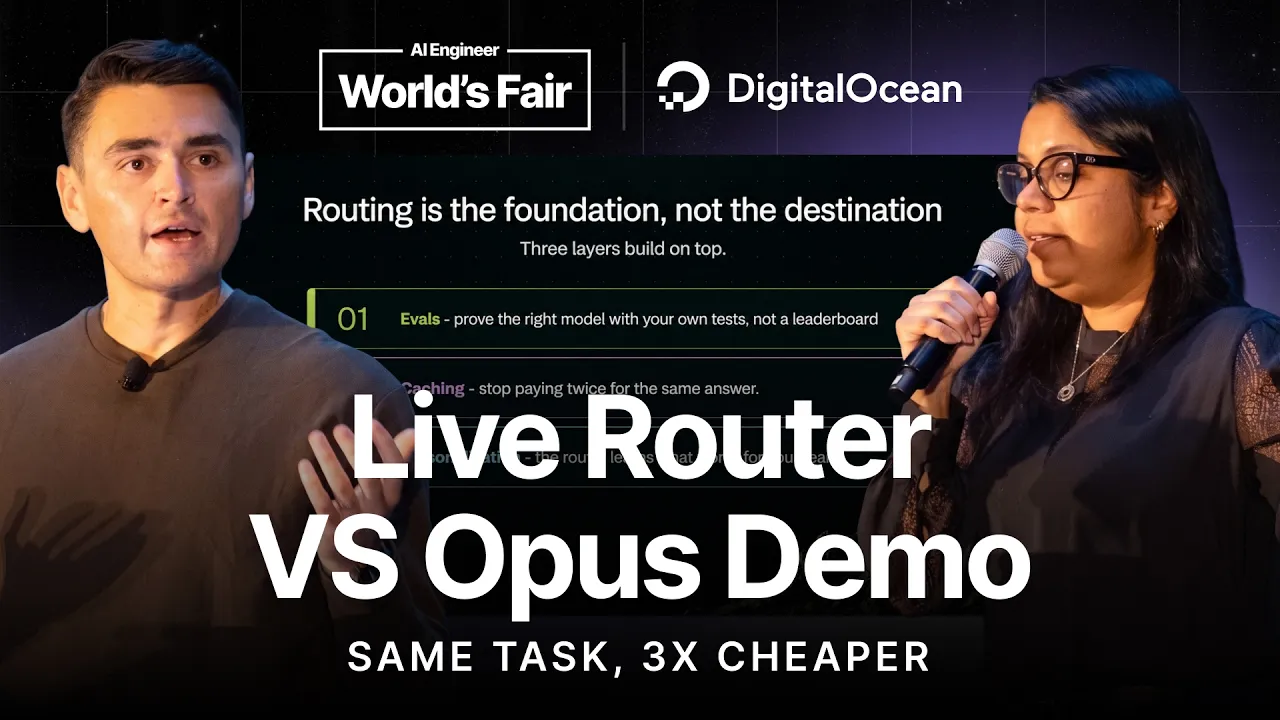
It's not really the destination. And there are three things that we usually build on top of it. The first one is evals to prove that the right model works with your use case and your test well. Caching, so that you can stop paying twice or more for the same answer each time. And personalization, so that the router learns what works for your team over time. This is a continuous improvement loop maturing over time. That means that the more you route and evaluate, the better the router does for your workload.
So, to summarize, where does this leave you? There is no single best model. There's only the right model for the request. And benchmarks will only tell you part of the story. Your preferences will tell you the rest. And we built the router to honor your preferences and stay open, so that you're never locked into a single stack. And that's how teams actually built. We are DigitalOcean, any i-native cloud. Come find us at the booth and route your next workload with us.
Thank you so much for being here. >> [applause]
The words are the caption track's own and nothing is reworded or re-transcribed. Paragraph breaks are placed between sentences so the text reads as prose.
Free tools for your own script. No signup, no login.
Paste your draft and see where viewers are likely to drop off, with a rewrite for each weak line.
Paste the first 30 seconds of your own draft for a hook score and rewrites.
Check your draft against YouTube's advertiser-friendly guidelines before you record it.
Read this channel's public videos and transcripts, and download a writing brief for it.