Getting the transcript
Reading the captions from YouTube. A video nobody has opened here before takes 10 to 30 seconds; this page fills in on its own.
Getting the transcript
Reading the captions from YouTube. A video nobody has opened here before takes 10 to 30 seconds; this page fills in on its own.
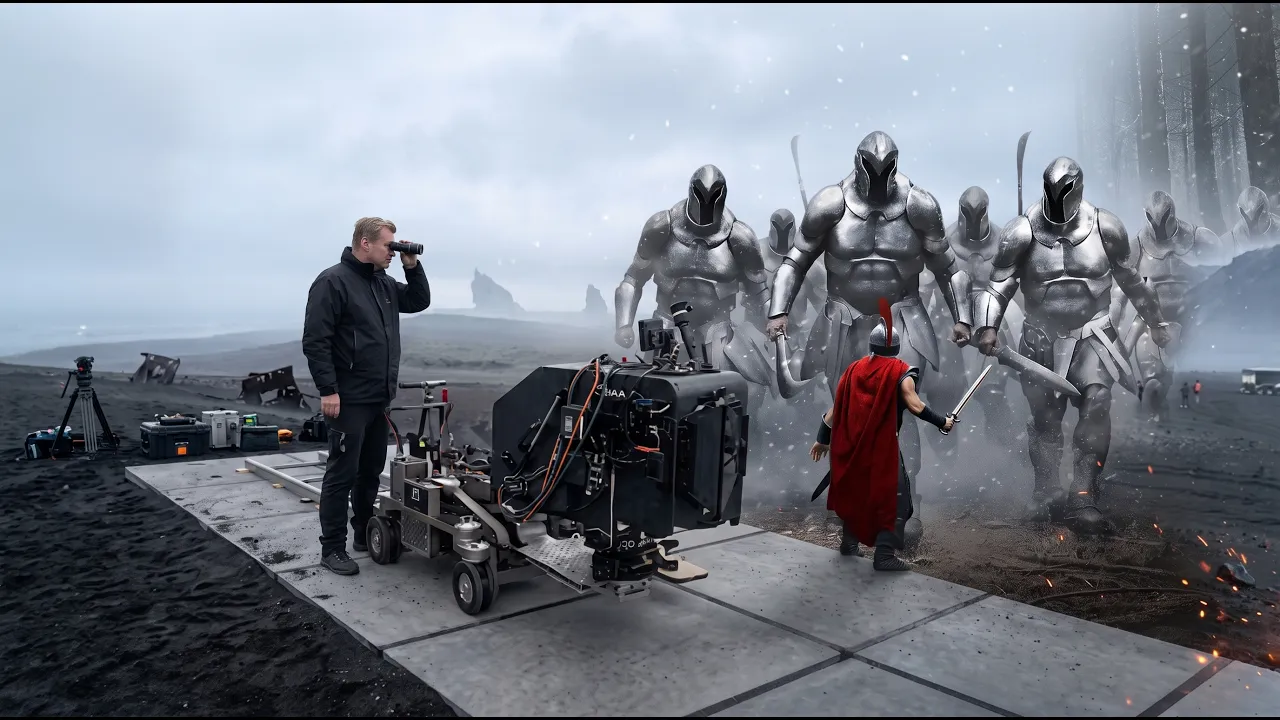
Rory Anderson · @RorZFilms1
Where viewers went back to watch this video again, from YouTube's public Most replayed graph, lined up with what was said at that moment.
Most replayed moment #1
7:412.9x the video's typical replay level
Instead, he treats them as the foremost experts of their own character psyches. Once the script is locked, he relies entirely on the cast to tell him how the mythic figures of the Odyssey should react to the world he has built around them. >> Particularly in the case of [music]
Said at 7:34
Most replayed moment #2
8:232.5x the video's typical replay level
Nolan ensures that the grand visual scope [music] is always matched by intense emotional intimacy. Recreating the Bronze Age for the Odyssey demanded more than just rugged locations and exhausted actors. It required the resurrection of entire ancient cities.
Said at 8:17
Most replayed moment #3
16:042.3x the video's typical replay level
structure. So, it both feels incredibly structured and incredibly creative and yeah, again, [music] weird magic trick. >> When a director has spent months fighting the elements, enduring the cold sea spray, the journey of Odysius is filled with breathless escapes, monstrous encounters, and long agonizing
Said at 15:56
The graph counts replays. It does not show where viewers stopped watching.
Words
3,850
Runtime
23:16
Speaking pace
165wpm
Reading time
16min
165 words per minute, between the 160 25th percentile and the 181 median of 349 measured videos. That distribution comes from the 349-video hook study.
Opening (first 30 seconds)
For decades, Christopher Noland has redefined the boundaries of the cinematic blockbuster, constantly pushing the limits of scale, time, and human endurance. But with his latest film, he's stepping back three millennia to adapt one of the oldest stories ever told, Homer's ancient epic, The Odyssey. It is a brutal tale of the Bronze Age, tracking the soldier King Odysius, the cunning deception of the Trojan horse, and a grueling 10-year struggle to return home. Bringing this ancient world to life required a
83 words, the words spoken in the first 30 seconds at 165 words per minute.
Free, no signup. See how the first 30 seconds hold attention, with rewrites.
Sentence shape
| Measure | This transcript |
|---|---|
| Sentences | 203 |
| Average words per sentence | 19.0 |
| Longest sentence | 57 words |
| Questions asked | 7 |
| Sentences containing a number | 19 |
Most used terms
Filler phrases
33 in total: like 10 · you know 7 · um 6 · uh 3 · actually 2 · kind of 2 · sort of 2 · I mean 1.
A literal whole-word count of the same phrase list the Prepublish browser extension uses, so a phrase inside another word is not counted and a phrase used in its ordinary sense still is. It is a count and not a judgement.
What this transcript is
Every word below is the caption track YouTube publishes for this video, pulled from the video itself and reproduced unchanged. It is not Prepublish's writing, not a summary, and not a re-transcription: it is the video's own published captions. English captions, generated automatically by YouTube, in the video’s original language. Source: the video on YouTube. A channel that would rather this page did not exist can ask for its removal through the contact page, and it is removed.
For decades, Christopher Noland has redefined the boundaries of the cinematic blockbuster, constantly pushing the limits of scale, time, and human endurance. But with his latest film, he's stepping back three millennia to adapt one of the oldest stories ever told, Homer's ancient epic, The Odyssey. It is a brutal tale of the Bronze Age, tracking the soldier King Odysius, the cunning deception of the Trojan horse, and a grueling 10-year struggle to return home.
Bringing this ancient world to life required a deeply modern and incredibly demanding approach. Nolan's guiding philosophy has always been to prioritize the viewer's visceral experience above all else. [music] >> The Odyssey is a massive story. And that's a really exciting challenge to take on. >> Promise me you will come back. >> What if I can't? I feel a real responsibility [music] to try and get as much on screen for the audience as possible to give the audience the the fullest flavor, the [music] fullest set of images and events that that we can give them for a given story. >> To deliver that fullest flavor, Nolan made a groundbreaking decision.
The Odyssey is shot entirely on 15 Perf IMAX film cameras. While many directors have embraced lighter, cheaper digital technology, Nolan remains a steadfast champion of celluloid. The 65mm IMAX frame captures an image quality of up to three times higher than standard digital cameras. The unparalleled resolution isn't just about pixel counts. It's about capturing [music] the staggering reality of ancient battlefields and mythic storms in a way that feels tangible, undeniably real.
The thing with IMAX film in particular is because it is the the highest resolution um highest quality imaging format ever devised. When you take a shot on IMX film, you've captured information that can then translate into every possible format. >> But why go to such extreme technical lengths? For a story filled with Greek gods and mythic elements, for Nolan, the spectacle is never just for show. It is a mechanism for psychological depth.
A Nolan film is designed to pull you out of the theater seat and drop you directly into the labyrinth of the narrative. He builds his films not by looking down from above, but by placing the lens right beside the protagonist in the center of the maze. I think yeah. I mean, I think with all my films, I've had an increasing desire to really try and create [music] an immersive experience and try and create a tactile sense of of a world and and, you know, put you there in it.
Achieving that tactile sense of the world means stripping away the safety nets of modern Hollywood. Rather than relying heavily on green screens and post-prouction trickery to build the ancient Mediterranean, Nolan insists on the physical and the practical. He believes the chaos of actual elements, the unpredictable winds, the crushing waves, the sheer weight of a physical set translates directly to the actor's performances and ultimately to the screen. >> And for me, the more areas in which you can embrace reality, the more areas in which [music] you can allow the real world to inform your your process, the richer the film becomes. >> Embracing that reality meant the journey of Odysius not as a distant fairy tale, but as an immediate visceral survival story.
Whether the massive camera is strapped to the hole of an ancient Greek ship or plunged into the chaotic shores of Troy, the [music] IMAX format demands a level of physical authenticity that forces the audience to experience the grit, the sweat, and the fear right alongside the characters. It transforms an ancient poem into a present tense thriller. >> When I'm writing, I'm visualizing the film as an audience member, as somebody experiencing the story.
Then when I direct the story, I'm trying to take the audience there. So in the case of the Odyssey, I'm trying to put the audience into that horse. I trying to put them on the deck of a decisive ship. Putting the audience inside the claustrophobia of the Trojan horse is a monumental task. The sheer size and mechanical noise of the 15 Perf IMAX cameras present extraordinary hurdles, especially when filming on water or within confined practical sets.
Yet, it is exactly this friction, the friction between the limits of analog technology and the boundless scope of Nolan's vision that creates cinematic magic. IMAX is a camera that doesn't lie. This is definitely [music] the format or the window that this story wants to be seen in. and that has always been our first choice. >> To capture the grueling voyage of the Odyssey, Christopher Nolan knew that shooting in the pristine safety of a Hollywood backlot wouldn't suffice.
Instead, he mounted a punishing global expedition, bringing his leading men like Matt Damon, along with thousands of cast and crew members to unforgiving locations across Greece, Iceland, Morocco, Italy, and Scotland. By shooting 2 million ft of 65mm IMAX film out in the harsh elements, Nolan ensured the camera was capturing genuine exhaustion, real weather, and true physical weight. He has built a reputation for doing things the hard way by adapting a 30,000-year-old epic tested the boundaries of what even his season crew could endure. >> The harder the better right to the point of the Odyssey.
And I think I think we were pushed pretty hard on this one and u maybe found some limits. >> Those limits were felt most acutely by the crew wielding Bronze Age weaponry on churning ships and stormb battered coasts while heavy IMAX cameras rolled. >> We had gone to IMAX and sort of challenged them to create new cameras that were quiet or at the very least create a blimp that would baffle the noise of the camera. They came back to us with new cameras plus a blimp. >> For Matt Damon, marking his third collaboration with Nolan after Interstellar and Oppenheimer, the physical and mental toll of this ancient battlefield was unprecedented. >> The first meeting I had with him, the at the end of the meeting, he said, "This this movie is going to be hard." I kind of looked at him like, "I've made I don't know 100 movies or whatever." I looked at him like, "Yeah, [music] I know." And he looked at me went, "No, this movie is going to be really hard." When a canvas is this impossibly large, it is easy for an actor to get lost in the spectacle.
Between the practical effects, the massive sets, and the mechanical roar of the IMAX cameras. >> It's a gigantic super heavy box. [music] But we as filmmakers, we're not supposed to be comfortable. We're supposed to present the audience with the best experience possible. So all our effort was all in service of making that work on set. The human element can easily be drowned out. But this is where Nolan's distinct approach to character work anchors his films.
[music] Despite the blockbuster scale, Noland remains deeply focused on the intricate mechanics of performance. >> He really understands what actors do and what what is required of them to do it. >> Nolan doesn't view his actors as mere props moving through a grand diarama. Instead, he treats them as the foremost experts of their own character psyches. Once the script is locked, he relies entirely on the cast to tell him how the mythic figures of the Odyssey should react to the world he has built around them. >> Particularly in the case of [music] actors, you're handing them the script and you're saying, "Okay, you go away and you become an expert [music] on that character's perspective on the story." So then when I'm on set, they're informing me, you know, they're bringing me information about how that character [music] would see things, how that character plays.
So in a way, it's the opposite of what people think it is. By impairing the actors to internalize the trauma and triumph of Odysius's men, Nolan ensures that the grand visual scope [music] is always matched by intense emotional intimacy. Recreating the Bronze Age for the Odyssey demanded more than just rugged locations and exhausted actors. It required the resurrection of entire ancient cities. Troy, Ithaca, and the sprawling Mediterranean ports of antiquity needed to look, feel, and function like [music] real places.
In an era where Hollywood leans heavily on computerenerated imagery to paint its historical epics, Christopher Nolan's [music] approach is radically, stubbornly physical. He understands that the towering 15p perf IMAX frame captures so much immense detail that digital trickery often shatters the illusion. For Nolan, the solution is simple. Just take some notes from Ridley Scott. >> That coliseum, those arches, those palaces on green screen.
We built it >> cuz I realized that actually if you build the set and you know what you're doing, it's cheaper than blue screen. Otherwise, every shot has got money in it that you hadn't allowed for. >> And so, all of that was built. >> If you need a palace, you build a palace. To construct the high walls of Troy and the ornate halls of Greek kings, Nolan relies on vast teams of production designers, carpenters, and artisans.
Every stone, every weapon, every sail must stand up to the unforgiving scrutiny of the highest resolution camera format ever devised. Moving the massive IMAX equipment through sand, sea, and physical sets required military level coordination. While building massive physical environments seems prohibitively expensive, Noland argues that meticulous preparation and practical sets actually protect the budget from endless post-production visual effects costs.
Managing a production of this magnitude transcends traditional film directing. When you are coordinating fleets of ancient ships, wrangling thousands of extras in period accurate armor and maneuvering cumbersome 65mm IMAX cameras, the role of the director shifts into something resembling a chief executive. [music] How do you how do you begin with that? What's what's pre-production like? What are you what are you sitting in the room talking about?
What are you challenging them? >> It's a corporation. Um, so I'm running a corporation because a unit [music] of this size, if we would did this in 51 days, was worth knowing. And so [music] you you are running a corporation that's 1,200 personnel with an army of personnel mobilized across multiple continents. Communication is the lifeblood of the project. Nolan maintains a strict fast-paced protocols to keep his massive crew aligned.
Yet amidst the sprawling infrastructure, the film's success ultimately hinges on the deeply human faces at the center of the frame. Populating the Odyssey meant finding actors who could project the mythic weight of Homer's characters without getting swallowed by the sheer scale of the production. When searching for the right warrior, king or goddess, he strips away the technical noise and trusts his gut. >> I believe in I got to cast really well. if I can and I found I'm pretty good at casting and most of it is intuition or they walk through the door, haven't spoken, you're [music] immediately interested or not.
That intuition is the crucial counterweight to the massive logistical machine of an IMAX blockbuster. by trusting his immediate instinctual reactions to an actor's presence. Once the sprawling cities are built and the massive 1200 person crew is in position, it is a carefully chosen cast [music] that must breathe life into the ancient myth. The Odyssey faced its most daunting technical adversary, the camera itself. Christopher Nolan's mandate to shoot the entire film on 15p perf IMAX film cameras meant strapping one of the heaviest, loudest, and most cumbersome pieces of photographic equipment.
A fully loaded IMAX camera can weigh upward of 50 lb, and with the blimp, it's almost 300 lb. The mechanical roar of film racing through the gate sounds akin to a revving chainsaw, presenting a massive hurdle for capturing [music] intimate, hush dialogue. That's why they built the blimp. Historically, Nolan reserved the towering format strictly for sweeping action, switching to smaller, quieter cameras for dialogue. >> The cameras are very loud, so you don't really want to do dialogue scenes that way.
So, we laid out which of the action set pieces we would shoot with the IMAX camera. >> But for the Odyssey, a film meant to completely envelop the viewers in Odysius's Perilous Voyage, breaking that immersion with format shifts was out of the question. Noland and his sound department had to invent new methods to isolate human voices over the deafening clatter of the camera, allowing the giant lens to capture everything from the thunderous fall of Troy to the quiet, desperate whispers of soldiers trapped inside the wooden horse.
When a director brings a camera of this scale directly into the actor's personal space, traditional cinematic composition goes out the window. Standard 35mm film making often relies on strict theatrical framing, but the IMAX frame is so massive, so tall and wide that it requires a complete reimagining of how a scene is constructed. Nolan relies heavily on his cinematographer to paint outside the lines, using the sheer size of the negative to wrap the environment completely around the audience's peripheral vision.
It it pushes you to a way of looking at cinematography where you're not looking at the precinium. You're not looking at the frame and making two-dimensional compositions. You're really just putting the camera in proximity to the actors and you're composing in a threedimensional sense. >> By abandoning two-dimensional composition, the cinematography of the Odyssey feels remarkably untethered. When the camera is thrust into the crashing waves of Pedan's wrath or the chaotic mala of a sword fight, the audience doesn't just watch the scene unfold.
They feel the spatial depth, the danger, and the proximity of the actors. Yet operating this mechanical beast in the wild means inviting chaos. Massive celluloid magazines must be reloaded constantly, and the giant lenses are at the mercy of sea spray, sand, and blazing sun. Nolan knows that surviving a shoot of this magnitude requires a willingness to let the elements dictate the rhythm of the day. A rogue wave or an unexpected shift in the storm clouds isn't viewed as a disaster is harnessed as a cinematic truth.
[music] >> With all the preparation in the world, it's not an excuse to not be prepared, but you know, you have to be open to reality and what that's going to going to put into the film you're you're trying to make. That openness to reality is what elevates the Odyssey from a staged period piece to a breathing living document of survival. By forcing the world's most advanced analog camera into the most unruly physical conditions, Nolan captures a friction that CGI can never replicate.
As the production moved into the editing bay, the challenge shifted from capturing the chaos to mastering its rhythm. The grueling physical production of the Odyssey yielded over 2 million feet of 65mm IMAX celluloid. But capturing the raw fury of the Bronze Age was only half the battle. Transforming that towering mountain of footage into a cohesive pulse [music] pounding narrative required a monumental effort in post-prouction. >> Like it's so structured, but then he is so open to ideas of the ways we can make it interesting and use editing to [music] make it interesting within that structure.
So, it both feels incredibly structured and incredibly creative and yeah, again, [music] weird magic trick. >> When a director has spent months fighting the elements, enduring the cold sea spray, the journey of Odysius is filled with breathless escapes, monstrous encounters, and long agonizing periods of suspense on the open ocean. Shaping that suspense means recognizing that a film's momentum cannot be judged by looking at scenes in isolation.
But one of the the things I've learned over the years is [music] to really judge it, you have to watch the whole film because your sense of an [music] internal rhythm is very very different depending on where you are in the film and the the pace of the sequence you've come out of, you know. Um I often have the experience particularly with the Dark Knight films, um if they're playing [music] on TV or whatever and I happen to turn it on and it's in the last third or so, the editing seems bizarly fast to me.
And you know, it's it's somewhat choppy because it has to be to to get that pace. Um, but it works if you watch it from the beginning. So, it modulates through the film. You can't edit things with the same rhythm at different points in a 2 and 1/2 hour film. This holistic approach to editing means that the rhythm of the Odyssey continually shifts. The rapid, visceral cuts of the Trojan War must give way to the slow, creeping dread of navigating uncharted mythic waters.
If a scene feels too slow in the editing room, the solution isn't always to simply cut it down. Sometimes it requires examining the rhythm of the entire hour that preceded it. But picture alone cannot carry the full weight of a myth. Nolan's films are famous for their overwhelming immersive soundsscapes where the auditory experience is just as crucial as the giant IMAX frame. In the Odyssey, the roar of pedan seas, the clashing of bronze swords, and the sweeping musical [music] score must work in perfect harmony.
Nolan rejects the traditional Hollywood wisdom that a film score should blend invisibly into the background. Instead, he treats the music as a vital breathing entity that drives the emotional core of the narrative. >> Music should lift and elevate. And I've never really uh agreed with that in film music either. I think that when when it's working, when it's something that you feel as a filmmaker, you want to put in there in in a passionate and obvious way, it becomes very much character in the film.
And I love movies that do that. By elevating the score to the status of a leading character, Noland ensures that the internal struggles of his heroes are projected outward. >> I love writing film scores because everything I get to do is so [music] different. The first conversation we had was Chris telling me that he wanted something completely unique for this film. No orchestra, no familiar sounds [music] that you've heard before in a movie like this. >> The music acts as the voice of the gods, the relentless pull of fate, and the agonizing longing for home.
We wanted the [music] film to feel like a recognizable world to people. Even though it was going to be ancient Greece, we don't want it to look and feel like previous movies that take on this kind of classical world. What can we do that's [music] more timeless than that? >> Through the meticulous alignment of towering IMAX visuals, carefully calibrated narrative rhythm. I knew that [music] in order to create this completely original world, I also had to get out of my comfort zone and find sounds that I haven't worked with before. >> Ludwig went very deep on researching the sort of instruments that they might have had at that time. >> Chris had mentioned early that he was interested in owls.
He was interested in liar. The owl is an [music] ancient Greek instrument. It was the most popular rockstar instrument for a thousand years. When the final cut of the Odyssey is locked, it isn't rendered out as a simple digital file sent to the cloud. It exists as physical heavy reels of 70 mm celluloid. In an industry that has overwhelmingly embraced the convenience [music] of digital cinema, Christopher Noland remains one of the last fiercest defenders of photochemical film.
The push to abandon this century old medium has been immense, driven by studios seeking leaner budgets and faster turnaround times. But Nolan actively resists this shift, fighting to keep the analog format alive for future generations. has been an economic imperative to push digital technology because it's perceived as being cheaper, which it isn't [music] necessarily, but um there are a lot of economic interests wanting to sell new equipment, wanting to, you know, evolve the industry uh and and make money that way.
And they've had a very powerful voice. >> Despite these industry pressures, Noland argues that film possesses a superior resolution and an organic rich color palette that digital sensors simply cannot replicate. But his crusade for celluloid is about more than just technical specifications. [music] It is fundamentally about the sacredness of the theatrical experience. To take a myth as enduring as the Odyssey and reduce [music] it to a file viewed on a smartphone or a living room television goes against everything he strives to achieve as a filmmaker.
And when film is [music] projected the way it was originally intended to be seen, the way you've shot the film, you project the film, uh there's a very unique [music] experience for the audience there that they can't get in their living rooms. To preserve that unique magic, Nolan treats the audience as his ultimate collaborator. Every impossibly difficult practical stunt, every deafening IMAX magazine change, and every meticulously sculpted soundsscape serves one singular purpose, to honor the people sitting in the dark.
He does not view himself as a dictator commanding an army from above, but rather as the very first spectator to witness the myth unfolding. >> I think of myself as the representative [music] of the audience on set. That's my north star. That's how I have to be looking at the film. >> Guided by that north star, it becomes a testament to the sheer power of cinema itself. By pushing the 15 Perf IMAX camera to the absolute breaking point, he bridges a 3,000-year gap, bringing the dust, the sea, and the blood of antiquity directly into the modern theater.
When asked how he views his own place within the sprawling history of Hollywood, Nolan remains humble, grounding his massive achievements in a deep reverence for the medium he loves so fiercely. I'd love to feel that [music] I had added something to the body of work of all the filmmakers [music] I have admired and that great film history that's developing. If I can play some part [music] in moving the language of it forward somehow, that would be that would be a great thing to be remembered for. >> With the Odyssey, Christopher Nolan has done exactly that.
He has taken the oldest of epics and forged it into a breathtaking leap forward for cinematic storytelling. It is a monumental voyage both for the hero trying to find his way home and for the visionary director reminding us all why we still gather in the dark to watch the light. If you like this video, subscribe and we'll see you in the next one.
The words are the caption track's own and nothing is reworded or re-transcribed. Paragraph breaks are placed between sentences so the text reads as prose.
Free tools for your own script. No signup, no login.
Paste your draft and see where viewers are likely to drop off, with a rewrite for each weak line.
Paste the first 30 seconds of your own draft for a hook score and rewrites.
Check your draft against YouTube's advertiser-friendly guidelines before you record it.
Read this channel's public videos and transcripts, and download a writing brief for it.