Getting the transcript
Reading the captions from YouTube. A video nobody has opened here before takes 10 to 30 seconds; this page fills in on its own.
Getting the transcript
Reading the captions from YouTube. A video nobody has opened here before takes 10 to 30 seconds; this page fills in on its own.
AI Engineer · @aiDotEngineer
This video has no Most replayed graph yet: YouTube shows one only once a video has enough views. These are the moments viewers replayed most in AI Engineer's most watched videos.
Most replayed moment at 18:45
4.8x that video's typical replay level
that they're they're changing they're changing things in the database not yet. You want to run them through the ontology first and make sure that works. Okay. I only got an I've got I've got another I've just a short time. I'm going to try to show you some of the things that um that you can
Said at 18:37
Most replayed moment at 16:13
3.6x that video's typical replay level
method signatures, the program layout and the call stacks. So here's some examples. I don't think you'll be able to read this one, but this is like the level of abstraction we're at. It's how we're actually going to lay this stuff out and how these systems are going to interact. Dylan Mulroy from Cloudflare talks a
Said at 16:06
Most replayed moment at 13:49
2.3x that video's typical replay level
Fable uh and it runs into an unknown, ask it to log it, right? So that um you uh you can see where the deviations happened and then you can sort of figure out why as well, you know? It will usually give you some context about what happened.
Said at 13:43
The graph counts replays. It does not show where viewers stopped watching.
Words
9,547
Runtime
1:03:20
Speaking pace
151wpm
Reading time
40min
151 words per minute, below the 160 25th percentile of 349 measured videos. That distribution comes from the 349-video hook study.
Opening (first 30 seconds)
Can everyone hear me? Excellent. Awesome. Greetings valiant few. Um I'm not sure how many folks have heard, um but there were some electrical issues in the rest of the building. Um so so y'all were the ones who showed up early, which means that y'all are part of the few that get to hear the talks. Um so if you don't feel lucky, just wait. You know, there is you are definitely you are definitely
76 words, the words spoken in the first 30 seconds at 151 words per minute.
Free, no signup. See how the first 30 seconds hold attention, with rewrites.
Sentence shape
| Measure | This transcript |
|---|---|
| Sentences | 568 |
| Average words per sentence | 16.8 |
| Longest sentence | 75 words |
| Questions asked | 26 |
| Sentences containing a number | 65 |
Most used terms
Filler phrases
812 in total: um 404 · uh 179 · like 140 · kind of 49 · you know 19 · sort of 10 · actually 6 · right? 3 · basically 2.
A literal whole-word count of the same phrase list the Prepublish browser extension uses, so a phrase inside another word is not counted and a phrase used in its ordinary sense still is. It is a count and not a judgement.
What this transcript is
Every word below is the caption track YouTube publishes for this video, pulled from the video itself and reproduced unchanged. It is not Prepublish's writing, not a summary, and not a re-transcription: it is the video's own published captions. English captions, generated automatically by YouTube, in the video’s original language. Source: the video on YouTube. A channel that would rather this page did not exist can ask for its removal through the contact page, and it is removed.
Can everyone hear me? Excellent. Awesome. Greetings valiant few. Um I'm not sure how many folks have heard, um but there were some electrical issues in the rest of the building. Um so so y'all were the ones who showed up early, which means that y'all are part of the few that get to hear the talks. Um so if you don't feel lucky, just wait. You know, there is you are definitely you are definitely experiencing something something special this morning.
Um and then for anybody who wants to come back and hear more or you missed the Gen Media session a little bit earlier today, we're going to be doing a whistle-stop tour of all of the presentations for DeepMind this afternoon. Um so you can come back and meet more of the team and kind of hear more about all of the talks and all of the technologies. I also really really love for sessions to be interactive. So I'm going to show you some demos.
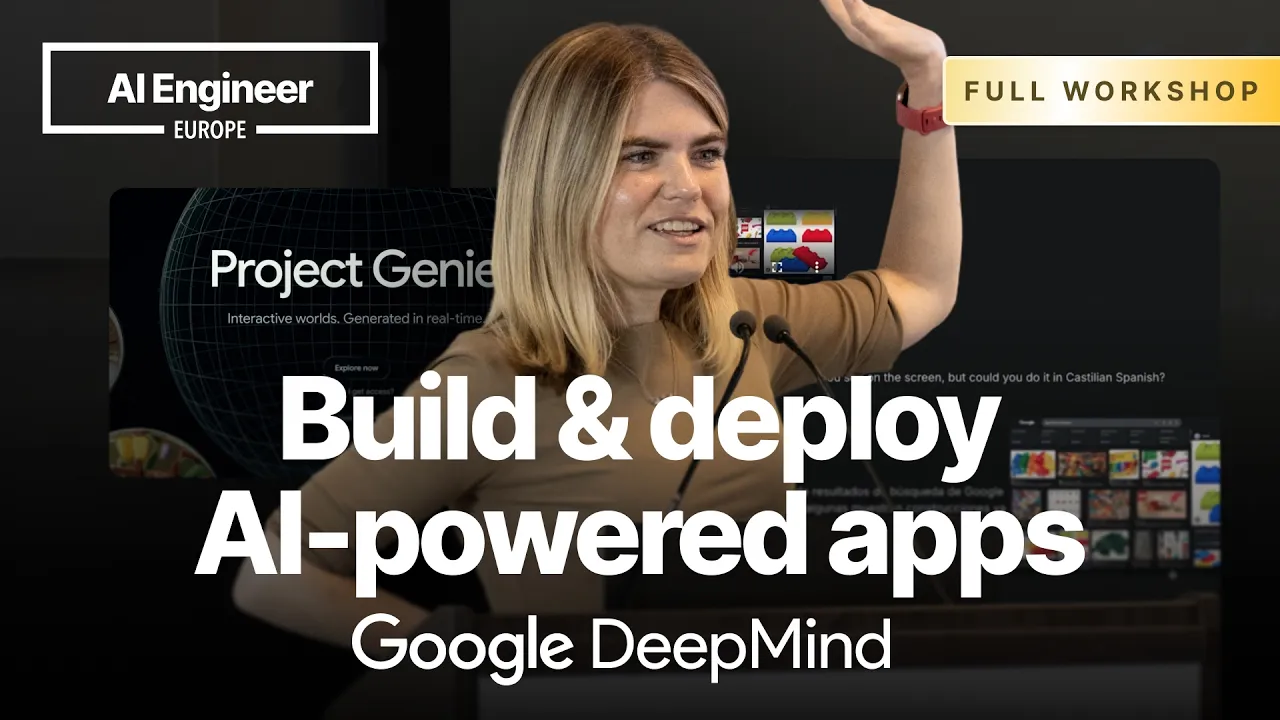
This is going to be very demo heavy as opposed to slide heavy. And then if you have any questions along the way, please feel free to shout them out. It's always much more interesting if this is you know, more of a conversation than just me like showing stuff over and over again. So I don't think it's a secret and also I guess introductions. Hi everybody. My name is Paige. I do I'm one of the inch leads for developer relations at Google DeepMind.
Um I've been doing machine learning for a really long time. I started in 2009 and was contributing to some of the early days of open source scientific computing libraries, things like NumPy, SciPy, scikit-learn. And then did product for a couple of years, and back on the engineering ladder, um, and really, really love that now it's really, really hard to to nitpick um, what's product, what's engineering, what's design, and what's DevRel.
Um, and all of the roles seem to be conflated a little bit. Um, so I don't think it's a secret that Google has been a little bit busy over the course of the last while. Um, over the last month and a half, we've been releasing models um, so fast, I feel like everybody's got a little bit of whiplash. Um, uh, Gemini 3.1 Flash Live, which we'll take a look at in a second. Gemini 3.1 Pro and Flash Light. Um, so respectively our largest and smaller model, um, that are uh, performant, efficient, able to do a lot of things um, very, very quickly and at low cost profiles.
Um, we actually just had augment code, if anybody is familiar with augment code, Replit, um, their entire agent system to default to Gemini 3.1 Pro specifically for performance plus cost uh, related reasons. Um, Nano Banana 2 for image generation and editing. Our embeddings model, um, which is supporting video and images and audio and text and code all in the same embedding space. So you can say, "Show me all of the content related to cats." And it will show you not just video of cats, not just images, but also things like uh, audio of a cat purring or meowing, um, or like books about cats, all sorts of stuff.
Um, Lyra 3D for music generation, um, which you saw if you were in the Gen Media session just a little while ago. Genie 3 for world model building, um, so being able to dynamically generate new worlds based on user input. Um, our full stack runtime for AI Studio, which includes things like databases and OAuth. Um, Gemma 4, which is part of our open model family. We're lucky enough to have a member of the Gemma team um here at AIE uh this uh this week um so definitely um Ian, raise your hand.
Um yep. Greetings. And so so the Gemma the Gemma team, if you're interested in open models, would be excellent to talk to. Um and then also VIO 3.1 light for video generation at a cost profile that's pretty compelling. Um so lots of different stuff. Uh just show of hands, how many how many folks have heard of all of these models before? Um excellent. And the DeepMinders in the back row like hopefully hopefully like that was like yep the but if you haven't heard of any of these by the end of the session, you'll know all about them.
And hopefully know which ones you could use or consider for your projects. Um so I don't think it's a secret that that Gemini is is kind of special in the industry. Um one of the reasons that it's very special is that it's multimodal both for inputs and also multimodal in terms of outputs. Um so it supports video, images, audio, text, code for inputs. Um but it can also output multiple modalities. It can output text and code but also audio um images.
It can images and text and relieved and most of the other models on the market are only capable of handling text and code um as outputs. And only things like static images as inputs. Um so it's pretty compelling to see what you're able to do. Um and via our APIs, you're also able to handle flexible um kind of input formats. So you can have PDFs with embedded images. Um you can have you know different types of video, different types of audio.
Um that that you can serve as as tokens for inference. But again, lot cooler to see it rather than to just have me talking about it and waxing poetic. Um so, I am going to go ahead and go to AI Studio real quick um and pull up uh pull up my personal instance of AI Studio, which is uh you know, I always say it, but if you see anything embarrassing, please don't judge me. Um so, this is how many folks have used AI Studio before?
Cool. Excellent. For folks who have never used it, you can access it at ai.dev or ai.studio or ai studio.google.com. Um it works just with your personal Gmail account. Um so, you can get started for free. Uh you can select different models here off to the right. Um so, you can see that there are different kind of pills here for the kinds of modalities that you might want to work with. So, things like video for um uh like video generation, um BO3.1, uh 3.1 fast, and 3.1 light are all kind of in this tier section.
Um you can also select the different Gemini models. So, Gemini 3 flash preview, um flash light preview. I'm going to select that one just for the interest of time. And you can also do things like toggle on and configure many of these different tools here off to the right. Um so, you can specify things like structured outputs, um code execution, which we'll take a look at in a second, function calling, um you can turn on things like grounding with Google Search.
So, just automatically incorporate that as a tool, um grounding with Google Maps, uh and also even things like URL context, which gives you kind of like poor man's retrieval. Um uh you can have a list of URLs, and then incorporate that into the model's context window, so it can use that um to ground some of its outputs. Um and as I'm sure all of y'all know, um models are kind of limited based on the data that they have as part of their pre-training and post-training mixtures.
So, if they're only trained on data up to a specific point, that's all of the insight that they have out of the box for those uh kinds of data. If you want it to be able to answer questions that happened after that date, um you're going to have to give it access to tools either through search or through retrieval in order to do that work. Um and again, if anybody has questions as I'm kind of rambling along, feel free to raise your hand and shout them out.
This is a small enough group that we can um that it should be pretty fun. Cool. So, I I've turned on grounding with Google Search. Um you can also add uh you can also add media. So, you can connect to Drive, you can upload files, you can record audio, um uh add camera footage, link a YouTube video, link sample media. Um and YouTube just works via URL, so you can paste in a YouTube URL, um and have that uh be used for inference with the Gemini models.
So, as an example, I haven't tried this, um so we'll see if it works. Uh uh but we can take a look uh to see uh to see if we can find a dinosaur video. Um I love T-Rexes. So, this uh so, this past uh weekend in the Bay Area, we had this thing called Bay Area Big Wheels, um which uh and it defaults to one frame per second. You can also specify different start and end times. Um so, just for the interest of speed, um I might specify start time as like maybe 000, um or uh 0 seconds, and then maybe end time would be uh um maybe like 300 seconds.
Um Uh and you can see that this ends up being around 27,600 tokens for 5 minutes of content. Um but I could say create a table um with timestamps for all of the kinds of dinosaurs that I Come on in. Uh you see in this video. No worries, it's all good. Uh I make sure to include a fun fact about each dinosaur type. Um and then hit run. Um but at what I was saying about Bay Area Big Wheels is that there's a big bendy hill in San Francisco um with a whole bunch of very whiplash sort of turns.
And everybody gets a little tricycle and rides down it. Um and I did that this past weekend. Um it's an Easter Sunday tradition. Um but I was dressed as a dinosaur and was handing out dinosaur Easter eggs. Um so this is very on brand. And what's happening behind the scenes is we've turned on grounding with Google Search. Um so we have search as a tool which can help inform some of our fun facts. We've got the video that's being pulled in.
So the the first um 5 minutes worth of content um we can see the the different dinosaur types. Um Rexy and his parents um obviously have a lot of appearances in this first episode um as well as a Brachiosaurus, a Velociraptor, and a Pteranodon which is a flying reptile. Um uh and I love that it's uh I love that it's calling out the true fact um that uh that Pteranodons are pterosaurs, not dinosaurs. Um and the uh and you can also see the different uh the different citations along the way.
Um uh from the the URLs that are informing all of these fun facts. Um you can also click get code uh to see all of the code that you would need in order to replicate the experiment that you just did in AI studio. So it selects the appropriate model. It shows you how you would handle the URI for YouTube and then it also gives you insight into the the prompt that you can use for the video in order to in order to do the work in Python and TypeScript and Java, whatever your favorite language might be.
And if you wanted to not use a YouTube URL, if you wanted to use your own video, you would be able to pass that to the model, too. It's just really really handy to be able to pull in a YouTube URL as opposed to having to do the process of downloading it and then kind of sending it off sending it off yourself. And now I also want to watch this episode of Rexy the little T-Rex. This looks very cool. If you hadn't seen as well in the thinking config, you have different thinking for all of our Gemini 3.1 series.
So minimal, low, medium, and high. If you want the model to spend more tokens thinking, you can turn on high thinking. But I often just keep it on minimal or low just for time's sake. For Gemini 3.1 flashlight, you get a really nice price versus sort of price price performance and and also speed profile for for the models. So you're not having to make big big trade-offs between them. So that is how you would interact with Gemini 3.1 flashlight within AI studio for video analysis.
One of the other slept upon features I think in our APIs as well as in AI studio in general is compare mode and also code execution, which we see here off to the right. So, if I turn on code execution, what we do is we give Gemini a sandboxed environment with Python and a whole bunch of data science libraries pre-installed where it can kind of pull in those libraries as tools to to kind of help solve arbitrary data science tasks.
And since this is sort of giving the model access to it in a sandboxed environment, you don't run the risk of having any of this impact your local environment, which is quite nice. Um the So, as an example, if I select Gemini 3.1 flashlight preview, turn on code execution, go into compare mode, I might try to compare it against Gemini 3 flash preview, also with code execution. Um and then one of the things that you can do, and we'll see if this works, um is you can select picture.
So, this is just some Lego bricks. Um what I could do is paste this in. We can make sure that it's secure and safe um for the corporate overlords. This image itself is around 1,000 tokens, but I could say something like draw bounding boxes around all of the green Lego bricks using Python make sure and then maybe display the image with with bounding boxes. And hit run. What should happen is that we see a head-to-head comparison of the two different models.
Gemini 3.1 flashlight was able to get it right out of the gate, which is pretty wild. So, this super super tiny model worked really really fast, wrote the Python code to to pull in the image, to analyze it, and to define the bounding boxes. And then if you hover over the token consumption, the amount of dollars required to do this work is pretty wild, right? Like so so being able to being able to pull in an image, do this kind of analysis, you could have also asked for things like segmentation masks.
You could have asked to count specific kinds of entities in the in the photo again using bounding boxes or something similar. And all of this was done at well under a fraction of the penny. So so strongly strongly recommend experimenting with the the smaller weight models especially turning on these tools to help them do their work more effectively. And like you can also see that Gemini 3 flash preview got to the got to the same answer.
It just took a little while longer. And then the the cost is slightly more but still well under a penny. Um. Cool. Um so this that's compare mode again using Gemini 3.1 flashlight just with the addition of code execution along the way. Um for folks who might be interested in URL context just because I know that this is this is something that we've heard quite a bit about from from folks that are that are using the the Gemini APIs pretty regularly.
If you turn on URL context, you can do things like add URLs. So I'm going to pull in a URL for a blog post about Gemma 4 which was released just recently last week after the models training data cut off. I'm going to pull in you know a blog post about Genie 3 also after the models training data cut off. And I could say something to the effect of compare and contrast Genie 3 and Gemma 4. Tell me how they're similar, different, or completely unrelated.
And they're mostly completely unrelated, but we'll see what the model thinks. Hit maybe turn on medium for the thinking level and then hit run. And what we should also see is that the model is able to give its output but site each one of the sources that it's using in order to make its assumptions. So you can see the different sources down at the bottom. The two URLs that I had used. You can use you know many many more than just two.
But it sites each one of the the sources in line as it's making assessments along the way. And so you can use publicly available information and then there are also tools within Vertex that allow you to do retrieval on custom custom documents that are internal only without necessarily having to set up a vector database for for retrieval. And again, if you click get code, it gives you all of the code that you would need to replicate what you're what you're doing in the in the AI studio interface.
Cool. So we've talked about we've talked about the Gemini 3.1 series of models. You can also use You can also use 3.1 Pro preview which is our largest model series. It's also our most expensive or our kind of by virtue of being larger, it's also a little bit slower. Gemini 3 flash is kind of the workhorse. It's the the model that we see most commonly used in production and then Gemini 3.1 flashlight is also gaining traction especially for people who are using Gemini 2.0 flash or 2.5 flash.
And then for our Gemini Live series, how many people have seen or heard of Gemini Live before? Cool. Couple of hands. Like thank you Thank you, DeepMinders, for uh for uh like you know, like paying uh like paying attention and also for using the models. Um, Gemini Live gives you the ability to share your screen, share a video feed, share audio with the model, and have a conversation with it dynamically, um including things like adding custom function calls, um generating automatic function responses, and then also doing things like grounding with Google Search.
Um, so I can turn on grounding with Google Search again, um just as a tool that the model can call. Um, and then I can give the model access to my screen to help me either navigate a an app, um to help me answer questions about what it sees, um and to do that in a broad variety of languages, etc. Um, so as an example, I can start screen sharing. It's Hey there, Gemini. Uh can you tell me what you see on the screen? I see a Google search for LEGO bricks and pieces.
There are tons of images of colorful LEGO bricks, sets, and bulk collections from various websites. On the right, there's a larger image featuring close-ups of red, yellow, blue, and green bricks. Are you looking for something specific on this page? And do any of y'all Does anybody in the room speak a language that is not English? Yeah. Guillaume, like you would know that you would not like you you would not be a reliable narrator.
Like but at least like last night we tried this and one of our colleagues yelled out, "Yes." very confidently, um a language that they do not speak. And so we did not have anybody to verify. But I saw a couple of hands on the front row. What what languages do y'all speak? Italian? Okay. So I'm going to Are you okay with verifying if the model is is like saying true things in Italian? Okay. Cool. Cool. Thank you for being our fact checker.
Hey Gemini, could you tell me what you Could you tell me what you said again? Just tell me in Italian. And then also could you tell me what is like in London today? Also in Italian. It was good. Excellent. Very cool. And so so you can you can ask for different languages. You can also say Hey Gemini, can you tell me a poem about what you see on the screen? But could you Could you tell me it using a Texan accent? Well, howdy there.
Let me take a gander at this here screen. I see piles of LEGO bricks, a colorful commotion. Like a tiny town fixing to rise from a plastic ocean. Red and yellow, blue and green in batches big and small. Ready to build a castle tall or maybe just a wall. Folks want to buy them, sell them, trade them from all over the place to put a smile I reckon on a little builder's face. Anything else you need help with, partner? That's giving me flashbacks to my hometown.
The but you can change you can change all of this dynamically just by asking naturally within the flow of conversation. Um, so you could imagine practically a scenario like perhaps you have um, an entryway in a bank, um, and there's some sort of a screen, somebody comes in, starts speaking in Spanish, or starts speaking in their, uh, you know, the language that they feel most confident in, and the model's able to dynamically respond and answer their questions in a language that's familiar to them.
Um, or you could, uh, kind of specify within system instructions um, what the, uh, what language, dialect, accent, style you might want the model to adopt. Um, so if you only want the model to respond in a specific language or a specific style or with a specific tone, um, strongly strongly recommend, uh, modifying the system instructions. And same as always, if I click get code, you see all of the code that you would need to use to replicate the experiment that you did, um, within the UI.
Um, so you can see the, the media resolution settings, um, the settings for compression, um, and all of that kind of, uh, kind of incorporated in naturally. Um, I can also do things like share video feeds. So, Hey there, Gemini. Uh, how many fingers am I holding up? You're holding up two fingers. What about now? That's a thumbs up. Yep. Cool. And so, uh, so big, big, uh, kind of, uh, spectrum of things that you can accomplish with Gemini Live.
And again, just a very, very low price point compared to other solutions that make you kind of stitch together the speech-to-text LLM understanding and text-to-speech pipeline with all of the video content inputs and outputs all by yourself. Um, we have another feature, uh, like I I always feel like, um, whenever I'm describing AI Studio, I'm just like, "And also, and also, and also, you can do all these other things." Um, we have another feature called build, which, if you've played with v0.dev or Lovable, feels very similar.
Um, it gives you the option to to kind of create and deploy, um, and to share, um, a whole spectrum of apps. And now we have even added support for things like databases and authentication. Um, so you can add a database, you can add, um, login with Google, you can add custom API keys, um, that are all kind of kept secure for you. Um, and you can also, uh, of course, create and edit existing apps. Um, so you saw a little while ago, uh, some examples using, um, using music, uh, um, from, uh, from Lyria 3, which is exciting.
Guillaume, who created the Lyria Studio app, is in the is in the back today. Um, and is, uh, like, these are all really, really fascinating to play with if you haven't had a chance to experiment with some of the generative media models. Um, you can see some of the examples with Nano Banana 2 as well. Um, and also with MediaPipe. So, as an example, if I click on this app, um, you can, uh, see that it's requesting camera access.
This is a game that's taking in, um, kind of the the location of my hand, so I can grab uh, grab and kind of, uh, we can all find out that I play this game really badly. Um, but you can, uh, sort of play, um, the, uh, the game and then also inspect all of the code that's used to create the app itself. Um, but for the purposes of this, I'm going to just show you how you can get started with creating an app from scratch, just based on anything that you you possibly imagine.
Um, so and I'm going to use database and authentication. Um, so, so we can uh so we can sort of uh add uh Firestore and authorize it um sort of the Google login with Firebase. And I will click this little speech-to-text microphone that we have here, so uh it's easier than me typing out all of the details. Um, but as an example, I create an app that allows me to upload uh uh to upload a picture of a bookshelf. Um, the bookshelf uh should have a lot of books in kind of profile view, so we can see all of the spines and maybe some information about um the titles of the books, uh the author's names, etc.
But, the app should use Google Search grounding to add more information, so what we should get is like the author name, um the the title name, a description of the book, kind of what the the category of the book might be, um and it should uh the app should ask the user to log in um with their Google login. It should save all of that information for the user um to uh to a database. Um, and uh you know, we should be able to to have that persist.
So, it's it's basically like you take a picture of your bookshelf um and it automatically catalogs all of your books for you. Which is a lot. Like, that that in theory would have been a startup, you know, 3 4 years ago. Um, but uh this looks reasonably correct. Um, so I'm going to go ahead and click built. Um, and what's happening behind the scenes as you can see Gemini 3.1 Pro preview kicks in. Um, it starts thinking and planning about what would be needed in order to create this app.
Since it's doing a lot, standing up a database, like thinking about authentication, it's going to take a while. And while it is, um we're going to be kind of going to going to show another couple of demos. Um so so we can let the let the model cook in the background. Um and then if it needs to if it needs me to take any actions, there will also be like a little ping. Um so we can we can hear it in the background. Um just in case uh just in case along the way.
Um so I am going to minimize this a little bit. Um and I'm going to pull up my pull up my other browser window. Um and we're going to take a look at Project Genie. Um so how many people have heard of Genie before? Yep. Excellent. So all of the hands in the back row, thank you. And then also also a few folks here in the audience as well. Um Genie 3 is DeepMind's model for generating new worlds. So you can describe kind of a scene, describe a character, and then actively experience it with each frame generated dynamically.
No physics engine behind the scenes, no Unity, no Unreal Engine. Just each frame generated dynamically pixel by pixel. You can navigate it using the arrow keys off to the left. So the the WASD keys within the the Genie app. Um and you can also change the video perspective using the arrow keys, do things like like the space bar. Um but it's everything from this like volcanic landscape where you're navigating with with kind of a rover.
Um to things like navigating a watery landscape on a jet ski. And you can see that if you hit one of these lights, um it actually responds as if there was some sort of a physics engine based on its training data and other information that it's seen along the way. Um it's also sounds like AI studio might have done something, so we'll take a look at that in just a second, too. Um and then you can also see things like hurricanes and what it would be like to experience a hurricane in Florida.
Um jellyfish, you know, in these thermal underwater situations. Um just really wild and very magical sorts of experiences anything you could anything you could create. Um so let's take a look at what AI studio is asking me for. So it's wants me to enable the Firebase database. Um and it looks like it's setting that up, so that seems good. Um like it's on track. Um and I'm going to head over to Project Genie and we're going to explore and create a world.
Um if I could sign in. We're very big on security. For good reason. Yeah. And then so we have the we have the option to create an environment. To create a character. And since I am feeling homesick after hearing that like Texas twang about uh about the poem for Lego bricks, I'm going to say um uh Big Bend National Park uh in Texas. Um in the middle of the summer. Um sun shining in the sky. Um but all of the rock formations are made out of Lego bricks.
Um and the uh the sky has a rainbow um, a quadruple rainbow. Um, why not? And that uh that I can guarantee you is is not like a a situation um, that exists in actual Texas. Um, I I ground is uh sandy and dusty. Um, and then maybe the character is um uh what would be a good idea for a character? Um ostrich with a rocket blaster um, and goggles. Maybe make it pink. So, pink ostrich Cool. I don't think Texas has ever had that.
So, uh we'll see we'll see what gets uh what gets created. Behind the scenes, Genie 3 is actually a composition of models. So, it's not just one model. It's uh Nano Banana, VO, um, Gemini to help with prompting, all kind of stitched together along with some really, really interesting approaches towards distributed systems and compute. Oh my gosh, this is amazing. Um, like I immediately want a YouTube video about this guy.
Also, we see some Lego brick rock formations. So, let's create this world. Um, and then what we should be able to do is navigate through it again using the arrow keys uh the arrow keys to change the visualization and the views and the WASD keys um, to navigate the the little dude around the world. Um, um, so so we've got uh we've got the the um, like a couple of little options for the ostriches. Um, each one moving. Um, so you can see that it's also seems to have given him like very, very muscular arms.
Like maybe maybe it uh, wants the the ostrich to um, uh, to to kind of be a like a military a military grade fighter. Um, but you can see it you can see it walking around. Um, navigating the Lego bricks. And then if I turn around, um, let me see if I can find my way out of this rock formation. Um, you can even have it investigate some of the some of the scenes. So we've got the the rainbows. Um, if I'm remembering correctly, if you walk towards this canyon, there should be a river at the bottom.
So we can try to make him jump into the canyon. Um, but but all of this is kind of captured again just dynamically um, by the by the Genie 3 by the Genie 3 model harness itself. Um, so come on. Oh, no, I didn't make it in time. Um, but it's it's really interesting to to see some of the things that you can build. One of our colleagues, um, Fofur on Twitter, so fofur, um, I created a game where you're a fish and you have to escape a kitchen and you're just like bouncing along as a fish, you know, trying to trying to get out um, before it's dinner time.
Um, so it's a really, really cool to to be able to see some of these things in action. Um, Genie 3 is not currently available as an API just yet. Um, but the team is, uh, you know, actively thinking about a trusted tester program. Um, and today you can access Genie 3 through an ultra subscription. Um, though the ultra subscription is only available with Genie in a and a select number of countries, so I strongly recommend um taking a look at that.
Yep, question. From my understanding it's it's like a it's very cool, but this is like video model essentially that does render a 2D representation. It's not like a 3D mesh >> No. No, it No, it It would not be able to create the 3D game meshes or pull them pull like this ostrich dude in as an asset for a game. It is just the pixels. Um so we have seen people um couple together things like the the images that are generated with Nano Banana and and kind of use additional techniques to turn them into 3D assets.
Um but uh but that does require additional work. This isn't automatically creating the 3D assets for the games themselves. Um but it's a it's a really really good question. There are some other companies um there are some other companies that are taking different approaches for world model building. So Fei-Fei Li's company as an example at World Labs uh is taking a a different approach towards building out these uh these environments that do incorporate more of kind of like the Unity Unreal Engine style asset generation.
Um but but I think it's uh longer term um as all of the models seem to converge on many input modalities, many output modalities, um we'll probably see all of that kind of converge as well. Um and so I I wouldn't be surprised if in the future there would be an opportunity to have like video as an ingested thing for a model and then 3D world or like the code for it produced externally. Yeah, especially given that with Gemini today you can already um kind of give it uh give it an image and then say please create like an SVG of this image and it can do it pretty well which actually might be a fun demo.
So like but when I've never tried before. So like let's see let's see if it actually works and hopefully it's not just me pretending that it does. So but what you can do is if we making sure I'm still sharing my screen. Cool. Well, so but that but that benchmark has gotten saturated, right? Like the so so I'll take the Lego bricks the Lego bricks photo that we had just used and say something like create an SVG of this image.
SVG representation of this image which is a very very simplistic prompt. I could probably get a lot better I could probably get a lot better results by asking Gemini to expand upon this prompt as opposed to as opposed to me just kind of like spitballing a really really simple one. So if we don't get great results, we'll ask Gemini to rewrite our prompt to to improve it and so we can see the the thinking kick in. One of my most favorite hackathon projects ever they created they use nano banana actually to take an input image and then to show step-by-step how you would be how you would draw it. with the the different the different stroke marks along the way.
But we can see that it's thinking through the perspective. It's defining the bricks. It's thinking about the dimensions of the bricks. It's calculating a grid, defining some colors. Since I turned on the thinking level to be high for the Gemini 3.1 Pro model Um, doing an awful awful lot of thinking about uh simulating the the rotations and the transformations. Um, we can see see that happen along the way. It also sounds like AI Studio um has an update um for the bookshelf cataloger.
So, let's take a look at that while the SVG is generated. Um, uh Firebase terms accepted. Uh, let's retry um to see to see what it's doing. And it looks like it was able to create some code for the TypeScript, the CSS, etc. I wonder if because I started using Gemini 3.1 Pro in a different tab. Um, maybe it got a little bit tired. But, we'll see. Um, I also really, really love that you can experiment with the generative media models in AI Studio.
So, if you were here for the earlier session, um you saw Guillaume share a lot about Lyria, about uh our nano banana models, about VEO 3.1 light. Um, and so as an example with nano banana two, um you also have the option to do things like image search grounding. So, you can turn on image search and it will kind of reverse the image search and bring back um things that are that are tightly aligned um with what you're asking for.
So, as an example, I could add sample media for this uh like this cute little dog. Um, maybe sample media for um let's see. Sample media for Hey there. Greetings. Welcome. Like the uh uh sample media for um maybe this uh outside uh this very, very nature-friendly um location and then say something like show me the dog in the middle of the natural park um with a can of Celsius um which if you have never had Celsius like bless your heart like that seems like a great life.
Um Celsius is like a notoriously a notoriously disgusting or at least from my perspective it's pretty disgusting. Um but very popular at hackathons caffeinated beverages that tastes um that tastes a little bit like battery acid. Um at least to me. Like I'm sure it tastes delicious to to many other folks. Um it's also very low calorie. So so it's it's a little bit like a Red Bull alternative. But I've given it a picture of a dog, the picture of this natural scene.
I've turned on a reverse image search. Um so it should be able to pull in details of what a Celsius can might look like um and it's thinking through the assignment. It's got my little dog in the natural scene with a can of Celsius. Um and you can also if you hover over the token consumption see that uh in comparison to the nano banana um the the kind of pro model or pro tier model um it's much much more cost-effective than uh than previous iterations.
So if you're if you're interested in using the nano banana series, nano banana two is a good one to get started and just as always if you click get code um it gives you the code that you would need to uh to replicate whatever you just did in the AI studio UI just using TypeScript or Python or whatever it might be. This is feature of thinking 10 plus. This is true. Like the if you if you want the just as as always if you uh change the thinking settings to be minimal or low, um the model will give you a response much more quickly.
Whereas, if you ask it to think, it will spend um a lot of time generating tokens for planning and for reasoning about the task that you've described. Cool. And so, let's go back to this SVG representation. It looks like we've got a first pass. Um so, I'm going to copy. Um I'm going to go to an SVG visualizer, um just an online one. Um and then paste in that. And it looks like we've got our LEGO bricks. They're a little bit distorted.
Um but they but they look pretty reasonable, honestly. Um and then the as a reminder, the the picture that we were trying to replicate is this one, and it was able to get all of the different kinds of LEGO bricks, just not in the right configuration setting. Um so, it's really, really cool to see um that you can kind of pull in an image. Um and then with a a this was a very, very simple prompt, but with a a much more detailed prompt, you would probably be able to to get a much better representation.
I'm also curious, like if I turn on code execution, um like I wonder if it would be able to have um I I wonder if it would be able to invoke code execution as a tool call in order to do that more effectively. Um so, we'll see that we'll see that in a second. Um so, it does look like it was able to it does look like it was able to pull in an appropriate library to to think through the um to think through the process of generating um generating SVGs.
Or an SVG for the image. And it's even doing the segmentation all. This is very cool. Um And for folks who came in a little bit a little bit later, code execution is a tool um automatically invocable via the API that all gives Gemini the option to to kind of create a sandboxed Python environment with a whole bunch of data science libraries pre-installed and it can invoke those as kind of sub tools um within the environment.
Awesome. Very very cool. So, uh we're also still uh building out the the uh the bookshelf visualizer. It looks like it's creating the the Firebase blueprint um uh as well as some of the rules. And so, if we go back to code, we can see all of this um getting generated along the way. Um another thing that I I strongly strongly recommend folks take a look at if you've uh if you have interest is our video generation city uh series.
So, um we have a new model called VO3.1 light that also gives you the option to create um really really nice stock footage backed with audio um as well as uh as well as basically anything that you would be using the the larger tier series of VO to do um just with the the model itself. Um so, as an example, uh let's go to uh let's go to Gemini and ask it to help us generate a prompt. Um I'm just going to to turn on thinking to be low um and say something like create a prompt for a video generation model um to generate stock footage uh for a vegan basketball-themed uh food truck.
Uh uh make sure that the food options are Warriors uh themed, um which is uh which is a San Francisco which is a San Francisco team. Then hit run. And then what we're going to do is we're going to take this output prompt. Um and then put it in uh put it in VO3.1 light. Hit run. You can see that the output resolution is set to 720p. You have a couple of different options for output resolution, not 4K, um which is something that uh that you would need to use kind of a higher-tier video generation model for.
You can also specify different aspect ratios, so 16 by 9 or 9 by 16 if you want more of a mobile app experience, and you can also uh sort of configure the video duration. So, if you want 8 seconds versus if you want um you know, something a little bit more concise, like 4 or 6 seconds, um you can pull that in um as well as uh this is a paid-tier model, so you would have to attach an API key in order to use it. Um the handy thing or another handy thing about AI studio is that if you ex- and the settings off to the left, um you can see there's a section called get API key.
Um and if you click get API key, you can create um you can create one that's acceptable for free-tier use just out of the box without having to Oh my gosh, Chef Curry. This is amazing. Chef Curry. Uh uh Splash brothers. And that does look like tofu like tofu barbacoa with kale and with avocado and with edamame. Like I would Oh my gosh. I love this. Ah, no kidding. Like as and I am absolutely going to send this to somebody I know because their dream is to start like a vegan basketball food truck.
Um the uh as well as like a custom vegan nut butter business which I think would be a really like apparently nut butters have like a 50 to 60% margin. Um so if any of us need like a a hobby plan uh like maybe maybe cultivating some of these culinary hobbies is a good is a good one to take. Um the another thing that I I want to make sure to mention, we talked about it a little bit is and uh we have Ian from the Gemma team also available in the back.
Um he'll come he'll be coming back uh later this afternoon to discuss as well. Um but we just recently released our Gemma 4 series of models which are extremely extremely powerful. Um so they're they're able to punch far above their weight um in terms of the the parameter size and the compute footprint associated. But they're uh but you can use them via the APIs in AI Studio as well for free. Um so if you if you want to be able to test out the Gemma series of models, you can have this kind of try before you buy experience within AI Studio um before downloading them to your own infrastructure or if you don't necessarily have a spare GPU at home um hiding out in your closet, uh you can just kind of uh you can ping it through the AI Studio interface as well.
Um and if you click um I'm going to uh do another another prompt um and then pull in just uh uh pull in just an example image. Um the the Gemma 4 models also support multimodal understanding, so they can analyze audio or video or images. You can say something like um generate a brief description um of this image. Turn thinking level to minimal. And then the the Gemma models are are pretty fast as well. Um so if you if you need a lighter-weight model accessible via an API that you can work with for free, or if you need a model that you can download, use on your own infrastructure, fine-tune, and run for free with an Apache 2 license, um the Gemma 4 models are an incredible option for you to try.
Um they also run on mobile devices for the smallest versions. So you can have one locally downloaded to your Pixel. Um the next series of Pixels uh like Pixel 10 should have Gemma already added to it. Um and then Chrome as a browser is also incorporating the Gemma models. Cool. So we've uh seen the Vegan Warrior Food Truck, we've seen Genie 3, we've seen our open model family, um some uh some LEGO bricks and pieces. Um it looks like the the AI Studio app is still cooking a little bit.
Um and uh one of the other things one of the other things that was mentioned was um one of the other things that was mentioned was uh the Lyra model, um which is also available via AI Studio. Um so if we go to audio, uh you can see a couple of different models that are available to try via API. So Lyra 3 Pro preview, Lyra 3 clip preview. Um so as an example, uh, if I click on this guy, um, you can see the the kind of some of the the automatic templates that you can use with it.
So, acoustic folk, um, '90s alt rock, etc. But, I really, really love this app that Guillaume built, um, which you can find in the gallery and can also remix to your heart's content. And it incorporates, uh, different sound configurations. Um, so, if we preview this guy, uh, you can see an option to create your own sound to a clip, um, maybe electronic, uh, danceable, um, uh, vegan food truck, uh, vegan basketball food truck, um, and Legos, uh, and then, uh, we talked about Italian.
What language do you speak, sir, in the front row? Oh. Yep. Spanish. Spanish, excellent. Uh, Spanish. Um, uh, lyrics in Spanish. Um, and then, create. And we should see the the clip start synthesizing. Um, it looks that does look pretty pretty Spanish. Um, and we'll see we'll see what it means for electronic and Oh my gosh, that's amazing. That is so cool. Um, >> This is You know, like it's so Well, so so we've got a video for it.
We've got We've got a theme song for it. Like clearly this is something that we should all be like like our post ASI plan is now like we're going to start a vegan food truck that's basketball themed and like it goes Um but this is this is our Lyra 3 model. Um we had a session a great session about generated media just before this led by Guillaume. Um so if you missed it it should be recorded and you can watch it you can watch it afterwards and we'll also be talking a little bit about it in the workshop later this afternoon.
Um but again all of the code is kind of available for the app so you can experiment with it and test it out. Um and then we'll also take a look at the Oh cool. So it looks like our bookshelf cataloger is done. Um I'm going to go ahead and sign in with Google. Um so it should ask me to log in with my personal Gmail account. Um we're going to continue. So it's signed in as me which is great. Um we're going to upload a photo so I'm going to find a bookshelf um with books on it.
A smaller one to make it a little bit easier. Let's go with I've tried So we'll see what this one looks like. Yep, so this one has some this one has some like handwritten style text that I want to see if the the model will be able to pick up on and also you can't really see some of the some of the author names so I want to see if it'll be able to sort of figure out what the what the book title is even though I can't see everything on the spines.
Um I'm going to upload this photo that we just downloaded. And it shows the latest upload. It's figuring out the book details. And it's adding all of them. So it's it's figured out the the different kinds of books, the the name of the authors, um the the descriptions of the books. Um and then if I sign out and sign back in again, it should be able to also persist. Yep, so it persists all of the books that I had on my shelf.
Um and then if I wanted to share it with all of y'all, um uh and copy the link, um uh make public, so public anybody can access. Um if anybody wanted to uh like QR code generator, um yeah, if anybody wanted to try out this uh this bookshelf um app themselves, you can access it by uh by trying out the QR code there um and going to it. Um which is pretty wild, right? Like it's also a one-button click deploy to deploy to Cloud Run.
Um though uh like in the interest of not burning up my quota too awful much, uh like that is I will refrain from doing it for this app in particular. Um but those are those are most of the things that I that I wanted to show. Um so let me go back to the slides again. I hate slides, like I'm pretty allergic to them. Um we'll see uh we'll see how this works. Um so we've talked about Lyra. Um another thing that you can use the Gemini live model, so that real-time interaction model that we were just uh that we were just playing around with is in robotics.
So, this is a robot called Pupper. Um it is completely uh like open source. You can 3D print all of the parts. It's running Raspberry Pi. All of the software is open source, but it's using the Gemini models behind the scenes for things like object detection and and um to to be able to to respond to its environment. You can also run Gemini live uh with the Pupper. Um you can use it to to kind of flexibly tell the robot um what to do.
And the the way to orchestrate this is in having Gemini live um control the robotic actions. You would have it kind of build the plan and then invoke models that might be local on the robot in order to to do things like um pick up specific items, but you can use Gemini to build the plan to to accomplish those tasks. Um and then also things like augmented reality. Gemini live is great at giving directions, at kind of responding to things that it sees, at describing, you know, how to do math that might be on a whiteboard.
Um and even uh you know, enabling things like um real-time transcription of uh you know, if somebody's speaking to you in Chinese, being able to to transcribe just in English um what the what the person is saying. Um so, lots of really, really cool things are capable um with these multimodal systems. Um and with that, uh it feels like a good place to stop to ask for questions um and to also I know I'm the only thing standing in between all of us and lunch.
Like hopefully hopefully get us all uh to the cafeteria or the the session with the food a little bit early. Um Does anybody have any questions? Did anybody learn anything new? Um Cool. Cool. Yep. So so yes, uh there there uh not not so much a co- codex, but there but there is uh there is a plan um to have an AI studio app which Logan has alluded to um at least a few times on Twitter. Um so stay tuned. Um stay tuned.
Uh it it should be it should be interesting to see um uh and the the team's very excited. Um Excellent. And you can also use the Gemini APIs with um all of the things that you know and love like Open Claw. Um uh we have a colleague Ali who is very emotionally invested in his Telegram plus Gemini setup um and uses it all the time to uh to invoke uh like workspace actions and to uh and coupled with Google search. Um so definitely uh especially given the free tier for the Gemma models and for some of our Gemini models, um Gemini plus Open Claw is a is a good path forward.
Cool. Excellent. Well, thank you all all for coming. Thank you all for being early as well. And then I hope to see you tomorrow and later this afternoon.
The words are the caption track's own and nothing is reworded or re-transcribed. Paragraph breaks are placed between sentences so the text reads as prose.
Free tools for your own script. No signup, no login.
Paste your draft and see where viewers are likely to drop off, with a rewrite for each weak line.
Paste the first 30 seconds of your own draft for a hook score and rewrites.
Check your draft against YouTube's advertiser-friendly guidelines before you record it.
Read this channel's public videos and transcripts, and download a writing brief for it.