Getting the transcript
Reading the captions from YouTube. A video nobody has opened here before takes 10 to 30 seconds; this page fills in on its own.
Getting the transcript
Reading the captions from YouTube. A video nobody has opened here before takes 10 to 30 seconds; this page fills in on its own.
The Escalist · @the.escalist
Words
1,818
Runtime
10:14
Speaking pace
178wpm
Reading time
8min
178 words per minute, just under the 181 median of 349 measured videos. That distribution comes from the 349-video hook study.
Opening (first 30 seconds)
Level zero. What if the wound you can see isn't where the real injury is? At the more localized end, skin separates from the tissue beneath it across a small area. Something that can pass for an ordinary scrape or flap, barely worth a second look. But underneath, it's already been cut off from the layer that feeds it. Not a scratch, a disconnection. Clinicians may check the circulation in the injured area, including how quickly color returns after pressure is applied. But a normallook response doesn't rule out
89 words, the words spoken in the first 30 seconds at 178 words per minute.
Free, no signup. See how the first 30 seconds hold attention, with rewrites.
Sentence shape
| Measure | This transcript |
|---|---|
| Sentences | 126 |
| Average words per sentence | 14.4 |
| Longest sentence | 40 words |
| Questions asked | 4 |
| Sentences containing a number | 1 |
Most used terms
Filler phrases
8 in total: like 5 · kind of 2 · actually 1.
A literal whole-word count of the same phrase list the Prepublish browser extension uses, so a phrase inside another word is not counted and a phrase used in its ordinary sense still is. It is a count and not a judgement.
What this transcript is
Every word below is the caption track YouTube publishes for this video, pulled from the video itself and reproduced unchanged. It is not Prepublish's writing, not a summary, and not a re-transcription: it is the video's own published captions. English captions, generated automatically by YouTube, in the video’s original language. Source: the video on YouTube. A channel that would rather this page did not exist can ask for its removal through the contact page, and it is removed.
No Script X-ray for this video: YouTube shows a Most replayed graph only once a video has enough views.
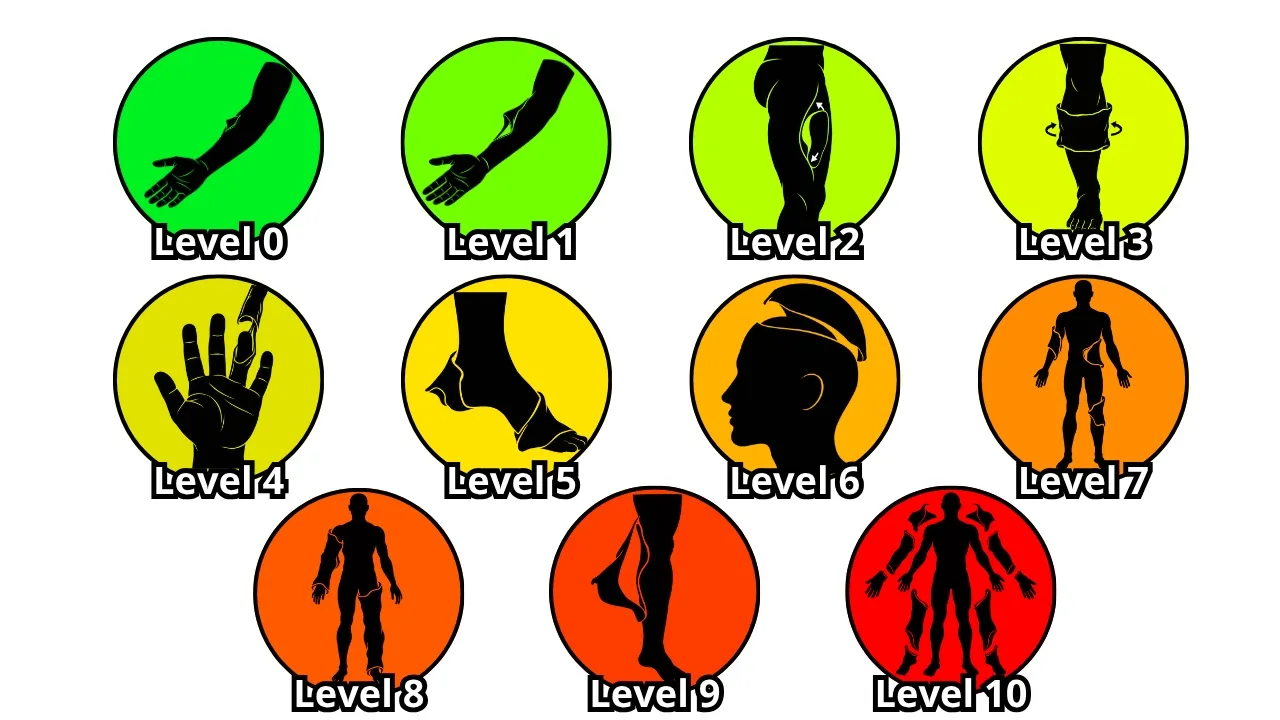
Level zero. What if the wound you can see isn't where the real injury is? At the more localized end, skin separates from the tissue beneath it across a small area. Something that can pass for an ordinary scrape or flap, barely worth a second look. But underneath, it's already been cut off from the layer that feeds it. Not a scratch, a disconnection. Clinicians may check the circulation in the injured area, including how quickly color returns after pressure is applied.
But a normallook response doesn't rule out deeper tissue damage. This is one of the reasons emergency clinicians examine even minor looking skin injuries carefully after high energy trauma rather than assuming a small wound means a small problem. Even skin that never fully detaches can still be quietly dying underneath. And that's a far more deceptive injury altogether. Level one, a flap can sit exactly where it always was and still be dying.
That's partial degloving. Skin partially separated from its underlying blood supply, but still attached at one edge. Skin survives on tiny vessels feeding it constantly. And when a shearing force rips it from that network, the surface can look fine while the tissue underneath is already failing. What matters isn't how much skin is missing. It's how much blood supply survived the tear, and appearance alone doesn't reliably tell you which.
Surgeons may watch how a flap behaves over the following days because reduced blood flow can become more obvious after the initial injury. The flap's fate isn't always settled at the first operation. Then comes the more deceptive version. The skin stays exactly where it belongs and the damage still happens entirely underneath it. Level two. A leg can look almost untouched after a fall and still hide a serious injury.
This is hidden deg gloving, sometimes called a morel lavallet lesion, where the skin stays fully intact on top while the layer beneath shears loose from the tissue covering the muscle, opening a pocket that fills with blood and fluid. From outside, a bruise, some swelling, maybe nothing at all. Underneath, separated tissue that can spread far beyond what the skin suggests. These pockets show up most often around the hip, thigh, or lower back. places where a body can slide across a hard surface while the skin itself stays gripped in place by friction.
A standard exam can miss how far the separation travels, which is why doctors often turn to ultrasound or MRI just to map the true size of the pocket underneath. Because the fluid pocket sits between two tissue layers rather than an open space, it doesn't always show up as an obvious bulge. And small collections are sometimes managed with compression and observation, while larger ones may need aspiration or drainage to prevent the space from becoming infected.
That same hidden separation can go one step further, wrapping all the way around a limb instead of spreading sideways. Level three, wrap that same shearing force all the way around a limb, and the injury can threaten blood flow beyond the wound itself. It depends on how much of the circulation underneath was disrupted, but the wound is no longer the only thing at risk. Doctors sometimes monitor circulation in the fingers or toes below the injury for hours after the initial treatment because a limb that looked fine right after repair can still lose blood flow later as swelling increases inside already tight tissue.
This kind of delayed change is one of the reasons follow-up checks matter just as much as the initial treatment. The hand introduces a different problem, one where circulation is only part of a much more complicated equation. Level four. Sometimes the skin peels back like removing a glove. That's a glove avulsion. one form of handy gloving. And it's rarely just about lost skin. The hand packs skin, nerves, tendons, muscles, and vessels into a remarkably compact structure, all working together for movement and sensation.
So losing the skin can mean losing sensation, grip, or tendon function all at once. These injuries are frequently seen after a hand gets pulled into moving machinery like a conveyor belt or a press where the same motion that causes the initial injury can also drag skin further than the original point of contact. Because the hand relies so heavily on precise nerve and tendon function, even a technically successful skin closure can leave lasting differences in grip strength or fine motor control.
Reconstruction here isn't covering a wound. It's rebuilding a machine. If the hand's problem is precision, the foot introduces something the hand never has to deal with. Weight level five. Closing the wound is only the first problem here. Skin on the sole of the foot is thick, tightly anchored, and specialized to withstand repetitive weightbearing. So, whatever replaces it after degloving has to survive years of ordinary walking, not just heal.
A graft can close the wound, but it may not tolerate the repeated pressure and friction of normal walking, as well as specialized tissue. For larger defects, surgeons sometimes use a free flap, tissue transplanted from elsewhere on the body along with its own blood vessels, specifically because it can handle the repeated stress of walking better than a thin skin graft. Because the heel and ball of the foot experience repeated pressure with every step, injuries in these areas can be particularly challenging to reconstruct.
This is part of why foot reconstruction after de- gloving is often judged not just by whether the wound closes, but by whether a person can eventually return to normal walking without ongoing breakdown. Day gloving isn't limited to places where skin has to absorb pressure. It can happen somewhere far more unexpected. Level six, an entire scalp can be torn off in a single sheet. A scalp avulsion separates the scalp from the deeper tissues over the skull.
Sometimes when hair or clothing gets caught in machinery. In some cases, surgeons can surgically reattach the entire evulsed scalp. When a scalp is fully evulsed, the detached tissue is typically cooled and transported alongside the patient. The same way any severed body part would be handled if reattachment is being considered. Even when replantation isn't possible, preserving as much viable scalp tissue as possible still gives surgeons more reconstructive options later.
But scale within one body part is only half the picture. The largest injuries aren't confined to a single region at all. Level seven. Sometimes the skin injury isn't the biggest problem in the room. High energy trauma rarely limits itself to one injury. A single crash can produce degloving alongside a fracture, a torn vessel, and damaged muscle, all in the same limb, all competing for attention at once. When major vascular injury is present, controlling life-threatening bleeding takes priority.
At this point, dloing isn't the whole injury. It's one piece of a much larger trauma. This pattern can occur in motorcycle collisions and heavy machinery accidents where the same forces tearing the skin away are also breaking bone and damaging vessels in the same moment rather than one injury happening after another. In cases like this, treating the fracture, the vessel injury and the degloving wound often has to happen in a specific order.
The scale keeps climbing and next it's the sheer amount of separated tissue that becomes the problem in itself. Level eight. Skin can stay physically attached to the body and still be dying from the inside. At the extensive end, large areas of tissue separate from what lies beneath them, and the question stops being how much is gone and becomes how much of what's left will actually survive. Surgeons often manage this with repeated deb brement.
Removing dead tissue in stages across several operations. Cutting away too much too soon can sacrifice tissue that might have recovered. Waiting too long can leave dead tissue in place and raise the risk of infection. Between debridements, the wound is often left open and dressed rather than closed right away, giving the tissue time to declare itself. Healthy areas stay pink and bleed when tested. Compromised areas turn dusky or cool to the touch.
What looks healthy on examination doesn't always mean the blood supply underneath is adequate. A piece of skin can still be attached and still be on borrowed time. Once the extent of viable tissue becomes clear, the resulting defect is sometimes covered with a skin substitute or temporary biologic dressing while the wound stabilizes. Buying time before a more permanent graft or flap is planned. This staged approach is commonly used when the true extent of tissue damage isn't obvious at first.
Take away enough of that protective layer and everything hidden beneath it becomes an open problem. Level nine. Open to gloving means the skin isn't just separated, it's gone. and structures never meant to see daylight. Fat, connective tissue, sometimes muscle sit exposed. Treatment becomes a checklist. Stop the bleeding. Assess what's still getting blood. Identify what's torn. Clean out contamination. Then decide what can be saved.
Wounds like this are frequently contaminated with soil, debris, or machine oil. Which is why aggressive irrigation and repeated washouts come before any thought of closing the wound for good. Between operations, negative pressure wound therapy, a sealed dressing connected to gentle suction, is often used to draw out fluid and encourage healthy tissue to grow. Even while a wound like this remains open, surgeons are often already planning the eventual reconstruction, deciding early whether a graft will be enough or whether a flap will be needed once the wound is clean.
This kind of planning ahead is part of why open deggloving injuries are often treated by a team that includes both trauma and reconstructive specialists from the very beginning. This stops being one procedure and becomes a sequence stretched across multiple surgeries over multiple days. One distinction still ahead changes the entire plan. Tissue barely hanging on versus tissue not attached to anything at all. Level 10.
Sometimes surgeons can reuse tissue that has come off. Complete degloving means the tissue has fully separated from the body with no skin bridge left connecting it to the limb. Depending on the location, contamination, and eskeeia time, how long the tissue has gone without blood flow, surgeons assess whether it can still be used in reconstruction. The most catastrophic cases combine it with major vessel damage, nerve injury, torn tendons or muscle, fractures, and contamination all in the same limb at once.
Here the skin is almost the least of the problem. The real work becomes triage. What still has blood flow? What can still move? What can be preserved? And whether the limb can ultimately be salvaged. Even within this same level, no two catastrophic de- gloving injuries are treated exactly alike. Since the combination of damaged structures differs from one case to the
The words are the caption track's own and nothing is reworded or re-transcribed. Paragraph breaks are placed between sentences so the text reads as prose.
Free tools for your own script. No signup, no login.
Paste your draft and see where viewers are likely to drop off, with a rewrite for each weak line.
Paste the first 30 seconds of your own draft for a hook score and rewrites.
Check your draft against YouTube's advertiser-friendly guidelines before you record it.
Read this channel's public videos and transcripts, and download a writing brief for it.