Getting the transcript
Reading the captions from YouTube. A video nobody has opened here before takes 10 to 30 seconds; this page fills in on its own.
Getting the transcript
Reading the captions from YouTube. A video nobody has opened here before takes 10 to 30 seconds; this page fills in on its own.
Nate Herk | AI Automation · @nateherk
This video has no Most replayed graph yet: YouTube shows one only once a video has enough views. These are the moments viewers replayed most in Nate Herk | AI Automation's most watched videos.
Most replayed moment at 20:09
3.5x that video's typical replay level
from that exact avatar five different times. So, selling gets easier, you're able to increase your prices, and more clients stay on retainer because you're not just a vendor at that point, you're the person who actually understands their business. So, here's one more prompt for you. Open up Claude and run this when
Said at 20:01
The graph counts replays. It does not show where viewers stopped watching.
Words
2,515
Runtime
9:47
Speaking pace
257wpm
Reading time
10min
257 words per minute, above the 201 75th percentile of 349 measured videos. That distribution comes from the 349-video hook study.
Opening (first 30 seconds)
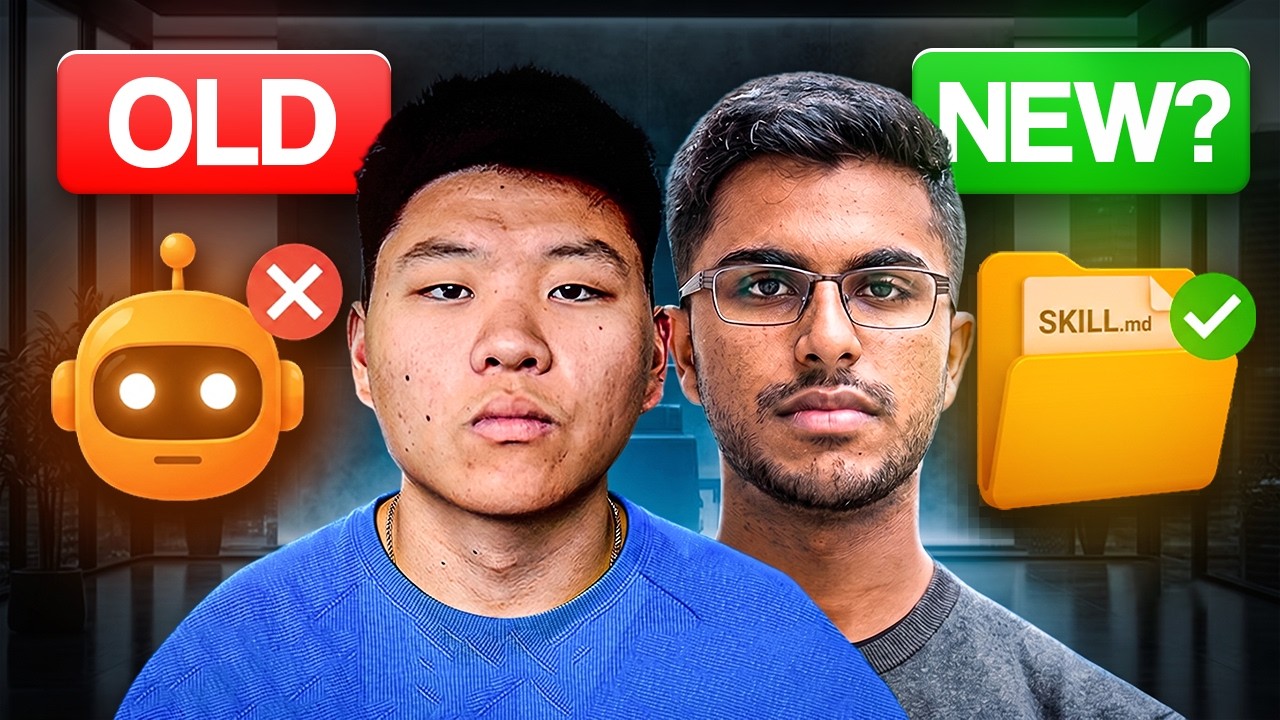
So, Enthropic Engineers just said that they stopped building agents and they started building something completely different. So, if you're still focused on building agents, you're probably wasting hours on something that'll never work the way that you actually want it to. But if you focus on what these engineers are actually building, you'll have a system that improves on its own. So, in this video, I'm going to show you what they said to build instead and the four things that actually make it work so that you can start getting the same quality results that Enthropic engineers are getting. So, let's get into it. All right. So, Enthropic isn't saying that agents are dead. Barry Jien and Mahesh Marog, the two people who created agent skills adanthropic,
129 words, the words spoken in the first 30 seconds at 257 words per minute.
Free, no signup. See how the first 30 seconds hold attention, with rewrites.
Sentence shape
| Measure | This transcript |
|---|---|
| Sentences | 154 |
| Average words per sentence | 16.3 |
| Longest sentence | 39 words |
| Questions asked | 0 |
| Sentences containing a number | 1 |
Most used terms
Filler phrases
48 in total: like 18 · actually 11 · basically 9 · kind of 4 · you know 3 · sort of 2 · literally 1.
A literal whole-word count of the same phrase list the Prepublish browser extension uses, so a phrase inside another word is not counted and a phrase used in its ordinary sense still is. It is a count and not a judgement.
What this transcript is
Every word below is the caption track YouTube publishes for this video, pulled from the video itself and reproduced unchanged. It is not Prepublish's writing, not a summary, and not a re-transcription: it is the video's own published captions. English captions, generated automatically by YouTube, in the video’s original language. Source: the video on YouTube. A channel that would rather this page did not exist can ask for its removal through the contact page, and it is removed.
So, Enthropic Engineers just said that they stopped building agents and they started building something completely different. So, if you're still focused on building agents, you're probably wasting hours on something that'll never work the way that you actually want it to. But if you focus on what these engineers are actually building, you'll have a system that improves on its own. So, in this video, I'm going to show you what they said to build instead and the four things that actually make it work so that you can start getting the same quality results that Enthropic engineers are getting.
So, let's get into it. All right. So, Enthropic isn't saying that agents are dead. Barry Jien and Mahesh Marog, the two people who created agent skills adanthropic, said that they basically stopped rebuilding a separate agent for every single job because the agent underneath had become way more general purpose than they expected. So, real quick, the easiest way to understand this is to look at your phone. Your phone has a processor, an operating system, and then all the apps that you actually use every day.
And a few massive companies build the processor and the operating system. You probably aren't changing either one of those things, but you can choose the apps, and each app gives that same phone a very specific capability. And the whole AI stack is starting to look pretty similar to that. The model is kind of like the processor. The agent runtime is like the operating [music] system. And then skills are the apps. So cloud code can already read files, write code, call tools, and work through a task.
You don't need to necessarily rebuild all of that every time that you want help creating a presentation or researching a company or writing a LinkedIn post or doing whatever kind of things you need to do like that. You give the same general purpose agent a skill that contains the process, the context, the scripts, and the examples for that specific job. So now let me talk about the four practical ways to make those skills work better.
So the first one is simple. Stop making Claude solve the same technical problem over and over. And team kept watching Claude write basically the exact same Python script every time it needed to apply styling to a slide deck. It would spend tons of tokens just recreating the code that has already been written. And because it was rebuilding it from scratch, the result could change from one run to the next. So it wasn't super consistent.
So what they did is they had Claude save that script inside the skill as in their own words a tool for its future self. So now the next time it needs to style a presentation, it can just run the version that already was proven to work. And developers have followed this idea forever. It's called dry or dr, which stands for don't repeat yourself. If you solve a problem in code, you can just save the solution and reuse it instead of rewriting the code every single time.
And you can do the exact same thing with Claude. I've got skills in my own AI operating system that use the same renderers, the same templates, scripts, and stuff like that every time. My carousel workflow doesn't ask Claude to reinvent how a slide gets rendered on every run. the skill just points it to the files that already work and then Claude can just focus on the new content. Like literally just changing the text.
So the next time Claude writes a script that gives you a result that you really like, don't leave that code trapped inside the chat just to get lost later when you start up new sessions. Tell it something like save the script you just used inside the skills script folder. Update the skill.mmd so that future runs execute that file instead of trying to rewrite it again. Then I want you to run the skill again and verify the result.
And real quick, you still obviously need to test it. You run the same type of task twice. You compare the important parts and make sure the skill is actually calling the saved file. The surrounding AI output may still vary a little bit, but you've replaced one fresh guess with a proven piece of code. So, moral of the story, don't pay Claude to rediscover a solution that you already have. But once you start building a bunch of these skills, Claude needs to know which one belongs to the job in front of it.
So, let's move on to number two. So, think about a mechanic for a second. A mechanic might own hundreds of tools, but he doesn't dump every single one onto the bench before he starts changing a tire. He basically just identifies the job and grabs the few tools that he needs and leaves everything else inside the toolbox. And skills work in a very similar way because of something that Enthropic calls progressive disclosure.
So when Claude starts, it doesn't read the full instructions and all the examples and all the scripts from every single skill you have. That would be a huge waste of time and tokens. It starts with the name and the description of each skill. And this is called the YAML front matter. Then when your specific prompt matches a description of a skill, that's when it reads the full skill. MD file. and any larger references or scripts can just stay in the folder until the task actually needs them.
Enthropic describes this as letting Claude load information only as needed. That basically keeps irrelevant instructions out of the working context, which helps you avoid the bloat and confusion which sometimes gets called context rod. But this depends on your description being really really clear. If one skill says help with content and another one says create marketing assets, then cla basically guessing because those descriptions sort of overlap and they don't tell the agent when either of those skills should actually run.
So, a stronger description might say something like, "This skill creates LinkedIn carousels from a topic, from a transcript, or an outline. Use this when the user asks for a carousel, carousel slides, or a LinkedIn document post." Now, Claude knows what the skill does and exactly when to use it. So, just keep each skill focused on one specific job. Put the words a real person would use inside the description and make sure two skills aren't competing for the same request.
And you can actually have Claude Code audit this for you. [music] Just say, "Hey, review all my skill descriptions. For each one, tell me what it does, when it should trigger, and where it overlaps with any other skills. Rewrite only descriptions that are [music] ambiguous. And then you can test these three things. The first one is an obvious request that should trigger it. The second one is a differently worded request that still should trigger it.
And the third one is an unrelated request that definitely should not trigger it. And just remember that a skill that Claude can't find is basically a skill that you don't have. So finding the correct skill handles today's tasks. But the next step is actually making sure that the skill gets better every single time you use it. So, number three, every time you correct Claude and then you close the chat, there's a pretty good chance you just threw that lesson away.
Maybe [music] it used the wrong tone or it skipped a validation step or maybe it formatted the final output in a way that you don't want to see again. And if all you say to Claude is fix it, then it probably will fix it, but the process stays broken. And this is something I've had to work through inside my own AI operating system. If an agent tells me it can't find a file that I know exists, I don't just hand it the path and keep moving.
I ask it to backtrack. I basically ask it to show me its work, show me where it searched, figure out why it missed the file, and then update the routing or the skill so that next run starts in the correct place. Enthropic designs skills as a step toward this kind of continuous learning. Their guarantee is that anything that Claude writes down can be used efficiently by a future version of itself. Now, here's the thing.
Skills don't remember every single thing, and they aren't a recording of every conversation that you've ever had. They basically store the procedural knowledge that Claude needs to do the [music] specific job. So, when a process is wrong, update the instructions in the skill.mmd. When Claude is missing your voice or your brand or your examples, then add a reference file. And when the same mistake keeps happening, then add a clear rule that explicitly prevents that.
And then rerun the same task. You could use a prompt like this. Review what went wrong during this run. Decide whether the cause was the process or missing context or a weak rule or unreliable code. And then update the skill in the smallest durable place. Then rerun the same task and verify [music] the fix. Over time, the skill becomes a living record of how you want the job done. And I do want to be precise about the phrase model proof.
No skill can just force a weaker model to perform exactly like the stronger one. Different models will obviously still produce different results and they interpret skills in different ways. But your process can be portable. Agent skills are an open format. So the same core like skills folder can work across compatible agent harnesses like codeex or Hermes agent or anything else. So test an important skill with another compatible agent.
If the result falls apart, then look for hidden assumptions, missing examples or instructions that only one model understands and then tighten up the skill and keep testing. All right, so the first three were very important, but this one is probably the most important. A skill shouldn't hand you its first attempt and call the job done. This is probably the biggest gap that I see with a lot of AI workflows. You run the skill, it creates the thing, saves the file, and then comes back to you and says, "Hey, I'm done." And then you open it and you realize that the formatting is broken, the sources don't support the claims, or that the script falls completely flat for the person you're trying to reach.
So, the AI did maybe 70 or 80% of the job, and now you're the human, you know, manually doing the last 20 or 30%. But if you already know how to personally check that work, then just bake those checks into the skill and let the AI close more of that gap for you. So, for example, for a slide deck, have the skill render each slide as an image, inspect the screenshots, fix anything that's cropped or hard to read or out of bounds, and rerender it.
For a research report, make it open the primary sources, match the claims [music] to the evidence, and remove anything that it couldn't actually verify. And if you're creating a script or an ad or something more subjective, then have a few different personas, like a few different sub aents, review it and discuss it. A beginner agent can tell you where they're confused. [music] A skeptical buyer agent can tell you what they don't believe.
Someone from your actual audience can tell you where they would probably click away. Now, you don't have to accept every single piece of feedback that you get from these different agent personas. That would probably make the output worse, but the skill can find the issues that show up more than once, make the strongest revisions, and then run the review again. And sometimes just hearing those different perspectives is really helpful.
And real quick, verification isn't clawed reading its own work and saying, "Looks good to me." It needs some kind of evidence outside of that first draft, whether that's a screenshot, a test result, [music] a source, a reference example, or like I said, feedback from a few different agent perspectives. And you can add something like this into almost any skill. Say something like, "Before returning the final output, define the acceptance criteria.
Create the first version, inspect it using the relevant verification method, fix every issue you find, and then run another pass. Return the output only after it meets the criteria with a short summary of what you checked. And if something can't be verified, then tell me exactly what remains. It's even better if there's some sort of objective success metric that you can set and just have the agents keep working until it hits that objectively.
But anyways, now the first output is basically an internal draft. Claude reviews it, catches the obvious problems, and then improves it before you see any of it, before you waste any of your time and attention on it. Because you're ultimately still going to be the final judge, especially when there's things like taste or strategy or business judgment involved in the process. The goal, though, is just to stop spending your time catching problems that the AI could have caught on its own.
Your first look should not be the agent's first look. It should be the agent's, you know, fourth or fifth or maybe even sixth look. So now you know what enthropic engineers are actually building. They save proven code instead of rewriting it. They give every skill a precise description so Claude loads only the correct one. They turn corrections into durable instructions that keep improving. And they verify the work before it ever reaches you.
That's how you take a general purpose agent and you teach it how you work specifically. And if you want to see how I organize the agents, the context, connections, capabilities, and cadence around all of this, then I'll put my full AI operating system course on screen right up here. I also have free courses, templates, and resources inside my free community that will help you build agents and workflows from scratch. You can join with the link in the description.
And if you want to go deeper [music] on turning these skills into a career, then you can check out my plus community. But anyways, that is going to do it for this one. So, if you guys enjoyed, you learned something new, please give it a like. It helps me out a ton. And as always, I appreciate you guys making it to the end of the video. I'll see you on the next one. Thanks everyone.
The words are the caption track's own and nothing is reworded or re-transcribed. Paragraph breaks are placed between sentences so the text reads as prose.
Free tools for your own script. No signup, no login.
Paste your draft and see where viewers are likely to drop off, with a rewrite for each weak line.
Paste the first 30 seconds of your own draft for a hook score and rewrites.
Check your draft against YouTube's advertiser-friendly guidelines before you record it.
Read this channel's public videos and transcripts, and download a writing brief for it.