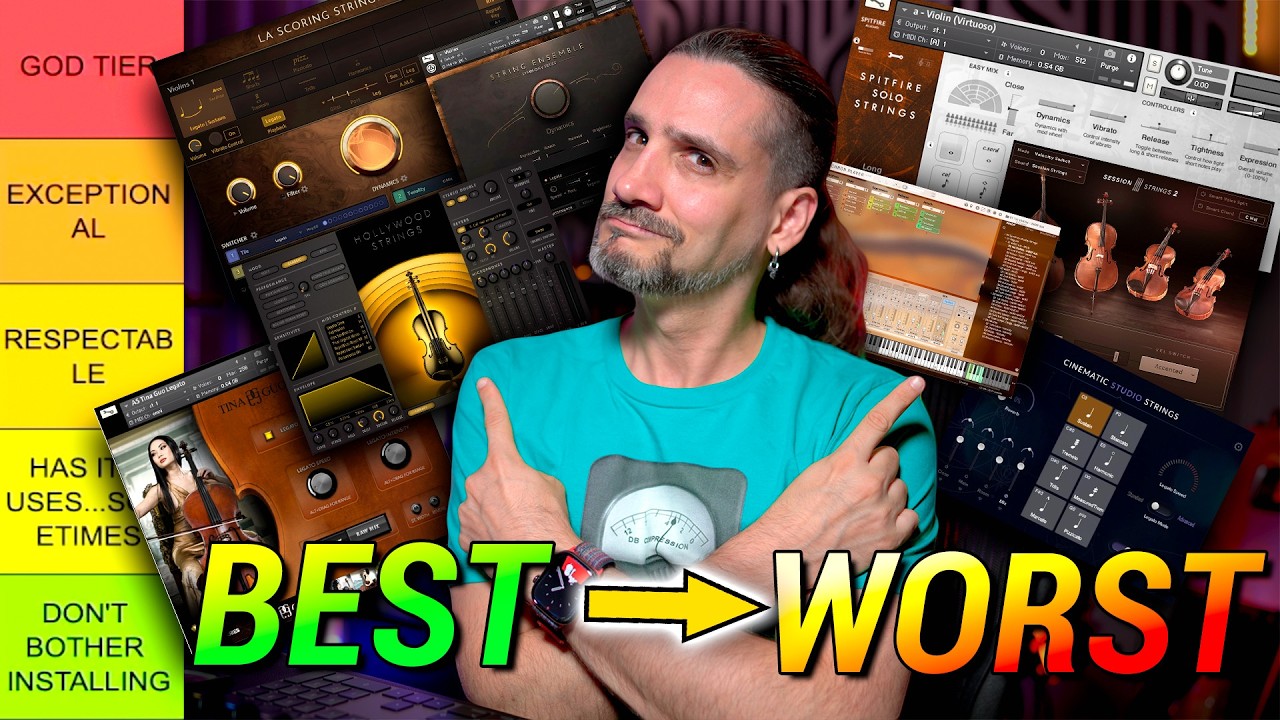
Ranking 25 TOP String Libraries from BEST to WORST! transcript
Dom Sigalas · @DomSigalas
Words
6,354
Runtime
38:14
Speaking pace
166wpm
Reading time
26min
166 words per minute, between the 160 25th percentile and the 181 median of 349 measured videos. That distribution comes from the 349-video hook study.
Opening (first 30 seconds)
Hey my friends, Dom here and I heard you. I heard you. In this video, we're going to rank 25 of the most popular string libraries from best to worst. I'm very excited. I know that so many of you have been asking me for this video. I'm going to be ruthless. Let's get started. So, as always, I'm going to explain the tiers. To begin with, I want to say that all the libraries that I have here are libraries that I
83 words, the words spoken in the first 30 seconds at 166 words per minute.
Sentence shape
| Measure | This transcript |
|---|---|
| Sentences | 552 |
| Average words per sentence | 11.5 |
| Longest sentence | 113 words |
| Questions asked | 20 |
| Sentences containing a number | 13 |
Most used terms
- library113
- libraries57
- strings50
- sound41
- uh31
- string30
- bit19
- video19
- absolutely17
- exceptional17
- legato17
- tier17
Filler phrases
202 in total: like 69 · you know 35 · kind of 31 · uh 31 · actually 13 · um 13 · right? 6 · I mean 4.
A literal whole-word count of the same phrase list the Prepublish browser extension uses, so a phrase inside another word is not counted and a phrase used in its ordinary sense still is. It is a count and not a judgement.
What this transcript is
Every word below is the caption track YouTube publishes for this video, pulled from the video itself and reproduced unchanged. It is not Prepublish's writing, not a summary, and not a re-transcription: it is the video's own published captions. English captions, generated automatically by YouTube, in the video’s original language. Source: the video on YouTube. A channel that would rather this page did not exist can ask for its removal through the contact page, and it is removed.
Transcript
Hey my friends, Dom here and I heard you. I heard you. In this video, we're going to rank 25 of the most popular string libraries from best to worst. I'm very excited. I know that so many of you have been asking me for this video. I'm going to be ruthless. Let's get started. So, as always, I'm going to explain the tiers. To begin with, I want to say that all the libraries that I have here are libraries that I have used extensively, that I know them very well.
I also wanted to include some libraries that I've used but I don't own. But uh because some of them don't even have demos and are really really difficult to get a hold of, I didn't want to include them if I didn't have a chance to play with them recently. So, if something is not there, I might include it on a future video. But let's explain the tiers. So first we have got tier. And in got tier are going to be the most amazing string libraries.
The libraries that I use all the time. The libraries that I cannot live without. The libraries that I really think you should consider buying if you're serious about your string libraries. Then we have the exceptional category. These are going to be really amazing libraries. Maybe not my top top choices. Then we have respectable and these are going to be libraries that are quite good but in my opinion nothing special nothing that's really exceptional and definitely not got tier.
Then we have has its uses sometimes. These are libraries that I still have on my hard drives but they don't get much use apart from specific use cases. And I'm going to explain what these use cases are. And then of course we have the last tier don't bother installing. These are actually libraries that I don't install anymore and are not currently on my hard drives. I've completely removed them from my system because I didn't feel they offered anything.
It doesn't mean they are completely terrible or that you can't make great music with them, but I personally don't [music] like them. Let's take it randomly. I'm going to start with this library right here. These are the LA scoring strings. Now, this library is um a very interesting library. In my opinion, it's not an easy library to work with. You need to mix it. You need to make it sound pretty. You need to add reverb.
It's a very dry library. It's also a little bit less kind of refined. It sounds a little bit not perfectly in tune, if that makes sense. But all of these reasons are the reasons why I absolutely love this library. This is a library that uh I think that if you're serious about writing for strings, it's a must just because it has this kind of raw quality. It kind of forces you to focus on the arrangement, the voice leading and all these things.
It can do great legato. But if you expect that you're going to run it and you're going to get a finished sound with it, you're not going to get this. However, this library is so good. I've been using it since like the really really early versions and now they have the new interface which improves the situation quite a bit and for me this goes straight to gut tier. It's a very good one. It's not cheap. I would do my research before investing but for me it's gut tier.
Next one let's go randomly. Okay, we have action strings 2 from Native Instruments. I don't want to be harsh but this library is not for me. This library has pretty much predefined patterns that you can change of course and it gives you a very nice sound. It does sound like cinematic. It does sound very actionlike. But to me, if you own this library, apart from a quick mockup, you're going to sound like everybody else.
This is my problem with these kind of libraries. Unless you are a very skilled composer and somebody who knows where and how to use this library, you're going to sound like everybody else because these are predefined patterns and string lines. And there are some libraries that have this kind of concept that I actually like. Maybe I'm going to talk about them on a different video, but for me, this goes to don't bother installing.
I don't have it installed. I have Native Instruments Complete. This is a library that I don't bother spending one single gig of my SSD on it because it's not useful. It's just sitting there. I never use it. Let's move on to the next library. And the next library is Sena string core. Now, this is a library. Again, I've made videos about this library. I've played them so you can go check them out if you want to listen to them in action.
But Sin String score is a very interesting library. I absolutely love it. and hate it at the same time. I love it because the sound is so good. It has a lot of delay. You can't really play and expect thath you are going to get like instant response. You have to adapt. You have to be a good keyboard player to adapt to the playing style. Especially for the legato. It sounds very raw. It's a little bit dirty. Lots of noise, lots of, you know, dirty samples.
But I love this. Quite honestly, I absolutely love this. There were also some problems that I reported on the video that I've done uh about this library. The fact that it was causing huge spikes in CPU with contact. I'm not sure if they fix that, but quite honestly, this remains one of my favorite libraries. It is one of the libraries that I like to layer with. I like to layer with sin strings. This is the ensemble, right?
And I like the new interface. It's one of these libraries that I'm going to reach out for for many things because I know what it's going to work on. So, for this one, I would place it to let's say either exceptional or respectable. I think I'm going to go for [sighs and gasps] it is exceptional. It's a little bit of an old library. Okay, let's go very very top end of respectable. You know, borderline exceptional for me.
It could be either. Next, we have the Joshua Bell Violin. Honestly, I'm going to say this right now. Go and buy this. Um, I have no affiliation with uh I don't even remember what the company name is. Is it Embertone? Yeah, it's Embertone. So, I don't have an affiliation with them. I'm just telling you, this library is amazing. It has character. It has vibe. It's uh very playable. The legato are the best legatos that I've ever heard on uh Violin Library.
Uh it's a secret weapon. You know, it's one of these libraries that many composers will use and they will never say that they're using it because it's just so good and they want to keep this sound for themselves. I know composers that do that actually. But I'm telling you, I'm spilling the beans. Go and get it. It's such a fantastic library. Absolutely. The the most important thing for me is that it's playable. It's instantly playable and it it's like it's reading your playing.
So you play fast, it's going to play this great kind of fast legato. If you want to play an expressive kind of portimento, it's going to do it's so so good. I'm not going to say more. Got tier straight away. Absolutely fantastic. Right here, I'm going to mention something that I know that many of you producers and film composers are going to be interested in. Right now, there's a crazy giveaway going on from Plug-in Masters.
To celebrate their 4th anniversary, they're giving away $10,000 worth of professional plugins to 10 lucky winners. And we're talking about some of the top plug-in manufacturers on Earth like Fab Filter, Universal Audio, Sound Toys, Isotope, Even Tide. The best part is that it's completely free to enter and there's absolutely no purchase necessary. So, all you need to do is click my link in the description, fill out the quick entry form, and that's it.
So, definitely don't miss this one. Check out the link below, enter now, and good luck. And I hope one of you, my friends, wins. Now, back to the list. Let's move on to another library from Audio Bro, Modern Scoring Strings. Okay, so this library, I bought it during a Black Friday deal if I'm not mistaken or maybe I'm mistaken. I don't remember. Okay, so uh maybe I paid full price for it. I had great expectations for this library.
Again, the problem with string libraries is that there are no demos. And for me, this is a big problem that we have in the industry. You know, you can't really demo these libraries. And it's kind of understandable to be honest with you because the bandwidth that you would need to have people download your libraries for free and demo them, it's probably prohibiting from allowing companies to say, "Okay, cool. Yeah, download 100 gigs of material.
We're going to pay for the server costs." There are things in the background that as a user you might not think, and I totally appreciate that, but these things are real. You know these are things that you have to pay for if you download a library 100 gigs the company has to pay for the hosting for the traffic and all these things and that's why myself along with other people on YouTube we try to show you how these libraries sound like I feel that sometimes the demos that some companies have are not really representative of what a library can do how it feels under your hands.
I want to see this thing. That's not related to the audio bro stuff, but it's a it's a general observation. So, for me, this library, it's it's a very very good library, but for me, it doesn't have character. When I load it up and play it, I don't feel inspired, if that makes sense. Is it a technically great and articulate library? Absolutely. It's amazing. I mean, you can just buy this library and you'll be good to go if you want to do orchestral mockups, but for me, I realize I spend so much money on it and I really don't use it.
So, for me, I would just I can't say that it has its use sometimes. I don't really use it, but it is respectable. I would call it exceptional if it was a little bit more inspiring in terms of sound and also it was a little bit more playable. I find I have to work hard with this library to make it work well under my fingers. You know, it might be just me. So, this is my personal opinion, of course, for all of these things, right?
So, if you love a library and I don't love it, absolutely fine. We're still friends. Let's move on to the next library. And let's go for the first VSSL library of the bunch. This is the Synchron Strings Pro. There's no other way for me but to place this in goier straight away. VSSL I've been using since the Giga Studio days, you know, that's like I show my age here, but I think they make the best samples on the market.
They have these anacoic chambers. They know how to sample. They are musicians. They have a pedigree. I mean, most of these developers here are musicians and they know how to do this. But VSSL, they do this differently. They are a special developer. And uh I think that maybe they don't cover the whole kind of spectrum. So if you want this huge um imperfect cinematic sound, maybe they're not the best company for this. But if you want the most detailed articulationheavy and a library that will allow you to score pretty much everything, you go for Vienna Symphonic Library libraries.
This is a very good example. The legato are amazing. The shorts are amazing. The effects are amazing. They have so many different legato types. VBR, molto vibbrd, sensa vibbrd. They have all these things. And I think that again, it's one of these libraries that you can just buy it and you're done with string libraries, unless you want a colored string library. Now, for something completely different, these are the session strings from Native Instrument.
Session strings 2. And I have to say, I never resonated with this library. Never liked it. It It's one of these libraries that it's supposed to be good for pop. But for some reason, there's a misconception that when a library is supposed to be good for pop music, it should sound kind of straight and emotionless and um kind of lacking dynamics. I don't know. I never like this library. I'm not saying that it's not good, okay?
Uh especially if you're tight for budget or if you have it installed with Native Instruments Complete, please give it a go. You might be inspired. You can tell that I'm also spoiled when it comes to string library. So, I have uh my bar set really, really high. So, please keep that in mind, right? So, for me, it's don't bother installing. And I will say once more that doesn't mean that you shouldn't bother installing it.
But it means that I don't have it installed. It's right there. I can click install. I don't install it because I want to save the space for something that's meaningful. For me, every time I try to like it and use it, I didn't like it, you know. So, it's it's absolutely fine, but you might like it. So, check it out. Maybe I kind of triggered your interest right now. right here. I want to say that this video is not sponsored by any of these library manufacturers, but if you want to support the channel, you can check out my ultimate Qbase masterass where I show you everything you need to know on how to use Qbase and become a professional user.
Over 20 hours of material, fully updated to include new chapters for Qbase 15. I cover everything from basics to advanced features like setting up for film composing. And of course, if you're interested in mixing, you can check out my brand new ultimate mixing masterass and of course my mastering master classes. Okay, back to the tier list. Okay, let's go for something very, very different now. And these are the swam strings.
Now, this is not a sample library. Technically, these are physical modeling, but if you ask me, this should be in every film composer's toolbox. These are extremely expressive because they're not samplebased. You can do things that you will never be able to do with sample libraries. At least up to this point, no sample library can do what the swamp strings can do. One way that I use them is I layer them with sampled libraries.
And the combination is killer because you get the articulation and all the nuances from Swam, but you also get a little bit of the kind of organic feel of a sample library. So, for me, this goes straight away. No questions asked. I wouldn't want to be without the Swan Strings. Go check them out. I've made a video about them. If I didn't like them, I wouldn't have made a video about them. I I have to say it again. I say it every single time.
You might like something or you might not like something. But if I make a video about a product, it means I actually really like the product. My time is very limited. I'm never going to make a video about something that I'm like, okay, I find it hard to make a video if I'm like this, you know? I want to be excited. So yeah, Swam absolutely love them. Next, we have cinematic strings. This library, I really like it. It's very simple, very straightforward.
It doesn't have like ton of articulations, but it has a very big cinematic sound and sometimes it's the only library that works. It's one of these libraries that you might want to use on trailer music, for example. I don't think the legato are the best legato. It has very good shorts, but it's it's it's a good library. It's a good library. I would say that this library is a library that I wouldn't want to, you know, part with.
It's old. I don't think there's been any update for this library for a while. I think that I would probably place it in respectable. Respectable with some exceptional annotations, right? So, this could also be exceptional as well. Okay. Actually, I haven't placed anything to exceptional yet. So, let's see if we're going to find something for exceptional. Next, we have Berlin strings from Orchestral Tools. I have to say here, Orchestral Tools is one of my favorite developers when it comes to orchestral libraries.
Absolutely fantastic. Pretty much everything they do. For me, it's again one of these libraries that are so detailed. The legato are great. The sound is great. I really like the sound of orchestral 2 libraries. It gives me this kind of Beethoven kind of vibe, you know? It kind of inspires me to play stuff like this. It's designed by people that you can tell that they know their classical music. They don't just do it for, you know, the Hollywood stuff or the cinematic stuff.
So, this library can absolutely sound cinematic. And I think it's one of these libraries that again, you can buy it and then you're done with strings for a while. For a while. I really like Berlin. Strings is a super solid library. And actually, this is my first exceptional one. I don't place it in gut tier because I think that it doesn't have all the articulations that I would want. It doesn't have a very obvious color, but at the same time, it's not as clinical as the VSSL.
So, it's kind of a middle ground, which makes it perfect for most things. But, uh maybe if you want to have a little bit of character or you want more articulations, you would go for something that's a little bit more specialized like LA scoring strings or Vienna. But quite honestly, if you don't want to risk, I would say this is the best middle ground when it comes to strings. Absolutely fantastic. Let's go for Hollywood Strings one.
And I also have two uh in here. So, Hollywood Strings One. This is a very, very good example of a library that is designed for Hollywood writing. Hollywood Strings One is a library that I bought when it was released. I bought it like now they have the subscription and the prices are lower but the subscription is a very good deal when it comes to East West and you know so many people have them have access to Hollywood Strings 1 and two.
I think it's a brilliant library. It's uh it's an old library but in my opinion it is the library for Hollywood writing. It sounds lush. It doesn't have like incredible definition like Vienna, but it is this Hollywood sound. If you want that Hollywood sound, you would go for Hollywood Strings version one. Big soaring strings, octave presets, so that you have these kind of doubled strings. It sounds lush. It sounds super cinematic and it's inspiring and it's very playable.
I absolutely absolutely love it. Goes straight to gut tier even though it's old. Absolutely love this library. And now with the OPUS player, they actually made it even better. So I I love this library. Let's move on to something that maybe I don't love so much, and this is the Native Instruments string ensemble. Um, this is made by Audio Bro and Audio Bro know how to make amazing string libraries. For me, this library never spoke to me and the price is really really high.
So, uh, I would not be able to recommend this. I would say go for LA scoring strings or go for even the um modern scoring strings from Audio Bro. This library, I'm completely indifferent. You know, I tried it um with the Native Instruments Complete. I was like, "Okay, wow, a new string library. I don't like it. I really don't like it. I don't see the point to be honest with you. It sounds u kind of boring to me to be honest with you." Again, I'm not saying it's a bad library.
I'm comparing it with the top top top libraries right here. So, for me, I'm sorry, but I have to place it to don't bother installing. I don't have it installed. I checked actually because I was like, how do I have it installed? If I have it installed, I don't want to say that I don't have it installed. You can imagine I never even checked because I never gravitate towards this. Can you make great music with it? Of course you can.
But I'm comparing it with, you know, Goliath here. Let's go for the sin string solo strings. Now, this is exactly the same thing like what I said for the core strings. These are the solo version of the sin sample strings. I would say that for this one again they are quite colorful. They are quite noisy sometimes these samples but they have a character that again they're super nice for layering. And if you have an exposed solo part I would feel comfortable with the sinister string solo strings.
However, with so many libraries that exist these days, I don't feel that I'm using them as much. So, I would probably place them to respectable or has its use sometimes. It's not the first solo string library that I'm going to load, but sometimes it's the only one that works and has the character that I want. So, I would place it to has its use sometimes, but it's a very respectable library. I like it. I wouldn't want to be without it.
You can check the video where I play it. I'm a fan. I'm a fan. But I I I have to kind of rate it in a way that is kind of fair, you know, compared to other offerings. Right now, sticking with solo libraries, let's go for the cinematic studio strings solo. Now, this one is one of my favorite libraries when it comes to solo. used to be actually and I use it a lot for uh when I have to do productions that are like acoustic folk stuff like this because they have this very very specific sound.
Their legados are super nice have a very strong character. They have vibratto. They're not like the most detailed library. Again, they're not the most detailed library. So it's not like you will be able to go from full non-vibr what is offered these days. I bought this full price. I maybe it was Black Friday as well. I don't remember but I think the price is a little bit high. The legato have a lot of lag so you have to adapt again but it's more predictable than the uh sin samples one.
So for this reason I will place it to respectable. It is respectable you know. Next we have the VSSL duality strings. I really like this library. I've made a video about this. I really love the concept, you know, the fact that you can blend between a larger section and a smaller section. I think this works very, very, very well. It's as good as it gets with VSSL. Consistent, precise, very responsive legato. You don't have to adapt.
It's really, really good. Very good library. I would place this in exceptional. If you want the ultimate thing, maybe the Synchron Strings Pro is a better choice. But this is also a very very good library. Let's move on to a Spitfire library. And next we have the Spitfire Solo Strings. Now this one is one of these libraries that I feel that it's age shows. It's not a bad sounding library, but I feel that it's not a modern library anymore. you know, the sound is a little bit thin.
The legato are not so playable. I find that it needs a lot of help with mixing and I don't think this is a library that if I wanted to write for a string quartet and I would have it exposed, I would go for this library. You would be able to tell that this is a sample orchestra straight away. I'm not saying you can't work hard and create something amazing. Obviously, so many people have been using this and uh you know, they've done amazing productions and amazing work.
But for me right now, would I recommend this? Would it be the one that I would reach for? Quite honestly, no. And I don't even have it installed. I'm not saying it's a bad library. Far from it. But uh I moved down and I don't use it anymore. Also, it still has this super like old contact interface, you know, this kind of other libraries have it as well in the list, but this for me it's so small and cryptic and hard to read.
No, no, I you know I I don't have it installed. I'm being honest. Okay, so I'm going to move on to a library that I have installed and I have this installed for years and this is the Tina Cello. Again, I've played this on previous videos. What can I say? This is one of the most expressive cello libraries ever. It has this Tina sound. You won't be able to find this sound anywhere else. It has one sound. It does one thing.
It's got tier. It's amazing. The legato are fantastic. It's also from Cena samples. Cena samples do amazing stuff. And the Tina, I think, is one of the best things that they've ever done. And I don't think that anyone has any objections when it comes to the Tina Guello. Let's move on to something else and let's go for the Lux strings from Sonoscore. This library when I first tried it, it blew me away. Not because of only the sound, which is amazing, which is lush, cinematic, playable, expressive, inspiring, all of these things, but also because it added features that no other library had.
You can morph the articulations. You can start from a sustained note and progress it into like um like a cluster or ali sounds or tremolos. And you can do this with the mod wheel. You can have it do it automatically. It has an auto DVY section as well. I'm not going to talk too much about this because I've made a video. Go watch it. Actually, the track that I play at the beginning of this video, it was flagged by YouTube for copyright because YouTube thought it was a real orchestra and actually gave me the name of the orchestra and uh the video got demonetized.
I had to, you know, do some crazy things in order to get the video up, but got here. No question. Let's go for something that's a special library. And this is the Aflatus strings from Stress of Sampling. I adore this library. I think this library is so so good. It's a really special string library. This is a thematic library. For this library, you have presets that are inspired by films uh by certain kind of um playing styles or period styles. for example, Barack and stuff like this.
I think it's a lovely library and so playable. I [snorts] love the fact that you can do polyhonic legato stress of sampling do this very very well. I would rate it exceptional. I'm not placing it on god tier because it's a very particular library. So it's not a library that you can use for everything and it might not be your first string library, right? But if I was ranking it in terms of sound and feel and expressiveness, it would go straight to gut tier.
Next, we have the Vienna Synchron Solo Strings. And uh these for me again go straight to gut tier just because they are the most detailed solo string sections. You will find so many articulations. If you want to get one solo string section, this could be it. Sometimes their tonal character is not 100% what I'm looking for, if that makes sense. So, they do sound a little bit clinical. They might sound a tiny bit harsh.
They're not a warm string library. They are a very kind of present and articulate and kind of bright string library, I would say. So, it's not one of these uh solo strings that um will give you this warm kind of cozy tone. They're kind of, you know, powerful and attacky. So, maybe I should have placed it to exceptional, but for me, they're gut tier. I would be panicking if I didn't have the solar strings from Vienna and I would have to write a piece for solo strings.
I always have to have them around. Let's move on to another library that is a solo string library. And this is the Chris Hine Solar Strings. And for me, these are really exceptional, very, very nice libraries. My only complaint is that the old contact interface is really old. I wish there was an update and uh the interface became a little bit more modernized. Very playable, very emotional, very unique character. So yeah, that's the reason why I'm placing this at exceptional.
And um if you haven't heard them, I would suggest you go check them out. They're really, really good. Next, we have the trailer composer favorite, the cinematic studio strings. And I have to be honest, my experience with this library is limited to, you know, having played it several times in studios that I was producing in. Um, they are very good strings. Are they the most detailed string library? No. Do they do what they do in the best way possible?
Yes. They are a great string library for cinematic trailer music, for symphonic metal stuff. They're really, really good because they cut through. Would it be the first library that I would buy? If you make these genres, yes. If you don't, maybe not. I think they are a little bit too uh let's say generic sounding rather than having character, but they cut through in a mix. Oh my goodness, they cut through. So, I would place them as respectable.
Really nice. Really nice. They're not cheap though. Again, they're old library and the price is the same for years and years and years. Uh which is there's nothing wrong there. It doesn't mean that you have to reduce your price if your product is like 10 years old, but but still. Next, we have the Chamber Strings by Spitfire. I feel that I have to make a part two of this so I can include some more libraries by Spitfire because I mean, to be honest with you, I do this randomly.
I just select some libraries that I think that so many of you will know and will have questions about, but there are libraries by Spitfire that are just much much better, right? But anyway, so the chamber strings I think is a very nice library. I like the tone of chamber strings. They are still on the thin side. They don't have this bigness. These old libraries by Spitfire, they were a little bit distant uh even if you activate the closed mic.
But the chamber strings is one of my favorites when it comes to writing for Barack. they have this very specific sound that sometimes I like to use when I'm doing this kind of period music which is not very uncommon because sometimes you know when I score films and you know the director wants this kind of vibe this could be one of the best libraries to do this or at least check it out when you start writing it still has this old contact interface quite honestly I'm really looking forward to see what Spitfire are going to do uh you know I really want to see some new string libraries, some new orchestral libraries by Spitfire because they are pioneers and I want to see more.
I want to see what's going to happen with Spitfire. Um, you know, I'm I'm very curious. I'm very excited. This one I would place it to has its uses sometimes. I don't use it like very often. I really like it, but check it out because you might not like it. It has a very specific sound. It has this very kind of intimate small string section. And let's move on to the last two libraries. Next we have Cremona Quartet. And okay, the general consensus about this library is that many people don't like it.
And I think that I'm one of these people. I'm not a big fan of this library. I'll tell you what I like about it. It has a very nice uh DVZ system. So when you place it under your fingers, it feels very nice. So you can play, you know, chords and do voice leading and it will mostly get it right. This is what I like about it. I think they did a very good job there. But that's it. Everything else stops there. The sound, I find it very sterile.
It has vibra, but the vibra is kind of almost like a fixed vibratto. If you try and isolate the instruments, none of them sound exceptionally good. So, I mean, if you play the cello, it's not going to sound nearly as good as the Tina Guo cello. The violin is not going to sound nearly as good as the Joshua Bell violin. Absolutely no comparison. So, for me, it's always like a mystery sometimes when there are libraries that are so old like Joshua Bell violin or the Tina Guacello and they are playable.
You just place them under your fingers and they play so well. And then you have modern libraries that were released recently and the legato are like they're okay, you know, not terrible, but they're just okay. They're not close to these pinnacles, you know. So, I'm wondering what's going on. Is it because of contact scripting? Uh, you know, some of the most talented people that were scripting for contact are not doing this job anymore, maybe because it wasn't profitable.
I don't know what it is. There must be a reason. But it's a trend that I see with orchestral libraries lately that, you know, there are exceptions like the Lux strings that you actually play them and they're really good. But there are also some libraries that, you know, you play the legato, you're like, "This is not legato." For me, I'm happy to let this go if the library has a really nice character, really nice sound.
But cremona quartet doesn't sound good to me. To my ears. To my ears, it sounds a little bit like I'm trying to sound like real strings, but ah, now you gave it away. It's always going to give it away at some point. So, the way I'm going to rank it is has its uses sometimes. And the use is that sometimes very rarely I just uh just load it up so that I can play some chords and do a little bit of rehearsing before I go and write a part with a good solo string library and I want to see how my arrangement sounds like.
It's good for that. But quite honestly, if I upgrade my system and I have to reinstall everything again, I won't bother installing it. But I have it installed right now. So I want to be fair. So it goes to has its uses sometimes. And the last library on the bunch is the Hollywood Strings 2. This is again a library that I really liked. It's a library that when I tried it, I was like, "Yes, now we're talking. This is a very, very good library." And I've made a full video where I orchestrate Beethoven 7 Symphony.
You can check it out here. And I'm using this library exclusively and it sounded amazing. So I have used this so much and it's a very nice library. I would place this as exceptional. For me it's not really a Hollywood sound. For me it's a Beethoven sound. It's a Mozart sound. I actually appreciate this even more sometimes. So there you go, my friends. This is my own personal tier list for string libraries. If you want me to make a part two, let me know in the comments down below which libraries I should include in part two.
And if I've tried them, I'm going to include them. I have so many more in my system, so please let me know in the comments down below. As always, if you enjoyed this video, like and subscribe because I have more tier lists coming your way. I'll see you on the next one. Bye-bye.
The words are the caption track's own and nothing is reworded or re-transcribed. Paragraph breaks are placed between sentences so the text reads as prose.
Use this transcript
Three free tools that work on the material around a video like this one. No signup, no login.
Hook Analyzer
Paste the first 30 seconds of your own draft for a hook score and rewrites.
Policy Pre-Flight
Check your draft against YouTube's advertiser-friendly guidelines before you record it.
Channel Skill Generator
Read this channel's public videos and transcripts, and download a writing brief for it.