Getting the transcript
Reading the captions from YouTube. A video nobody has opened here before takes 10 to 30 seconds; this page fills in on its own.
Getting the transcript
Reading the captions from YouTube. A video nobody has opened here before takes 10 to 30 seconds; this page fills in on its own.
AI Engineer · @aiDotEngineer
This video has no Most replayed graph yet: YouTube shows one only once a video has enough views. These are the moments viewers replayed most in AI Engineer's most watched videos.
Most replayed moment at 18:45
4.8x that video's typical replay level
that they're they're changing they're changing things in the database not yet. You want to run them through the ontology first and make sure that works. Okay. I only got an I've got I've got another I've just a short time. I'm going to try to show you some of the things that um that you can
Said at 18:37
Most replayed moment at 16:13
3.6x that video's typical replay level
method signatures, the program layout and the call stacks. So here's some examples. I don't think you'll be able to read this one, but this is like the level of abstraction we're at. It's how we're actually going to lay this stuff out and how these systems are going to interact. Dylan Mulroy from Cloudflare talks a
Said at 16:06
Most replayed moment at 13:49
2.3x that video's typical replay level
Fable uh and it runs into an unknown, ask it to log it, right? So that um you uh you can see where the deviations happened and then you can sort of figure out why as well, you know? It will usually give you some context about what happened.
Said at 13:43
The graph counts replays. It does not show where viewers stopped watching.
Words
1,823
Runtime
12:39
Speaking pace
144wpm
Reading time
8min
144 words per minute, below the 160 25th percentile of 349 measured videos. That distribution comes from the 349-video hook study.
Opening (first 30 seconds)
[music] >> Yes, so good afternoon and thanks for coming to this session. I know there's a lot to choose from. Uh my name is Ben Cohan. I'm a forward deployed machine learning engineer in Modal. And uh I want to talk about an interesting pattern that we've been seeing uh in AI application development. I'll give you the punchline now. Um it's about uh as companies mature and their products mature
72 words, the words spoken in the first 30 seconds at 144 words per minute.
Free, no signup. See how the first 30 seconds hold attention, with rewrites.
Sentence shape
| Measure | This transcript |
|---|---|
| Sentences | 114 |
| Average words per sentence | 16.0 |
| Longest sentence | 48 words |
| Questions asked | 20 |
| Sentences containing a number | 9 |
Most used terms
Filler phrases
137 in total: um 39 · uh 35 · right? 15 · like 14 · you know 12 · kind of 9 · sort of 5 · actually 3 · basically 3 · I mean 2.
A literal whole-word count of the same phrase list the Prepublish browser extension uses, so a phrase inside another word is not counted and a phrase used in its ordinary sense still is. It is a count and not a judgement.
What this transcript is
Every word below is the caption track YouTube publishes for this video, pulled from the video itself and reproduced unchanged. It is not Prepublish's writing, not a summary, and not a re-transcription: it is the video's own published captions. English captions, generated automatically by YouTube, in the video’s original language. Source: the video on YouTube. A channel that would rather this page did not exist can ask for its removal through the contact page, and it is removed.
[music] >> Yes, so good afternoon and thanks for coming to this session. I know there's a lot to choose from. Uh my name is Ben Cohan. I'm a forward deployed machine learning engineer in Modal. And uh I want to talk about an interesting pattern that we've been seeing uh in AI application development. I'll give you the punchline now. Um it's about uh as companies mature and their products mature and specialize, we're seeing more and more turn to fine-tuning to get in increased performance, better costs, and so forth.
So this brings up an interesting question of when does your application step over the line into a custom domain? When is fine-tuning worth it? Um so if you're not familiar with Modal, uh we're a general purpose serverless compute platform. Uh we provide sort of basic building blocks like serverless functions and uh like hardened sandboxes for code execution. And so as an FDE on a general purpose platform, I had the opportunity to work with sort of a extremely wide range of AI applications.
So from physics simulations to uh quantum chemistry, and of course like voice processing, LLMs, and agents. A really interesting um one that's been really blowing up is large-scale reinforcement learning. Um and so we started to think about um some of these customers as where where are they on the model spectrum? So on one side of the spectrum is a frontier API. And the frontier APIs, uh I think everyone here would agree, has unlocked a completely new era of uh you know, accelerated growth.
Um people can build basically anything exceptionally fast. Um they're amazing. Um but uh you can't customize it at all uh beyond prompt engineering. And so um you might I mean uh I love the uh the whole caveman mode thing. If you tell your LLM to speak like a caveman, you can reduce your tokens by like a lot. But that's not going to scale if your startup, you know, 100 X's or 1,000 X's, right? Um another um kind of interesting thing we see is when uh startups win large enterprise contracts with very specific latency or throughput requirements.
Um there's very little ability to customize for those things. Let alone if you have a custom metric that encapsulates your business logic. Okay, so to get this model differentiation, a lot of companies turn to fine-tuning. And what that has meant traditionally is this huge jump to the other end of the spectrum, right? We training has a very different like scaling and compute characteristic to most production workloads.
So if you want to train and serve a production workload, in the past you have to get a big cluster. Now you have to isolate that those resources from your production resources. Your going to need infrastructure engineers or your AI engineers are going to be working on infrastructure, maybe even your scientists. So with this kind of extremely customized uh you know, powerful option, you also have this massive responsibility for the entire stack.
Um And so uh you might have a guess who I would recommend for this, but there's sort of a middle ground that's emerging. There's a new type of cloud provider that makes this a lot easier. And um you know, we're we're building this to address uh this problem that we're seeing, right? So leader after leader in the space are announcing or publishing that they've fine-tuned and gotten incredible results. Okay, so Intercom is beating their frontier API at 1/5 the cost.
Um Pentress says orders of magnitude. I wish I knew the exact amount, but I think uh one of our customers, Decagon, has summed this up really well, which is that um basically the frontier labs probably don't have the exact same goal as you, right? They want their models to win on everything possible. And um we want our models to win at our business logic, right? You want to be the best at what you provide your customer.
Um And so yeah, I'm happy to announce that it's actually a lot easier than you might think to train a model. Um with there's some incredible open-source libraries out there now that make this extremely accessible. They give you uh full control over the algorithm, right? So you get to kind of reach across the spectrum to doing it yourself at the algorithm level without having to also manage the cluster and so forth. And the most important thing is that this retains the fast iteration cycles of the frontier end of the spectrum.
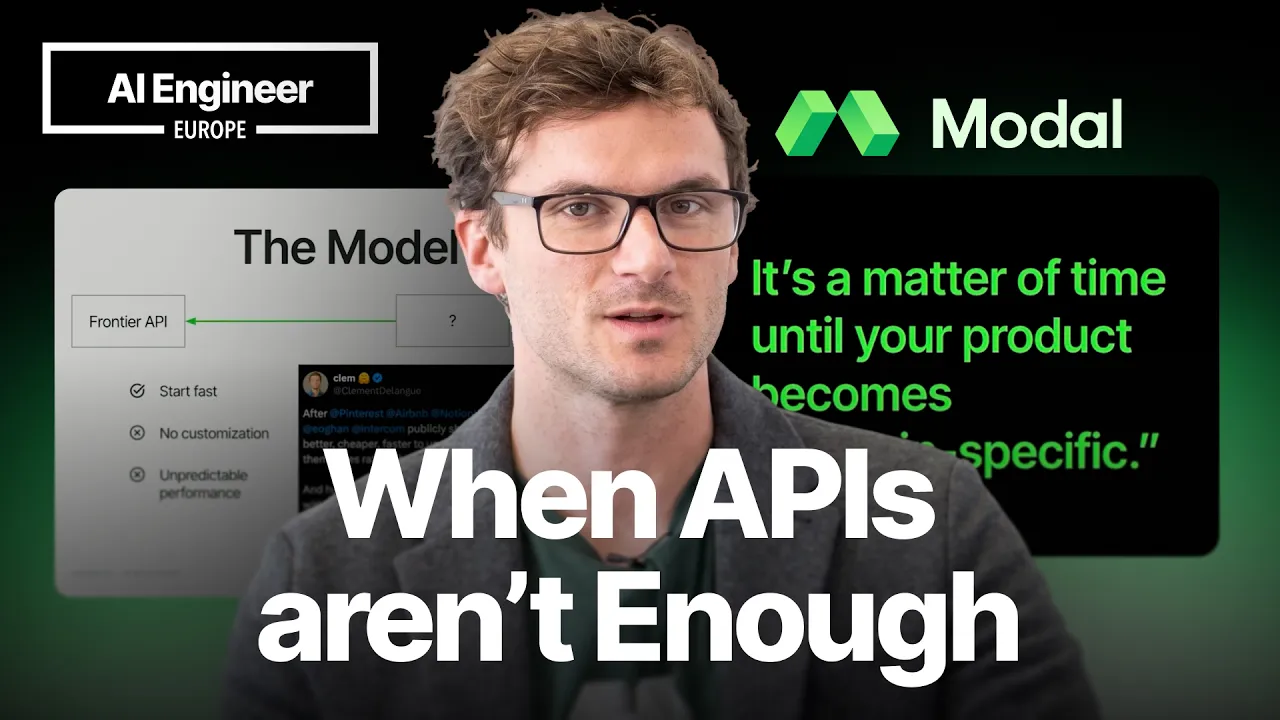
Um so that's basically our entire mission is to give you algorithm control and fast iteration. >> [clears throat] >> Um so this is my hot take that it's just a matter of time until your product steps into a being domain specific. Right? So in some sense, like if you have a differentiated product, it is custom, right? So uh when exactly you cross that line, that's a decision you have to make, but it's something we'd love to talk to you about.
Um so I I have here a few signals that might indicate that you know, you're getting close to that time. So if you've uh moved to caveman mode and you're still paying more for your API than your customers are paying you, that might be a signal that your economics aren't scaling, right? And that you you could probably benefit from a customized inference endpoint. Um Same for latency and throughput, right? So if you if you are plateauing on your evals, that is a that's a signal that you might get something out of fine-tuning a model.
Um there's a decades-old adage in training that if you have garbage data, it's garbage in, garbage out. So if you haven't been collecting data and you don't have mature evals, it's probably not time to train. You need to collect the data. Um that said, uh this is one of the main takeaways that I'd love for everyone here to walk out with, is that if you have built a product, you probably have at least touched all the things you need to train if you haven't already done it.
Okay, if you've built an agent harness, then you have what you need to have a new model, you know, learn through reinforcement learning how to provide your service. Right? So if you're evaluating your products um and collecting that data on what's working and what's not, then you have training data to train your model. Um and with you know, the advent of uh serverless compute platforms and uh these open-source libraries, I don't know like uh a lot of us when we started training models, we were taping the gradient by hand and like implementing the linear algebra.
You don't You don't have to do that anymore unless you have a freaky model. Um which if you do, I'd love to talk to you about it. Um but yeah, you don't need the infrastructure experts um and so forth. So this is an exciting time. Um I knew the video wouldn't play. Anyway, so uh the next couple of slides are just some snippets of code. I don't expect Oh yeah, you can't even really read it, but I just want to uh kind of illustrate what it looks like to set up a training algorithm today.
It's not uh a gigantic monorepo with thousands of lines of code. You can do supervised fine-tuning in 300 lines of Python. Okay, so once you have your data curated, uh once you have an account on Modal or some other serverless platform, you can get started really fast. And this code is on our examples repository. Um The The thing in this video, it's just showing how um we can scale containers really fast. And so just to bridge bridge these concepts a little bit, people usually associate serverless with uh inference.
But with training, it can be really really handy, too, uh for doing something like hyperparameter tuning, right? You You can You don't have to uh you know, every minute on your cluster isn't sacred anymore. You can fan out to a bunch of containers, get them on demand. As soon as it's not promising, kill it. And you it's kind of uh almost like an a meta-evolutionary algorithm at that point. Um so it's it's a exciting time to be doing that.
And the same goes for reinforcement learning. Um a lot of us who got our, you know, the graduate degrees in machine learning in the last 10 years uh didn't do reinforcement learning, right? This is relatively I mean, it's actually really old, but the stuff we're using today is kind of new. But they have these libraries, too. You can do it in 300 lines of code. Um and something interesting about Modal in particular is we have sort of unified APIs for sandboxes and GPU containers or clusters.
So what this means in a nutshell, when you're training a model with RL, it needs to sort of practice a lot. And so this is massively embarrassingly parallel kind of evaluation thing called a rollout. And so we have one of the most amazing things in the last quarter has been customer scaling up to 50,000, 100,000 sandboxes just to do RL. Um and you can do it, too. The code is open source. And then I'd be remiss not to mention what comes after the training.
You have to serve the model, right? And this is what the eight the frontier API is doing, you know, under the hood. Um well, they I don't know if they use vLLM, but my point is that you can do it, too, and it's actually not that much code. vLLM, SG Lang, Triton Inference Server, or a custom inference workflow with just Python. Um on Modal or other, you know, serverless platforms, you can auto scale all of this stuff to match your traffic as it's coming in.
So yeah, so just to kind of sum everything up what I'm saying here. I'm not saying go train your model right now. I'm saying it's not something that is like, "Oh, I'll do that in 10 years." You might You might want to train your model in 1 year, right? You might want to do it in 6 months. So start thinking about what is when am I going to know, okay, it's time to train my model? And how can I prepare for that moment by collecting data, developing your e-vals?
And yeah, I'd love to, you know, come by our booth. We're like kind of the end over on that side. Love to talk to you more about this, or you can reach out on my email here. That's it. >> [applause] [music]
The words are the caption track's own and nothing is reworded or re-transcribed. Paragraph breaks are placed between sentences so the text reads as prose.
Free tools for your own script. No signup, no login.
Paste your draft and see where viewers are likely to drop off, with a rewrite for each weak line.
Paste the first 30 seconds of your own draft for a hook score and rewrites.
Check your draft against YouTube's advertiser-friendly guidelines before you record it.
Read this channel's public videos and transcripts, and download a writing brief for it.