Getting the transcript
Reading the captions from YouTube. A video nobody has opened here before takes 10 to 30 seconds; this page fills in on its own.
Getting the transcript
Reading the captions from YouTube. A video nobody has opened here before takes 10 to 30 seconds; this page fills in on its own.
AI Engineer · @aiDotEngineer
This video has no Most replayed graph yet: YouTube shows one only once a video has enough views. These are the moments viewers replayed most in AI Engineer's most watched videos.
Most replayed moment at 18:45
4.8x that video's typical replay level
that they're they're changing they're changing things in the database not yet. You want to run them through the ontology first and make sure that works. Okay. I only got an I've got I've got another I've just a short time. I'm going to try to show you some of the things that um that you can
Said at 18:37
Most replayed moment at 16:13
3.6x that video's typical replay level
method signatures, the program layout and the call stacks. So here's some examples. I don't think you'll be able to read this one, but this is like the level of abstraction we're at. It's how we're actually going to lay this stuff out and how these systems are going to interact. Dylan Mulroy from Cloudflare talks a
Said at 16:06
Most replayed moment at 6:57
5.9x that video's typical replay level
do light mode. It's I It's not my nature, but sometimes. That's better, yeah? Okay. So we have we have a model and we're trying an old LG Sorry. We We shouldn't have seen that. No, we'll
Said at 6:50
The graph counts replays. It does not show where viewers stopped watching.
Words
1,882
Runtime
15:04
Speaking pace
125wpm
Reading time
8min
125 words per minute, below the 160 25th percentile of 349 measured videos. That distribution comes from the 349-video hook study.
Opening (first 30 seconds)
[music] >> Okay, hello everyone. So, my name is Midam Kim. I am an ML engineer from ServiceNow and I'll be talking about a linguistic framework for voice AI. So, quick background of me so you know where I'm coming from. Like I said, I'm an ML engineer at ServiceNow, but I'm also a researcher, lifelong researcher, of speech communication in the wild.
63 words, the words spoken in the first 30 seconds at 125 words per minute.
Free, no signup. See how the first 30 seconds hold attention, with rewrites.
Sentence shape
| Measure | This transcript |
|---|---|
| Sentences | 132 |
| Average words per sentence | 14.3 |
| Longest sentence | 55 words |
| Questions asked | 19 |
| Sentences containing a number | 2 |
Most used terms
Filler phrases
57 in total: uh 32 · like 9 · um 7 · kind of 3 · I mean 2 · actually 2 · right? 1 · you know 1.
A literal whole-word count of the same phrase list the Prepublish browser extension uses, so a phrase inside another word is not counted and a phrase used in its ordinary sense still is. It is a count and not a judgement.
What this transcript is
Every word below is the caption track YouTube publishes for this video, pulled from the video itself and reproduced unchanged. It is not Prepublish's writing, not a summary, and not a re-transcription: it is the video's own published captions. English captions, generated automatically by YouTube, in the video’s original language. Source: the video on YouTube. A channel that would rather this page did not exist can ask for its removal through the contact page, and it is removed.
[music] >> Okay, hello everyone. So, my name is Midam Kim. I am an ML engineer from ServiceNow and I'll be talking about a linguistic framework for voice AI. So, quick background of me so you know where I'm coming from. Like I said, I'm an ML engineer at ServiceNow, but I'm also a researcher, lifelong researcher, of speech communication in the wild. So, my motto is doing linguistics and what I'm going to be doing today is to hand you that lens of linguistics.
So, have you experienced voice AI failures? Yeah, like everyone. >> [laughter] >> So, I'm going to introduce an example that I experienced myself. So, the bot asked me, "Could you please spell your first name?" And then I slowly start to spell my name. Yes, it is m i d a m. And the bot says, "Confirming with you, is it m i d a n?" And then I say, "No, it is m i d a m." Um and the bot says, "Thank you for your correction.
Happy to help you today, Madam." And I then I get slightly annoyed, more annoyed, because my name is Midam, not Madam. And then it asked me about, "Now, what is your account number? And then, I start start getting confused. What is that account number thing? And then, I try to find uh information about that. So, which one? Um it must be and I start uh slowly start spelling the account number. So, it is A X 4 5 1. And then, I take time because I'm not used to reading this strange number.
And then, the bot cuts me off. And then, it says, I couldn't find your record. And then, without even trying, it asked me to repeat that again. Can you please repeat that? And then, I get super annoyed and then, I can say, can I talk to a person? I just don't want to deal with you anymore. So, this is a very typical pattern of voice AI, unfortunately, at this point. So, I just want to navigate how we can solve this problem with linguistics.
So, voice AI is booming. But users are still often preferring human agents over voice agents. How can we mitigate this issue? But in the first place, what are the actual problems? So, I think we can think about a fundamental frame framework to understand this into an architecture of voice AI, which is called linguistics. So, as all of us already know, human communication is a joint activity, like the thing that we're doing right now.
So, I give you my sounds and words. You hear them. And then, if it is a conversation, you're going to give me your sounds and your words. And then this is going back and forth through interaction. And then in this process, we're continuously processing and updating our mental models. So that's a joint activity for human communication. And I would like to say in the voice AI human communication, it also has to be a joint activity like this.
Because that's the only thing that we know about human communication as a human being. We have been evolving thousands of years as communicators, and this is what we know. So we expect the same thing to bots. So let me go over the failure scene of my call with the voice agent in this framework. So you see there's listen and speak for each party. So I start spelling my first name. And then the bot did not hear that the difference between M and N correctly, so it's an SCT failure in the listening level.
And then the TTS applies only English-centric reading rules to my name, M I D A M, would read it as Midam in the American English version. So I'm confused, but at this time I'm kind of generous because that happens a lot even with human beings. So I'm okay. But then when it brought brought up account number thing because I don't know what that is, I'm confused again. But I'm adaptive, I can find I can look for it. So I found the number, start reading it, but the STT did not recognize the word unit correctly, so it cuts me off, and uh uh finally, it's uh eventually talked over me.
So, I get really irritated. And then, when it asked me for the repetition of the same information, and then, it is clear that the spot is not tracking the mental model with me. And then, very rudely, it's uh does not even try interactive clarification, which is a common strategy by human beings. So, I don't want to deal with this anymore, so I say, "Can I talk to a person?" So, let's go over the uh the framework again.
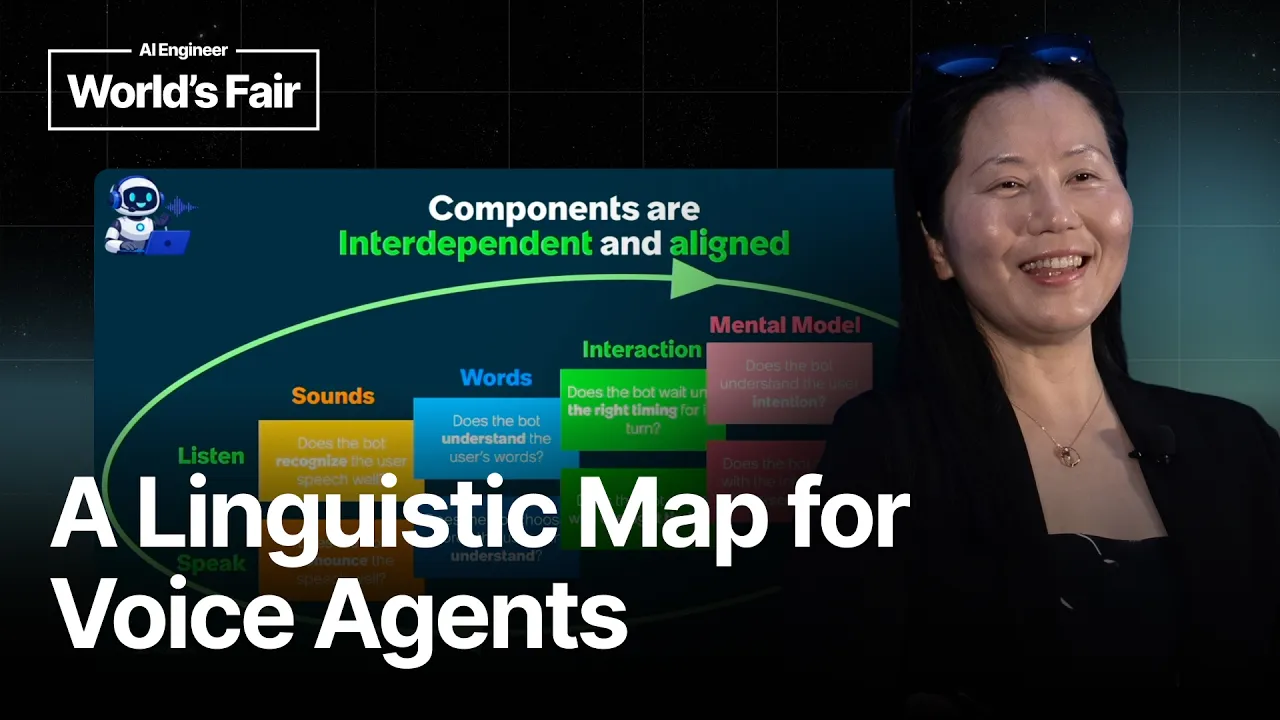
So, the these are the linguistic components that are expected and well maintained in human-to-human voi- uh uh conversation. So, there are listening channels, a listening channel and speaking channel, and there are different components like sounds, words, interaction, and mental model. So, the first component is, does the bot recognize the user's speech well? And all of these technical terms uh will fall under this. And then, there was there's going to be this second component, which is words in the listening channel.
So, does the bot understand the user's words? And then, the third one is, does the bot wait until the right timing to for its turn? It's about It's going to be about uh listening channel interaction. And then, uh the last part is mental model. So, does the bot understand the user's intention in the listening part? And then, we can also go to the speaking channel, so it's going to be about pronunciation for the sound.
And also there's about understand the the words users are uh there's about choose the words the user can understand. And in the interaction part, there's about speak with the right timing. And lastly, there's about speak with the information the user actually need. So, there are a lot of engineering or linguistic or cognitive science terms that are in here that that are here. Um you can see now see that all of those have their right spots in this linguistic framework.
And importantly, these components are interdependent, not separate or uh independent from each other. They're interdependent and they're aligned. So, when you want to do good things about sounds, you have to think about words level. And then when you want to do good things about these sounds and words, you also have to uh account for interaction, so turn taking or turn detection. And then finally, you want to uh have good uh task completion, which is the goal of these mental model uh layer.
Then you have to have all of these. Without all of those, without any of those, any of those components, your voice agent will fail. And then finally, uh it has to be well aligned. All of these have to be well aligned. And additionally, you have to keep your mind keep in mind that this is happening on the timeline. What I mean by that is it is silently tracked. Unlike in chat, in chat you see the history of what was said uh as text.
But in voice agent experience, uh, you say something, and the bot says something, you go back and forth, and then see, all these waveforms, the air via the vibration in the, uh, in the air, they're all gone. And only the user's mental model is the thing that's left, and that matters. So, sounds, words, interactions vanish the moment they're spoken, but the mental model proceeds and grows over the timeline. So, this is what you have to target for user satisfaction.
And then, what can we do for the bot to meet the standard of the user? So, what we can do, uh, would include, of course, choosing good ASR models or configurations and do some post-processing, uh, choosing good TTS models, configurations, and pre-processing, and, uh, carefully curate the vocabulary that can be shared between the bot and the user, and do good job of a turn-to-turn detection, latency, and turn-taking. Um, and very importantly, we have to, it would be great if we can do good emotion detection and handling, and context retention, and by context, what I mean is context about all of these.
And importantly, uh, it has to be dynamic because things are always changing, uh, throughout over the course of the call. So, we would have to do this management dynamically along the timeline for different kinds of people. So, kids or different kinds of people like these will have different expectations that we have to satisfy. Uh, not just when they're happy, but also when they're not happy. So, only then you can pursue a dynamic and truly scalable orchestration of voice AI.
So, it's a very difficult job to do. We always say that voice is the most natural way of communication, but it is not actually not easy. Behind the scene, it is thanks to this linguistic orchestration. When your bot is not good at it, it's a catastrophic failure. Um, so paying attention to this linguistic framework would have lots of business implications because then you can uh decrease all of these user frustration, task failures, live agent escalation, or abandoned calls, or silent failures.
So, in ServiceNow, we have made a a good uh benchmark end-to-end benchmark called Eva bench. So, you can try that to diagnose your voice agent's uh status. Um, key takeaways. So, voice AI is a joint activity between the bot and the user, not just a pipeline. And we must serve users' needs in multiple layers real time. It's not that I have given you a fix today because there's nothing like that. It just uh the fix is in you and your system.
But, what I have given you is today is the linguistic framework you can try to diagnose your system and to build your system upon. You can try Eva, but also you can learn linguistics and hire linguists. Um, another thing I want to remind you of is that business implications are linguistic implications and vice versa in this voice AI scene. Because voice is fundamentally a linguistic and very human and cognitive experience.
I would like to ask you a longer term question. Speakers adapt. So, I I'm pretty sure that in this talk in my talk with you guys today, you have learned something about me, about my speaking style, what kind of accents I speak, what kind of words I'm using. So, next time I see you guys in person, you would find it more comfortable to talk to me because you have paid attention to me. Right? So, speakers are always adapting.
So, the user will be adapting to your voice agent throughout the call. So, is your system ready for them to use you better, use it your voice agent better the next time? And language is always change. So, is your voice agent ready for language change in 1 year or 6 months even? So, thank you. >> [applause]
The words are the caption track's own and nothing is reworded or re-transcribed. Paragraph breaks are placed between sentences so the text reads as prose.
Free tools for your own script. No signup, no login.
Paste your draft and see where viewers are likely to drop off, with a rewrite for each weak line.
Paste the first 30 seconds of your own draft for a hook score and rewrites.
Check your draft against YouTube's advertiser-friendly guidelines before you record it.
Read this channel's public videos and transcripts, and download a writing brief for it.